The Smell Of Inspiration

schiller

Emily Temple compiles a list of literary figures with strange obsessions. Here’s her entry for the German poet and philosopher Friedrich von Schiller:

Friedrich von Schiller kept fruit flies. Rather, he put rotten apples under his desk to inspire him with memories of the orchards of his youth. When he faltered for the right word, he took a quick sniff, and it materialized.

(Portrait of Schiller by Gerhard von Kügelgen, via Wikimedia Commons)

Should We Kill Cursive?

Morgan Polikoff nods:

Cursive should be allowed to die. In fact, it’s already dying, despite having been taught for decades. Very small proportions of adults use cursive for their day-to-day writing. Much of our communication is done on a keyboard, and the rest is done with print. Additionally, there is little compelling research to suggest the teaching of cursive positively affects other student skills enough to merit its teaching. While both research and common sense indicate students should be taught some form of penmanship, there is simply no need to teach students both print and cursive.

Kate Gladstone is on the same page:

Reading cursive matters, but even children can be taught to read writing that they are not taught to produce. Reading cursive can be taught in just 30 to 60 minutes — even to five- or six-year-olds, once they read ordinary print. Why not teach children to read cursive, along with teaching other vital skills, including a handwriting style typical of effective handwriters?

Off-Grid For A Year

photo

Technology writer Paul Miller returns from a year of self-imposed Internet exile, which was designed to improve his life and initially did the trick:

I lost 15 pounds without really trying. I bought some new clothes. People kept telling me how good I looked, how happy I seemed. In one session, my therapist literally patted himself on the back.

I was a little bored, a little lonely, but I found it a wonderful change of pace. I wrote in August, “It’s the boredom and lack of stimulation that drives me to do things I really care about, like writing and spending time with others.” I was pretty sure I had it all figured out, and told everyone as much. As my head uncluttered, my attention span expanded. In my first month or two, 10 pages of The Odyssey was a slog. Now I can read 100 pages in a sitting, or, if the prose is easy and I’m really enthralled, a few hundred. …

Without the retreat of a smartphone, I was forced to come out of my shell in difficult social situations. Without constant distraction, I found I was more aware of others in the moment. I couldn’t have all my interactions on Twitter anymore; I had to find them in real life. My sister, who has dealt with the frustration of trying to talk to me while I’m half listening, half computing for her entire life, loves the way I talk to her now. She says I’m less detached emotionally, more concerned with her well-being — less of a jerk, basically.

But the catharsis didn’t last:

When I stopped seeing my life in the context of “I don’t use the internet,” the offline existence became mundane, and the worst sides of myself began to emerge.

I would stay at home for days at a time. My phone would die, and nobody could get ahold of me. At some point my parents would get fed up with wondering if I was alive, and send my sister over to my apartment to check on me. On the internet it was easy to assure people I was alive and sane, easy to collaborate with my coworkers, easy to be a relevant part of society. So much ink has been spilled deriding the false concept of a “Facebook friend,” but I can tell you that a “Facebook friend” is better than nothing. My best long-distance friend, one I’d talked to weekly on the phone for years, moved to China this year and I haven’t spoken to him since. My best New York friend simply faded into his work, as I failed to keep up my end of our social plans.

My plan was to leave the internet and therefore find the “real” Paul and get in touch with the “real” world, but the real Paul and the real world are already inextricably linked to the internet. Not to say that my life wasn’t different without the internet, just that it wasn’t real life.


Public Transit Goes Mobile

David Talbot reviews a new project that is using location data from mobile phones to improve public transportation infrastructure in developing countries:

Researchers at IBM, using movement data collected from millions of cell-phone users in Ivory Coast in West Africa, have developed a new model for optimizing an urban transportation system. The IBM model prescribed changes in bus routes around the around Abidjan, the nation’s largest city. These changes—based on people’s movements as discerned from cell-phone records—could, in theory, slash travel times 10 percent.

While the results were preliminary, they point to the new ways that urban planners can use cell-phone data to design infrastructure, says Francesco Calabrese, a researcher at IBM’s research lab in Dublin, and a coauthor of a paper on the work. “This represents a new front with a potentially large impact on improving urban transportation systems,” he says. “People with cell phones can serve as sensors and be the building blocks of development efforts.”

How The Middle East Sees Its Media

dish_media credibility

A study of media perception in eight Arab countries examines how people weigh the credibility of their news sources:

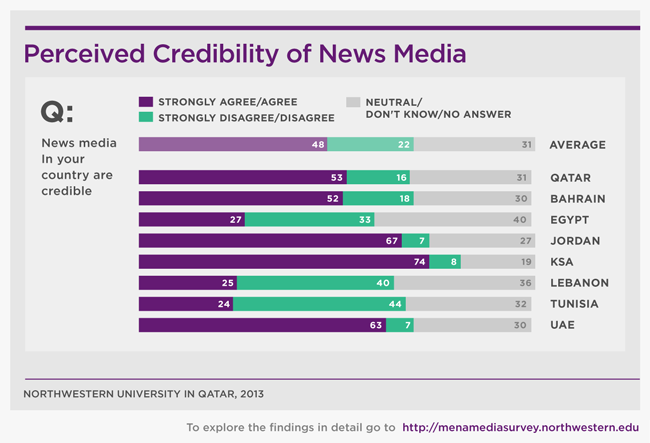
[A] large majority of adults in Saudi Arabia, Jordan and the United Arab Emirates believe their news media are credible (74 percent, 67 percent and 63 percent, respectively). Meanwhile, only approximately one in four of those surveyed in Egypt, Lebanon and Tunisia believe the news media in their countries are credible.

But respondents, by and large, feel that their media is getting better:

Participants are far more likely to agree than disagree that reporting has improved, by ratios of more than 19 to 1 in Jordan and 21 to 1 in Saudi Arabia.

Explore the data on an interactive website here.

The GOP’s Healthcare Problem

Douthat articulates it:

It isn’t that conservative ideas about health policy don’t exist, and it isn’t that they won’t work. It’s that right now the feasibility question is purely academic, because even after five years of debating these issues, and despite Eric Cantor’s best efforts, there still aren’t enough Republican lawmakers willing to take even the smallest of steps toward putting those ideas to the test. This means that no matter how much of a “bureaucratic nightmare” the implementation of the current health care law turns out to be, liberals at least have this ace in the hole: When it comes to health care reform, there is still no politically realistic alternative to their approach.

What Really Made The South Republican?

Contra Bouie, Sean Trende argues that the partisan shift in Dixie was not as dependent on the racial strife of the ’60s as most people assume:

In fact, the white South began breaking away from the Democrats in the 1920s, as population centers began to develop in what was being called the “New South”… . In the 1930s and 1940s, FDR performed worse in the South in every election following his 1932 election. By the mid-1940s, the GOP was winning about a quarter of the Southern vote in presidential elections. But the big breakthrough, to the extent that there was one, came in 1952. Dwight Eisenhower won 48 percent of the vote there, compared to Adlai Stevenson’s 52 percent. …

Perhaps the biggest piece of evidence that something significant was afoot is Richard Nixon’s showing in 1960. He won 46.1 percent of the vote to John F. Kennedy’s 50.5 percent. One can write this off to JFK’s Catholicism, but writing off three elections in a row becomes problematic, especially given the other developments bubbling up at the local level. It’s even more problematic when you consider that JFK had the nation’s most prominent Southerner on the ticket with him.

But the biggest problem with the thesis comes when you consider what had been going on in the interim:

Two civil rights bills pushed by the Eisenhower administration had cleared Congress, and the administration was pushing forward with the Brown decision, most famously by sending the 101st Airborne Division to Arkansas to assist with the integration of Little Rock Central High School.

It’s impossible to separate race and economics completely anywhere in the country, perhaps least of all in the South. But the inescapable truth is that the GOP was making its greatest gains in the South while it was also pushing a pro-civil rights agenda nationally. What was really driving the GOP at this time was economic development. As Southern cities continued to develop and sprout suburbs, Southern exceptionalism was eroded; Southern whites simply became wealthy enough to start voting Republican.

Trende’s book, The Lost Majoritydigs deeper into this contrarian history.

Our Digital Fall From Grace

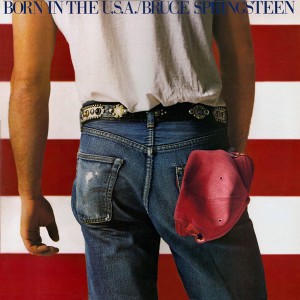
Discussing the history of rock album art, Patrick West expresses nostalgia for a less digital age:

The decline of the album sleeve is symptomatic of a deeper crisis. Things aren’t consumed as they were. Rather, they are increasingly given away or stolen. And when something’s value is 600full-born-in-the-u.s.a.-cover-300x300diminished, so is its worth. As James Heartfield has observed in Mute magazine: ‘The declining value of music also means that it is of declining value to the consumer, so that they will tend to fail as goods that enhance the self-esteem of their purchasers.’

When you don’t pay for something, you don’t take the time to enjoy it. That’s why you come away from a free newspaper website feeling unsatisfied. If you pay for a newspaper, you are much more like to read it properly.

Objects have character, memories, idiosyncracies, flaws. My long-dead grandmother’s pencilled ‘arguments’ with Freud in his books remain my connection with her. A certain skip in ‘Here Comes the Sun’ on my taped copy of Abbey Road will remind me always of a caravan holiday in 1992. And ‘Eddie’, the skeletal icon that featured on Iron Maiden album sleeves and t-shirts, will forever bring me back to a family holiday to Yugoslavia in 1984, where I first saw it. In the digital age, all these moments will be lost in time, like tears in rain.