The Apple Doesn’t Fall Far From The Other Apple

In the wake of the Boston marathon bombings, Alix Spiegel reviews research on influential siblings:

Consider, for example, the research that looks at how much a parent who smokes influences his child to smoke, versus the degree to which an older sibling who smokes influences a younger sibling. “Both can tsarnaev-brothers-thumbhave an effect, but in a lot of studies they’ve found that the effect ‘older sibling smoking’ has is greater than the effect that ‘parental smoking’ has,” Rende says. It’s the opposite of what many people assumed, he says. Older siblings are more influential.

Rende says you can see this influence of big brothers and sisters in all kinds of families — rich, middle class and poor. But their power is really magnified in the particular subset of families he studies: families that are psychologically and economically unstable. In those families the power of the older sibling is much greater because parents aren’t around as much, and the siblings tend to spend a lot of time together. …

[T]he reverse is also true. Good behavior in older siblings can be as contagious as bad. It just seems that — particularly when families are struggling — the fate of the kids is more tethered to their siblings than we originally thought. For good and, apparently, for bad.

The GOP’s Demographic Time-Bomb

Nate Silver’s demographic and immigration reform calculator is worth a look. The graphic below shows what happens if you apply the model’s defaults to the next 35 years:

Demographic Calculator

Silver explains how immigration reform could change these calculations:

Suppose, for example, that the voter population grows in accordance with the defaults assumed in the model. This would produce a net of 6.3 million new votes for Democrats by 2028.

And suppose that 25 percent of the immigrants currently here illegally gain citizenship and vote by 2028. The model calculates that this would provide another 1.2 million votes for Democrats.

But suppose also that, as a result of immigration reform, the Republicans go from winning about 28 percent of the Hispanic vote and 24 percent of the Asian vote (as they did in 2012) to 35 percent of each group by 2028. That would shift about 4.8 million votes back to the G.O.P. — about four times more than it lost from the immigrants becoming citizens and voting predominantly Democratic. However, it wouldn’t be enough to outweigh the Democratic gains from long-term population growth.

Douthat thinks that immigration reform can help the GOP “only if such a reform somehow complemented a new conservative economic agenda rather than posing a substitute for one.” He isn’t holding his breath:

I can imagine an immigration overhaul finding a place in a broader right-of-center vision that’s geared toward reassuring blue-collar whites, enticing middle-income Hispanics, and boosting new immigrants into the middle class.

But that vision doesn’t exist at the moment, and it isn’t likely to emerge in a world where the Congressional G.O.P. can’t even manage to take baby steps toward an Obamacare alternative. And so long as that’s the case, the kind of immigration reform being contemplated is likely to be worse for the G.O.P. politically than a similar bill would have been under George W. Bush. For all his faults, Bush understood that his party couldn’t win over Hispanics — or any economically-vulnerable constituency — without substantive as well as symbolic overtures. Right now, his successors seemed poised to learn that lesson the hard way.

Tsarnaev And The Saudis

The Daily Mail’s report is followed by this statement from the Saudi Embassy:

The Saudi government had no prior information about the Boston bombers. Therefore, it is not true that any information, written or otherwise, was passed to the U.S. Department of Homeland Security (DHS) or any other US agency in this regard. The Saudi government also does not have any record of any application by Tamerlan Tsarnaev for any visa to Saudi Arabia.

The Climate Change Culture War

Tim McDonnell ponders the results of a new study that gave liberals and conservatives the choice between conventional light bulbs and the more energy-efficient compact fluorescents:

Both bulbs were labeled with basic hard data on their energy use, but without a translation of that into climate pros and cons. When the bulbs cost the same, and even when the CFL cost more, conservatives and liberals were equally likely to buy the efficient bulb. But slap a message on the CFL’s packaging that says “Protect the Environment,” and “we saw a significant drop-off in more politically moderates and conservatives choosing that option,” said study author Dena Gromet, a researcher at the University of Pennsylvania’s Wharton School of Business.

… Gromet said she never expected the green message to motivate conservatives, but was surprised to find that it could in fact repel them from making a purchase even while they found other aspects, like saving cash on their power bills, attractive. The reason, she thinks, is that given the political polarization of the climate change debate, environmental activism is so frowned upon by those on the right that they’ll do anything to keep themselves distanced from it.

This is really a form of tribal nihilism. One party has become entirely about a posture, not a set of feasible policies. I can see no reason whatever that conservatism must mean destroying the environment – or refusing to do even small ameliorative things that can help. There should be a robust conservative critique of liberal approaches to climate change, but the point is to get a better grip on slowing that change and more effectively protecting the environment by conservative ideas and principles. Snark is not a policy, although it may be a successful talk radio gimmick.

The trouble is that the talk radio gimmickry now defines an entire political party. Kevin Drum sighs:

On the right, both climate change and questions about global limits on oil production have exited the realm of empirical debate and become full-blown fronts in the culture wars. You’re required to mock them regardless of whether it makes any sense. And it’s weird as hell. I mean, why would you disparage development of renewable energy? If humans are the ultimate creators, why not create innovative new sources of renewable energy instead of digging up every last fluid ounce of oil on the planet?

I can remember when even Glenn Reynolds wanted an all-of-the-above approach to tackle climate change because energy innovation was a no-brainer, even if it didn’t always work out.

Faces Of The Day

Civil Union in Colorado.

Led by Mayor Michael Hancock, Anna and Fran Simon are the first couple to take part in a civil union ceremony at the Webb Building in Denver, Colorado. The Clerk and Recorder’s Office opened for business from midnight to 3 a.m. to issue civil union licenses to couples on May 01, 2013, when the Civil Union Act became law. By Craig F. Walker/The Denver Post via Getty Images.

Meanwhile, the Rhode Island bill for marriage equality carries the following important religious exemptions:

The bill that passed the House stated that religious institutions may set their own rules regarding who is eligible to marry within the faith and specifies that no religious leader is obligated to officiate at any marriage ceremony. The Senate added language to ensure that groups like the Knights of Columbus aren’t legally obligated to provide facilities for same-sex weddings.

I favor maximal religious liberty with maximal civil equality. The point is the expansion of freedom, not its contraction. And religious freedom and gay freedom are inseparable under the Constitution, in my view. That mix is likely to be signed into law tomorrow. It’s the formula of the future.

How Velveeta Relies On Gang Rape Porn

VelveetaFOD-1024x759

Here’s a fascinating story about digital media, and the use of Search Engine Optimization, from Digiday. Take the humor site, Funny Or Die:

On its surface, the site would have little to do with adult content. Some of its videos might be a bit tawdry, but that’s all. Then, start to do some risque searches. “Sex”: Funny or Die shows up as the first Google result. “Tits”: the site is top of the pile again. Even “rape videos” returns Funny or Die. The listings are auto-generated topic pages Funny or Die produces as part of an aggressive SEO strategy. It’s not exactly a shocker to the publisher, however. After all, ComScore reports that six of its 10 top search-term referrals for March were sex-related, including “sex,” “XXX,” “boobs,” “tits,” “sexy” and “rape videos.” In fact, “sex” searches drove more traffic to the site than “Funny or Die” queries.

Because of the SEO techniques used by Funny Or Die, landing pages are automatically generated for thousands of terms, including “rape videos” and even “gang rape.” Searches for some of those terms drives significant traffic to the site.

And Velveeta gets to advertize itself next to a bunch of “gang rape” material. What’s striking to me is how completely shameless the site’s “editorial” remains about this. Funny Or Die’s COO Mitch Galbraith is quoted thus:

“The content itself is clean content; it’s just a function of the fundamental SEO our site does.”

The site “just does” this. And no one is responsible? No one decided to do this? No one actively set up a system so that searches for “tits” gets Funny or Die a click and a pageview and a little bit of moolah from an ad impression? Yeah, right. Look: these are editorial choices, driven by desperate need for ad revenue; they are not automatic. But increasingly, the act of editing is entirely being out-sourced to algorithms and search engines. Which means there is no editing at all. Just “tits” and “rape videos”.

When The Rubber Hits The Road, Ctd

A reader responds to this post:

Under the category of “you’re doing it wrong”, I might suggest that one problem is that so many people put the condom on dry. Put some lube on first and the sensitivity is greatly improved. I’m surprised now many guys I’ve had sex with seem unaware if this tip. Maybe I was the only one paying attention during all those presentations in college. And not the molecule of lubricant some condoms come with. Use a bunch.

Another reader:

I was glad to see I’m not alone in losing a fair amount of sensitivity during sex thanks to condoms – and I was circumcised as an infant, so my senses are already dulled – but I’m going to keep wearing condoms. When I read in that post that the withdrawal method of birth control has a failure rate of four percent while condoms have a failure rate of two percent, I take away that “pulling out” is twice as likely to result in unplanned pregnancy as wearing a condom. That two percent is a significant two percent to me (and, more importantly, to my girlfriend).

Also, isn’t it only natural to connect that post to the posts last week about guys becoming addicted to dopamine, online porn, and Viagra?

A few more readers overshare to that “Master Of Your Own Domain” thread after the jump:

Like you I’m vintage ’63 and grew up Catholic in a traditional lower-middle / working class environment. Useful information about sex, other than the church’s helpful “it’s a sin – so don’t,” was scarce. I was also a bookish loner, thus without access to the carnal wisdom of my peers.  At fourteen my experiments with “what sex would feel like” involved simply clamping my erection, tightly, in my fist. The concept of adding motion never dawned on me.

By fifteen I had graduated from “MAD” magazine to “National Lampoon,” which was racy and had the occasional picture of naked breasts.  Carefully reading a new issue on the long Thanksgiving morning drive, I came across the fantasy story “My Penis,” the tale of a hot high school cheerleader who suddenly wakes up one morning with a dick, and all the things she later does with it. Masturbation was described. In detail.

That night on the couch in grandma’s living room I put my newfound knowledge into practice – and have yet to stop.

Another:

I never had a problem with masturbation. There were a few weeks when I was 15 or so when I wouldn’t but the urge became irresistible  And I concluded that if God didn’t want me to do it, he wouldn’t give me the urge. And there have been times when I don’t have the urge.

I have a problem with recurrent prostate infections. Some men do, just like women have recurrent vaginal infections. One of the things to be done is to empty it out fairly often. That was the cure before there were antibiotics – expressing it. Flush out the infection and hope it goes away. First time it happened it was very very bad. No symptoms specific to prostatis like burning urination or orgasm. Just that I would get up in the morning feeling okayish and by late afternoon I would be running a fever. Had to take a nap. Would take one and the fever would be gone – but the nap was hours long. And by mid evening it would be back. I’d go to bed early and wake up in the morning feeling okay. Until late afternoon. Took about a week to decide to go to the doctor. I now watch for subtle symptoms. I can predict within a day or so when I’m going to get the urge to nap. Being very very sleepy is one of the symptoms.

I haven’t noticed much of a change since my late teens. I don’t want to hump any man still breathing but I get the urge about once a day and if I don’t have anything else to do I indulge it. I still enjoy it as much as I did when I was 16. Maybe not as noisy but it’s still a lot of fun.

Depending on how you want to read Romans, Saint Paul warned us against doing things that go against our nature. Some men want to do it three or four times a day and some men want to do it once and some men want to do it twice a month. Whatever works for you. But deliberately not cumming? I’d put in the same category that we are warned about in Romans.

The Deepening, Disgusting Stain Of Gitmo, Ctd

US-POLITICS-GUANTANAMO BAY

Benjamin Wittes argues that the president’s own policies give rise to the problems he outlined in yesterday’s presser:

Remember that Obama himself has imposed a moratorium on repatriating people to Yemen. And Obama himself has insisted that nearly 50 detainees cannot either be tried or transferred. True, he would hold such people in a domestic facility, rather than at Guantanamo Bay. But so what? Does the President not understand when he frets about “the notion that we’re going to continue to keep over 100 individuals in a no-man’s land in perpetuity” that if Congress let him do exactly as he wished, he would still be doing exactly that—except that the number might not reach 100 and the location would not be at Guantanamo?

Serwer reviews Obama’s options:

By resuming transfers, the Obama administration might be able to end the strike. But doing so would entail taking on a significant amount of political risk—and, the administration believes, national-security risk as well. “The secretary of defense could just boldly issue the required certifications, bulling past the question of whether they were truly met,” says Robert Chesney, a law professor at the University of Texas School of Law who served on the Obama administration’s task force on detention policy. “With or without a certification requirement, of course, these days all releases carry political risk since a former detainee committing a terrorist act would almost certainly be blamed on the administration anyway.”

Max Fisher spells out other possibilities:

So what can Obama do? He can lobby Congress, as he hinted he would do at Tuesday’s news conference, perhaps to change the legislation blocking the U.S. from trying Guantanamo detainees or keeping them on U.S. soil. He can work with Yemen; a majority of the detainees are Yemeni, and their home country, which has been beset by political turmoil for the past two years, says it’s working on a $11 million facility to house and rehabilitate former Gitmo detainees. Perhaps Yemen could be better prepared to accept former detainees and to give them enough good options that they won’t want to turn to extremism. Obama could also work with Congress to loosen the politically unpalatable process for releasing detainees, or he could go ahead and release them anyway, although that would require finding countries to accept them.

And Amy Davidson emphasizes the humanity of the prisoners:

Do we even see them as people who may have the imagination to think about what it means to be in a jail on an island forever, without ever going to trial? Is that a life we can picture? There are undoubtedly terrorists at Guantánamo—Khalid Sheikh Mohammed, the alleged mastermind of the 9/11 attacks, is there. But he’s one of the six who’s actually getting a military-commission hearing. At Guantánamo, it seems, the less you have done, the more trapped you are.

Recent Dish on Gitmo here.

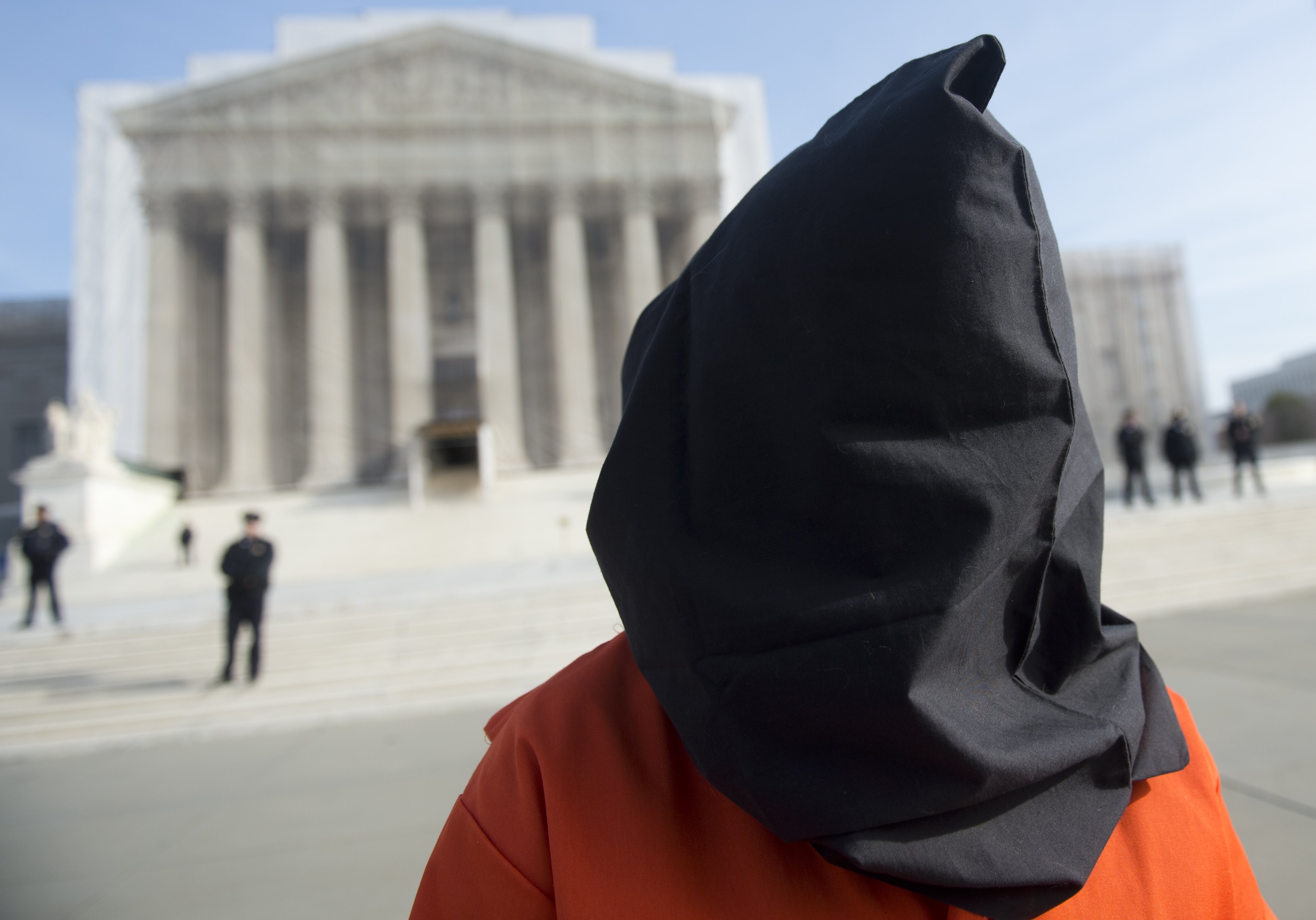
(Photo: A protestor wears an orange prison jump suit and black hood on his head during protests against holding detainees at the military prison in Guantanamo Bay during a demonstration in front of the US Supreme Court in Washington, DC, on January 8, 2013. By Saul Loeb/AFP/Getty Images.)

Lessons Of Bush v. Gore

Sandra Day O’Connor recently told the Chicago Tribune that “maybe the court should have said, ‘We’re not going to take it, goodbye,” referring to the case that decided the 2000 presidential election. Doug Mataconis argues that the Supreme Court refusing to take the case “would have hardly been the end of the chaos that surrounded the 2000 election”:

No matter how that process in Florida ended, there would have been a question of legitimacy hanging over whoever it was that ended up assuming the Presidency on January 20, 2001. By accepting the case, the Supreme Court brought some degree of certainty into the process and lent an air of legal legitimacy to the outcome of the election that was sorely lacking during the long period after Election Day. For that reason alone, I’d suggest that, in the end, history will judge that the Supreme Court did the right thing even if it did take a hit to its reputation in the short term.

My guess is that Doug is right in the long run. Megan McArdle agrees:

The original sin, in my view, was Gore’s attempt to recount just the votes in a few heavily Democratic counties.

I’m not saying that Bush would have done any different, had the positions been reversed.  But once that had happened–and Democrats on local election boards and the Florida Supreme Court had decided to go along–there was no longer even a pretense that this was about anything other than naked post-facto power grabs, using whatever political levers your party controlled.  “Count all the votes”, which most progressives now remember as the rallying cry, actually came very late in the process, and only after the Supreme Court of the United States told the Florida Supreme Court that no, it couldn’t just let Al Gore add in some new votes from Democratic Counties his team had personally selected.

Yes, Gore’s strategy was so clever it ended up being stupid. A full recount would have been better – but not as sure a thing from his point of view as a partial recount. It would also have added real legitimacy to the winner. And the further we get from that brutally polarizing few months, it’s worth recalling that this was the back-drop to 9/11 and what followed. I sometimes wonder if history would have been different if the president on 9/11 had been seen as clearly legitimate by all the country. It didn’t help that George W. Bush did not seem in any way sensitive to the precariousness of his presidency and instead of seeking a middle ground with polarized Democrats, acted as if he had won in a landslide. Compare his attitude with his successor’s who did have two clear victories, and followed through with moderation and compromise. Ian Millhiser, meanwhile, thinks the case reveals an important truth about the Court:

If nothing else, Bush v. Gore demonstrates how justices who are determined to reach a certain result are capable of bending both the law and their own prior jurisprudence in order to achieve it. In Bush, the five conservative justices held, in the words of Harvard’s Larry Tribe, that “equal protection of the laws required giving no protection of the laws to the thousands of still uncounted ballots.”