Will The Race & IQ Debate Ever Be Resolved?

After digging into the literature on race and genetics, Ta-Nehisi interviews geneticist Neil Risch about race, IQ and other genetics issues. There’s a lot of good stuff TNC has unearthed – among them these papers: “The Importance of Race and Ethnic Background in Biomedical Research” and “Assessing Genetic Contributions to Phenotypic Differences Among ‘Racial’ and ‘Ethnic’ Groups“. Have at them. Here’s the final question and answer:

Your paper on assessing genetic contributions to phenotype, seemed skeptical that we would ever tease out a group-wide genetic component when looking at things like cognitive skills or personality disposition. Am I reading that right? Are “intelligence” and “disposition” just too complicated?

Joanna Mountain and I tried to explain this in our Nature Genetics paper on group differences.  It is very challenging to assign causes to group differences. As far as genetics goes, if you have identified a particular gene which clearly influences a trait, and the frequency of that gene differs between populations, that would be pretty good evidence. But traits like “intelligence” or other behaviors (at least in the normal range), to the extent they are genetic, are “polygenic.” That means no single genes have large effects — there are many genes involved, each with a very small effect. Such gene effects are difficult if not impossible to find. The problem in assessing group differences is the confounding between genetic and social/cultural factors. If you had individuals who are genetically one thing but socially another, you might be able to tease it apart, but that is generally not the case.

In our paper, we tried to show that a trait can appear to have high “genetic heritability” in any particular population, but the explanation for a group difference for that trait could be either entirely genetic or entirely environmental or some combination in between.

So, in my view, at this point, any comment about the etiology of group differences, for “intelligence” or anything else, in the absence of specific identified genes (or environmental factors, for that matter), is speculation.

I note that Risch says that “traits like ‘intelligence’ or other behaviors (at least in the normal range), to the extent they are genetic, are ‘polygenic.'” That has to be true. The answer to this question is likely to be extremely complicated – rather like the impact of genetics and environment in the persistent phenomenon of homosexuality. But what if the normal range is where we shouldn’t look for insight. The major ongoing Chinese experiment to find the genetics of intelligence is focusing on extremely high IQ individuals – to see how their DNA is different than the rest of us. Razib praises TNC’s interview. But he thinks that the race, IQ and genetics question “will semi-resolve within the next 10 years”:

Let’s focus on the black-white case in the American context. On intelligence tests the average black American scores a bit less than 1 standard deviation below the average white American. As I’ve observed before the average black American is ~20% European, but there is variation around this value. Because the admixture is relatively recent (median ~150 years before the present) there is a wide range across the population of ancestry. In fact, the admixture is recent enough that siblings may even differ in the amount of European ancestry on a genomic level. An additional issue which is of relevance is that the correlation between ancestry and physical appearance in mixed populations is modest. By this, I mean that there are many individuals who are more European in ancestry in the African American population who have darker skins and more African features than those who have less European ancestry. Obviously on average more European ancestry predicts a more European appearance, but this is true only on average. There are many exceptions to this trend.

At this point many of you should have anticipated where I’m going. If the gap between blacks and whites on psychometric tests is totally driven by genetic differences between Africans and Europeans, then the gap should be obvious between pools of individuals of varying levels of European ancestry within the African American population. It seems unlikely that it would be that simple (i.e., all driven by genes without any sensitivity to environmental inputs or context). Therefore I suspect some design where you compare siblings would be more informative.

I cannot predict scientific findings. But I hope we make empirical progress, with less political drama. The main threat to that, of course, is the political stigmatization of such research. Which is why Jason Richwine’s sweeping political inferences from decent empirical work was actually self-defeating.
No Splooge On A Dress, To Start With

Garance Franke-Ruta compares Obama’s bureaucratic scandals to Clinton’s rivetingly human ones:

The main difference is this: In contrast to the highly personal nature of the Clinton scandals, none of the so-called Obama scandals involve direct actions by the president or his wife, let alone their romantic or financial dealings before or during their time in office. Instead, the controversies swirling around the administration all involve the conduct of individuals within the federal government overseen by Obama as the head of the executive branch.

Well: duh. Meanwhile, Charles Franklin rightly recommends patience when assessing the impact of recent events on Obama’s approval numbers:

In the rush to find instant effects of events, we look at data before there is enough evidence. But more important, the enduring political impact of events, if there are any, are not usually things we see in a week or even two but rather shifts in trends that set approval on a new trajectory, whether up or down. Rare events, such as the killing of bin Laden do produce almost immediate jumps in approval, but those events usually prove fleeting and the trend rapidly returns to its previous track. The real test of the impact of events over the past two weeks will come in six months when we can look back and see if May 8 represented a turning point after which the trend in approval shifted, either up or down, with lasting consequences. Such enduring shifts are the events that reshape presidencies, not short term bounces.

I agree. And, of course, we cannot know if there’s something more there than has yet to meet the eye. But the critical issue will also be the economy – which buoyed Clinton in his darkest hours – and the failure or success of the GOP in actually proposing some solutions to some pressing problems that can actually stand a chance of getting done. In other words, it’s not just Obama and the “scandals”. It’s the general political climate that could make these grow in intensity or peter out.

Just How Gay Are The Boy Scouts?

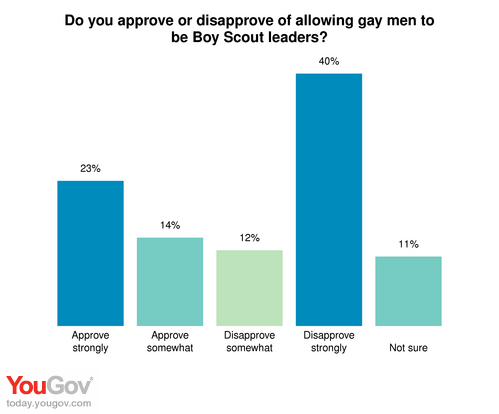
YouGov finds that a majority of the public agrees with the Boy Scouts’ new policy of accepting gay troops but banning gay troop leaders:

Gay Scout Leaders

I suspect the issue has been clouded by the impact of the sexual abuse crisis in the Catholic church and understandably greater nervousness about allowing boys to be supervised by grown men away from their parents. But although that’s understandable, it’s irrational. Openly gay scoutmasters are far less likely to abuse boys than closet case “bachelors” – because they are more emotionally and sexually adjusted. And closet-case “bachelors” will remain in the Scouts, while the less damaged ones are purged.

This is not to say that all closet-case bachelors are would-be molesters (many have, for decades, channeled their repressed sexuality into completely ethical and moral leadership for boys, including the Boy Scouts founder, Robert Baden Powell, who is now widely regarded as bisexual, if not gay). He had a decades-long deep friendship with another man he referred to as “The Boy”:

“The available evidence points inexorably to the conclusion that Baden-Powell was a repressed homosexual,” Tim Jeal wrote in The Boy-Man: The Life of Lord Baden Powell. (Long out of print and available only used, Jeal’s book is now also available as Baden-Powell). And Jeal should know; he is a well-respected British biographer and novelist whose work about David Livingstone was chosen when it was published as one of the best books of the year by editors at the New York Times and The Washington Post.

From the very beginning of the Scouts in Britain, their reputation as a homophilic organization was very real:

In Evelyn Waugh’s novel Brideshead Revisited, Lord Sebastian Flyte turns the pages of the News of the Scouting_for_boys_1_1908World and sighs, “Another naughty Scoutmaster.” This was 1923, only a few years after the Boy Scouts had been created, but they had already become a source of indelicate mirth… He was obsessed with boys and “boyology.”

The index of Tim Jeal’s excellent biography Baden-Powell speaks of his “aesthetic and sexual interest in men,” “pre-marital celibacy,” “dreams of young men,” and “anxieties over sexuality.” He got married, at 55, to (as Jeal put it) “a sporting girl whose interest in outdoor comradeship seemed at least as great as her desire for sexual fulfillment,” and he even managed to beget three children. But thereafter he always slept out on his balcony (and this in the English climate) rather than in the marriage bed.

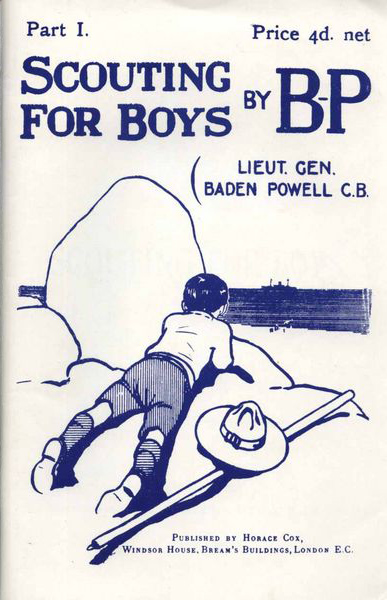
And don’t even ask about his dreams (just look at the drawing on the first cover of “Scouting For Boys”). It’s a fantastic irony that in today’s boy scouts, the very founder of the organization would be deeply suspect.

The Delusions Of Ross Douthat

TO GO WITH AFP STORY By Otto Bakano -- T

Ezra weighs in on Chait’s piece on Josh Barro and the plight of reformists on the right:

If you imagine a policy spectrum that that goes from 1-10 in which 1 is the most liberal policy, 10 is the most conservative policy, and 5 is that middle zone that used to hold both moderate Democrats and Republicans, the basic shape of American politics today is that the Obama administration can and will get Democrats to agree to anything ranging from 1 to 7.5 and Republicans will reject anything that’s not an 8, 9, or 10. The result, as I’ve written before, is that President Obama’s record makes him look like a moderate Republicans from the late-90s.

He is indeed a moderate Republican, which is why I’ve always liked his approach to governing and to policy. And that, of course, makes Ross Douthat nervous, because Ross is a smart man trying to engage a party that is currently out of its tiny mind. He reminds me of sane and sober Labourites in the early 1980s. But at least they fully copped to the extremism of their own side.

Ross won’t quite. He disputes Ezra on two grounds: first that the political environment has changed too. He says, for example, that the GOP’s retreat from cap-and-trade is a function of the 2008 economic meltdown, a temporary abatement in warming, the failure of global cap and trade, etc. But that would lead to healthy conservative skepticism of policies like cap and trade, and an attempt to think through alternatives. Jim Manzi represents this line of thinking best. But what Ross’s party has actually done is embrace total climate change denialism. That’s a huge shift toward irrationalism, fueled by fundamentalist Christianity, which, of course, Ross won’t recognize as a core part of the GOP problem. Because if he did, he would be Frummed out of the party altogether.

Then Ross argues that the GOP is more moderate than Ezra claims. So Ross defends the GOP on, say, immigration, because it has a healthier internal debate, which more closely represents public divisions. But, in fact, the GOP base, as Ross knows, is dedicated to destroying immigration reform, just as it did when even Bush was in office. Again, compare this with Reagan’s amnesty and an era where open borders conservatives were mainstream in the GOP (yes, I remember that). The actual Ronald Reagan would not stand a chance in today’s GOP. And the only argument for immigration reform that has any real traction in the party is electoral and arithmetical, not ideological. And those spearheading the effort, like Marco Rubio, face a perilous future in their party.

On taxes, the GOP is relentless, even though the boundaries of the debate have shifted dramatically their way since the 1980s. With revenue far too low, and structural spending bound to increase as we support baby-boom retirees, an absolutist refusal to raise any more revenues is a 10 on the scale of 1 – 10. This is especially true when the GOP is demanding much more spending on national “defense”. Yes, there are, mercifully, a few civil libertarian voices on the right, but surely Ross knows that his party reacted to Obama’s war on terror speech last week as if it were treason. Butters:

“At a time we need resolve the most, we’re sounding retreat.”

Peter King, the former terrorist-funder turned terrorist scourge, echoes the Ailes line:

“In many ways al Qaeda is more dangerous now than it was prior to September 11.”

Does Ross believe that? Does any sane person believe that? The truth is that the GOP is the most extreme, nihilist pseudo-conservative party I have seen in my lifetime in any developed country.

The GOP, for example, is in favor of torture as a national policy, placing it outside every mainstream right-of-center party in the West. How far have they traveled? Reagan strongly supported and signed the UN Convention Against Torture (and anything even close to it).

On Medicare, Ross is right that premium support, done right, is an arguably centrist position. But we know what Paul Ryan originally wanted – and Obama is the first Democratic president willing to cut Medicare seriously as part of a big fiscal deal. Every time Obama moves to the fiscal right, the GOP moves the goalposts one more time – and then demonize the president for, say, a stimulus package that was one third tax cuts. On social issues, the GOP is now further to the right than it has ever been, while the country has found a new middle. The GOP supports a constitutional amendment to ban gay couples from having any formal rights at all; and a federal ban on all abortions. Again, you have to find a neo-fascist party in other Western countries to see any Western equivalent. The fundamentalists cannot compromise on this – because their God won’t compromise. And the base has no other ideological foundation than fundamentalism of various neurotic kinds.

There’s a case to be made for pure oppositionism. But I truly think Ross under-estimates the depth of the nihilism that truly motivates his party, the thinly veiled racism and unveiled homophobia that courses through its activist veins, and the theocratic impulses that uniquely fire up the base. And I don’t think the fever is breaking. The IRS scandal will deepen and intensify all the defensive and self-defeating paranoia on the partisan right. Issa will be their champion; Ailes the fanner of the conspiratorial flames; and talk radio the defining ideological conversation.

Barro sees this as plainly as day. Ross is making, presumably, another calculation. For my part, I suspect there’s little hope for the GOP; and I increasingly see it as conservatism’s most implacable ideological, radical, destructive foe. I thought it would get worse before it got better; but I see no signs of the pathologies weakening. In the wake of an epic defeat, they appear to be gathering strength.

Ask Josh Barro Anything

This embed is invalid

[Re-posted from yesterday with many questions added by readers]

A brief bio of Barro:

He is the lead writer for the Ticker, an economics and politics blog hosted by Bloomberg L.P.. He appears regularly on Bloomberg Television and has appeared on Real Time with Bill Maher on HBO. Time named Barro’s Twitter feed one of “The 140 Best Twitter Feeds of 2013”, one of ten in the Politics category. In 2012, Forbes selected him as one of the “30 Under 30” media “brightest stars under the age of 30.” Barro describes himself as a Republican, but has expressed opposition to the policies of the Republican party.

Last week the Dish highlighted Chait’s profile of Barro. Andrew Leonard wrote of him recently:

He is, in my opinion, a rare breed indeed: an intellectually honest analyst of political and economic affairs who makes up his own mind, does not hew to any preset ideology and relies on facts to makes his arguments. People who disagree with him have labeled him conservative, liberal and libertarian. That’s not easy to achieve! Barro can wage total war against the notion that austerity is the correct prescription for our economic problems while at the same time arguing that public sector unions are bankrupting state governments. I follow him because I always learn something from him, even when I disagree with him. … Josh Barro is also the gay son of the famously arch-conservative economist Robert Barro, which makes him inherently interesting for reasons that have nothing to do with the quality of his analysis, and everything to do with the social and cultural splits that define our current society.

To submit a question for Josh, simply enter it into the Urtak survey after answering all of the existing questions (ignore the “YES or NO question” aspect and simply enter any open-ended question). To vote, click “Yes” if you have a strong interest in seeing Josh answer the question or “No” if you don’t particularly care. Thanks for your help.

Where Can Colleges Cut Back?

Wilkinson asks why moving courses online is a better option than trimming administrative bloat:

[S]tudents have faced rapidly rising tuition costs not due to large increases in the cost of instruction, but mostly due to the dramatic, rapid growth of the university bureaucratic class, which offers nothing of obvious worth to the education of their universities’ increasingly cash-strapped and indebted students.

According to a 2010 study on administrative bloat from the libertarian Goldwater Institute, tuition tripled from 1993 to 2007 at my own school, the University of Houston. Over that period, instructional spending per student changed not at all, while administrative spending per pupil nearly doubled. This is fairly representative of the national pattern. This seems to me to suggest that state university systems might first seek savings in leaner management before outsourcing instruction to glorified versions of YouTube. Public-university systems might take a page from Sweden, a paradisaical Scandinavian social democracy, which outsources to private companies the management of some of its public hospitals, as Schumpeter discusses, and recommends. In any case, it’s outrageous that students should be made to pay ever more to support assistants to assistant deans, in exchange for the right to earn a degree filling in worksheets and ignoring videotapes from home.

Recent Dish on MOOCs here, here and here.

Quote For The Day

“Your letter … contained some amount of backbiting, name-calling and sneering. We refrained from wading into this battle in the past out of a hope that the crooked could be straightened by the easiest and softest means. … But the wound continued to bleed, and in fact increasingly bled, until your last letter arrived, ending any hope of stanching the wound and healing it,” – the leaders of al Qaeda in Maghreb to a difficult employee.

I loved this bit:

The list of slights is long: He would not take their phone calls. He refused to send administrative and financial reports. He ignored a meeting in Timbuktu, calling it “useless.” He even ordered his men to refuse to meet with al-Qaida emissaries. And he aired the organization’s dirty laundry in online jihadist forums, even while refusing to communicate with the chapter via the Internet, claiming it was insecure.