Do We Have A Suicide “Epidemic”?

Suicide Rate

Tony Dokoupil claims we do:

[T]he last decade isn’t just a statistical blip, a function of a bad recession, unlocked gun cases, or an aging counterculture. It’s much darker, and deeper than all that. This is the “new epidemiology of suicide,” as [Julie Phillips, a sociologist at Rutgers University,] puts it, one where the tectonic changes of the last decade—socially, culturally, economically—have created a heavy burden of suicide, growing heavier by the year.

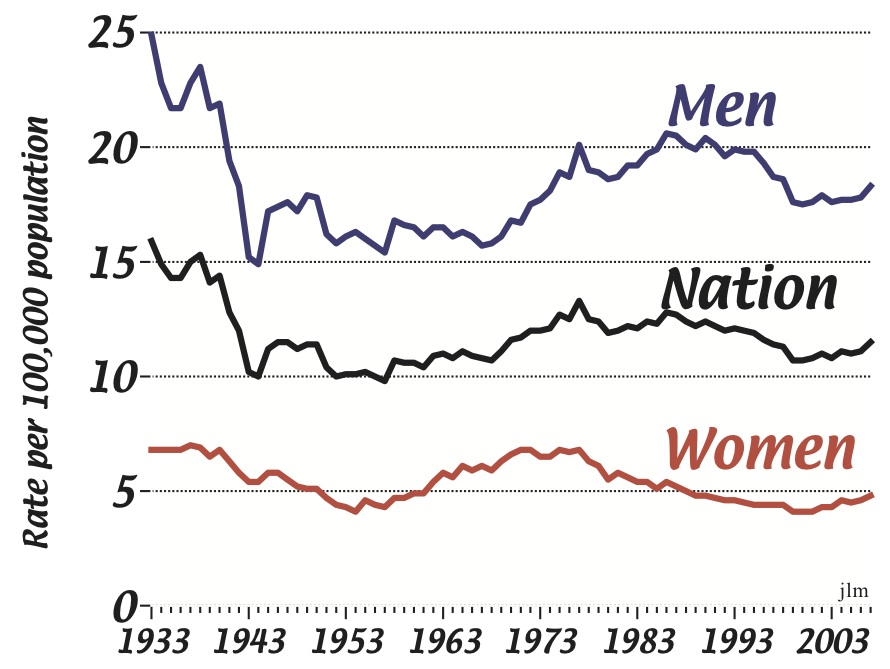
Nate Cohn, who posts the above chart, disagrees:

[T]alk of a “suicide epidemic” borders on sensationalism. Dokoupil’s piece is generally sound, but he contends that we live in a dystopic era of “unprecedented despair,” and that “we have never been more burdened by sadness.” Suicide rates have, indeed, climbed since 1999, a year that represented the all-time low for suicide in the United States, but today’s suicide rates are roughly comparable to those between 1940 and 1990, and below the rates of the 1930s.

That trendline corresponds with long-term trends in the national economy, adding credibility to the economic explanation for the suicide surge.

Sean Trende slices the data on suicide differently:

As it turns out, once you control for gun ownership, religiosity does have a statistically significant relationship with suicide … in a hypothetical state with no guns and no religion, we’d expect a suicide rate of 17 (per 100,000), give or take a few points. In a state where everyone had guns, and no one practiced religion, we’d expect a suicide rate of 39. If everyone were religious, but no guns: 11. Everyone religious, everyone owns a gun: 21. From a political perspective, there’s really something for both the left and right to like here.

Unfriending Ted Cruz

John Dickerson notes that the new Texas senator has already butted heads with several of his colleagues:

Do you need friends in the Senate anymore? Ted Cruz, Sen. Rand Paul of Kentucky, and Sen. Mike Lee of Utah are testing this theory in new ways. The power of Tea Party activists in Republican politics, the public’s low esteem for Congress, and structural changes in the Senate like the elimination of earmarks and the weakening of appropriations power have created more incentives for senators to get by without a little help from their friends.

Cruz has had a series of run-ins with his colleagues since being sworn in only four months ago. He battled Democratic Sen. Dianne Feinstein over gun control, his Senate Republican colleagues over a threat to filibuster gun legislation; and most recently he tangled with McCain and Republican Sen. Susan Collins over budget procedure.

Should Cruz run for president, John Sides expects this could hurt him:

Cruz’s path to the presidency—if he decides to run—must consist precisely of convincing “the middle” of the party that he’s electable despite the fact that he may be the most conservative member of the Senate (pdf).  To do that, he’ll need the support of his fellow party leaders to send that signal.  It doesn’t matter if he has “a knack for making his opponents lose their wits.”  His opponents will be busy nominating Hillary Clinton or whoever.  And it doesn’t matter whether, deep in his heart, he trusts Republicans. What matters is whether he has a knack for making his fellow Republicans trust him.

Commemorating The Confederacy

800px-Confederate_Monument_-_E_frieze_and_Minerva_-_Arlington_National_Cemetery_-_2011

Over the Memorial Day weekend, Jamie Malanowski called for [NYT] the government to rename Army bases named for generals who served the Confederacy:

Changing the names of these bases would not mean that we can’t still respect the service of those Confederate leaders; nor would it mean that we are imposing our notions of morality on people of a long-distant era. What it would mean is that we’re upholding our own convictions. It’s time to rename these bases. Surely we can find, in the 150 years since the Civil War, 10 soldiers whose exemplary service not only upheld our most important values, but was actually performed in the defense of the United States.

Erik Loomis focuses on the soldiers asked to serve at these forts:

[Malanowski asks] a fair question. And it is indeed an insult to ask African-American soldiers to serve at a fort named after P.G.T. Beauregard or John Gordon, who followed his war career by becoming the head of the KKK in Georgia.

Josh Marshall doesn’t mince words:

There’s a major difference between respecting and honoring sacrifice – which exists separately from the political movement you’re fighting on behalf of – and honoring people in this way. Today most of us probably see the problem as the fact that these guys fought to protect slavery. And whatever revisionist nonsense you hear out there that is unquestionably true. But that’s only one part of the equation. At least as big in my mind is that these men were traitors – rebels against the democratic ideal and the federal union around which any American patriotism has to be based. Taken together these two things are a really, really big deal. One can only begin to imagine what Union soldiers who died on the battlefield would make of all this. … Perhaps we’ve come far enough – regardless of the equities at stake 100 or 75 years ago – that we can revisit this question.

Dr. Charles Cogan counters:

These are memorials to the great and not-so-great Confederate generals: Fort Lee (understandable) but also Fort Bragg. I do not object to such a practice, as it is a recognition that both sides suffered during the war –just as Memorial Day honors the dead of both Union and Confederate soldiers. (Though at the beginning, Memorial Day was solely a Northern commemoration.)

This joint mourning has been central in achieving a reconciliation between North and South that has been truly remarkable – to the extent that talk of re-secession is never taken seriously. Indeed the South has become the most “patriotic” and military-oriented section of the country – partly due to its long and pre-bellum tradition of military honor. But while we can hardly object to the South’s honoring of its Pantheon of Civil War generals and of the thousands who died in the service of the Confederacy, we should not lose sight of the underlying imperatives of the Civil War: the preservation of the Union, and the abolition of slavery.

Slog’s David Goldstein explores the justification for honoring Confederates:

Over the years, I’ve had the chance to talk to a few proud Southerners about what it is exactly that they are so proud of, and while they may not use these exact words, invariably they say it was the nobility of the struggle that they honor. But whether or not they acknowledge it, the cause the South struggled for was preserving (and expanding) the institution of slavery. I don’t mean to go all Godwin and everything, but I’m sure many Nazi soldiers fought courageously too, yet you don’t see Germany building monuments to its World War II heroes.

TPM reader and Southerner CH worries about the potential backlash:

Before President Obama was elected, I would have agreed that maybe it is time to rename some military bases (and colleges) and maybe even consider doing something about the carving on Stone Mountain. And I would have agreed with you that after 1865 it was never again seriously considered that history might repeat itself. But as things now stand, I’m not sure that those same considerations which led to the mollification decisions back then, have become irrelevant; I’m not sure that the rationale for those decisions has outlived its usefulness.

Most rural Southern white men already feel that “their” country has been “taken” from them by a black Muslim. They watch Fox exclusively and without ceasing so they are constantly on edge and genuinely and earnestly believe that President Obama’s sole mission is to destroy America. I don’t know if we are sitting on a powder keg again or not. On a rational and academic level, I think that notion is absolutely ridiculous. But on a gut and emotional level, I worry. Sometimes I think all they need is a final straw to rally around. So maybe we could wait until a new president is in office again before we risk giving them a rallying point. Maybe the temperature down here will drop some by then.

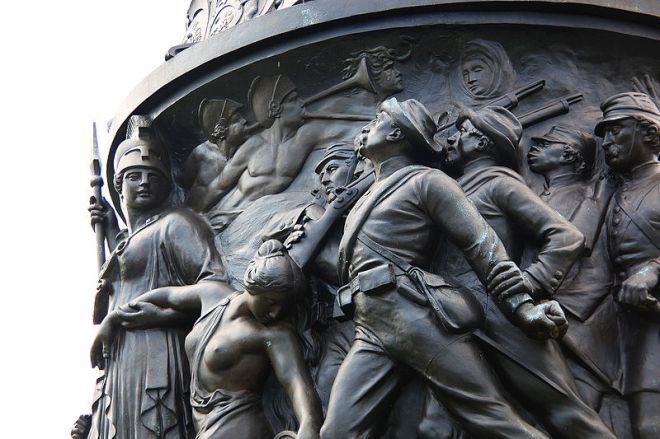
(Photo: Detail of the southeast corner of the frieze on the Confederate Monument at Arlington National Cemtery in Arlington, Virginia, in the United States. The goddess of war, Minerva (l), looks at the fallen “The South” while “spirits of war” trumpet for assistance. To the right, a sapper (with bag) and a soldier answer the call. An African American soldier answers the call to defend slavery with his white master. From Wikimedia Commons)
Tales From The Crit

Tara McGinley sympathizes with an art student who flipped out during a critique (seen above):

Whether or not this is staged (performance art?) it’s hard to tell. But it does show what it’s like to have your work shit on during a crit by a bunch of assholes (and why so many people say “fuck it” to art degrees). For some reason this whole freak-out reminds me of an episode of Girls.

Traveling The Crowded Skies

With travel season upon us, Daniel Gross checks in on the airline industry:

Ten years ago, the load factor—the percentage of seats actually occupied—was generally in the mid-70 percentages. The load factor has climbed steadily over the past decade—to 83 percent in 2011. As the Bureau of Transportation Statistics reported, in February, the most recent month for which numbers are available, “The system load factor of 79.2 percent, the domestic load factor of 81.0 percent, and the international load factor of 75.8 percent were record highs for the month of February.” That means your flight is more likely to be crowded, totally booked, or overbooked, that your ability to go standby or get an upgrade will be degraded, and that the prospects of getting stuck in a middle seat between a screaming baby and a person of size are substantially greater. By the time you do get on board, it will more likely that the overhead compartments will be full and you’ll have to check the bag.

On the plus side:

When you reach your destination this summer, your luggage will be much more likely to be there.

After realizing it costs them a few hundred dollars each time they lose a bag, airlines have engineered an impressive reduction in the incidence of lost luggage. The rate of “mishandled bags” have plummeted from 7.05 per 1,000 passengers in 2007 to 3.15 per 1,000 in the first quarter of 2013.

An excerpt from Cockpit Confidential, airline pilot Patrick Smith’s new book, tries to put flying in a better light:

We’ve come to view flying as yet another impressive but ultimately uninspiring technological realm. There I am, sitting in a Boeing 747, a plane that if tipped onto its nose would rise as tall as a 20-story office tower. I’m at 33,000 feet over the Pacific Ocean, traveling at 600 miles per hour, bound for the Far East. And what are the passengers doing? Complaining, sulking, tapping glumly into their laptops. A man next to me is upset over a dent in his can of ginger ale. This is the realization, perhaps, of a fully evolved technology. Progress, one way or the other, mandates that the extraordinary become the ordinary. But don’t we lose valuable perspective when we begin to equate the commonplace, more or less by definition, with the tedious? Aren’t we forfeiting something important when we sneer indifferently at the sight of an airplane — at the sheer impressiveness of being able to throw down a few hundred dollars and travel halfway around the world at nearly the speed of sound? It’s a tough sell, I know, in this age of long lines, grinding delays, overbooked planes, and inconsolable babies. To be clear, I am not extolling the virtues of tiny seats or the culinary subtlety of half-ounce bags of snack mix. The indignities and hassles of modern air travel require little elaboration and are duly noted. But believe it or not, there is still plenty about flying for the traveler to savor and appreciate.

Should The Government Buy Kidneys?

Kidney Shortage

Rohin Dhar thinks so:

What’s the advantage of letting Medicare buy kidneys instead of creating a free market? First, it would save Medicare and private insurers money since the current cost of dialysis for people on the waitlist is so high. These parties have a financial incentive to consider a plan like this.

Second, a government-regulated system can address concerns about equity. Rather than rich people privately contracting poor people to buy their kidneys, the government and the UNOS can continue to allocate purchased kidneys based on need (Objection 1). Moreover, the risk for organ thieves is eliminated in this scenario (Objection 2). Would an organ thief show up at the Medicare office with bag of kidneys? Instead, individuals would have to go through an approval process to ensure that they are not selling their organ under duress and understand the risks.

(Chart from Mark Perry)

Ask Josh Barro Anything

This embed is invalid

A brief bio of Barro:

He is the lead writer for the Ticker, an economics and politics blog hosted by Bloomberg L.P.. He appears regularly on Bloomberg Television and has appeared on Real Time with Bill Maher on HBO. Time named Barro’s Twitter feed one of “The 140 Best Twitter Feeds of 2013”, one of ten in the Politics category. In 2012, Forbes selected him as one of the “30 Under 30” media “brightest stars under the age of 30.” Barro describes himself as a Republican, but has expressed opposition to the policies of the Republican party.

Last week the Dish highlighted Chait’s profile of Barro. Andrew Leonard wrote of him recently:

He is, in my opinion, a rare breed indeed: an intellectually honest analyst of political and economic affairs who makes up his own mind, does not hew to any preset ideology and relies on facts to makes his arguments. People who disagree with him have labeled him conservative, liberal and libertarian. That’s not easy to achieve! Barro can wage total war against the notion that austerity is the correct prescription for our economic problems while at the same time arguing that public sector unions are bankrupting state governments. I follow him because I always learn something from him, even when I disagree with him. … Josh Barro is also the gay son of the famously arch-conservative economist Robert Barro, which makes him inherently interesting for reasons that have nothing to do with the quality of his analysis, and everything to do with the social and cultural splits that define our current society.

To submit a question for Josh, simply enter it into the Urtak survey after answering all of the existing questions (ignore the “YES or NO question” aspect and simply enter any open-ended question). To vote, click “Yes” if you have a strong interest in seeing Josh answer the question or “No” if you don’t particularly care. Thanks for your help.

Quotes For The Day

“It is time for the world’s major central banks to acknowledge that a sudden burst of moderate inflation would be extremely helpful in unwinding today’s epic debt morass … Moderate inflation in the short run – say, 6% for two years – would not clear the books. But it would significantly ameliorate the problems, making other steps less costly and more effective,” – “austerian” Kenneth Rogoff, 2008.

“Larry Ball makes the case that we would be a lot better off with a 4 percent inflation target rather than the 2 percent that is now central bank orthodoxy. Intellectually, this position is hardly outlandish; indeed, Ball’s case is very similar to the case Olivier Blanchard made three years ago, just stated more forcefully and with more evidence,” – “anti-austerian” Paul Krugman, last week.

More discussion here.