Star Words

Kory Stamper notes how sci-fi influences our vocabulary:

Many words have their origins in science fiction and fantasy writing, but have been so far removed from their original contexts that we’ve forgotten. George Orwell gave us “doublespeak“; Carl Sagan is responsible for the term “nuclear winter“; and Isaac Asimov coined “microcomputer” and “robotics“. And, yes, “blaster”, as in “Hokey religions and ancient weapons are no match for a good blaster at your side, kid.

The genres also reintroduce or recontextualize already existing words:

Savvy writers of each genre also liked to resurrect and breathe new life into old words. JRR Tolkien not only gave us “hobbit”, he also popularized the plural “dwarves”, which has appeared in English with increasing frequency since the publication of The Hobbit in 1968. “Eldritch”, which dates to the 1500s, is linked in the modern mind almost exclusively to the stories of HP Lovecraft. The verb “terraform” that was most recently popularized by Joss Whedon’s show Firefly dates back to the 1940s, though it was uncommon until Firefly aired. Prior to 1977, storm troopers were Nazis.

Mythologizing 1979

Reviewing Christian Caryl’s Strange Rebels: 1979 and the Birth of the 21st Century, Michael Kimmage notes the way the book challenges our understanding of history and the present:

The book’s temporal frame is intended to provoke. Caryl accords the Paris or Berkeley or Prague of 1968 no lasting political stature. Nor is 1989 the year in which everything happens. Those years imply a Eurocentric emphasis, too rooted in the socialist dream or too disconnected from the salience of modern religion. Caryl argues that market capitalism and political Islam were the primary forces shaping the past 34 years. Embodying these forces were Margaret Thatcher, Pope John Paul II, and the Ayatollah Khomeini. The successive collapse of Western-style modernization and of Soviet-style communism in Afghanistan completes Caryl’s story.

By amalgamating distinct geographic areas and seemingly disparate historical forces, Caryl uncovers new and vivid questions. Why is it that an enthusiasm for the market arose almost simultaneously in countries as dissimilar as the United Kingdom and China? Why did this enthusiasm appear at the end of the 1970s? And why did secularism wear so thin at this time? Why was it that the Shah’s Iran could not restrain a religious movement that seemed, to the Shah and his American backers, to have come from nowhere? Why was it John Paul II who undid the Soviet empire? These rich questions are made richer by their presentation as pieces of the same historical puzzle. Strange Rebels implies that the puzzle fits together.

Jonathan Karl hesitates just a bit:

“Strange Rebels,” though engagingly written, is occasionally repetitive, and Mr. Caryl’s effort to craft a coherent narrative out of a series of disparate and chaotic events is at times a bit forced. But the reader comes away convinced that the forces set in motion, for good and for ill, in 1979 set the stage for the world we see today, in ways that were hard to see at the time. We’ll no doubt face another turning point (maybe we already have?), and when we do, there is no guarantee that it will be any more obvious than it was in 1979.

The Thrill Of The Slip

Clinical psychologist Jay Watts observes:

[C]ommunications technology means that Freudian slips are increasingly unforgettable within our culture. If you Google ‘Freudian slip’, you’ll find multiple compilations of slips from politicians and celebrities. If we film celebrities for long enough, something other than the performance managed by media training, publicity agents and the celebrities’ own ideas of themselves emerges. We relish these eruptions, especially when they come from ‘the great and the good’. George H W Bush’s famous slip is a good example: ‘For seven and a half years, I’ve worked alongside President Reagan, and I’m proud to have been his partner. We’ve had triumphs. We’ve made some mistakes. We’ve had some sex — setbacks.’ Many sites include instructions to watch Bush’s chest during the replay as he ‘looks like he’s having a minor heart attack after the slip’ — an example of the glee we often find when discussing celebrity slips. Slips become great power equalisers. ‘You are not what you would have us believe you are,’ we say, laughing.

Writing Through The Darkness

Jessica Grose ponders Sylvia Plath’s astonishing productivity as a writer, despite being a mother and wife who battled mental illness:

Plath battled the depression that would ultimately fell her throughout her entire working life, but she still managed to be highly productive, even during the period when she was a single mother of two young children after separating from Hughes. Work was so important to her sense of self that Plath’s suicide attempt during that summer of ’53 was in part because her depression rendered her unable to write.

Among the reasons for Plath’s copius output? Grose cites Diane Middlebrook’s biography, Her Husband, on the importance of the poet’s daily writing schedule:

“Daily routines were the kind of thing Plath liked to describe in letters to her mother, so we know that [she and Hughes] planned to write for four to six hours a day, 8:30-12:00 in the morning, 4:00-6:00 in the afternoon. In later years, after they had children, they split the day into two parts: Plath took the hours after breakfast, and she aimed to be at work by 9:00; Hughes had the hours between lunch and tea. Despite the evident differences in their dispositions, routines suited both of them, and what they considered good work flowed from Hughes’s pen and Plath’s keyboard for the whole of their first two months of married life.”

Even in the frenzied final months of Plath’s life, during which she was plagued by anxiety, depression, and insomnia, she would write from 4 a.m., when her sleeping pills wore off, until 8 a.m., when her son and daughter woke up and needed her. She wrote much of the heralded poetry collection Ariel in this fashion.

A Poem For Monday

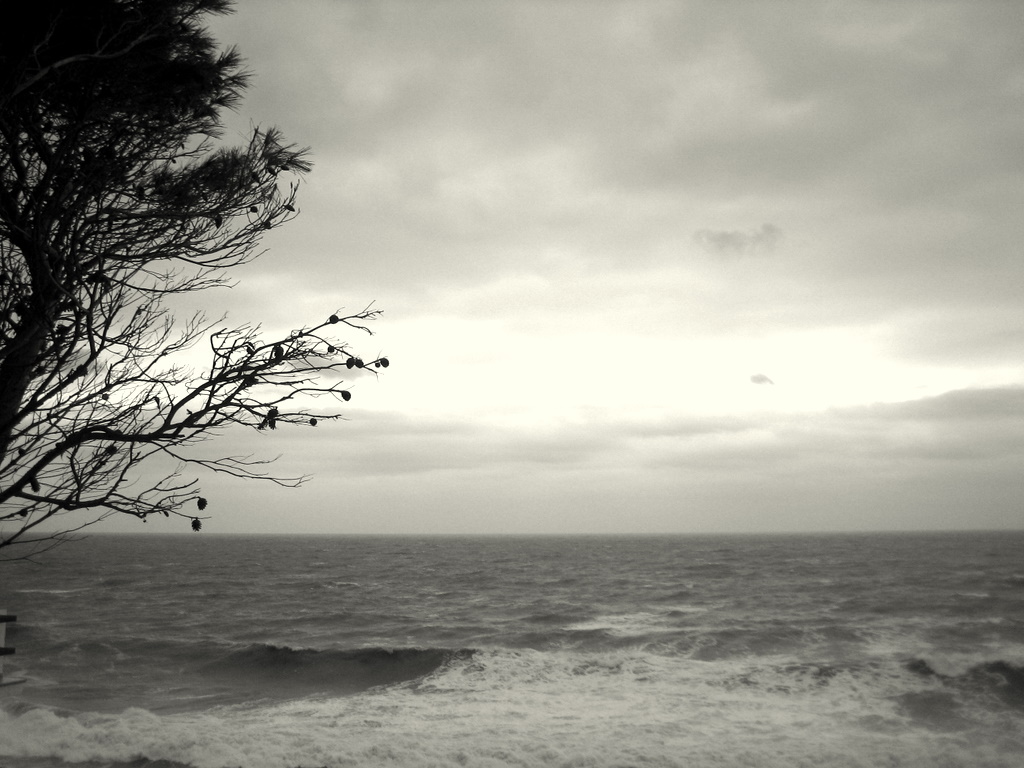
sea

“Staring at the Sea on the Day Of the Death of Another” by May Swenson:

The long body of the water fills its hollow,
slowly rolls upon its side,
and in the swaddlings of the waves,
their shadowed hollows falling forward with the tide,

like folds of Grecian garments molded to cling
around some classic immemorial marble thing,
I see the vanished bodies of friends who have died.

Each form is furled into its hollow,
white in the dark curl,
the sea a mausoleum, with countless shelves,
cradling the prone effigies of our unearthly selves,

some of the hollows empty, long niches in the tide.
One of them is mine
and gliding forward, gaping wide.

(From May Swenson: Collected Poems, Langdon Hammer, editor (The Library of America, 2013) © The Literary Estate of May Swenson. Photo by Flickr user echiner1)

The Body Politic’s Taste In Art

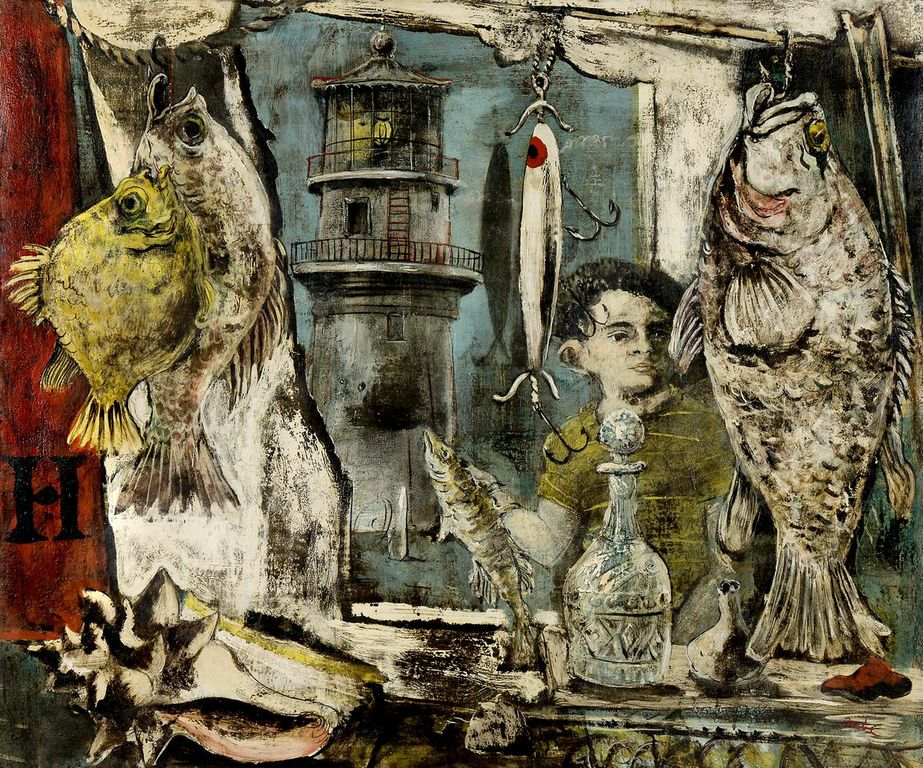
dish_zerbe_aroundthelighthouse

Advancing American Art was a 1946 art collection selected by US State Department; the shows were intended to fight the Cold War by promoting American cultural values abroad. The experiment was a domestic flop:

The highly conservative radio host Fulton Lewis Jr derided the art as “so far advanced that it’s completely out of sight and no one in his sane mind is ever going to try and catch up to it”. Upset citizens wrote letters to their elected representatives, deriding the use of taxpayers’ money for the project. Those politicians in turn spoke out in the press and on Capitol Hill.

The objections to the works took various forms. Complaints were made against the darkness of the works, both in palette and content, by those who felt that they failed to portray the nation as a thriving war victor. The “foreign-sounding” names of many of the artists, many of whom were in fact immigrants, was also an issue.

Perhaps most troubling for some protestors was the political orientation of many of the artists. … [T]he unfamiliar style, and hence artistic merit, of the work was called into question. Perhaps the most damning derision in this area came from none other than President Harry Truman, who in a letter to a State Department official leaked to the press, dismissed the art as “merely the vaporings of half-baked lazy people”.

The controversy came to a head in a series of Congressional hearings. While artists and museum officials around the country convened to try and save the programme, their counter protest was to no avail. Threats of State Department funding cuts put their other programmes at risk, which by that time included the popular Voice of America radio broadcasts, the Fulbright Programme and Unesco involvement. The outcomes of the hearings were the recall of the art to home, the dismissal of [State Department member Joseph LeRoy] Davidson and the elimination of his position.

A recreation of the exhibition can be seen at the University of Oklahoma through June 2nd. From there, it travels to Indiana University and the University of Georgia.

(Pictured: Around The Lighthouse, Karl Zerbe, n.d.)

Everest Going Downhill

The world’s highest mountain has become overcrowded and polluted, reports Mark Jenkins, in large part due to its draw as a tourist destination for inexperienced climbers:

Everest has always been a trophy, but now that almost 4,000 people have reached its summit, some more than once, the feat means less than it did a half century ago. Today roughly 90 percent of the climbers on Everest are guided clients, many without basic climbing skills. Having paid $30,000 to $120,000 to be on the mountain, too many callowly expect to reach the summit. A significant number do, but under appalling conditions. The two standard routes, the Northeast Ridge and the Southeast Ridge, are not only dangerously crowded but also disgustingly polluted, with garbage leaking out of the glaciers and pyramids of human excrement befouling the high camps. And then there are the deaths. Besides the four climbers who perished on the Southeast Ridge, six others lost their lives in 2012, including three Sherpas.

James Joyner is pessimistic:

The prospects of this happening are dismal. Nepal is a poor country and the government took in over $3 million in permit fees last year and climbers brought an estimated $12 million into the local economy. The corrupt, incompetent government diverts the money it brings in, re-investing very little in safety and cleanup of Everest.

Kashish Das Shrestha, a writer who offered insight into a sherpa’s view of the mountain’s “traffic jam” last year, compares his observations with Jenkins’s, noting the similarity of their visions for reform. From his May 2012 report:

While shutting down Everest for a season or two might seem radical, at least fiscally, it actually might not be.  There are 326 peaks that are open for mountaineering in Nepal. Of that, 25 are in the Solukhumbu region.

So shutting Everest down temporarily would not mean taking away revenues from Solukhumbu or the Sagarmatha National Park. It would only mean being able to offer a safer Mount Everest down the line, while promoting other peaks in the region and the country.

Mount Everest is not, and should not, be treated like an expensive amusement park. And nobody’s permit fee is bigger than somebody’s safety more than 7,000 meters above sea level.

In an update, he indicates that hope is not lost:

I was recently told that if one wanted the government to respond to certain public discourses, a document outlining the discourse or proposed policy suggestions had to be submitted to the relevant Minister or Secretary of the relevant Ministry. Perhaps it is worth submitting Mark’s and my propositions to those offices, as well as to the industry’s trade body, to see if there is a response.
Ready For Awesom-O

Having grown up reading on tablets and talking to Siri, today’s kids are primed to welcome the presence of robots:

Because children are accustomed to this social relationship, their perception of technology and its purpose differs from those of their parents. Devices can be friends or teachers, not just tools or entertainment. Last year, a team at Boston-based research firm Latitude asked children to imagine how robots could fit into their lives. Sixty-four percent imagined a social humanoid, and the bots were more likely to act as tutors, playmates, or companions than exclusively as maids or assistants. Members of Generation Z will also be the first to have advanced robot companions at home. Last fall, Hasbro released a new generation of Furby that gathers data from sensors—including an accelerometer that measures how gentle or rough a child is with the toy—and changes its personality based on how it’s treated. Several more robots launching this year, including Romo and WowWee RoboMe, use a smartphone as a computing brain, so they’re able to utilize the camera and facial recognition to react to people.

What Poetry Can Learn From Pop Music

Tasha Golden points out that “pop music loves the public”:

In Poetry Land there’s a myth that art is tainted by popularity: the more eyes see it, the more corrupt it becomes. Said myth is outdated and nonsensical, but survives because it’s a nice stunt double for artistic integrity. It’s also great for cognitive dissonance: if no one’s reading poetry, it helps to think we never wanted them to. AND it justifies our laziness in connecting with non-poets. Hooray!

But um… The myth is rank, you guys. It creates disdain for the public, shames us for our desires to communicate, and imprisons us in Insular Poetry Land… Pop music has an audience in part because it wants one. It appreciates, respects, and engages the public. We should, too.

Here Comes America

Allison Yarrow defends Here Comes Honey Boo Boo, which recently premiered in England. She thinks the reality show “is exactly the kind of cultural product America should be exporting” because it “features among the most real, relatable, unpretentious Americans on television”:

[T]he show depicts and humanizes a national reality that too often gets ignored on TV. For many Americans, poverty, obesity, teen pregnancy, and unemployment are facts of life, just as they are for the Thompson/Shannons. Mama June’s couponing prowess allows her to feed the family on $80 per week. She and her girls diet and discuss their fight to lose weight on the show. Chickadee is among the teens who make up the one-fifth of all unplanned pregnancies in the U.S., and the show’s season finale featured the birth of her own daughter. Despite all this, they seem genuinely happy. They’re not in denial of their problems, but they’re not defined by them, either. …

These are appropriate heroes for a country struggling out of a recession—certainly a better standard-bearer than other reality-TV families who aggressively pursue money, beauty, and fame. Mama June likes to say that she and her girls represent nobody—not Georgians, Southerners, or anybody else—but themselves. Luckily for us, she’s wrong.