The Geography Of American Politics

Kyle Kondik observes that “rural/urban divide in American presidential politics is pronounced”

Generally speaking, Republicans win the districts that are geographically large, and Democrats win the districts that are geographically small. This squares with the national political scene — as we noted right after the election last year, Obama won more than 90% of the nation’s 50 most populous counties, while Romney won more than 90% of the counties in rural Appalachia.

This helps explain the Republicans’ structural advantage in the House. Yes, redistricting in many states has something to do with it (although Democrats benefit from gerrymandering in some places too), but Democratic voters are also clustered closer together than Republican voters are, which hurts Democrats. For instance, Obama won 70% or more of the vote in 61 House districts in 2012, while Romney got 70% or more in just 19 districts. Political scientists Jowei Chen of the University of Michigan and Jonathan Rodden of Stanford University argue that the close proximity of Democratic voters dilutes their power in the House: “In many states, Democrats are inefficiently concentrated in large cities and smaller industrial agglomerations such that they can expect to win fewer than 50 percent of the seats when they win 50 percent of the votes,” they wrote.

This clustering becomes readily apparent with just a cursory glance at a map of House results. Based on U.S. census data, the 234 Republican House members represent districts that cover four-fifths (80%) of the United States’ land mass, while the 201 Democrats in the House hold just about 20% of the country’s land.

Arrested Fanbase Development

Ryan McGee worries about Netflix releasing an entire season of Arrested Development on Sunday:

The intensity in and out of the industry means this show will essentially blind everything else around it for a few days. Of that, we can be certain. Everyone will be talking about it. But they may not necessarily be discussing it.

He zooms out:

If social media/social energy is a deciding factor in which shows live or die above and beyond the increasingly irrelevant Nielsen ratings, then harnessing that energy rather than dissipating it seems like a smart business move. Releasing everything all at once results in a very loud, very short burst of interest. But it also potentially scatters that interest the nanosecond after creating it. The week between episodes isn’t just a time for people to sit on their hands and passively wait for a new episode. It’s time to analyze, criticize, and proselytize. Telling everyone about a great show you just finished is fine. Telling everyone about a great show they could share with you in real time is even better. People love watching TV, but they love talking about it even more. The Netflix model cuts off that conversation, and thus cuts off a central part of what makes the medium so great. It’s not just about what’s onscreen. It’s about those on the other side of it.

Living To Blog The Tale

Ars Technica writer Jason Marlin describes a recent hair-raising experience:

I was getting ready to dive back into work when the storm really picked up. “Ahhhh,” I thought as I leaned back in my chair to stare out at the strange greenish light against a purple-clouded backdrop. “So beautiful!” At that moment—and this part is a little foggy—a bright arc of electricity shot through the window and directly into my chest. I’m not sure whether the arc originated from the sky or the ground, but it knocked me out of my chair. I hit the concrete floor and bounced back up to my feet, which were shuffling at top speed into a bookshelf. I remember thinking, “OK, going to die now. Do not fall down. Do not pass out.”

Luckily, other than some next-day soreness, Marlin was fine. He wonders about the EMT’s question about whether he was wearing shoes, which he wasn’t:

It turns out there’s something of an obsession with shoes and lightning, the predominant belief being that rubber soles offer some insulating protection against the current. But as Kyle Hill writes in a blog post, “If lightning has burned its way through a mile or more of air (which is a superb insulator), it is hardly logical to believe that a few millimeters of any insulating material will be protective… I tend to believe that there would be little effect from whatever is on the bottom of your feet.”

An Investment That Wasn’t A Lemon

Connor Simpson is impressed by Tesla’s early repayment of their Department of Energy loan, which has earned the government a $20 million profit:

It’s quite an accomplishment considering the fates that have befallen other green energy companies. The Department of Justice seized $21 million from electric car maker Fisker before the company went into bankruptcy after it received a $529 million loan guarantee in 2009. Battery maker A123 Systems spent $132 million of its $250 million guarantee from the Department of Energy before they bit the dust. That does not sound great, but the Department of Energy guarantees are actually creating jobs.

Peter Eavis notes that “Tesla has not fully weaned itself from government support” because buyers “of Tesla cars can get substantial tax credits that reduce the purchase price.” Yglesias defends this tax credit:

Now it’s quite right to say that current policy is not exactly optimal. A $20 per ton carbon tax with the funds used to lower other taxes would be much better nudge than a regressive tax credit initiative. But you rarely get optimal policy, and the course we’re taking is a reasonable and practical one.

An Islamist Beheading In Britain, Ctd

_67786092_67786091

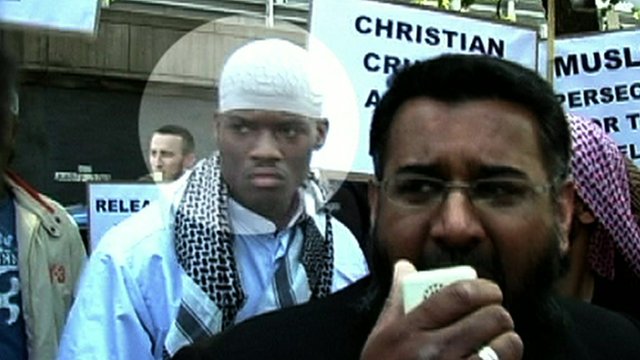
Greenwald refuses to label the beheading in London “terrorism,” calling it just another attempt to stir paranoia against Muslims:

[T]he term at this point seems to have no function other than propagandistically and legally legitimizing the violence of western states against Muslims while delegitimizing any and all violence done in return to those states …

I really have to try restrain my anger here. First off, Glenn’s adoption of the view that the wars in Iraq and Afghanistan amounted to “continuous violence by western states against Muslim civilians” seems a new step toward the memes of Islamist propaganda. Does Glenn really believe that the wars in Afghanistan and Iraq, however flawed, were deliberate attempts to kill Muslim civilians, in the way al Qaeda deliberately targets and kills Muslim civilians?

If he does, then I beg to differ. The reason we invaded Afghanistan was not because we decided to launch a war on Islam. It was because wealthy, Islamist, hypocritical bigots launched an unprovoked Jihadist mass murder of Western innocents from a cell based in a country run by a regime that specialized and specializes in the mass murder of other Muslims.

Before 9/11, America had saved Muslims in the Balkans from Christianist fanatics. We helped liberate Muslims in Afghanistan from Soviet oppression. We continue to give vast amounts of money to Muslim countries like Egypt, and, because of our economic development and need for oil made multi-billionaires out of Saudi clerics. And the war against Saddam, though a criminal enterprise and strategic catastrophe, nonetheless removed one of the most vicious mass murderers of Muslims on the planet. And the sectarian murder of Muslims that followed, however the ultimate responsibility for the occupying forces, was not done by Westerners. It was done by Muslims killing Muslims. The West, moreover, is committed to removing its troops from Afghanistan by next year and is fast winding down drone strikes.

How can that legitimize a British citizen’s brutal beheading of a fellow British citizen on the streets of London? If we cannot call a man who does that in the name of God and finishes by warning his fellow citizens “You will never be safe” a terrorist, who would fit that description, apart, of course, in Glenn’s view, Barack Obama?

The barbarian with the machete was not born in a Muslim country or land. He was born in Britain, educated at Marshalls Park school in Romford and Greenwich University.

He does not have a history of concern with foreign policy – or even sensitivity toward the mass murder of Muslims. There is no record of his protest against the mass murders by the Taliban – because those kinds of murders of Muslims he approves of. He is a convert to the Sunni Islamism of Anjem Choudary, whose street thugs were involved in a melee in a London street only last week as they attacked and scuffled with Shi’a Muslims. Choudary’s group wants Sharia law imposed on the UK, a war against Shiites everywhere, the brutal subjugation of women, and suppression of every freedom Glenn cares about. The idea that this foul, religious bigotry – when it provokes its adherents to the kind of barbarism we saw two days ago – is some kind of legitimate protest against a fast-ending war is just perverse.

I want the war in Af-Pak to end. I agree that blowback is a real problem. I was horrified by the Iraq war. I remain appalled by GTMO and the legacy of torture. But I cannot defend any analysis of what happened in London as some kind of legitimate protest against Western foreign policy rather than terrorism in its most animal-like form, created and sustained entirely by religious fanaticism which would find any excuse to murder, destroy and oppress Muslims and non-Muslims in the name of God.

They did this before 9/11 and before our invasions of Afghanistan and Iraq. They are doing it now in Syria in the name of the same God. These genocidal theocrats did not need to be spurred by the US and UK’s actions – although they can view those as a further inflammation. They are living out their twisted, foul faith – which requires them not merely to kill, but to hack and mutilate and dismember another human being and celebrate that fact with a glee and a pride that has absolutely nothing to do with foreign policy and everything to do with the evil lurking in the totalitarian’s soul.

I have to say I have always respected the sincerity and clarity of Greenwald’s critique of the war on terror. But his blindness to the savagery at the heart of Salafism is very hard to understand, let alone forgive.

Recent Dish coverage of the Woolwich beheading here, here, here and here.
Eat In, Get Thin

As long as you stick to the serving sizes:

Jane Brody pushes back against attempts to pin the obesity epidemic on sugar:

Sugar, it turns out, is a minor player in the rise. More than half of the added calories — 242 a day — have come from fats and oils, and another 167 calories from flour and cereal. Sugar accounts for only 35 of the added daily calories. Demographic changes, and how the food and restaurant industries responded to them, compounded the problem. As more women entered the work force, family meals and especially home-cooked meals became less frequent. (Relatively few husbands became family cooks, sadly.) From 2005 to 2008, according to the Department of Agriculture, 20 percent of American calories were consumed in fast-food and full-service restaurants, more than triple the amount in 1977-78.

Eating just one meal a week away from home can translate into two extra pounds a year for the average person, the department calculated. Although the recent economic downturn forced more people to dine at home, the average adult now eats out nearly five times a week.

Zak Stone highlights a troubling implication of this trend:

The advice for the American diner, which, is also the message of Michael Pollan’s new book Cooked: A Natural History of Transformation, is to cook your own meals using unprocessed ingredients if you want to buck the trend toward becoming overweight. The problem, of course, is that this is not a reality for many overworked, poor Americans who don’t have access to healthy food in their neighborhoods–the exact demographic most likely to battle obesity.

Meanwhile, Wisconsin is currently considering a bill that would prohibit local governments from limiting food or beverage portions. Two top children’s health officials take to the op-ed page to oppose the bill:

Adults may defend the right to choose a healthy or unhealthy lifestyle, but avoiding collective responsibility to provide a healthy environment for children is difficult to defend. In Wisconsin, 39 percent of students in grades three through five are overweight or obese. Unless change is made, most are doomed to be obese adults. Refusing to even consider policies that could alter this trend is an expensive proposition. In 2013, Wisconsin will spend about $2.7 billion on obesity-related medical expenses that trickle down to communities.

What You Don’t Know Could Save Your Life

A couple months ago, the American College of Medical Genetics and Genomics (ACMG) recommended that doctors share incidental genetic findings with patients. Robert Green explains:

The recommendations state that laboratories performing a sequencing analysis of the protein-coding regions of DNA (the exome) or of the entire genetic code (the genome) for any medical indication should also examine 57 genes for well-recognized mutations that might signal a risk for one of 24 life-threatening but treatable conditions. While there are literally thousands of genes that could potentially influence a person’s future health, the ACMG felt that discovering mutations for these 24 conditions (such as hereditary cancers or heart conditions that could cause sudden death) was so important that a laboratory sequencing the genome should deliberately search for these mutations, and that these were genetic “panic values” that should always be returned to the ordering physician. The recommendations called for analyzing and returning this information without seeking the patient’s explicit permission for each and every gene to be tested, and regardless of the age of the patient being sequenced.

Not everyone in the scientific community agrees. Ronald Bailey’s view:

I predict that, as genomic testing becomes more precise and prognostic, failing to tell a patient about her genetic disease risks will be seen as being just as moral as neglecting to tell her about an aortic aneurysm discovered during an ultrasound examination for gallstones. Keeping people ignorant is rarely the right thing to do.

Who Should Pay For Early Education?

Lane Kenworthy believes that, eventually, “the United States is likely to have universal publicly-funded early education for children aged one to four.” How he would like the system designed:

American parents with a child younger than age five in out-of-home care currently pay, on average, about $9,000 per year for that care. Childcare expenditures amount to 40% of income for families with incomes below $18,000, and 20% for those with incomes between $18,000 and $36,000. That’s far too much.

How much should parents pay? A sliding scale, with the user fee rising in proportion to family income and capped at around 10%, seems sensible.

Should it be free for those with low incomes? I think that would be a mistake. Early education differs from services that relatively few people opt out of, such as police protection, healthcare, and even K-12 education. Families that prefer to provide stay-at-home parental care for their young children will elect not to use it. This argues for having parents who do use it pay something — even parents with little income. The fee should be modest, but it shouldn’t be zero.

Some recent polling on who should pay for early education:

[A]ccording to the latest Reason-Rupe poll, only 37 percent of Americans favor raising taxes to create a universal preschool system, while 61 percent oppose. When asked who should be “primarily responsible” for paying for preschool, 57 percent of Americans think parents should pay and 32 percent want the government to be responsible for paying.