What The Hell Is Happening In Sweden?

There has been rioting in Sweden for the past five nights (NYT):

As the unrest spread from the outlying district of Husby, where it was apparently set off on Sunday by the fatal police shooting of a local man wielding a knife, gangs of youths have torched schools and other public buildings and set alight scores of cars. The rioting, for which the authorities have sought to blame a small group of troublemakers, has been focused in areas with a majority population of poor immigrants and asylum-seekers.

The Guardian adds that the rioting has “exposed a faultline between a well-off majority and a minority, often young people with immigrant backgrounds, who cannot find work, lack education and feel marginalised.” Niklas Pollard and Phillip O’Connor find that the violence shows the “ugly side of the ‘Nordic model'”:

Conversations with residents of this immigrant neighborhood soon bring tales of fruitless job hunts, police harassment, racial taunts and a feeling of living at the margins that are at odds with Sweden’s reputation for openness and tolerance. … The Swedish model of welfare – such as its 480 days of parental leave for each child – hides another side. Some 15 percent of the population is foreign born, the highest in the Nordic region. … [And e]ven second generation immigrants struggle to find white collar employment. As one Asian diplomat puts it: “On the one hand Sweden has all these immigrants. On the other hand, where are they? It sometimes seems they are mostly selling hotdogs.”

Elias Groll records the reactions of the politicians. Samuel Goldman examines the implications for Americans:

What’s happening around Stockholm, then, can’t be explained away as a reaction to official neglect or poverty. Rather, it’s a predictable consequence of mass immigration from the Third World into a small, ethnically and culturally homogeneous society.

Immigration critics on this site and elsewhere worry that the United States is failing to assimilate the millions who have come here, legally and illegally, since the 1960s. I think those fears are mostly exaggerated. Although fashionable multiculturalism can inhibit assimilation, American life has proven to be an reliable solvent of foreign identities. As Christopher Caldwell has argued, however, the classic nation-states of Europe lack the cultural resources to absorb an influx of population from some of the poorest and most backward societies in the world. I’m glad I don’t live in Stockholm tonight.
Obamacare Can Work? Ctd

Yesterday California announced premium rates for its healthcare exchanges. Sarah Kliff points out that the premiums are lower than many estimates:

Health insurers will charge 25-year-olds between $142 and $190 per month for a bare-bones health plan in Los Angeles. A 40-year-old in San Francisco who wants a top-of-the-line plan would receive a bill between $451 and $525. Downgrade to a less robust option, and premiums fall as low as $221. These premium rates, released Thursday, help answer one of the biggest questions about Obamacare: How much health insurance will cost. They do so in California, the state with 7.1 million uninsured residents, more than any other place in the country.

It’s also worth noting that, thanks to Obamacare’s subsidies for the poor, many will pay less than the already low sticker prices. In case you missed it, Jonathan Cohn weighed in this morning in a must-read. Ezra notes how California is a vital test:

It’s not just the largest state in the nation. It’s also one of the states most committed to implementing Obamacare effectively. Under Gov. Arnold Schwarzenegger — remember how that really happened? — California was the first state to begin building its insurance exchanges. The state’s outreach efforts are unparalleled. Its insurance regulators are working hard to bring in good plans and make sure they’re playing fair. If California can’t make the law work, perhaps no one can. But if California can make the law work, it shows that others can, too.

Elspeth Reeve adds that other states have had similar experiences:

We’ve see this happen in other states. Earlier this month, rate proposals released by insurance companies in Washington state showed some people’s premiums would actually go down. Premera Blue Cross had estimated that premiums would rise about 50 percent to 70 percent. When Oregon released proposed health care premiums online in May, two insurers requested the chance to adjust their rates — to make them lower. Why is this happening? “The premiums and participation in California, Oregon, Washington and other states show that insurers want to compete for the new enrollees in this market,” the Kaiser Family Foundation’s Gary Claxton told The New Republic. The glories of the free market.

Let us now praise the Heritage Foundation, that Marxist-Leninist den that originally came up with the idea of healthcare exchanges.

How Harmless Is Your High?

GinLane

As part of a “Room for Debate” series on how to sell marijuana safely, psychiatry professor A. Eden Evins spells out the risks for stoners:

Regular cannabis use has been associated with an 8- to 10-point drop in I.Q. over the course of 20 years, a change that would bring one from the 50th percentile to just over the 30th. Again, those who started regular use in adolescence experienced greater I.Q. decline than those who started as adults. Marijuana worsens cognitive performance, particularly in the domains of verbal learning, verbal working memory and attention accuracy. Some deficits appear to be lasting. Attention accuracy deficits associated with cannabis use do not improve with abstinence. These results suggest hippocampal, subcortical and prefrontal cortex abnormalities, some of which may be lasting.

As usual, these potential drawbacks are never related to the drawbacks of many other legal substances, like, say tobacco or alcohol. In fact, our public discussion of these pleasures almost never focuses on their potential harm. Alcohol clearly does far more harm to people than marijuana. It foments violence, can destroy the liver, breaks up families and is far more addictive than pot. So let’s see how the same newspaper, the New York Times, covers those risks:

Sipping a good gin and tonic is like finding a 20th-century oxford shirt in the closet and realizing that you can still wear it downtown tonight without looking out of step with the century we’re stuck in.

It just works.

But that hasn’t stopped mixology-besotted bartenders from trying to make it better. You’ll find a few of them who can’t resist filling a glass with more and more flavor dimensions, creating a gin and tonic that’s such a complicated spectacle, you barely recognize it. The good news, though, is that plenty of fresh and successful variations are being dreamed up by bartenders and restaurateurs who don’t view the word “restraint” as an epithet.

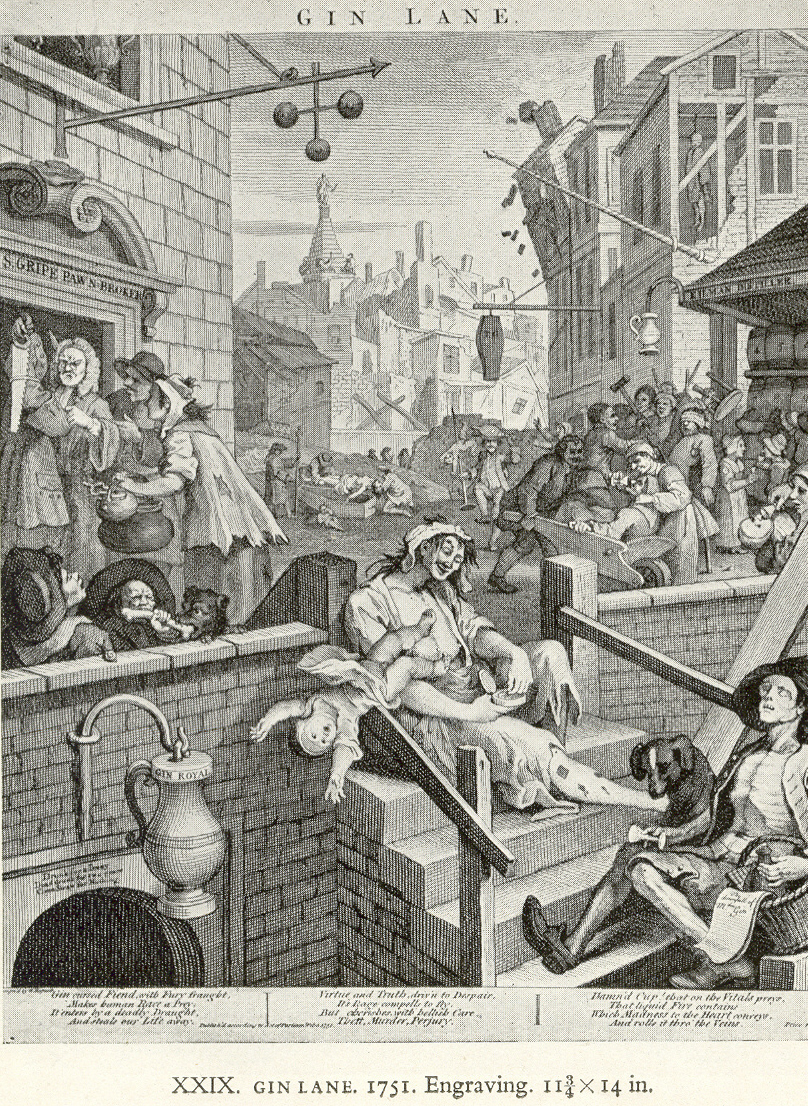
Notice how “restraint” is clearly here a negative notion. So you have the same newspaper celebrating the lack of restraint for a form of alcohol that once turned London into a chaotic, crime-ridden, besotted mess (see above), while noting small, long-term effects for a much safer form of recreational release. I’m all for weighing the costs of smoking or inhaling cannabis. We should be aware that, like all substances, it can give pleasure and also physical or mental harm. But when it is singled out for obloquy in the same space that a far more dangerous drug is not just celebrated but lionized, something other than science is at work.

(Illustration: Gin Lane by Hogarth, 1751.)

When Freedom Threatens Social Stability

George Packer enumerates a long list of “technological advances that make life easier, tastier, more entertaining, healthier, longer; and socio-political changes that have made the [United States] a more tolerant, inclusive place”:

The bottom line in all these improvements is freedom. In America, that’s half the game.

The flip side:

[W]hen the results are distributed as unequally as they are at this moment, when the gap between promise and reality grows so wide, when elites can fail repeatedly and never lose their perches of privilege while ordinary people can never work their way out of debt, equal opportunity becomes a dream. We measure inequality in numbers—quintiles, average and median incomes, percentages of national wealth, unemployment statistics, economic growth rates—but the damage it is doing to our national life today defies quantification. It is killing many Americans’ belief in the democratic promise—their faith that the game is fair, that everyone has a chance. That’s where things have unquestionably deteriorated over the past generation.

Samuel Goldman argues that social equality actually encourages economic inequality:

[I]t is hard for a society characterized by ethnic and cultural pluralism to generate the solidarity required for the redistribution of wealth. People are willing, on the whole, to pay high taxes and forgo luxuries to support those they see as like themselves. They are often unwilling to do so for those who look, sound, or act very differently. In this respect, the affirmations of choice and diversity that now characterize American culture, tend to undermine appeals to collective action or shared responsibility. If we’re all equal in our right to live own lives, why should we do much to help each other?

Which is where my libertarianism cedes to conservatism. At some point, freedom must be tempered if its impact undermines the very social contract that allows it to exist. The inequality we are experiencing as a function of globalization, technology, recession and a tax system so complex it beggars understanding is a real and direct threat to our social coherence and stability as a democratic society. It seems to me conservatives should be among the first to recognize this danger – as Bismarck and Disraeli once did – and forge a public policy to counter it.

This conservatism would embrace universal healthcare as a bulwark of democratic legitimacy in an age of such extremes; it should break up the banks and bring back Glass-Steagall; it should drastically simplify the tax code, ridding it of special interest deductions; it should construct an international agreement to prevent the egregious and disgusting tax avoidance of a company like Apple; and it should seek to invest and innovate in education and infrastructure.

Some of this inequality cannot be stopped, the globalizing forces behind it are so strong. But mitigating its damage is a real challenge. And conservatives who believe that we are one nation should rise to it.

Obama’s War On Terror Speech: Reax II

suspects1and2

From Jane Mayer’s write-up of Obama’s speech:

What kind of solution for indefinite detention can be arrived at, however, Obama left for later. It won’t be easy. As Joseph Margulies, clinical professor at Northwestern University Law School and lead counsel in the first Guantánamo case in the Supreme Court, noted, “The devil is in the details.” Obama’s speech has, at least, put the right questions on the table. Even Margulies, who has been critical of Obama for not doing more to close Guantánamo in the past, admitted he was “excited” by the speech. He said, “All the high-flying rhetoric about values and ‘who we are,’ and national identity is great.” But, he said, “Unless he follows up on it, it’ll all be for naught.” Much of the burden of moving forward, however, is not in Obama’s hands. Within minutes of his speech, conservatives on Capitol Hill had already begun jumping on him for having a “pre-9/11 mindset”—as if, somehow, the 9/11 mindset should last forever.

Daniel Klaidman reports on first steps the administration is taking:

So for many advocates of closing the detention facility, who Obama appoints inside the White House will be a key measure of his commitment [to closing Gitmo]. “The president has the authority to close Guantanamo,” says Thomas Wilner, a prominent Washington lawyer who has argued landmark cases at the Supreme Court on behalf of Gitmo detainees. “What he’s got to do is act and put the full authority of the White House behind getting the prison closed.”

Wilner and his allies may soon get some good news. A White House official confirmed to The Daily Beast that Obama has asked his chief counterterrorism adviser, Lisa Monaco, to handle the day-to-day responsibilities for Guantanamo. Monaco has daily access to the president and clout within the national-security bureaucracy. She also has deep experience dealing with the Guantanamo conundrum. When she first joined the administration in 2009 as a senior Justice Department official, she worked on Gitmo.

Fallows celebrates Obama’s call to wind down the War on Terror:

I am long on record in arguing that, even though America will continue to face threats and endure attacks including from Islamic-motivated extremists, it needs to move off the open-ended, permanent-war footing that was used to justify invasions and constraints on civil liberties. Yes, there will still be attacks, perhaps (I hope not) even as horrific as the recent one in London. But we do not let the tens of thousands of annual highways deaths justify banning cars; nor the toll of alcohol justify a new Prohibition; nor take an absolutist approach to a range of other risks, starting with guns. So too with “terror” risks. We cannot end them, but we don’t have to be driven mad by them.

Mary Ellen O’Connell was unsatisfied by Obama’s defense of the drone program:

The President attempted to defend drone use for several reasons other than legality. He said there are places where it is difficult, expensive, or dangerous to send special operations forces. Yet people everywhere know—as a matter of common sense and decency—that you cannot use military force because the police forces of a state are weak or because it is expensive or dangerous to send your own police or military to act under police rules. The reasons for this are already codified in international law.

Freddie deBoer wants more than words:

We have lived with this “war on terror” for a third of my life. And liberals: speeches do not walk the dog anymore. The time for flowery speeches is over. It’s time for action. Saying “we’re going to end the AUMF eventually” is not enough. Talking about closing Guantanamo is not enough. It has to actually happen. Like Anthony Romero of the ACLU says, actions are more important than words. If Obama actually closes Guantanamo, I promise I will applaud. If Obama actually reduces or ends the drone campaign, I will celebrate. But those specific policies will only be valuable if they are part of a broad attempt to end the hostilities between the United States and the Muslim world. Given that every Muslim terrorist who announces their motives says that they are based on our incursions into the Muslim world, that can only happen if we withdraw.

Yes and yes. My support yesterday for the arguments of the speech is, of course, contingent on actual progress. Friedersdorf is in the same ballpark:

All things considered, Thursday’s developments were an improvement on the status quo. Obama constrained himself rhetorically in ways he hadn’t before, expressed agreement with core civil libertarian critiques, and signalled that future policy will shift in that direction as a result. But talk is cheap, Obama has a history of breaking promises to civil libertarians, and drone strikes remain surrounded in enough secrecy that it will remain difficult to verify what’s going on. Moreover, policies implemented at the president’s prerogative can be changed on his determination too. There remains an urgent need for Congress to step into the breach and constrain the president, even if only in the ways that Obama says that he has constrained himself.

Agreed. But this Congress? Good luck. My thoughts here. Earlier reax here.

Being Master Of Your Own Domain, Ctd

Hugo Schwyzer considers another aspect of the debate over onanism:

Masturbation feels really good. It also can feel really icky, when conditioned feelings of guilt wash over the masturbator as he or she comes down from a post-orgasmic high. That shame may or not be rooted in religion, but it is certainly grounded in the idea that the fundamental sexual unit should always be more than one person. The persistence of that shame serves as a reminder that our culture war isn’t just about who we have sex with, but about why we have it in the first place. Is sex solely about connecting with one other person in intimate relationship, or is it about delighting in something that first and foremost, belongs to us as individuals?

I’d hazard the following ill-advised answer to that question: both, as a matter of pure realism (as that fantastic French video explains). But if sex is never attached to relationship, if it is merely an act rather than an interaction, it will wither eventually in ways not true of all solitary pleasures, and miss something essential about sex. As Malcolm Muggeridge once said in defense of lust: it’s all give-give-give. It suffers in some profound way when there is no one else to give it to.

Chart Of The Day

Screen shot 2013-05-24 at 11.49.14 AM

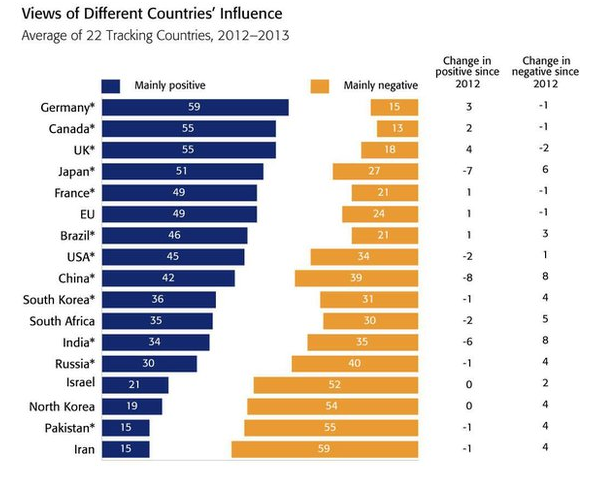
It’s the result of the latest annual Country Ratings Poll for the BBC World Service. Britain has been buoyed by the Olympics; China and India have sunk; Germany has also seen gains in approval, even in France! And then you notice the group of countries Greater Israel is now lumped in with: North Korea, Iran and Pakistan. Good going, Netanyahu! Just keep building those settlements.