The Boy Scouts of America will accept openly gay Scouts but not gay adult Scout Leaders. Because who wants kids to grow up to be leaders?
— LOLGOP (@LOLGOP) May 23, 2013
The Boy Scouts of America will accept openly gay Scouts but not gay adult Scout Leaders. Because who wants kids to grow up to be leaders?
— LOLGOP (@LOLGOP) May 23, 2013
How Chait understands Obama’s remarks (seen above):
President Obama’s speech today defending his conduct in the war on terror was notable for what he was defending it against — not against the soft-on-terror (and maybe sorta-kinda-Muslim) attack that Republicans have lobbed against him since he first ran for president, but against critics on the left. … Politically, if not substantively, Obama’s speech today represents a watershed moment. For the first time in the post-9/11 world, the domestic political threat in the war on terror comes from the left rather than the right.
Matt Welch wants more than a speech:
There was much to like in Obama’s speech today if you like words, and share the broad worries he outlined above. And it is surely true that changing policy becomes easier after you make public arguments about changing policy. But the fact is Barack Obama is the president of the United States, and according to both the Constitution and especially the way executive power has accrued over the past century, Obama actually has quite a bit of latitude to impose his values on the waging of American war. After 52 months in office, it’s long since past time to stop judging the man by his words alone.
Max Fisher focuses on the case Obama made for drones:
Although there’s a complexity to Obama’s moral case for drones, it reduces down to a binary: Using drones can kill civilians, but not using them would lead to even more civilians being killed. There are many, many more moral, ethical and legal issues related to drones, some of which are in the speech and some of which aren’t. And there is a wide range of gray areas in how they’re implemented, against whom, under what circumstances and what guidelines. But it’s this basic proposition – taking lives to save others – that seems at the heart of Obama’s case.
Ackerman’s bottom line:
Obama’s new approach to the drones in Year Thirteen of the war on terror should feel familiar. It contains an echo of how he wound down the Iraq and Afghanistan wars: not by drawing a hard and fast end to them, but by allowing military commanders to very slowly reduce the size of their forces. If it worked well enough for flesh-and-blood troops, Obama is basically saying it’ll work well enough for robots.
PM Carpenter praises the speech:
One phrase deployed by Obama really struck home. In America’s continuing battle against terrorists, there is “no moral safe harbor.” Not, anyway, for a president, this one or the next. Virtually every counterterrorism path that a president pursues is a trade-off–a little security here for a piece of your liberty there; 10 innocents killed in exchange for a thousand later saved–and it’s just so damn refreshing to hear a president admitit rather than suppress it through a fog of uberheroic, hyperpatriotic neocon bullshit. Wars do compromise our values; we eventually become what we hate; and President Obama appeared to be running the clock back. He knows where this is headed, and it ain’t good.
Allahpundit heard little new:
He’s offering a robust defense of drone warfare to a public that already accepts it. The speech is really just an unusually exhaustive compendium of the foreign-policy establishment’s favorite counterterror bromides. Foreign Policy magazine has a Cliff’s Notes version of the four major takeaways, but none of them are actually major. He wants to close Gitmo, which we knew; he kinda likes the idea of independent oversight on drone strikes but maybe not too much, which we could have guessed; he wants to codify drone practices to make sure they’re used as narrowly as possible, but an Obama official couldn’t tell FP how that differs from the current policy; oh, and he thinks it’s time to stop thinking of this as a “boundless” global war on terror and start thinking in terms of discrete actions, which is semantic nonsense.
Kilgore was stuck by how often Obama blamed Congress:
One thing is fairly clear: the speech poses a challenge to congressional Republicans that may not be that easy for them to meet, distracted as they are and as divided as they tend to be on national security policy these days. As Slate’s Dave Weigel quickly noted, Obama four times shifted responsibility for current dilemmas at least partially to Congress: on drones (where he insisted the appropriate congressional committees have known about every single strike); on embassy security; on the 9/11-era legal regime that still governs anti-terrorist efforts; and on Gitmo (where Republicans have repeatedly thwarted effort to transfer detainees to U.S. prisons).
And Benjamin Wittes thinks Obama is more powerful than he lets on:
Obama does not need Congress to narrow or repeal the AUMF or to get off of a war footing. He can do it himself, declaring hostilities over in whole or in part. And Obama, needless to say, did not do anything like that. To the contrary, he promised that “we must finish the work of defeating al Qaeda and its associated forces” and while he used a lot of nice words about law enforcement and a lot of disparaging words about perpetual states of war, he also promised to continue targeting the enemy with lethal force under the AUMF. In other words, he promised—without quite saying it directly—to keep waging war
My thoughts here.
After an earthquake struck southwest China earlier this year, social media and mobile phones proved instrumental in relief efforts. Patrick Meier considers the broader implications for the Chinese government:
[U]sing social media to crowdsourced grassroots disaster response efforts serves to create social capital and strengthen collective action. This explains why the Chinese government (and others) faced a “groundswell of social activism” that it feared could “turn into government opposition” following the earthquake (6). So the Communist Party tried to turn the disaster into a “rallying cry for political solidarity. ‘The more difficult the circumstance, the more we should unite under the banner of the party,’ the state-run newspaper People’s Daily declared […], praising the leadership’s response to the earthquake” (7). …
Aided by social media and mobile phones, grassroots disaster response efforts present a new and more poignant “Dictator’s Dilemma” for repressive regimes. The original Dictator’s Dilemma refers to an authoritarian government’s competing interest in using information communication technology by expanding access to said technology while seeking to control the democratizing influences of this technology. In contrast, the “Dictator’s Disaster Lemma” refers to a repressive regime confronted with effectively networked humanitarian response at the grassroots level, which improves collective action and activism in political contexts as well. But said regime cannot prevent people from helping each other during natural disasters as this could backfire against the regime.
Earlier Dish on crowdsourced disaster efforts here.
(Hat tip: Duck of Minerva)
Jane Mayer narrates the struggle of two documentary filmmakers to produce their documentary Citizen Koch and get it aired on public TV. A sample:
The messages from [Independent Television Service] ITVS officials grew confusing. [Vice-president of programming] Aguilar again praised the film as “great,” and said, “I think you’ve preserved the anger of the film, which I love.” Other officials, though, kept urging the filmmakers to change the title, add negative material about Democrats, and delete an opening sequence that showed Sarah Palin speaking at a rally sponsored by Americans for Prosperity, the Kochs’ main advocacy group. Several times, [filmmakers] Lessin and Deal asked ITVS officials if Koch’s trusteeship at WNET was a factor. During the phone meeting on December 7th, Vossen said, “I can absolutely assure you that ITVS does not want your film to be buried.” She said of the title, “I think you understand why it’s problematic. . . . We live in a world where we have to be aware that people with power have power.”
Alyssa questions the limits of true independence in public broadcasting:
Disputes like this one highlight the extent to which making PBS reliant on private charity calls into question the meaning of “public” television. A state of affairs in which television content is determined by the government is obviously undesirable and subjects programming to a partisan agenda in a way that would serve members of both parties ill by turns, and the public poorly at all times, given how timid the content choices would likely be. But a “public” television regime that’s established to give extremely wealthy people another way to buy programming power other than by purchasing affiliate stations is “public” only in a business sense, rather than serving a broadly-defined public interest.
She really wants that song dammit:
Another possible use for the technology:
[Anjan Contractor] sees a day when every kitchen has a 3D printer, and the earth’s 12 billion people feed themselves customized, nutritionally-appropriate meals synthesized one layer at a time, from cartridges of powder and oils they buy at the corner grocery store. Contractor’s vision would mean the end of food waste, because the powder his system will use is shelf-stable for up to 30 years, so that each cartridge, whether it contains sugars, complex carbohydrates, protein or some other basic building block, would be fully exhausted before being returned to the store.
Ubiquitous food synthesizers would also create new ways of producing the basic calories on which we all rely. Since a powder is a powder, the inputs could be anything that contain the right organic molecules. We already know that eating meat is environmentally unsustainable, so why not get all our protein from insects?
Also, CNN reports on how a 3D printer saved the life of an infant with breathing problems:
“We can put together a complete copy of a body part on the 3-D printer within a day,” [Dr. Glenn] Green said. “So we can make something very specific for a patient very quickly.”
Green then took the splint, measuring just a few centimeters long and 8 millimeters wide, and surgically attached it to Kaiba’s collapsed bronchus. It was only moments before he saw the results.
“When the stitches were put in, we started seeing the lung inflate and deflate,” Green said. “It was so fabulous. There were people in the operating room cheering.”
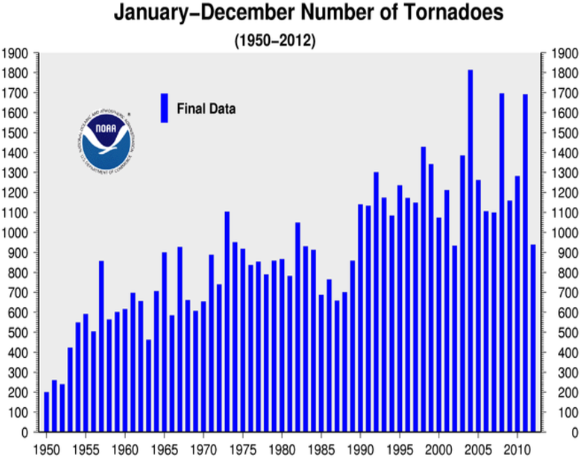
It’s tempting to assume that climate change is responsible for an increase in the number devastating tornadoes, like those that ravaged Joplin, Missouri, in 2011, and Hattiesburg, Mississippi, in February. But if these tragedies are indeed becoming more common, it’s mainly because of population growth. Sixty years ago, yesterday’s tornado might not have killed anyone at all: Moore had a population of 942 in 1950, but today has more than 56,000 residents.
There has been an increase in the number of reported tornadoes: Since 1950 (or even over just the last two decades), the U.S. has added Doppler radars capable of detecting tornadoes, and population growth has increased the number of on-the-ground observations. But it’s unclear whether tornadoes have become more frequent, let alone because of climate change.
Enten has more on the subject.
If you want to support online journalism that is not thinly-veiled corporate branding, [tinypass_offer text=”subscribe!”]
We really are trying to find a business model for online writing and thinking that can stand on its own independent feet, and be able to challenge corporate and government power, without fear or favor. We really do hope that if we succeed, others can follow.
Non-sponsored content may not be as pretty fucking awesome as sponsored content. But it isn’t quite as corrosive. So if you’ve been on the edge of signing up, please take a few moments to help us shift the parameters of the media future a little – for [tinypass_offer text=”just $1.99 a month”]. Our success or failure is entirely dependent on you.
Reports from China indicate plans to pilot a carbon trading program next month in the southern city of Shenzen, as part of a regional rollout in 2014 and a potential countrywide cap in 2016. Katie Valentine calls the announcement a “bombshell”:
If the cap is adopted, it would be a major step for the world’s top CO2 emitter, which desperately needs to slow its carbon production. China is experiencing the world’s fastest growth in energy production and CO2 emissions, while production and emissions in the U.S. and Europe are flat-lining or decreasing. China uses 47 percent of the world’s coal, a number that’s only going up: in 2011, China’s coal consumption grew by 9 percent, accounting for 87 percent of the world’s 374 million ton increase in coal consumption that year. …
The possibility of a carbon cap in China has been hailed as “potentially transformative” in the fight against climate change, as other major emitters such as the U.S. have historically cited China’s inaction on climate change as reason to avoid implementing meaningful greenhouse gas regulations. Previously, China has shied away from cuts in emissions, saying its main priority was the growth of its economy. In November 2012, the state-owned Xinhua quoted Xie Zhenhua, China’s chief negotiator to the UN climate change talks, as saying it was “unfair and unreasonable to hold China to absolute cuts in emissions at the present stage, when its per capita GDP stands at just 5,000 U.S. dollars.”
Claire Thompson agrees that the move “seriously weaken[s] one of the U.S.’s go-to excuses for climate inaction”:
Like sparring siblings, China and the United States — the world’s two biggest carbon dioxide emitters — keep passing the climate-action buck back and forth: “Why should I cut emissions if they don’t have to?” Well, China is either the more mature of the pair, or just majorly sucking up to Mama Earth.

 The Dish