Reality Check

Hanrob Pet Hotels Launch 'Petskype'

What we spend on our pets:

Americans spent approximately $61.4 billion in total on their pets in 2011. On average, each U.S. household spent just over $500 on pets. This amounts to about 1 percent of total spending per year for the average household.

Timothy Taylor puts this in perspective:

[T]he World Bank often uses a poverty line of $1.25/day in consumption to measure deep destitution in developing countries. Nearly one-third of the population of South Asia and nearly half the population of Africa has a consumption level below this line.  Over 365 days in a year, $1.25/day works out to $456.25.  Thus, the average U.S. household spends more on pets than the poverty line for humans in the developing world. And the statistics don’t include the fact that pets live rent-free.

(Photo: Henry the dog talks to his owner through Skype on May 13, 2012. Luxury pet accommodation group Hanrob Pet Hotels is launching Petskype so people can watch and even chat to their cats and dogs while travelling interstate or overseas. By Tess Follett/Newspix/Getty Images)

Decoding Family Secrets

Recounting the story of a girl who discovered through genomic testing that her brother was actually her uncle, Daniel Engber considers how genetic testing companies deal with potentially startling results:

23andMe does take some steps to warn its users of the risks. The top question on the company FAQ is “What unexpected things might I learn?” and the answer mentions that “genetic information can also reveal that someone you thought you were related to is not your biological kin. This happens most frequently in the case of paternity.” The terms of service specify that “once you obtain your Genetic Information, the knowledge is irrevocable,” and that “you may learn information about yourself that you do not anticipate” and “may provoke strong emotion.”

Yet it’s also true that the chances of discovering a case of nonpaternity through 23andMe, and the relative significance of that discovery, far outweigh almost every other finding that the service can provide. Much of what the scan can tell you is perfectly trivial. Do you have the genes for blue eyes or red hair? (For a first approximation, try looking in the mirror.) Do you have the genes for tasting bitterness in Brussels sprouts? (Maybe, but who cares?) After Steven Pinker signed up for 23andMe, he wrote in the New York Times Magazine, “For all the narcissistic pleasure that comes from poring over clues to my inner makeup, I soon realized that I was using my knowledge of myself to make sense of the genetic readout, not the other way around.”

The Next Generation’s Privacy Settings

Pew Privacy

Jared Keller summarizes findings from a new report by Pew and the Berkman Center for Internet Society:

The joint paper found that teenagers are sharing more and more personal information online: 91 percent of teenagers post at least one photo of themselves (up from 79 percent in 2006), while 71 percent post their school name (up from 49 percent), 53 percent post their email address (up from 29 percent), and 20 percent post their cell phone number (up from two percent). At the same time, teenagers are more and more cautious as to who sees this information: about 60 percent of teen Facebook users set their profiles to private (friends only), and most report high levels of confidence in their ability to manage their settings, with 56 percent of users noting that it’s “not difficult at all” to set privacy controls (while only eight percent say it’s “somewhat difficult”).

Danah Boyd comments:

My favorite finding of Pew’s is that 58% of teens cloak their messages either through inside jokes or other obscure references, with more older teens (62%) engaging in this practice than younger teens (46%). This is the practice that I’ve seen significantly rise since I first started doing work on teens’ engagement with social media. It’s the source of what Alice Marwick and I describe as “social steganography” in our paper on teen privacy practices.

While adults are often anxious about shared data that might be used by government agencies, advertisers, or evil older men, teens are much more attentive to those who hold immediate power over them – parents, teachers, college admissions officers, army recruiters, etc. To adults, services like Facebook that may seem “private” because you can use privacy tools, but they don’t feel that way to youth who feel like their privacy is invaded on a daily basis.

Graphic from Pew.

What Threatens The Middle Class?

In his new book, Jaron Lanier blames the web:

Much of the book looks at the way Internet technology threatens to destroy the middle class by first eroding employment and job security, along with various “levees” that give the economic middle stability. “Here’s a current example of the challenge we face,” he writes in the book’s prelude: “At the height of its power, the photography company Kodak employed more than 140,000 people and was worth $28 billion. They even invented the first digital camera. But today Kodak is bankrupt, and the new face of digital photography has become Instagram. When Instagram was sold to Facebook for a billion dollars in 2012, it employed only 13 people. Where did all those jobs disappear? And what happened to the wealth that all those middle-class jobs created?”

Bill Herman disagrees with this thesis:

The best explanation that I’ve seen of America’s growing wealth inequality is Winner-Take-All Politics, in which Jacob Hacker and Paul Pierson start with a simple look at other industrialized countries to show that inequality isn’t an inexorable outcome trade and automation. The Germans and Swedes certainly have similar chances to outsource their manufacturing and use technology to reduce labor forces.

Not only does the rest of the industrial world have the internet, too, better telecom policy means they generally have faster connections and cheaper prices. Yet as measured by the Gini Coefficient, a measure of economic inequality, their economies have far more equal distributions of income in take-home pay and wealth.

The wealth distribution in particular is just shocking — the US has a wealth Gini of .801 (where 1.000 is “one person owns everything”), the fifth highest among all included countries and almost exactly the same as the distribution of wealth across the entire planet (.803). Think about that for a second; we have the same radically unequal distribution of capital within the US as among the entire population of the world across all countries — from Hong Kong and Switzerland to Nigeria and Haiti.

Where The Suburbs Don’t Meet Utopia

Pivoting off Dreher’s recent musings on the suburbs, Alan Jacobs considers our dissatisfaction with them:

Suburbs are diverse not just in age but also in population density. There are no “empty” suburbs, of course, or else they wouldn’t be suburbs, but while some disperse their people into spacious lots, others pack them in in city-like ways. The lots here in the older part of Wheaton are large enough, it seems to me, but I can easily walk downtown to have a drink at the pub or buy pastries at the bakery or eat various cuisines. It’s like a gently exploded version of a city neighborhood.

It’s too easy to drive, though, as Rod recently noted. Often I do when I really should walk. In the country you have to drive when you want to go anywhere; in a big, dense city people get around on foot and via public transport. Suburbs are in this respect in-between. And in other respects too. Which is why, I suppose, suburbs are never perceived as either divine or demonic. “Nothing too much,” the suburb seems to say, which means that, though its human dramas exist, and are as meaningful as they are anywhere else in the cosmos, they remain largely inaccessible to our myths.

We’re The Fairest Of Them All

Last month a reader asked for a study to test the premise of a Cool Ad Watch in which Dove reassures us that we are more beautiful than we think. Here’s one:

The researchers took pictures of study participants and, using a computerized procedure, produced more attractive and less attractive versions of those pictures. Participants were told that they would be presented with a series of images including their original picture and images modified from that picture. They were then asked to identify the unmodified picture. They tended to select an attractively enhanced one.

Epley and Whitchurch showed that people display this bias for themselves but not for strangers. The same morphing procedure was applied to a picture of a stranger, whom the study participant met three weeks earlier during an unrelated study. Participants tended to select the unmodified picture of the stranger.

The bottom line:

[W]hat Dove is suggesting is not actually true. The evidence from psychological research suggests instead that we tend to think of our appearance in ways that are more flattering than are warranted. This seems to be part of a broader human tendency to see ourselves through rose colored glasses. Most of us think that we are better than we actually are — not just physically, but in every way.

Disorder Disorder, Ctd

A reader writes:

Allen Frances bemoaned, “About half of Americans already qualify for a mental disorder at some point in their lives.” Roughly 100% of Americans already “qualify for” a somatic disorder at some point in their lives.  Does that mean we have too many somatic disorders on the books?   Or does it mean the human body and its interaction with the physical environment is a highly complex system in which there are a lot of things that can go wrong? Consider how complex the brain is as an organ, and how complex the mind is, and how complex the interactions between those things and human culture are.  How many places and ways are there for a system that complex to malfunction?  And how far is our understanding of that system behind our understanding of the human body?   I’m not sure why anybody would be surprised that we’re finding a lot of new mental disorders.

Another:

As someone who seriously studied Foucault as an undergraduate philosophy major, its hard to believe I am about to make what amounts to a defense of the new DSM, but here it goes. One of the reasons some of the definitions have been expanded has to do with insurance reimbursement.

Insurance companies need a diagnosis in order to pay clinicians to treat individuals. This is even more important for low-income individuals, because there is a select set of disorders, referred to as “serious mental illness for which individuals can be eligible to receive treatment. It happens that major depressive disorder is one these illnesses. We also know that the loss of a loved one is an event that can trigger major depressive disorders in individuals who may have not show clinical symptoms prior to the loss. So hypothetically, with the old “bereavement exception” (experience clinical depression symptoms after the loss of a loved one), an individual who may be in serious need of help and cannot afford to pay out of pocket, would not be eligible for services under the old criteria.

Were the motivations to change the criteria primarily driven by concerns for the poor? Probably not. Under these new guidelines, pharmaceutical companies will certainly benefit from physicians prescribing anti-depressants for what has traditionally been understood as the normal grieving process. But I have trouble with people, especially clinicians, laying the blame at the foot of the APA and DSM. Like any diagnosis, the new guidelines are intended to be made by experienced professionals using clinical judgement. They are not meant to be read like a laundry list or a cookbook that is then juxtaposed on an individual.

No, gluttony is not “binge eating disorder” if it’s a conscious choice that you are okay with. But it is an issue if it causes you distress, feels uncontrollable, causes you to gain weight and could lead to a host of other physical and mental health issues. That is why most disorders come with the qualification that they cause distress and impair functioning.

But the larger point is dealing with how our society views mental illness. It seems that implicit in Dr. Frances’ post is the notion that somehow mental illnesses are reserved for the “other”. Sure, about one half of individuals qualify for a mental illness at some point. How many qualify for a physical illness? I am sure the number is much higher. It is true that physical illness is typically much easier to understand that the complexity of the brain and its interactions with the body, and not to mention other individuals and society as whole. But if that is the case, it seems that the more productive conversation is about how our understanding of the brain and mental illness is only emerging and if we think a medical model is appropriate for both capturing and treating human suffering in its various forms.

Letters From Oklahoma

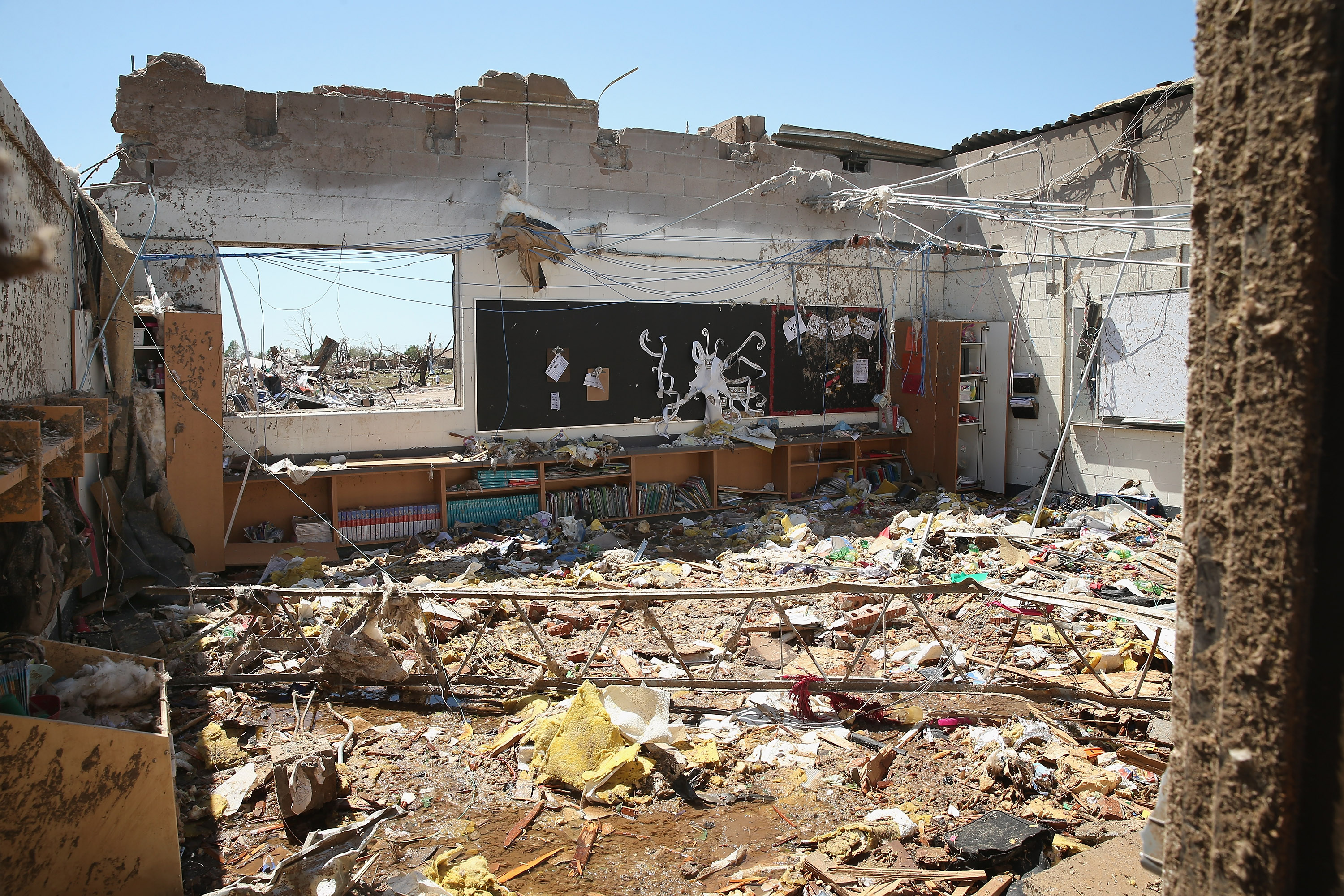
Massive Tornado Causes Large Swath Of Destruction In Suburban Moore, Oklahoma

A reader writes:

I live in Moore about a block south of the corner of SW 19th and S Santa Fe, less than 2 miles south of where Plaza Towers Elementary used to be. I drove past Moore Medical Center every day on my way home from work. If the tornado had turned east toward Santa Fe just a quarter of a mile sooner than it did, our home would have taken a direct hit. Our power has been restored, and though our yard is filled with trash (a familiar refrain: I have found strangers’ family photos on our lawn), our house is largely untouched. Almost everything north of us has been obliterated. I came very close to losing everything, yet came out largely unscathed. What I keep returning to in my mind is that just a few blocks away, seven kids lost their lives.

Another:

I just wanted to make sure that you know that, although the tornado warning was issued with 16 minutes warning, we had multiple days of warning that Sunday and Monday were high risk tornado days in our area. Scroll through the Facebook posts from the US National Weather Service in Norman (just south of Moore) and you will see what I am talking about. On Monday morning they warned that the risk in our area would be maximal at about the time kids were to be let out of school, and that we might need to make different plans. I picked my children up from their elementary school in Oklahoma City early that day in response to their video update from around 11 AM. Had I waited until close to their usual 3:10 pick up time, I would not have been able to get them, as the school was on lock down due to the tornado warning. My kids’ school does not have underground shelter. With an F5 tornado, that’s what they need. I know the schools need improved safety, but with that monster coming I was glad we had an in-ground shelter in the floor of our garage.

Anyway, the National Weather Service has been the unsung hero of this, and I wanted you to know about them and their relatively new foray into social media. (They are facing sequester cuts, which is terrible.) Oh, and on the subject of shelters, I wanted to add my curmudgeonly two cents.

My family has a small in-ground shelter in our garage. I got it after we moved into a new house and realized that it had no good interior rooms for shelter and no basement (they all leak around here). One tornado siren with my husband, my newborn and my 20-month-old, huddled in a hallway under a mattress, was enough to make me bite the $5000 bullet and get one. That was five years ago.

My neighbors saw the shelter crew jackhammer the hole in our garage floor and put it in. They took interest, but none of them bought one.

On Monday as the sirens blew, and while I was upstairs keeping close track of our excellent meteorologists on TV and frantically trying to think of the things I needed to grab that would be crucial to us if the house blew away, my bicycle-helmeted kids were safely in the shelter. So were my two crated cats, my two dogs, my computer hard drive and my wedding album, along with our prescription drugs, several lanterns, a battery operated fan, my kids most favorite stuffed animals, and my plastic tub containing our emergency supplies (crowbar, blankets, water, food, emergency contact information, cash, etc.). It was pretty jam-packed down there.

I would have tossed everything but my kids out without hesitation to save my neighbors if that tornado had come to our house (some neighbors have come over in past storms). But I have to admit that I am just a bit ticked off that none of them have gotten their own shelter. Not everyone can afford them, but my neighbors could. They all have their places to go in the event of a tornado, but when it is an EF5 and you know you won’t survive above ground, you need an underground plan. I don’t mind if my shelter is someone’s accidental plan. I just don’t want it to be the place they depend on. I feel guilty saying it, but I want to be able to keep my wedding album and my hard drive and my kids’ stuffed animals, and especially my pets!

Want I want to say but never would is this: “Get your own damn shelter!”

Another:

One of your OKC subscribers writing in. We are all devastated. Seeing this type of destruction in your own city is a difficult feeling to describe.

My husband was huddled in an underground room of his school with high school students not far from the storm. When our local weather man said that the storm was taking the same path as the May 3, 1999 storm, I shuddered. That would have meant it was coming for my husband’s school, which was hit by that storm. Fortunately for us, the storm went east instead of north this time, thereby missing Tinker AFB and Midwest City.

What we spoke about last night, though, as we watched our local anchor report the gut wrenching news, was what will change now? When we grew up here as kids they told us go to an interior closet or bathroom, put on a helmet, put a mattress over your head if you can. But after May of 1999, they knew yesterday to tell us on the TV, “Get underground or get out of the way.” They kept repeating it, knowing they were trying to save lives. These “grinders,” as they call them, are different. They literally scour the earth. With a storm that can go from nothing to EF5 in under an hour, what about those parents who do work far from their kids schools? Many times growing up I was huddled against a hallway wall in duck and cover position, and that was not enough to save some of those kids.

What do we do? I can tell you that it is a conversation many of us are having right now. We have always dealt with tornadoes here – they are a part of life. But we are all thinking about what types of emergency plans we need to reconfigure, how our mindset will be different the next time. For a state full of people already extremely knowledgeable about what to do during a tornado, what can we do to be better prepared?

(Photo: Debris litters what remains of a classroom at Plaza Towers Elementary School after it was destroyed by a tornado that ripped through the area on May 22, 2013 in Moore, Oklahoma. Seven children died in the school during the tornado. The tornado of at least EF4 strength and two miles wide touched down May 20 killing at least 24 people and leaving behind extensive damage to homes and businesses. U.S. President Barack Obama promised federal aid to supplement state and local recovery efforts. By Scott Olson/Getty Images)

“He Said It Was A War”

I’m feeling things today in the wake of this act of religious barbarism on the streets of London that I haven’t felt for a while. The monster who paraded around on the street after hacking a soldier to pieces is chilling in many ways. But everything points to a religious act of terror, motivated by the same Jihadist rage that captured the Tsarnaev brothers. For these men, “our land” is not Britain; it is the land of Islam in their minds. Here’s the full quote of the Jihadist:

We swear by the Almighty Allah we will never stop fighting you until you leave us alone. The only reason we have killed this man this is because Muslims are dying daily. This British soldier is an eye for an eye a tooth for a tooth … We must fight them as they fight us. An eye for an eye a tooth for a tooth. I apologize that women had to witness this today but in our lands our women have to see the same. You people will never be safe. Remove your government. They don’t care about you.

This eye-witness account shows that even in the midst of this Islamist barbarism, some shred of humanity remained:

“I saw a guy with no head lying on the ground. He had been decapitated. There were two black guys walking around his body saying ‘This is what God would’ve wanted’. My friend and her mum were walking up the hill and the mum came straight to the victim. She asked the black guys ‘can I help him?’ And one of them said he was already dead but she could go. Then one of them said ‘No man is coming near this body, only women’. She was so brave, she didn’t care what happened to her – she knelt down by his side and comforted him. She held his hand and put her other hand on his chest. I think she might have been praying.”

There is no formal confirmation that the victim, who was run over on the sidewalk by the Islamists’ car, was actually a soldier, but he was wearing a t-shirt that referred to a charity for veterans, and was near a barracks. Mercifully, the response from the Muslim community in London has been unequivocal:

This is a truly barbaric act that has no basis in Islam and we condemn this unreservedly. Our thoughts are with the victim and his family. We understand the victim is a serving member of the armed forces. Muslims have long served in this country’s armed forces, proudly and with honour. This attack on a member of the armed forces is dishonourable, and no cause justifies this murder.

A girl scout leader, Ingrid Loyau-Kennett, was on the scene and managed to talk to the butchers as they hung around, bragging for the cameras, their hands dripping with blood:

I spoke to him for more than five minutes. I asked him why he had done what he had done. He said he had killed the man because he [the victim] was a British soldier who killed Muslim women and children in Iraq and Afghanistan. He was furious about the British army being over there.

There was blood on the pavement by the car where the man on the ground had been hit by it. At first there was no blood by the body but as I talked to the man it began to flow which worried me because blood needs a beating heart to flow. But I didn’t want to annoy the man by going back to the body.

I asked him what he was going to do next because the police were going to arrive soon. He said it was a war and if the police were coming, he was going to kill them. I asked him if that was a reasonable thing to do but it was clear that he really wanted to do that. He talked about war but he did not talk about dying and then he left to speak to someone else.

Two things are true here. The first is that this was a religious sacrificial murder, authorized by God in the eyes of the killers. The second is that this is clearly motivated by blowback from the wars in Iraq and Afghanistan. The first is indefensible on any grounds. The second is a reminder that in the war against this religious barbarism, occupying Muslim countries is not an answer.

Insane Clown Family

The fascinating and often poignant documentary that a reader mentioned in an update is worth watching in full (NSFW):

A primer on the Juggalo subculture:

The term originated during a 1994 live performance by Insane Clown Posse. During the song “The Juggla”, Violent J addressed the audience as Juggalos, and the positive response resulted in Bruce and Shaggy 2 Dope using the word thereafter to refer to themselves and their friends, family, and fans, including other Psychopathic Records artists. The fanbase boomed following the release of their third album, Riddle Box, in 1995, leading Insane Clown Posse to write the songs “What Is A Juggalo?” and “Down With The Clown” for their 1997 album The Great Milenko.  According to Utsler, “[Juggalos come] from all walks of life – from poverty, from rich, from all religions, all colors. […] It doesn’t matter if you’re born with a silver spoon in your mouth, or a crack rock in your mouth.”