Faking Out The Führer

Susan Karlin previews an upcoming PBS documentary about the “artistic sleight-of-hand” that helped the US defeat the Germans in WWII:

This is the astonishing true story of the 23rd Headquarters Special Troops, nicknamed the Ghost Army, a group of 1,100 handpicked American G.I.s who tricked the German army with rubber artillery, sound effects, fake radio transmissions, and psychological illusions during the summer of 1944. Many of these young soldiers were art students who would go on to illustrious careers in art, design, and fashion–including fashion designer Bill Blass, painter Ellsworth Kelly, and photographer Art Kane. But during quiet moments, they would often sketch and paint their surroundings, offering a fine-art chronicling of the mission. …

The Ghost Army devised more than 20 deceptive operations, phony convoys, and phantom divisions–each impersonating a different (and vastly larger) U.S. unit–to fool the enemy about the strength and ubiquity of American units. Soldiers even hung out at local cafés, spinning yarns for eavesdropping spies. The effort culminated along the Rhine in the final days of the war, in which thousands of lives depended on a convincing performance.

Judging A Society By Its Word Choice

David Brooks considers [NYT] recent studies on the frequency of given words in published books over time:

The first element in this story is rising individualism. A study by Jean M. Twenge, W. Keith Campbell and Brittany Gentile found that between 1960 and 2008 individualistic words and phrases increasingly overshadowed communal words and phrases. That is to say, over those 48 years, words and phrases like “personalized,” “self,” “standout,” “unique,” “I come first” and “I can do it myself” were used more frequently. Communal words and phrases like “community,” “collective,” “tribe,” “share,” “united,” “band together” and “common good” receded.

The second element of the story is demoralization. A study by Pelin Kesebir and Selin Kesebir found that general moral terms like “virtue,” “decency” and “conscience” were used less frequently over the course of the 20th century. Words associated with moral excellence, like “honesty,” “patience” and “compassion” were used much less frequently.

Robin Lakoff, professor of Linguistics at UC-Berkeley, counters with an example:

Consider “racism.” It is first attested, according to the Oxford English Dictionary, in the first decade of the 20th century. By Brooks’ standard, that would imply that racism, the attitude and behavior, only came into being then, and therefore only then needed a word to describe it. Similarly, “sexism,” in its current sense, is only attested in the mid-1960s. What should we make of that?

Actually, the appearance of these words at those times is a positive indicator. Racism and sexism have been endemic in our species as far back as the historical record allows us to determine, and probably further. But it was only in the 20th century that people first began to see these kinds of behaviors as something other than normal and inevitable, and therefore worthy of naming and eventually changing.

The “Loneliness Epidemic”

Douthat, noting [NYT] that violent crimes are on the decline while suicides are up, blames increased isolation:

As the University of Virginia sociologist Brad Wilcox pointed out recently, there’s a strong link between suicide and weakened social ties: people — and especially men — become more likely to kill themselves “when they get disconnected from society’s core institutions (e.g., marriage, religion) or when their economic prospects take a dive (e.g., unemployment).” That’s exactly what we’ve seen happen lately among the middle-aged male population, whose suicide rates have climbed the fastest: a retreat from family obligations, from civic and religious participation, and from full-time paying work.

Nate Cohn pushes back:

Contrary to what Douthat might expect, there’s no correlation—zero—between a states’ suicide rate and religion, marriage rates, or single occupancy homes.

State economic growth or unemployment don’t line up, either. … If anything correlates with suicide rates, it’s a states’ population density: In populous areas, suicide rates are low; in the sparsely populated hinterlands, suicide rates are high. Perhaps depression and loneliness is particularly harsh in desolate areas, and maybe it’s easier to cope in a major city like D.C. or New York.

A more intriguing possibility is gun ownership, which, like suicide rates, is highest in the West and lowest in the Northeast. The relationship between gun ownership and suicide isn’t hard to envision, since more than half of suicides are by firearm. Therefore, accessible firearms could plausibly increase suicide rates. Then again, the South has high levels of gun ownership and higher levels of depression than the inland West, but suicide is rarer in Alabama than Montana.

Douthat goes another round:

A strong link between population density and suicide hardly demonstrates that social belonging doesn’t play a role in suicide rates: It just suggests that the literal physical component in loneliness can matter as much or more than emotional and institutional ties. And the geographic pattern Cohn describes is perfectly compatible with other factors — from unemployment to divorce to, yes, gun policy — playing a role in national trends. There are plenty of cases where longstanding patterns don’t suffice to explain emerging trends that cut across regions and demographic groups: The fact that crime rates are generally higher in cities doesn’t mean that “population density” suffices as an explanation of changes in the crime rate, for instance, and the fact that out-of-wedlock birth rates are higher among African-Americans than whites doesn’t mean that “race” suffices as an explanation for the post-1960s rise in unwed childbearing.

One factor that might be salient in increasing suicides is the staggering increase in the use of prescription drugs. Here’s what I recently wrote in my column for the Sunday Times:

Consider that for eleven consecutive years, drug overdose deaths have risen in America, from 4,000 in 1999 to 16,000 by 2010, according to the latest statistics from the Centers for Disease Control. The majority of these deaths are now from drugs prescribed legally in the US and the world – opiate pain-killers like Oxycodone leading the way, but often combined with anti-anxiety medications. Yes, these require a prescription – but just sit down and see how easy it is to get these drugs online through fake doctors or doctors for hire. Yes, more monitoring is now recommended and more crackdowns on unethical doctoring. But you get the distinct sense that this is a losing struggle. Both the technologies of pharmaceuticals and of their distribution have been revolutionized in the last couple of decades. It’s going to be as hard to return to more social control as it will be to sustain newspapers printed on paper.

But that may simply confirm Ross’s worry about social isolation, and the consequences of untrammeled libertarianism. The trouble is that if you accept Ross’s analysis, it’s not clear what the solution is. Freedom is contagious; community fragile.

Losing Your Privates, Ctd

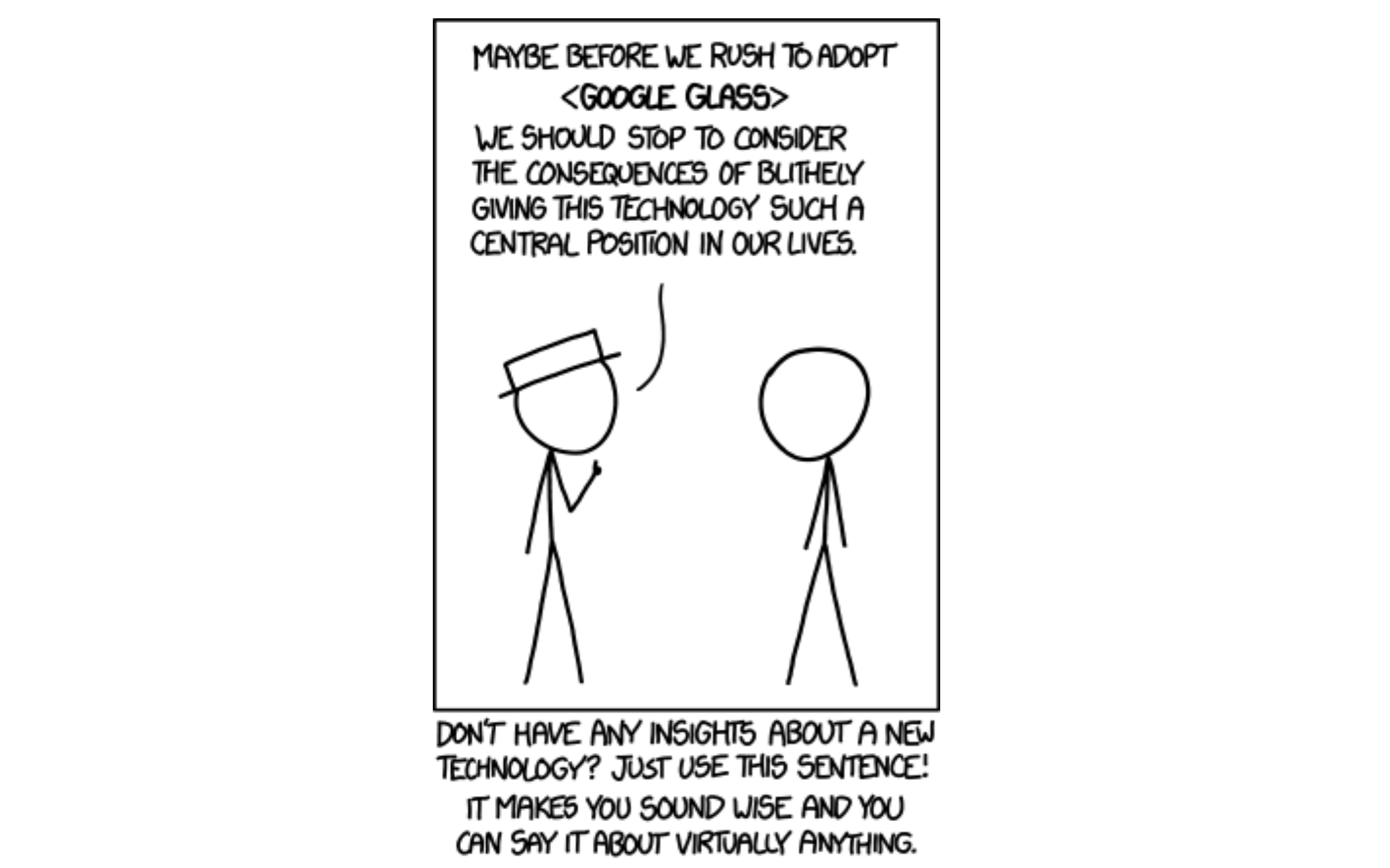
XKCD

Brad Keywell downplays Google Glass privacy concerns:

[Y]ou don’t need Google Glass to surreptitiously record something or someone. Generic-looking eyewear with hidden cameras have long been available for about $300, a fraction of Google Glass’s $1500 price tag. Micro wireless cameras sell for about $40 on eBay, and devices like pens and MP3 players can be purchased with hidden cameras. While you would never think twice about someone wearing sunglasses or carrying a pen in their pocket, Google Glass is literally in your face. You need to say, “OK, Glass,” and “Record a video,” or move your head in certain directions to capture anything — not exactly discreet. With the flash turned off, recording with a smartphone would be less obvious.

Along the same lines, Timothy B. Lee thinks that driverless cars are worth sacrificing some privacy. But he also wants stronger protections:

Fights over privacy in the self-driving future will focus on many of the same issues that are currently being debated with regard to cellphones. Governments currently claim broad power to seek location records from cellphone companies without judicial oversight. Reforming those laws to require the government to get a warrant before seeking historical records for a cellular connection would protect the privacy of both mobile phone users and self-driving car passengers.

(Comic: XKCD)

Insta-Vaccine

In preparing for a rapid response to a new deadly outbreak of the flu, Craig Venter and his colleagues engineered the key part of a vaccine within hours of receiving the gene sequence of an unknown virus:

The team took this information and used it to make DNA that contained both the gene sequences themselves and the genetic apparatus needed to let a cell read those sequences and produce proteins from them. They then put these pieces of synthetic DNA—which were, in effect, tiny chromosomes—into cell cultures derived from dog kidneys, which have been found particularly effective for this kind of work.

The dog-kidney cells duly churned out viruses, suitable for seeding the process of vaccine manufacture, that contained the proteins in question. Since these two proteins are the variable elements that stop new strains of flu being recognised by the immune systems of people who have had influenza in the past, this is an important step forward. Experiments on ferrets (which are often used as stand-ins for people in tests of flu vaccines) showed that these seed viruses stimulated the animals’ immune systems in the desired way, producing protective immunity.

A New Stock Market Bubble?

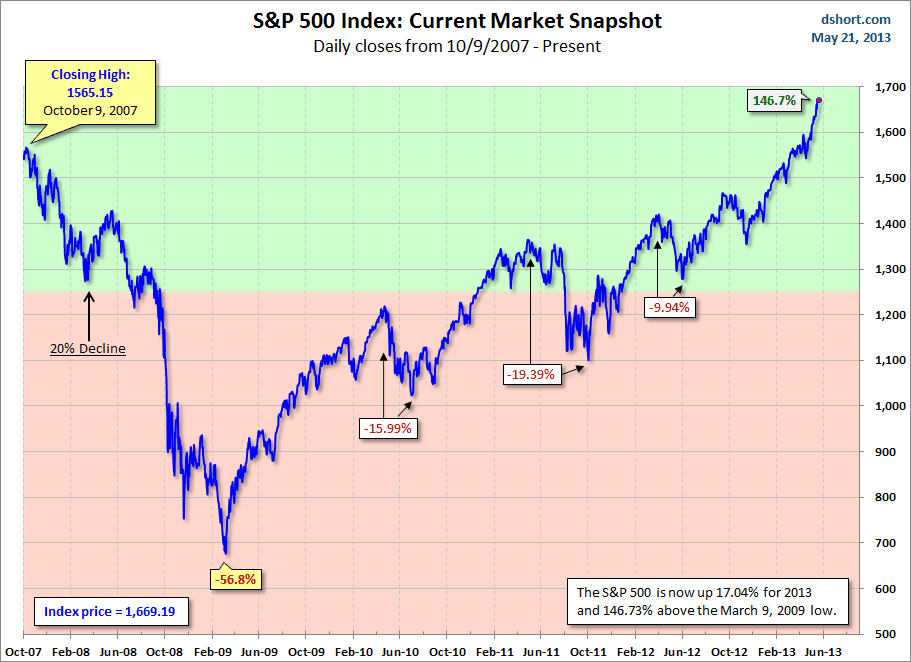
S&P 500 Chart

Surowiecki doubts it:

The underlying issue is that in recent decades there’s been a shift in the U.S. economy: it’s become far more congenial to businesses and investors. The fundamental trends that have driven the profit boom are unlikely to be reversed. That doesn’t mean that companies are going to be able to keep slashing their way to profit growth. As Doug Ramsey, the chief investment officer for Leuthold Weeden Capital Management, told me, “It’s hard to see how companies can get profit margins much higher, unless they want to see massive labor strikes across the country.” But keeping profits where they are doesn’t look all that difficult, which makes stocks today quite reasonably priced. It’s still possible that investor hysteria could eventually inflate stock prices, or that investor panic could send them crashing, but there is no profit bubble and, for now, no stock-market bubble, either.

Felix Salmon weighs in:

The stock market is a rising tide which is lifting only the luxury yachts; everybody else is underwater. That is genuinely deplorable. But it doesn’t mean that we’re in a bubble, and it doesn’t mean that if and when the tide goes out, the rest of us are going suffer massive injuries. There are always tail risks, of course: there are always unknown unknowns. But for the time being, the most likely scenario is that when asset prices start to fall, the main people to be hurt will be the ones owning the assets in question. In other words, the people who can best afford it. That’s not a bursting bubble: it’s just a common-or-garden bear market, of the type that all investors should be able to withstand.

(Chart from Doug Short)

An Islamist Beheading In Britain, Ctd

A reader writes:

Today’s atrocity will remind people everywhere what we are up against. Past revolutionary groups killed hostages, planted bombs and committed all manner of violent mayhem to try and destabilize the societies they hated. But Islamic fundamentalist terrorists have been different since they announced themselves on the world stage decades ago. They also take hostages and plant bombs. But they bring to their work a suicidal commitment and a depravity Westerners simply cannot fathom. Every time there is a horror like this we have to learn it all over again. We have to think  “oh, right…I forgot…they are monsters among us.”

The significance of today is that people like this, monsters like this, will never stop and will use any tool that comes to hand. For many this will mean “conventional” attacks with low body counts. For others it will mean designing spectacular events that may take years to come to fruition. So our choice is not simply to come terms with terrorism as a cost of doing business. X number of bombs and deaths a year is a normal part of modern life that only unmanly hysterics bother to get upset about. This is something we have never actually experienced in the civilized world.

Also of interest today is the story regarding the friend of Tsarnaev shot by the FBI. It looks likely that in addition to the bombing they slit the throat of some Jewish kids on another 9/11 anniversary. Monsters.