Sitges, Catalonia, 10.12 am
Sitges, Catalonia, 10.12 am
Carol Matlack reports on the recent move away from flat taxes in the Czech Republic, Slovakia and Bulgaria:
The lesson: Flat taxes seem to work pretty well when an economy is growing—but not so well when it is stagnant or shrinking. Across Central and Eastern Europe, “every country is in need of more revenue because of debt and public deficits,” says Andreas Peichl, a senior research associate at the IZA think tank in Bonn, Germany. “There is a feeling that the crisis has affected poorer people more than the rich and that the rich should contribute more. But that is not easy to do if you only have one tax rate.”
Given the extremes of inequality we are now facing – and likely to intensify as technology cuts yet another swathe through entire industries that sustain a middle class – I have to say I am pragmatically against such a tax now, even though I have consistently supported one in the past. I’m only flip-flopping, I hope, in the best way. A flat tax remains theoretically and symbolically deeply attractive to me. I still believe that penalizing people for succeeding in our economy is unjust to those individuals. But in our current contingency of accelerating inequality, a flat tax would be socially destructive.
And a true conservative seeks to avoid social destruction more than he enshrines ideological purity (which is why I really have no love, and a lot of distaste, for the current GOP). Nonetheless, we clearly, desperately need simpler taxation. And surely that is one area of potential compromise for both the GOP and the president, if the GOP hangs on in the House.
You would have to make it revenue neutral at first. But taking not a scalpel but a sledge-hammer to deductions, especially corporate welfare, could finally create a tax code that is comprehensible to most citizens.
It is deeply damaging to our core democratic legitimacy that the average citizen has no hope of understanding the tax code. If we cannot understand it, we cannot truly monitor it. And thereby lies one root of profound distrust of government, of the way in which powerful interests, like Apple, can find ways to avoid tax, while the struggling middle class has no way out. Yes, we need new revenue. Desperately. But if the actual politics prevent it, why not the next best thing: radical tax simplification. Some may argue that this could ultimately hurt the Democrats’ leverage for more revenue. So be it. We have four years of what could be stalemate – and this framework could unite sane people in both parties to make our tax regime comprehensible, reduce the income of lobbyists, and restore a sense that the game is not rigged. Those are important – close to indispensable – elements of a functioning democracy.
I had no idea – and you probably didn’t either – that Simon Cowell’s Simon Fuller‘s Idol franchise extends to the Arab world – and, in fact, may be one of the last gasps of pan-Arabism, as the region descends into a sectarian and educational hell. But the story of a young Palestinian who somehow managed to get past all the roadblocks and barriers to make it to the first stage of the competition in Cairo is quite something. From a Gaza refugee camp, he eventually had to climb over the walls of the compound where the auditions were taking place because he arrived too late. Once inside, without a ticket, he just burst into song amid the crowd of contestants, and one of his fellow competitors was kind enough to offer him his place. He’s now one of the favorites to win – and has managed to pierce through the grinding existence in Palestine to offer a unifying – and strikingly Western – vision. His main rival? A Syrian woman.
Maysoon Zayid, in a truly engaging essay, explains what she sees as his significance:
Mohammed Assaf is the face of the Palestinians that Netanyahu and friends refuse to admit exists. He is Muslim, but not radical. He is owned neither by Hamas nor Fatah and represents not just Gaza but Palestine as a whole. He humanizes a generation of males who have been reduced to terrorist caricatures. He has parents who obviously love and support him, the antithesis of the fabled Palestinian parents who want their children to die martyrs, and he has fan girls. Arab girls of all ages are in love with Mohammed Assaf and they are not afraid to Tweet it. Nor are they in danger of being “honor”-killed by the men in their families for doing so.
Know hope.
A reader writes:
As an African-American, I respect your point about the value of Obama’s speech at Morehouse, but ultimately, I completely agree with TNC’s critique. Why? Because I am tired. It seems that every time Obama comes to the black community to address us, he lectures us; he does not simply speak to us. He gives us a lesson about personal responsibility; he preaches to black men about responsible fatherhood; etc. These are crucial topics, and matters that we, as a community must solve and address, but must he talk about them every goddamned time he comes into the community?
This is especially galling when he refuses to address in explicit terms the specific policy needs of the black community (and they do exist).
I understand that he is the President of ALL of America, but would it kill the man to fight for at least a few policy initiatives that would specifically benefit low-income African-Americans, in particular? God knows we fought for him when we stood in lines across this country, often times for hours, in the face of relentless Republican efforts to disenfranchise us, simply so that he could put up with those boneheads for another four miserable years. If he is going to be our constant scold, it would ease the sting if he was occasionally more than our symbolic benefactor.
I will close on one last note, and I want you, in particular, to be mindful of this. Some of the best and brightest young African-American men in the country attend Morehouse, and many of those men grew up in middle and upper middle-class families (a number of which are likely still intact). I would not be surprised if there are at least 1-2 men in each class who turn down Harvard, and a handful more who turn down other Ivy League schools, in order to attend Morehouse. It has a storied history, and the men who attend that institution graduate, attend exceptionally fine graduate institutions, and often lead wonderfully productive lives.
Of all the groups of young men in the world who needed to hear the lecture that the President gave, they should not have been high on that list. He should have treated them like he would have treated the graduating class at Harvard: like bright young people with a world of possibilities in front of them, who had the right to pretend on just one day that a legacy of pain and the assumption of inadequacy did not accompany their every step.
I’m grateful for that perspective. And for my reader’s sharing of it.
David Cay Johnston believes that “costly specialized storm shelters—big public structures that would be used only every few years or even every few decades” aren’t smart investments:
In Webb City, next door to Joplin, the Federal Emergency Management Agency gave $3 million last year to build a safe room at the local high school. It can shelter 3,000 people, if they can get there before a twister strikes. (And that’s a big if, given the short time between a tornado warning and the moment when the doors need to close; just picture how tough it is to get 250 people into a jumbo jet in 40 minutes.) The shelter cost $1,000 per person it can protect from a tornado; building shelters for everyone in Missouri at this rate would cost $6 billion. Based on Missouri’s average of two deaths per year from tornadoes, this measure would save 100 lives over 50 years at a cost of $60 million per life. Even if the shelters last 200 years, the cost would be $15 million for each life saved.
An alternative:
A planned addition to Andalusia Middle School in the southern part of Alabama includes an interior multipurpose room designed to withstand deadly storm winds. Its walls are made of thick concrete with rebar reinforcing rods. And the hallways are built with the doglegs that Roberts favors. The new school also has windows, which are good for education and a sense of well-being. If a tornado approaches, heavy steel shutters inside the building lock in place, letting the winds throw the glass outward, but leaving those inside safe.
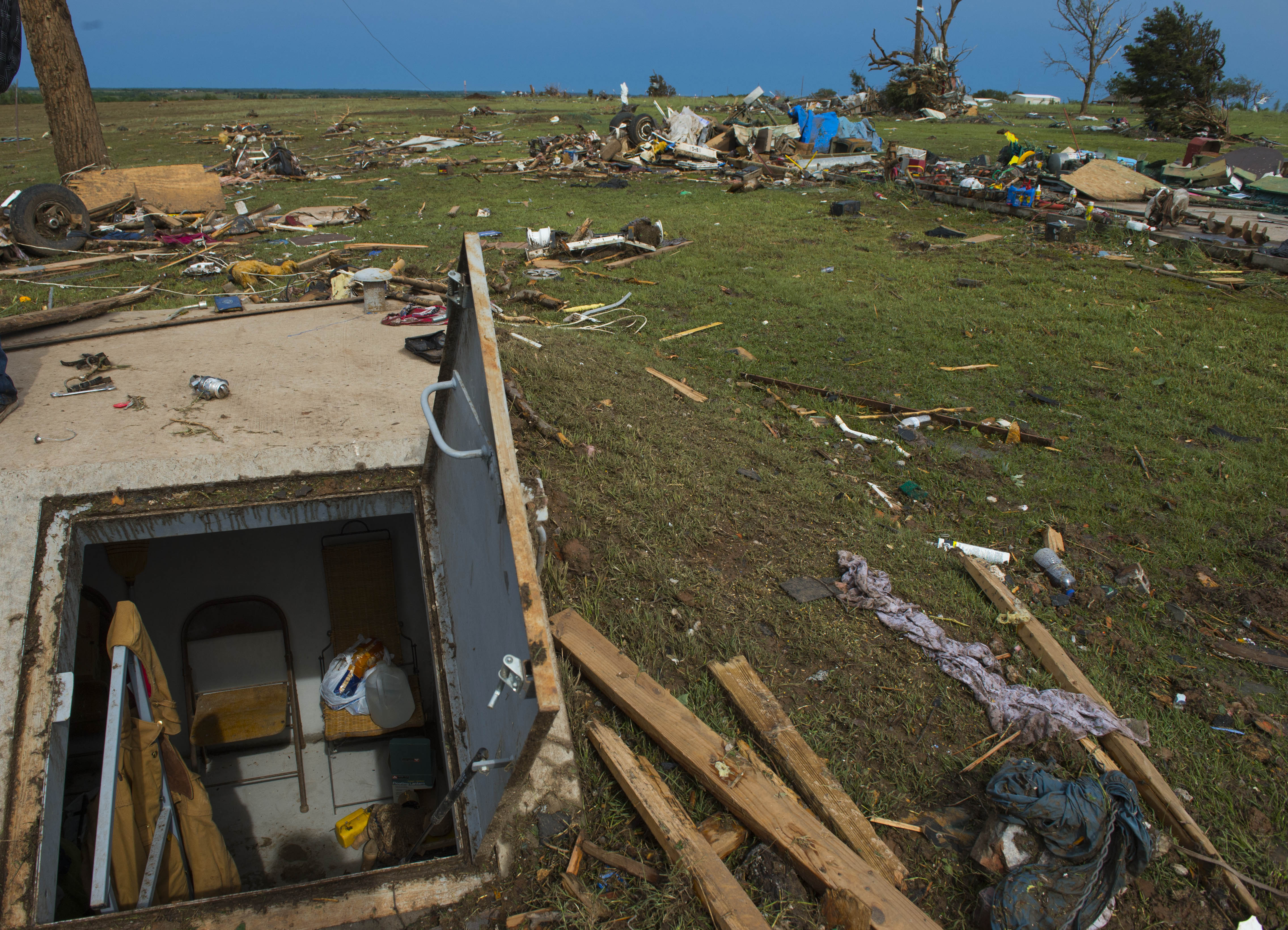
(Photo: Shown is the storm shelter that Gary and Ferrell Mitchusson used to ride out a massive tornado on May 21, 2013 in Moore, Ok. Their home was completely destroyed in the massive tornado. By Ricky Carioti/The Washington Post via Getty Images)
The horror, the horror:

David Gianatasio looks away:
I’m not sure which is more disturbing—the hirsute images that adorn the Beardvertising site from Kentucky ad agency Cornett-IMS, or creative Whit Hiler’s use of the work “mancessory” to describe such facial hair. You might recall Hiler from past wacky ventures such as conquering Reddit with fake fliers (including a meetup to recreate scenes from Human Centipede—”Guys only”) and crafting a tourism campaign that was presumably too “kick-ass” for the Bluegrass State. Here’s his latest pitch: “Do you wanna get paid for having an epic beard? Of course you do. Join the world’s first Beardvertising network. Get paid. It’s simple—turn your beard into a business. Just like Duck Dynasty. Hang a BeardBoard (Patent Pending) in your beard. Sit back and get paid up to $5 per day.”
Damn. I just trimmed mine right back.
“This ‘closing off’ that imagines that those outside, everyone, cannot do good is a wall that leads to war and also to what some people throughout history have conceived of: killing in the name of God. That we can kill in the name of God. And that, simply, is blasphemy. To say that you can kill in the name of God is blasphemy … The Lord has redeemed all of us, all of us, with the Blood of Christ: all of us, not just Catholics. Everyone! ‘Father, the atheists?’ Even the atheists. Everyone! …
We all have a duty to do good. And this commandment for everyone to do good, I think, is a beautiful path towards peace. If we, each doing our own part, if we do good to others, if we meet there, doing good, and we go slowly, gently, little by little, we will make that culture of encounter: we need that so much. We must meet one another doing good. ‘But I don’t believe, Father, I am an atheist!’ But do good: we will meet one another there,” – Pope Francis, in a homily today that brought tears of relief to my eyes.
Evan Wolfson criticizes Michael Kinsley for prematurely declaring victory on marriage equality:
We’ve built a 58% majority for same-sex marriage nationwide, up from 27% in 1996, when Congress passed the so-called DOMA as I was co-counseling the world’s first-ever trial on whether the government actually has a good reason for denying the freedom to marry in Hawaii. We are, happily, winning … but we are far from having won.
Freedom to Marry … is gearing up for the next round of work and battling it will take to turn the public opinion we have persuaded into the actual legal and political action that will be the true “mission accomplished” that Kinsley is prematurely celebrating. We know we will win, but also know we have a huge amount still to do – organizing, educating, enlisting, lobbying, door-knocking, fundraising, and campaigning that Kinsley’s piece trivializes when he writes, “The challenge [is] simply getting people to think about it a bit.” If only it were, or had been, or will be that simple.
I think Evan mistakes Mike’s enthusiasm – and the extraordinary gains we have indeed made – with complacency. But they’re both right; we have won the argument in a way few movements have so swiftly; but we still have not come close to accomplishing the mission. We saw the still-enormous gap to overcome yesterday as gay couples were removed from being covered under the new immigration reform. The reform tries to include everyone  trapped in immigration hell or limbo (and sometimes, trust me, purgatory), but it explicitly excludes only one group of people: gay and lesbian Americans who have taken up the responsibilities of civil marriage.
These people are not immigrants; they are American citizens forced to choose between their country and their spouse. No heterosexual would see that exclusion as anything other than what it is: the American government’s persecution of its own citizens, even as it seeks to ease the plight of its resident non-citizens. And breaking up families or forcing them to move abroad to stay together is more than discrimination. It’s cruelty. It doesn’t get clearer than that. Gay citizens are regarded as less worthy than straight non-citizens by their own Congress.
The quote of the day was from Lindsey Graham: “You’ve got me on immigration. You don’t have me on marriage. If you want to keep me on immigration, let’s stay on immigration.” There are things I would want to say to Butters that only human decency prevents. I wish he’d treat Americans like my husband with a scintilla of such respect.
Harry Enten examines the deep-red states least hospitable to equality:
With the exception of Virginia, it’s pretty clear that southern Republican support for gay marriage is lower than among Republicans nationally. As such, it’s difficult to see how support among southern Republicans will hit 50% anytime before 2040. It’s hard to imagine more than the stray Republican voting for same-sex marriage. Polarization is at all-time high, and politicians are more afraid about losing primaries than general elections. Republicans have no need to vote for same-sex marriage.
Thus, unless the federal government jumps in, most, if not all southern states won’t legalize same-sex marriage for the foreseeable future. Most of their citizens don’t want it, and by the time they do, most Republicans still won’t. Considering you’ll need a majority or supermajority of state legislators to get the bans reversed, and that Republicans have a strong hold over these chambers, same-sex marriage in the south doesn’t have much of a chance anytime soon.
Annalee Newitz introduces more theories as to what happened to the human subspecies:
Anthropologists, according to [Professor John] Hawks, often ask the wrong questions of our extinct siblings: “Why didn’t you invent a bow and arrow? Why didn’t you build houses? Why didn’t you do it like we would?” He thinks the answer isn’t that the Neanderthals couldn’t but that they didn’t have the same ability to share ideas between groups the way H. sapiens did.
Their bands were so spread out and remote that they didn’t have a chance to share information and adapt their tools to life in new environments. “They were different, but that doesn’t mean there was a gulf between us,” Hawks concluded. “They did things working with constraints that people today have trouble understanding.” Put another way, Neanderthals spent all day in often fatal battles to get enough food for their kids to eat. As a result, they didn’t have the energy to invent bows and arrows in the evening. Despite these limitations, they formed their small communities, hunted collectively, cared for each other, and honored their dead.
When H. sapiens arrived, Neanderthals finally had access to the kind of symbolic communication and technological adaptations they’d never been able to develop before. Ample archaeological evidence shows that they quickly learned the skills H. sapiens had brought with them, and started using them to adapt to a world they shared with many other groups who exchanged ideas on a regular basis. Instead of being driven into extinction, they enjoyed the wealth of H. sapiens’ culture and underwent a cultural explosion of their own. To put it another way, H. sapiens assimilated the Neanderthals. This process was no doubt partly coercive, the way assimilation so often is today.
Recent Dish on Neanderthals’ extinction here.

 The Dish