Syria From The Outside

Jenna Krajeski looks at how the Syrian conflict has bled into Turkey:

It has cost Turkey seven hundred and fifty million dollars to host the [Syrian] refugees, with about one hundred million more coming in from outside sources. Members of Syria’s opposition—both armed and not—consider Turkey their base, and the Turkish government’s support for them has made the country an opponent of the Assad regime in more than just words. The border is being knocked down piece by piece—whether by journalists and soldiers crossing back and forth or shells falling on Turkish towns. In a report issued this April called “Blurring the Borders: Syrian Spillover Risk for Turkey,” the International Crisis Group says that that Turkey “now has an uncontrollable, fractured, radicalized no-man’s-land on its doorstep.” The two car bombs that exploded in Reyhanli last Saturday were like two deadly exclamation points at the end of that sentence.

Julia Ioffe captures Russia’s perspective:

“Moscow understands that something has to be done because the war has been going on for two years and it has to stop,” [Maxim Yusin, the deputy foreign affairs editor of the Russian newspaper Kommersant] explains. “But if Assad’s opponents win, there will be a bloodbath. Shiites and Alawites will be slaughtered.” Moreover, he adds, echoing the official Russian position, that the successors to Assad will likely be the ones flying the black flag of jihad and sponsoring terrorism outside Syria’s borders. Lukyanov points out that Syria has long been home to those displaced by the upheavals in the Caucasus, which has become a hotbed of terrorism and Islamist insurrection. “Getting rid of a dictatorial but secular regime, and replacing it with an Islamist regime creates yet another support network for the terrorists in our backyard,” Lukyanov explains. Yusin makes a starker analogy. “Assad does not want to target America, but these guys do,” he says. “These are thousands of potential Tsarnaevs, and France and Britain want to arm them!”

Meanwhile, Nikolas Gvosdev tries to parse American views on Syria from both sides of the aisle:

It was often said that the first Gulf War in 1990-91 exorcised the ghost of Vietnam. Today, the ghost of Iraq is alive and well, prowling the halls and counsels of government. Some want that ghost to be heeded and for the United States to stay out of Syria. Others argue that decisive action is needed to banish that apparition once and for all. How this plays out in the coming weeks remains to be seen.

Daniel Larison takes a less charitable view of those calling for intervention:

While their goals of regime change and opposition victory may be very ambitious, Syria hawks seem to have little interest in the positive transformation of Syria. Their principal concern seems to be the destruction of the current regime, and just as in Iraq there is little or no attention paid to what would be done to reconstruct a working Syrian government once this is achieved. … For many Syria hawks, the reason to intervene in Syria is not to promote a more liberal or democratic political order. Indeed, some Syria hawks may understand that any post-Assad regime will be illiberal and majoritarian, but this doesn’t stop them from wanting to bring it to power.

No, the reason most Syria hawks want to overthrow Assad is to reduce Iranian influence, and there’s not much more to it than that.
Gaming Out The Limits Of Morality

Christian Brown showcases videogames that challenge the conception of winning at all costs, such as Spec Ops: The Line:

[A]s the game progresses, generic Arab bad guys are replaced with American soldiers and sometimes civilians. The load screens — most commonly seen after the player dies — explicitly question the values of the player. “DO YOU FEEL LIKE A HERO YET?” they ask, as you wait to jump back in and shoot dozens more digital soldiers. One’s motives for playing the game are openly called into question: The decision to keep playing instead of walking away from the game is likened directly to the in-game character’s refusal to give up on his mission and stop killing. Many players (me included) quit the game in disgust at a certain point, when you drop white phosphorous mortars onto civilians being evacuated from Dubai in order to keep playing.

In an interview with Polygon, Walt Williams, who designed Spec Ops: The Line, said, “This is where the characters have to look at the consequences of their actions and say: ‘Should we have gone further? Should we have left? Should we leave now? Is it right to keep going?’ …  And if the player is thinking about seriously putting down the controller at this point, then that’s exactly where we want them to be emotionally.”

Disorder Disorder

Psychiatrist Allen Frances worries about the expanding definitions of mental illness in the new edition of the DSM:

The grief I felt when my wife died would now be called “major depressive disorder”; forgetfulness in older age “mild neurocognitive disorder”; my gluttony now “binge eating disorder”; and my hyperactivity “attention deficit disorder”. As for my twin grandsons’ temper tantrums, this could be misunderstood as “disruptive mood dysregulation disorder”. And if you have cancer and your doctor thinks you are too worried about it, there’s “somatic symptom disorder.” It goes on, but you get the idea.

About half of Americans already qualify for a mental disorder at some point in their lives and the rates keep skyrocketing, especially among kids. In the past 20 years, the prevalence of autism has increased, childhood bipolar has multiplied 40-fold and attention deficit disorder has tripled.

One consolation: the kids are not suddenly getting much sicker – human nature is pretty stable. But the way we label symptoms follows fickle fashions, changing quickly and arbitrarily. And freely giving out inaccurate diagnoses can lead to grave harms – medication that isn’t needed, stigma, lower self confidence and reduced self expectation.

Recent Dish on the DSM’s waning influence here.

Subconscious Storytelling

In Story of a Writer, the 1963 documentary on Ray Bradbury seen above, the author describes how downtime is crucial to his craft:

The time we have alone; the time we have in walking; the time we have in riding a bicycle; are the most important times for a writer. Escaping from a typewriter is part of the creative process. You have to give your subconscious time to think. Real thinking always occurs on the subconscious level.

I never consciously set out to write a certain story. The idea must originate somewhere deep within me and push itself out in its own time. Usually, it begins with associations. Electricity. The sea. Life started in the sea. Could the miracle occur again? Could life take hold in another environment? An electro-mechanical environment?

Paul Gallagher adds:

This was the kind of thinking that made Bradbury’s book so irresistible. Anything was possible with Bradbury. He had a joyous, child-like enthusiasm for life that infused his books, with a brilliance and pleasure, that makes them so very, very special.

“Stuff your eyes with wonder, he said, live as if you’d drop dead in ten seconds. See the world. It’s more fantastic than any dream made or paid for in factories,” – Ray Bradbury, Fahrenheit 451.

More quotes from Bradbury here. Previous Dish on the author here.

What Will Become Of Syria?

Michael Totten hazards a guess:

Lebanon is an interesting case and could be held up as a partial example for post-Assad Syria. It has never been unified. It never had a homegrown dictatorship. It never went through a socialist phase. Lebanon never wanted those things, never tried. It has a weak central state by design. That way, no one group can seize power and rule over the others. If anyone does seize power like Hezbollah recently did, it hardly makes any difference because the state’s teeth are so few and so small. Aside from Lebanon’s foreign policy shift, hardly anything changed after Hezbollah took over the government. Lebanon is still just as freewheeling and decadent as it was before. …

We shouldn’t forget that Syria’s borders were drawn not by Syrians, but by French imperialists.

The Alawites wanted a state of their own north of Lebanon and south of Turkey in the green part of Syria between the Mediterranean and the an-Nusayriyah Mountains. They actually had a semi-autonomous Free Alawite State, complete with their own flag, before the French forced them back into a merger with the inland Sunni Arab region. The Kurds in the north and northeast likewise never wanted to be part of Syria. They wanted, and still want, an independent Kurdistan of their own. If the people of Syria had drawn their own borders, the country would be smaller and more cohesive than it currently is. It has only been held together thus far because it has been ruled by a totalitarian terrorist state.

“Look,” [Lebanon MP Amine Gemayel] said, “you have to understand something. There is no multicultural country in the world that can survive without some kind of a composite state. All multicultural nations are federate states. Belgium, Switzerland, Canada are all federal states. Spain doesn’t like to be called a federal state, but it is in fact a federal state. Multicultural states that don’t go to federalism go to partition like Yugoslavia. It’s very difficult without federalism. You’re asking people who are very different, who have different attachments to the region around them, to rule the country together. It’s impossible.”

An Acclaimed Afterlife

Robert McCrum pens a tribute to W.G. Sebald, whose practice of mixing various genres of writing with images outlived him:

[H]ere’s the strange, and heartening, thing – and also the riposte to the cultural pessimists (vide supra). Sebald lives on. Uniquely, among so many recently deceased writers, he and his oeuvre have had a rich and productive afterlife. Now only did he, between 1992 (the German publication of Vertigo) and his untimely death (2001), move from total obscurity to international renown, he then posthumously proceeded to influence a whole generation of writers, in the best possible way, as a spirit and an example. Today, the influence of his work crops up all over the place, in the most surprising quarters. Most prominently, in the UK, he has inspired Will Self, Robert Macfarlane, and Iain Sinclair.

More than a decade after his death (he was just 57), hindsight suggests that his extraordinary, genre-bending “method”, that’s so bewitching and hypnotic, is fully in tune with the spirit of an age that likes to mash up words and music, video clips and archival documents.

Ángel Gurría-Quintana reviews a recently translated collection of works:

It is the piece on German-Swiss novelist Robert Walser (1878-1956) that most perfectly distils Sebald’s approach to his subjects. Remarking on the physical similarity between Walser and Sebald’s grandfather, and the fact that they died the same year, he wonders: “What is the significance of these similarities, overlaps and coincidences? Are they rebuses of the memory, delusions of the self and of the senses, or rather the schemes and symptoms of an order underlying the chaos of human relationships, and applying equally to the living and the dead, which lies beyond our comprehension?”

Torture TV

Fox is bringing back 24. Alyssa compares the show’s pro-torture scenes with torture story-lines in newer shows, which are unafraid to depict more sadistic horrors. On the treatment of one character in Game Of Thrones (spoilers below):

[Theon Greyjoy’s] expectations that anyone will be merciful are slowly dismantled. “Water. You want some water?” his main torturer asks Theon, then tells him “I wish I had some for you,” while pouring out the water on the floor. And bit by bit, his corporeal body is pared away, first a finger Theon begs the man to cut off after it’s been flayed, hoping amputation will relieve his pain, and then his genitalia, taken from him as a way of robbing Theon of the part of his identity that’s bound up in his sexual prowess. “No, mercy, please. Mercy, mercy,” Theon cries as his emasculation approaches. “This is mercy,” his torturer tells him. “I’m not killing you. Just making a few alterations.” It’s an efficient and nasty definition of what torture is, not an intelligence-gathering technique, not a tool that must only be used occasionally with great regret, but the process of turning someone into something else, and often something less. And Game of Thrones is making sure that its audience understands the full weight of that process.

Watch that gruesome scene here, if you must.

Disappointed With Daddy Lit

Davy Bry pans the recent spate of memoirs about fatherhood:

While most genre memoirs seek to explain a specific and unique experience, shared by some but not by many, the fatherhood memoir is a study of a common phenomenon. And there’s a too frequent problem with studies of this common experience. It has to do with a thing that lots of people learn when they have a kid and so find themselves sitting around with other parents talking about their kids a lot: No one is ever going to think the way your kid mispronounces words when he or she is learning to talk is as cute as you think it is. (No one except the kid’s grandparents.) So when Magary repeatedly quotes his son saying “oat-kay” instead of “okay” (“Deddy, are woo oat-kay?”) and when Price, throughout the book, has his sons refer to each other as “brudda” (“It’s OK, Big Brudda is here!”), it’s like listening to the parents on the next table over at Chuck E. Cheese’s coo babytalk and pet names at children you don’t know. Such pitfalls makes an author’s job harder—the more mundane a story a book tells, the more exceptional the telling must be. Magary endured the premature birth of a child, and a serious health crisis that followed. But neither he nor Price can claim access to parental experience that falls very far outside of the norm.

Battling Depression Stigmas

Mark Brown suggests that glorifying high-achievers with mental health difficulties may be more insensitive than inspiring:

Where the inspirational figure is selected for us, and the gap between their life and ours is too great, the effect is not one of encouragement but of disillusionment – especially if their story is told in terms of personal qualities like bravery or persistence.

The blogger Neuroskeptic takes Brown’s point – “‘He’s got it, and so do you, so you can be like him’ is perilously close to ‘He’s got it, and so do you, so you should be like him – what’s your excuse?'” – but maintains that celebrity sufferers contradict different stigmas in different ways:

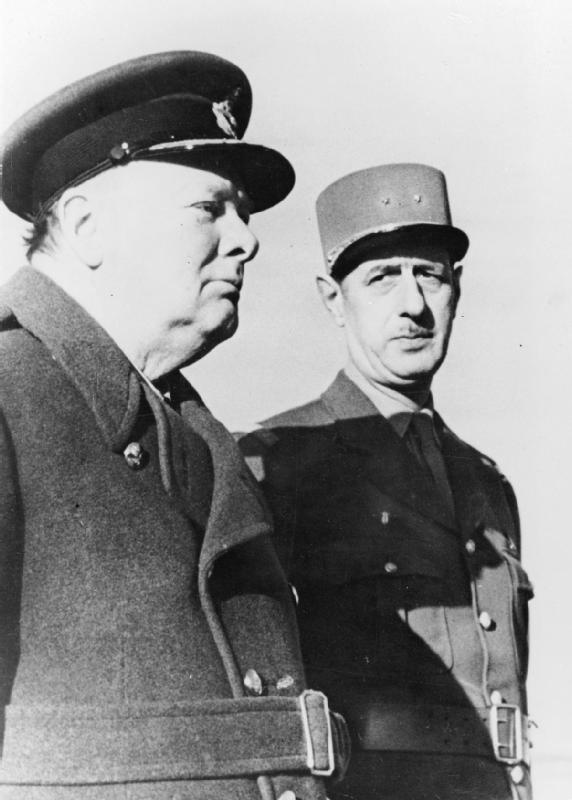
dish_Churchill_De_Gaulle

In the case of depression, the core stigma is that depression is a weakness, a moral failing. That depressed people are soft, weak, pitiable. This attitude is specific to depression – not even bipolar disorder is seen in the same way, let alone the other diagnoses. They have their own stigmas. Depression’s is weakness.

Now this is why Churchill is a good counterexample. Not just because he’s famous or ‘great’, but because he was famously tough. He faced down Hitler. He was blood, sweat and tears. In the most famous photos of him (and they are famous, out of all his photos, because they correspond to the mental image) he is almost unsmiling – but never despairing. Just resolute.

That he experienced depression undermines the myths surrounding that condition, in a way that an entertainer or other generic celebrity wouldn’t.

(Photo: Prime Minister Winston Churchill and General Charles De Gaulle, January 1944, via Wikimedia Commons)

Racism In The World, Ctd

Siddhartha Mitter takes issue with Max Fisher’s map of racism by country:

[T]he biggest problem, of course, is that “race” is impossible to operationalize in a cross-national comparison. Whereas a homosexual, or an Evangelical Christian, or a heavy drinker, or a person with a criminal record, means more or less the same thing country to country, a person being of “another race” depends on constructs that vary widely, in both nature and level of perceived importance, country to country, and indeed, person to person. In other words, out of all of the many traits of difference for which the [World Values Survey] surveyed respondents’ tolerance, the Swedish economists – and Fisher, in their wake – managed to select for comparison the single most useless one.

Mitter thinks this is representative of broader problems in the blogosphere:

The specialty of foreign-affairs blogging is explaining to a supposedly uninformed public the complexities of the outside world. Because blogging isn’t reporting, nor is it subject to much editing (let alone peer review), posts like Fisher’s are particularly vulnerable to their author’s blind spots and risk endogenizing, instead of detecting and flushing out, the bullshit in their source material. What is presented as education is very likely to turn out, in reality, obfuscation.

This is an endemic problem across the massive middlebrow “Ideas” industry that has overwhelmed the Internet, taking over from more expensive activities like research and reporting. In that respect, Fisher’s work is a symptom, not a cause.

Dan Drezner disagrees:

[I]n this instance, the primary fault lies not with foreign policy bloggers, but with academics.

It’s not like Fisher commissioned a bogus survey and then wrote up the findings in a misleading manner.  Rather, he relied on a survey that goes back three decades and has been cited pretty widely in the academic literature.  He got to that survey via an academic article that got through the peer-review process.  Almost all journalists not in possession of a Ph.D., going through that route, would have taken the data as gospel.  … I’m all for better education in the ways of statistics and social science methodology in the foreign affairs community, but methinks Mitter is setting the bar extraordinarily high here.

Second, the blog ecosystem “worked” in this particular case.  Fisher posted something, a bunch of social scientists looked at the post and found something problematic, and lo and behold, errors in the data were discovered and publicized.  As I’ve opined before, one of the signal purposes of blogging is to critique those higher up in the intellectual food chain.  I understand that Mitter would prefer that the original error never take place.  By its very nature, however, the peer review process for blogging takes place after publication — not before.

Drezner updates:

Mitter has responded in part here, and at more length in a constructive comment to this post.  Both are well worth reading, and put some more context into his original post.  He’s getting to some interesting tensions about the nature of expertise and “publicity” in a changing media landscape that are worth mulling over before responding.