In case you missed it, it’s our Tuesday Cry. Below is another video of a survivor emerging from the destruction, followed by another amateur video surveying a leveled neighborhood:
Month: May 2013
Phone Rage
Last week, Kevin Williamson took matters into his own hands when a fellow audience member wouldn’t stop using her smartphone during a theater performance:
The lady seated to my immediate right (very close quarters on bench seating) was fairly insistent about using her phone. I asked her to turn it off. She answered: “So don’t look.” I asked her whether I had missed something during the very pointed announcements to please turn off your phones, perhaps a special exemption granted for her. She suggested that I should mind my own business. So I minded my own business by utilizing my famously feline agility to deftly snatch the phone out of her hand and toss it across the room, where it would do no more damage.
He was subsequently ejected and could face criminal charges. I’m with Kevin 100 percent. He didn’t grab the phone before talking with the management. The management simply refused to stop the disruption. It was only then that he lost it. And I fully understand why.
I refuse to have dinner with someone constantly consulting their iPhone. I ask them to put it away or end the meal. I’m also an Acela Quiet Car Nazi. The plague of smartphone chatter is slowly destroying whatever space individuals once had to separate ourselves from the maddening crowd of gabbers. When some of us are allowed an oasis of calm – the quiet car – and others refuse to abide by its strictures, talking loudly with one another or yelling into their phones, I simply point to the quiet sign and remind them that this is supposed to be a library atmosphere. Others are too polite to address the rudeness. But they seem grateful for my being the necessary asshole. My gripe is that I am forced to be an asshole by the poor manners and contempt for others of gabbing phone-addicts. In my Acela experience, it’s often the executive white male types who simply ignore me and force me to find a conductor. Yes, in the end, my objections can make more noise and disruption than the asshole on the cellphone. But he started it.
I’ve stopped going to the movies entirely because of this. You cannot ignore a sudden light appearing three rows down. You cannot ignore the tippity-tap of the texter behind you. You can try – but there’s a reason the lights are kept low in theaters – so you can focus on the stage or the screen. These anti-social yahoos are destroying the performance for everyone – and then act all affronted when told how douchy they are. John Del Signore is among many calling Williamson a hero:
How many stern warnings do obnoxious assholes get before there are actual consequences? Unlimited, apparently. “I don’t think we’re going to start a new policy of ejecting customers,” [said Howard Kagan, one of the producers of the show Williamson was attending].
[But as Williamson notes,] “The Alamo Drafthouse has a very strict policy about this sort of thing. If you talk, if you use your phone, you’ll be thrown out. And it’s a very successful business model. People are willing to pay more for it! Theater managers have to do something about this… I wish twice a month some Broadway theater would jack somebody, do a high profile ejection. I think you would establish a new set of social norms.”
Me too. Or maybe one movie theater in a complex where cellphone use is explicitly barred. Alas, there remains some kind of deference to these morons, as if they had some kind of right to spoil Tyler Coates thinks Williamson acted just as selfishly as the person he was admonishing:
Williamson engaged in an angry conversation with a stranger during a musical performance, one that is set in an intimate cabaret environment. Surely that was distracting to his fellow audience members, not to mention the actors. In the end, he was forced to leave the show, and I can imagine that the scene of watching a woman slap her neighbor and then having security escort him out disrupted the performance for many more people than the woman’s silent Googling. I don’t find it inspiring; I find Williamson’s actions to be just as (if not more) rude than the woman who annoyed him. It’s not commendable, and it’s a shame to see an amateur provocateur take the attention away from the people on stage in the show whose job it is to perform for an audience.
There is no “silent Googling”. The management should, in my view, throw the Googler out. Dreher sympathizes with Williamson’s vigilantism:
More and more people, it seems, simply do not understand how to behave in public, and how to respect others. I wouldn’t recommend seizing the phones of rude old ladies and throwing them across the room. But I understand the impulse, and would pay Kevin Williamson’s court costs, if it came to that.
And Tod Kelly doubts that the incident really happened:
[N]othing in the exchanges Williamson notes sound or feel like the exchanges real people have in real life – it reads more like something he imagined doing while stewing in his seat. Being the latest in a long, long line of Irish Storytellers, I can usually tell a story from an account, and Williamson’s feels like the former.
Well, we’ll see as the legal process unfolds.
(Video: Hugh Jackman discussing when he, from the stage, had to admonish an audience member whose phone kept ringing through a crucial scene in the play A Steady Rain.)
(Thumbnail photo by Jenny Cestnik)
Obama At Morehouse, Ctd
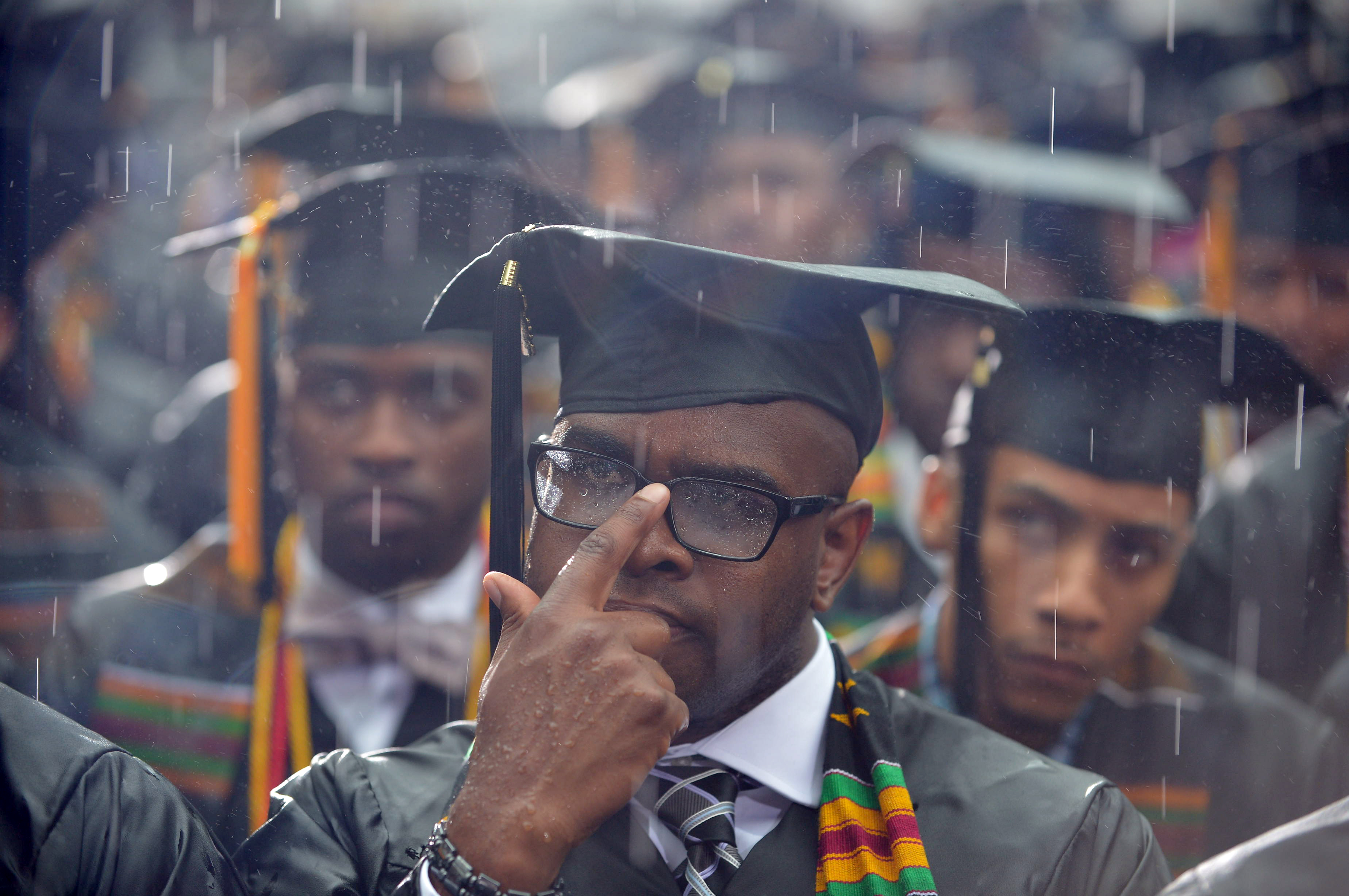
TNC is less than enthusiastic about the tone that the Obamas struck in their recent commencement speeches:
Taking the full measure of the Obama presidency thus far, it is hard to avoid the conclusion that this White House has one way of addressing the social ills that afflict black people — and particularly black youth — and another way of addressing everyone else. I would have a hard time imagining the president telling the women of Barnard that “there’s no longer room for any excuses” — as though they were in the business of making them. Barack Obama is, indeed, the president of “all America,” but he also is singularly the scold of “black America.”
TNC even goes on to call Obama’s defense of and call for personal responsibility and fatherhood “targeted scorn”. Good Lord. Why so defensive? The importance of personal discipline and responsible fatherhood are surely central to many of the issues facing black America. Without them, it is hard to see how African-Americans are going to thrive in an increasingly competitive global marketplace or leave behind some of the family breakdown that has so contributed to poverty and crime. Fallows is more forgiving:
We all take a different tone in setting expectations for “our own.”
I can hold Americans overseas to a different standard than I would Russians or Japanese; I can harangue (and have!) my colleagues in the press about why we should do better; I expect something from myself and my kids I wouldn’t expect from you and your kids, and so on. The challenge for Obama, exactly as Ta-Nehisi pointed out, is that he is simultaneously addressing all Americans as his own (apart from those who consider him alien) while also in this speech addressing as his own the most historically distinct subset of our population. …
I increasingly think of Obama as walking a tiny, little rope suspended across a Grand Canyon. Through four and a half years he has mainly kept his footing, in a way that becomes cumulatively surprising — and I say that even while disagreeing with many of his policies, notably including the recent security-state extensions. Every now and then, as with this speech, we see how hard what he is doing is.
And how unforgiving and touchy his audience can be. My thoughts on Obama’s speech here.
(Photo: Graduating students with rain soaked mortar boards, listen as US President Barack Obama delivers the commencement address during a ceremony at Morehouse College on May 19, 2013 in Atlanta, Georgia. By Mandel Ngan/AFP/Getty Images)
Malkin Award Nominee
“I said to a minister I know: have you thought this through? Because you’re doing the law of succession, too. When we have a queen who is a lesbian and she marries another lady and then decides she would like to have a child and someone donates sperm and she gives birth to a child, is that child heir to the throne?” – Norman Tebbit, former chairman of the Conservative Party, on the bill for marriage equality in Britain.
Question Of The Day
A reader writes:
I agree with your poll that the Daily Wrap wasn’t useful enough to justify the time commitment. But could you do some kind of end of day “thing”? I did like the wrap because I knew when I got to the end-of-the-day’s posts. Is there something easy or similar that can be a final thought, or a final feature to close out the day’s posts? Thanks for the consideration!
I think I’m going to re-post my favorite post of the day. And maybe add a couple of links to other posts I think may be worth a second or first look. How’s that?
The Sanity Of The American People, Ctd
Blumenthal finds that Obama’s approval ratings are holding steady:
The current HuffPost Pollster estimate of Obama’s job approval rating, based on the combination of all available public polls, is 47.6 percent. His approval rating has been declining since the January inauguration, but at a glacial pace, erasing gains made during and after the fall campaign. However, a closer look at the most recent daily tracking polls shows no dramatic change in the past week.
Maybe it’s because, as yet, there is no real scandal. Even the IRS targeting of dubious Tea Party (c)4s is beginning to seem less insane as we discover the scale of their sleaze and the bipartisan calls for oversight. The AP leak was a very serious one, exposing a crucial agent inside a dangerous Yemeni Jihadist cell. Benghazi? There’s very little there there. Nate Silver credits the economy for Obama’s resilience:
Based on the historical relationship between Mr. Obama’s overall and economic approval ratings in the poll, you’d predict that his overall approval rating would be 53 or 54 percent given an economic approval rating of 48 percent. Instead, it’s 51 percent. So it may be that the talk surrounding Benghazi, the I.R.S. and the Justice Department has negatively affected Mr. Obama’s approval rating by two or three percentage points, but that the economy has lifted his numbers by about the same amount.
Ezra sees Obama’s poll numbers as evidence that “scandals are likely to simply harden the Democratic perception that Republicans are out to get Obama, and the Republican perception that Obama is a corrupt president”:
“People respond along party lines,” writes Alan Abramowitz, an Emory political scientist who predicted last week that the polls would remain unchanged, “just like members of Congress. Republicans believe the worst of Obama, but they already believed the worst of Obama. Democrats (correctly) see Republicans pushing these things because they are out to get Obama and stop his agenda and/or they think Obama is responding correctly to the problems that do exist. So it’s like almost every other issue or controversy.”
Except for Independents who, I suspect, are somewhat bored/exhausted by the Washington minutiae. And every day the GOP obsesses about these details, they fail to propose any set of sane policies to address the national problems. In the end, that matters. Under Clinton, at least the GOP had an agenda, other than pure oppositionism. Seth Masket notes that, during the Lewinsky scandal, Clinton famously saw an approval rating bump. The causes of that bump that may also apply to Obama:
One [theory] is that the public largely sympathized with Clinton. Not that they approved of his behavior—far from it—but that they felt that his affair did not warrant impeachment or the media firestorm that surrounded it, and they registered their dissent with the media and with overly enthusiastic congressional Republicans by supporting him.
Another theory, offered by John Zaller, my advisor when I was in graduate school, is that the public generally doesn’t factor scandals in when evaluating presidential performance. What they do care about are the same things they care about during elections: peace, prosperity, and moderation. The intense scandal coverage caused people to pay attention to politics in a non-election season. They evaluated Clinton’s performance and generally judged him to be running things well.
I suspect they think the same of the current president. With good reason.
Very Small Town America
An Oxford American mini-documentary, featured above, lost a National Magazine Award earlier this month to Romney’s 47% video on Mother Jones. Kevin Hartnett reflects:
There’s a lot of joy and some sadness, too, in Tiny Town, a small-scale world housed in Hot Springs, Arkansas. The elaborate model was carved and assembled over the course of 68 years by Frank Moshinskie and today it’s managed as a modest tourist attraction by his son, Charles. … The movie shows Charles–who’s no young man himself–telling about how the display began as a decoration beneath his dad’s Christmas tree and grew over seven decades into an ensemble that includes scenes from 21 different states in the country. There’s a replica of Dodge City from the television show Gunsmoke, a little Niagara Falls, and an island cabin tucked among the trees. Charles says his dad liked to carve figures that move, so Tiny Town includes kids poised on teeter-totters, a sheriff sticking up some poor soul, a floating hot air balloon, and a circling airplane. The whole thing is marvelous, but it becomes more acutely melancholic when Charles climbs into Tiny Town to show the audience around: He’s ostensibly a giant, but really the model’s smallness starts to reflect our own.
Update from a reader:
The touching video you posted today of Frank Moshinskie and his “Tiny Town” reminded me of another talented folk artist whose life work has become a beloved roadside attraction. I had the pleasure of visiting Barney Smith’s Toilet Seat Art Museum in San Antonio, Texas a few summers back. Mr. Smith is a warm, lively soul in his 90s who shows no signs of slowing in his passion for making art out of toilet seats. Barney said, “I was a master plumber before I retired so I was comfortable with the medium.”
I made a short video of our visit. Here’s a link.
“Racists Love Race Science”
Freddie DeBoer has a new post on the race and IQ debate that deserves to be read in full. A key part:
People insist: hey, you’ve got to let the science be the science, you’ve got to look at the facts, you’ve got to let them make the case. And I try. I read their essays. I follow their links. I do make a good faith effort. But I do not make that effort with similar credulity or sympathy that I do when I read someone write about tweaking the Earned Income Tax credit or make an argument about alcohol licensing. Why? Because one of these arguments has been used for the perpetuation of a system of chattel slavery and racist domination. That’s why. And, sure enough: whenever people pop up to tell me, “Here, check this link, read the facts,” and I click and read around, and then I follow more links, inevitably, I end up at Stormfront or similar houses of explicit racism. Inevitably, the people who are arguing about inherent black and Hispanic tendency to be unintelligent are also arguing about “black aggression” or “hypersexuality” or “inherent tendency to criminality.” This will apparently come as a shock to Andrew: racists love race science.
Is the correlation between belief in race science and racism 1? No. But it’s a lot closer to 1 than it is to 0. Is that dispositive of the question? Of course not. If there’s a racial bias towards low IQ, and if IQ is really an adequate gauge for real-world, lived intelligence, then the truth will out, just as it will if homosexuality is pathogenic. But to pretend as if people who are pushing the idea of inherent racial inferiority in IQ don’t tend to be the kind of people who believe all sorts of racist things is stupid. It’s moronic. It’s exactly the kind of willful failure to see connections that Andrew is accusing other people of.
I do not doubt that many of those pursuing this question are doing so for ugly reasons. Probably a hefty majority. That should make one especially leery of their arguments and make one very aware of the need to use empiricism almost pathologically. But, of course, one reason why this area is so clogged with racists is that non-racists don’t want to go there. My worry is that not going there will only rebound against the case that such data should not in any way be used for public policy. If affirmative action is finally abolished, we may be able to get race as an identifier out of policy discussions altogether. But what happens if affirmative action goes and we have universities that are overwhelmingly Asian-American and Jewish? What will liberals do then? Another important section from Freddie:
I appreciate that Andrew has, as he always does, engaged with criticism and opposing opinion on this issue. But I am frustrated by Andrew’s continuing ahistorical credulity on this issue, his tendency to read the people making these arguments with the most possible charity. And he matches that with a distinct lack of charity for those resisting them, the constant invocation of liberal piety and political correctness.
I would like very much for Andrew to consider whether his long history with this issue, and the attendant criticism he’s received, has rendered him too ready to see those pushing the race-IQ connection as principled empiricists untouched by emotion or animus. To posit that they are sober-minded, rational minds merely pursuing the scientific truth disinterestedly while their opponents are motivated by groupthink and emotion is a pretty great way to make yourself gullible on an issue where gullibility has profoundly negative consequences.
I cannot analyze myself – but I’m sure I am affected by my history on this. One part, as I’ve written before, is that my entire education was made possible by an IQ test at age eleven, which gave me entrance to what Americans would call a magnet school. I owe a lot to that test – and it was initiated by the left. Today’s liberals forget that testing IQ was once a leftwing idea. It was designed to rescue the poor from the trap of poverty by giving bright kids from poor backgrounds a swift entry to the British elite. That was the left of the 1940s – and you can look up Keynes and eugenics for further insight into how socialist this idea was in origin. Another part was, indeed, the reaction to my convening a debate on “The Bell Curve” at TNR, in the best-selling issue in that magazine’s history. I saw how some liberals really do not believe in free debate where race is concerned.
But I do not believe that critics of the whole project are fueled by groupthink or emotion alone. There’s a very solid case against race as anything meaningful in our culture, and an even stronger case that in the process of constant miscegenation, we are rendering the whole idea of race moot. I sure hope so. There’s also a strong argument that IQ is of extremely limited use – and, in fact, misses a whole range of intelligences that are often more important to our lives and cultures as humans.
I just refuse to wish the data away. The data shocked me when I first read it, and shocks me still.
Pop Goes The Easel

Image Duplicator is an exhibition featuring artists who have re-appropriated the works of Roy Lichtenstein, the pioneering appropriator of comic book art:
According to the Tate Modern – home to an exhibition of his work until May 27 – he is one of the true greats of the twentieth century. His paintings are worth millions, and even those with little knowledge of or interest in art will instantly recognise prints such as Whaam! and Drowning Girl.
But the trouble with Lichtenstein’s work, says [curator] Rian Hughes, is that most – if not all of it – is appropriated from comic book artists without credit or compensation. “Almost every painting [Lichtenstein] ever did was appropriated without asking permission or paying royalties. If he was a musician, he would be facing a copyright lawsuit,” claims Hughes. …
So why has this been allowed to continue for so long? Hughes believes it’s symptomatic of a widespread snobbery towards commercial art. “If you unearthed a rare song and sampled it, people would take great delight in pointing out the source material. Yet in the art world, the source material – particularly when it is created by commercial instead of fine artists – is often treated as if it is some kind of cultural clip art – “low” art that fine artists will elevate to “high” art,” he says. “[W]hat we’re really hoping to do [with Image Duplicator] is encourage people to celebrate good art regardless of where it came from,” he says.
(Image: Dave Gibbons’s re-appropriation of Whaam!, inspired by illustrations by Irv Novick, courtesy of Orbital Comics Gallery)
Programmed For Your Personal Pleasure
Bill Wasik considers the next step in the tech revolution – a world in which our appliances talk to one another and anticipate our next moves:
Think about where you spend most of your waking hours: your office, perhaps, or your living room or car. There are all sorts of adjustments you make over the course of any given day that are reducible to simple if-then relationships. If the sun hits your computer screen, then you lower a shade. If someone walks in the door, then you turn down your music. If there’s too much noise outside, then you close your window. If you have a Word document open but haven’t finished writing a sentence in 10 minutes, then you brew another pot of coffee. Would you want to automate all of these relationships? Not necessarily. But you might find that automating some of them would make your life easier, more streamlined.
Deciding what to call it is a whole other matter:
Some have called it the Internet of Things or the Internet of Everything or the Industrial Internet—despite the fact that most of these devices aren’t actually on the Internet directly but instead communicate through simple wireless protocols. Other observers, paying homage to the stripped-down tech embedded in so many smart devices, are calling it the Sensor Revolution.
But here’s a better way to think about what we’re building: It’s the Programmable World. After all, what’s remarkable about this future isn’t the sensors, nor is it that all our sensors and objects and devices are linked together. It’s the fact that once we get enough of these objects onto our networks, they’re no longer one-off novelties or data sources but instead become a coherent system, a vast ensemble that can be choreographed, a body that can dance.
 The Dish