The high drama in the Commons can be monitored at the Guardian here. The Telegraph’s live-blogging is here. I fear the Tories have made themselves look divided as well as cynical, even though support for marriage equality from Cameron and others is genuine. It didn’t help that over the weekend, an unnamed alleged friend of Cameron’s described the Tory party right as a bunch of “mad, swivel-eyed loons”. Not exactly diplomatic.
Month: May 2013
Which Syrian Rebels, Exactly, Should We Arm?
The Economist has a helpful graphic on key rebel groups in Syria:
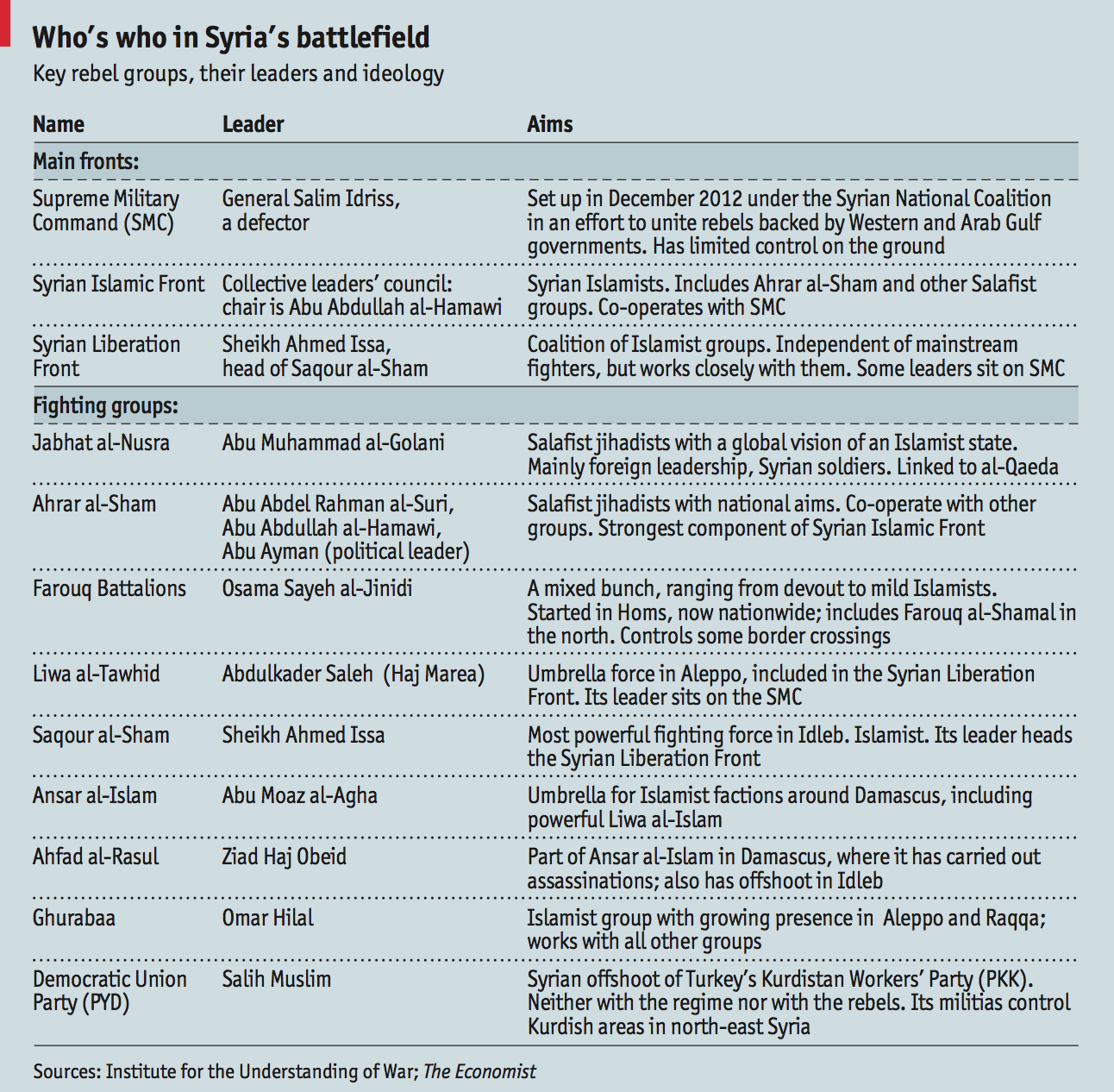
Note how may of these groups are described as “Islamists” or “Jihadists.” Matt Steinglass doubts there is much we can do:
[W]hat about trying to just end the bloodshed and freeze the current situation? Given that the country’s population has effectively split into irreconcilable warring camps, wouldn’t it be best for all concerned if those camps were each acknowledged as legitimate in their areas of control? If those areas of control are more homogenous than the overall Syrian state, couldn’t that form a more stable basis for governance? Should America aim for a resolution along those lines in the talks it’s convening with Russia?
Maybe. Then again, maybe not. The problem with formally acknowledging armed secessionist groups as soon as they gain control over a patch of territory is that it encourages new armed groups to secede, provoking yet more civil wars. (See under: Yugoslavia.) And in the middle east, hopes that such splinter groups will grow into non-belligerent stakeholders once they’ve become responsible for controlling populations and territory are often disappointed. (See under: Hamas; Gaza.)
Even Jeffrey Goldberg, who has been itching for a new war, is now wary of getting involved. He thinks the US may have missed its chance:
Early intervention — a coherent, active attempt by the U.S. and its allies to build up, finance and advise what was then a moderate opposition — might have worked. Now, though, the Assad regime is showing signs of real resilience, and the opposition is showing signs of real brutality. It is easy to blame Obama for his early passivity. It is slightly harder to blame him for looking at Syria as it is today and then choosing to ignore calls for deeper intervention on the side of the rebels.
And Conor Friedersdorf wants interventionists to consider non-military ways to alleviate suffering around the world:
When an interventionist wants to put boots on the ground, arguing that it’s necessary to save lives, it means asking ourselves, before acceding, “can more lives be saved by spending this money on anything other than a war”? The fact is that, even granting the smartest critiques of international development work, it is usually a better way to help people than war, and it engenders good feelings rather than blowback.
Obama At Morehouse
Every now and again, an event happens that makes you see much more clearly how divorced from its previous ideals the GOP has become. Obama’s speech at Morehouse was something every conservative has always asked of African-American public figures. We have in Obama a black man raised by a single mother who is now, as even his critics acknowledge, a dedicated father to two daughters, whom he obviously adores. If the right is concerned about the black family, they should be falling over themselves to celebrate what Obama’s family is, and means. But they don’t. It would kill them to say anything gracious about this president.
Drudge yesterday cherry-picked only those parts of the speech that could divide people racially, only those moments when Obama dared to recognize the discrimination and difficulties of young black men – before urging them to overcome them. There’s a racial nastiness here that decent voters still hear and that Republicans have deployed constantly. Their historic refusal to cooperate even one iota with the first black president betrays, it seems to me, a staggering lack of grace and historical sense.
But as with everything Obama says, the speech balanced calls for equality with an admonition that personal responsibility is the inextricable complement to equality. And he did something more in the interstices. A member of the Morehouse faculty writes:
Morehouse is a college dedicated to African American men, the only one of its type in the country. To hear the first African-American male U.S. president address a class of 500+ African-American men was moving, especially as he touched on his personal struggles of not having a father in the home.
But the reason I’m writing to you though is because he gave two shout-outs to gays. He encouraged the young men to be a better husband to their wife but then added “or to your husband or partner”. Later, he told them that their experiences as African-American men should make them more empathetic to others who feel left out, such as Hispanics because of their immigration status, gays and lesbians because of who they love, and Muslims because of how they worship. The ease with which he address gay issues now is striking to me. Just like with the second inaugural address, it’s just a part of his normal speaking. It is even more noteworthy because Morehouse once had a reputation as a homophobic place due to several factors, including a student beating about ten years back.
This speech reminded me once again why I supported this man and continue to do so.
Me too. While Washington obsesses over scandals that so far have no connection to him, the president stays calm and carries on.
Noonan Just Loses It, Ctd
Responding to this post, Conor quotes me:
Has this president broken the law, lied under oath, or authorized war crimes?
Yes, President Obama has broken the law on multiple occasions. Despite clearly stating, in a 2008 questionnaire, that the commander-in-chief is not lawfully empowered to ignore treaties duly ratified by
the Senate, Obama has willfully failed to enforce the torture treaty, signed by Ronald Reagan and duly ratified by the Senate, that compels him to investigate and prosecute torture. As Sullivan put it earlier this year, “what Obama and Holder have done (or rather not done) is illegal.”
Obama also violated the War Powers Resolution, a law he has specifically proclaimed to be Constitutionally valid, when committing U.S. troops to Libya without Congressional approval. Or as Sullivan put it in 2011, “I’m with Conor. The war in Libya becomes illegal from now on. And the imperial presidency grows even more powerful.”
On the subject of war crimes, Sullivan wrote that “Obama and attorney-general Eric Holder have decided to remain in breach of the Geneva Conventions and be complicit themselves in covering up the war crimes of their predecessors – which means, of course, that those of us who fought for Obama’s election precisely because we wanted a return to the rule of law were conned.” In a separate entry, he went so far as to say that Obama is “a clear and knowing accessory to war crimes, and should at some point face prosecution as well, if the Geneva Conventions mean anything any more.” That seems rather farther than Noonan went in her column.

Sure. But none of those things disturb Noonan, who is on record as wanting to walk swiftly by the crime of torture in order to focus on an overwhelmed IRS office in Cincinnati. And the context of those questions was in response to her summary of three recent “scandals”. If the GOP were to go after the president on the questions above – all far more serious than the White House non-scandals – I’d be with them. But they aren’t. I agree with Conor on this. The real scandals are obvious and ignored. But not by this blog. Just by the GOP.
Ask Sue Halpern Anything: Our Special Relationship With Dogs
The author weighs in on why dogs and humans get along so well, with a follow up about what her therapy dog Pransky was able to teach her about that special relationship while they worked together at a local nursing home:
Back in March, Halpern wrote a piece on the human relationship with dogs that we very much enjoyed here at the Dish. Here’s another excerpt from it:
[M]ost dogs that were originally bred to work—herding sheep, ferreting rats, retrieving game, or even, like those first labradoodles, guiding the blind—now live out their days as suburban or urban habitués, with little to do all day but wait for the return of family members from work or school. The fact is that dogs—at least dogs like [author John Homans’] Scout and Stella, and my dog and probably yours—come into our world for our pleasure, whatever that pleasure is. They are here at our invitation, and exist under our control. We determine what they eat and when, and how much they exercise and how, and we train them—à la [Jill] Abramson’s Scout—to live according to our rules and standards. The human–canine bond is inherently unequal. Like it or not, it is a power relationship.
Yet at the same time, we love our dogs.
We feel sure that they know us and like us, although we never know just how well; we sense they adapt to our moods, but we also know that they very naturally may be more interested in dogs they meet on the street; we believe we can count on them to be absolutely loyal companions, something we may not be able to say about most people we know. Maybe more than at any other time in history, we love our dogs as we love one another, and sometimes even more than that. …
From the start of our lives together, our relationship to dogs has told us something about ourselves: what we have valued, how we have behaved, and our connection to the natural world and to our animal selves. These days, unlike days past, some of us appear to be uncomfortable with our dominion over our dogs, perhaps because canine science offers a nuanced and thought-provoking take on a dog’s capacities, sensibilities, feelings, and intelligence. Still, the elevation of our dogs to honorary human status is not exactly new. Fourteen thousand years ago, people chose to be buried alongside their dogs. Yet you have to wonder: fourteen thousand years hence, when archaeologists uncover Swarovski crystal–encrusted dog collars and that trove of canine Harley gear, what will they say it says about us?
Sue’s new book, A Dog Walks Into a Nursing Home: Lessons in the Good Life from an Unlikely Teacher, came out last week. Watch her previous answers here. Full AA archive here.
2,700
Christopher Frizzelle processes last week’s NYT story about military suicides:
More than 2,700 American soldiers have killed themselves since 2001. That’s not counting veterans and it’s not counting “National Guard and reserve troops who were not on active duty when they committed suicide”…. But make no mistake: Suicides among veterans have risen too. The number of veterans who kill themselves is an unbelievable 22 per day, according to the Department of Vetern Affairs. As for the active-duty soldiers, a “dauntingly complex web of factors” figures into the data about why they commit suicide. While “troops with multiple concussions were significantly more likely to report having suicidal thoughts” than others, “deployment and combat by themselves cannot explain the spiking suicide rates.”
He asked his brother, a former Army officer, for insight as to why more than 80 percent of those who committed suicide had never been in combat. The response:
Because regardless of what they’re called or what “stage” we’re in, we’re still at war. Being in a war zone for 9+ months is unbelievably stressful even if you’re not in combat. Not to mention, you work 15 hours a day and get 0 days off, which is tough even in a regular job for that amount of time. You have no social life, and people are social beings. You just become numb mentally and emotionally. I was for months after I came back and my deployment wasn’t that bad compared to some. One of my guys killed himself a week after we got back. He seemed fine.
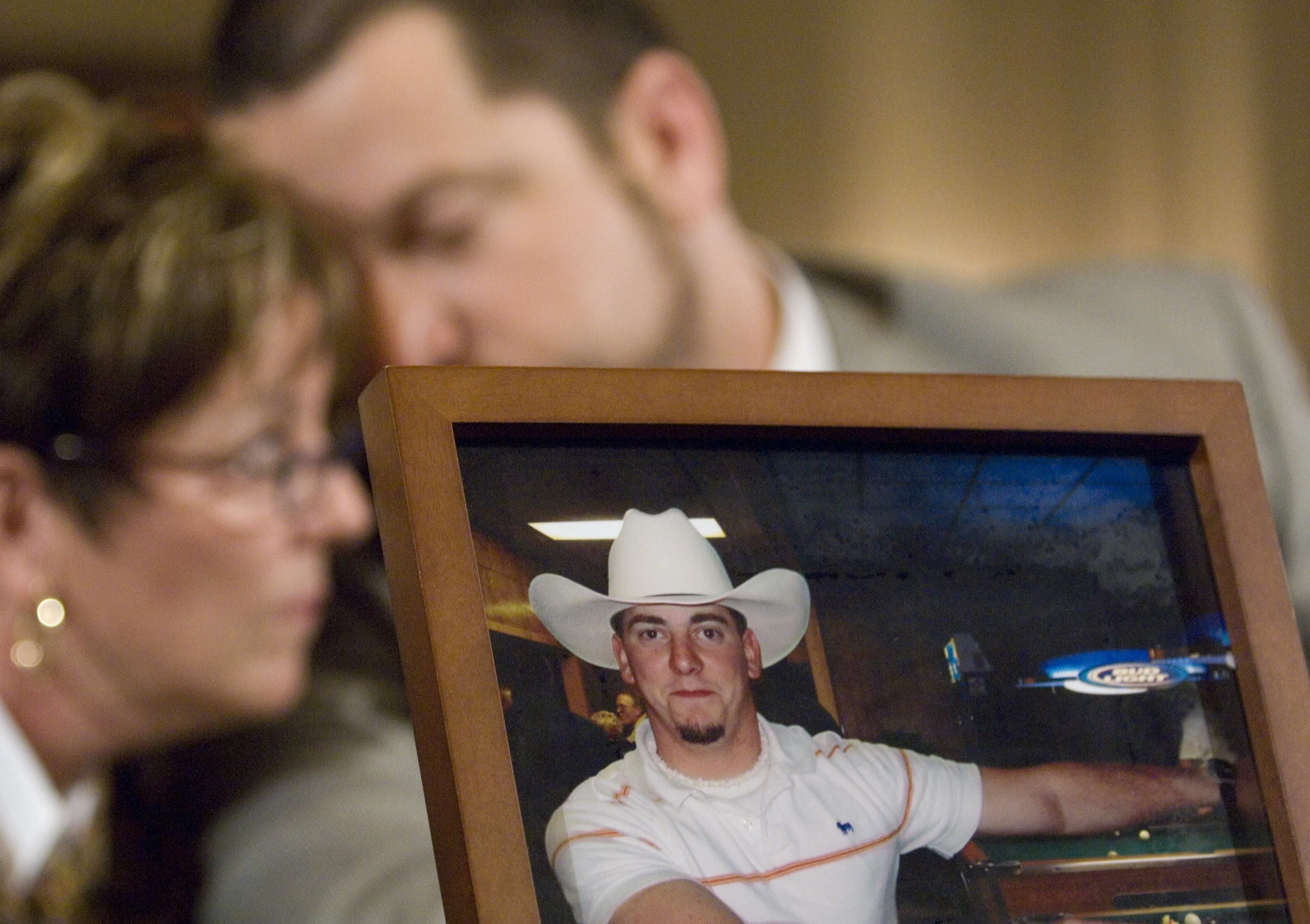
(Photo: Mike and Kim Bowman, of Forreston, Illinois, whisper behind a photo of their son, Specialist Tim Bowman, U.S. Army, Illinois National Guard, Bravo Troop, 106th Calvary, as they prepare to testify during the House Veterans Affairs Committee hearing on ‘Stopping Suicides: Mental Health Challenges Within the Department of Veterans Affairs (VA),’ on Wednesday, Dec. 12, 2007. Their son shot himself after returning form duty in Iraq. By Bill Clark/Roll Call/Getty Images)
Marriage Equality On The Brink In Britain
David Cameron’s inability to control his party must not be allowed to wreck the Equal Marriage Bill. Labour’s commitment unwavering.
— Ed Miliband (@Ed_Miliband) May 20, 2013
The British prime minister, David Cameron, is beginning, alas, to resemble the last Tory PM, John Major, in his inability to control his right flank, especially on Europe, their bugaboo, but also on core social reforms, like marriage equality. Over the weekend, a rebel group of Euroskeptics and social reactionaries, led by a former minister Tim Loughton, cynically backed an amendment to the marriage equality bill that would also allow all heterosexuals to get civil partnerships, a move that has all but destroyed marriage as a distinct and socially stabilizing institution in France.
It reveals, it seems to me, the extent to which this group of Tories are anti-gay, rather than pro-marriage. Nothing would hurt civil marriage as an institution more than universal civil partnerships – which may also cost the Treasury up to $5 billion a year. As of yesterday, there was a sense of real crisis – as the Tory amendment was backed by Labour.
Today, however, the Archbishop of Canterbury came out against the amendment and the opposition Labour party withdrew its support and offered instead an immediate consultation on the question of universal civil partnerships as well as full support for the marriage equality bill. In the words of the Labour shadow Home secretary:
“We would urge the government, we would urge the Liberal Democrats, we would urge backbenchers of all parties to support this [Labour] amendment to allow the bill to pass without the Tim Loughton amendment for the time being but also allowing an immediate consultation to start on the opposite-sex civil partnerships. On that basis we would recommend to people not to support the Tim Loughton amendment.”
Labour has the backing of the Liberal Democrats who are in coalition with the Tories. Deputy Prime Minister, Nick Clegg, said this morning that
“It’s my party’s policy there should be civil partnerships for heterosexual couples so we’ve no problem with the principle at all. But it’s a pragmatic question. I don’t want anything to interfere with the central purpose of this legislation, which is to provide the right to marriage to same sex couples.”
There will be a vote later today. It will not be a party-line vote, so there’s no assurance of anything. We’ll keep you posted. But this has proven to be another sign that the Tories cannot cohere as a party of government. To have a key part of the government’s agenda rescued by the opposition reveals a prime minister whose grip on his own party is steadily weakening because of the ferocity of the far right.
Sounds familiar, doesn’t it?
Christianism Watch
“[Homosexuality] attempts to poison our children, divide them from their parents and the teaching of the church and basically turn them into pawns for that movement so that they can sexualize them at the earliest possible age. It really is insidious and I agree with you, it is a super sin,” – E.W. Jackson, a black minister that the Virginia GOP just nominated to run for lieutenant governor. Nine more hateful quotes from Jackson compiled here.
David Boaz notes just how extreme the Virginia GOP now is:
Last week I reported that 40 percent of Virginia Republicans – and 56 percent of independents – now support gay marriage. But on Saturday the Virginia GOP nominated three statewide candidates whose views on homosexuality and marriage equality range from unwavering opposition to bigoted to insane.
Dragged Into The E-Book Era
Novelist Ted Heller, a dead-tree loyalist, caves to e-readers at last:
The ultimate irony is that my new novel (West of Babylon) is only available in electronic form. I didn’t merely get hoisted by my own petard—my petard fell on me and shattered my skull. There will be zero chance I’ll ever see anybody reading my book. Zero. It will never, ever happen. I will never be able to sign anyone’s copy. (There won’t be a copy!) I’ll never experience the sheer delight (it has almost reduced me to tears) of walking into a bookstore and seeing a novel I wrote prominently displayed on a table in the front (or rotting away in the H section on a shelf next to Ernest Hemingway and Herman Hesse). There will be friends of mine who, because they’ll never buy an e-reader, will never read the book at all.
But what’s crucial, what gives me some infinitesimal measure of hope, is that this book I wrote and slaved over every day and obsessed over for years will still be out there. Wafting in the either, zipping across USB cables, flickering on screens, bubbling up to the surface of the world. The book will be somewhere.
I think.
Psychic Shelter
Cerebral Hut is an installation at the Istanbul Museum of Art that claims to interact with visitors’ brain waves:
The Turkish architecture firm Ozel Office “hacked” a commercially available headset that measures brain waves and blink rates, and wrote a program that connects that data to a hut made from kinetic building materials. The more a visitor to the installation concentrates, the more the hut pulses and contorts. The result, according to the creators, is the first “moving architecture that directly responds to human thought.” They also note that Cerebral Hut has the quality of a video game environment, which raises the fun possibility of using side-by-side cerebral huts to conduct staring competitions (whoever’s hut bends farthest and longest wins) or engage in concentration art displays, where judges assess the concentration patterns that produce the most interesting architectural changes.
 The Dish