Misguided Moralism

The Mockingbird blog highlights this arresting passage about The Brothers Karamazov from Jaroslav Pelikan’s Fools for Christ:

Dostoevsky’s study of human nature made him see a demonic element in man for which moralism could not account. Like few men before him, Dostoevsky learned to know the subtle means which the demonic employs in asserting itself with the hope of achieving divinity. The temptation “You will be like God” can come in the opportunity to violate moral law, as it did to Raskolnikov. It can also come in the guise of piety and morality, and it is in this latter form that the demonic is most seductive. Then it employs the sanctions of conventional morality for the accomplishment of its demonic ends. The ultimate and most profound critique of the identification of the Holy and the Good comes in the realization that the demonic in man transcends the moral sense and the ethical consciousness. Therefore, relation to the Holy is far more than accepting of living up to a moral code. As a matter of fact, accepting and living up to a code can be and often is the device by which the demonic ego defends its autonomy against the claims which the Holy lays upon it… God is more than the validation of our moral consciousness.

(Video: A scene from a 2002 BBC adaptation of Dostoevsky’s novel)
Quote For The Day

“Christ kept eating with people after He was dead. He still does. The Last Supper is not in the past, but in the present. Before Abraham was, I am means the time and mortality the man ran naked for and from are real, and are to be feared and loved; but that before time and mortality, God is, and so love is; and God’s love entered them and mortality as a baby, a boy, a man, to show itself through the flesh. Knowing that those few years of physical presence are not enough, He remains in the flesh: in bread and wine, in the acts of eating and drinking. The Communion with God is simple, so we will not be dazzled; so we can eat and drink His love and still go about our lives, so our souls will burn slowly rather than blaze.

We can live with this miracle, for it requires so little of our bodies and minds and hearts. We simply have to be where the Eucharist is, and open our mouths to it. We can even receive it without eating it. On most mornings after my accident, I did not have the energy to go to Mass, then prepare meals and write and try alone to run a household. A priest brought me the Eucharist when he had time to, and once he said: ‘Every day you are receiving Communion of desire; other people are receiving it for you.’ So the Last Supper did not take place on one night in one room, and to eat God’s love, we do not even have to open our mouths; we can be walking, sorrowful and confused, with a friend; or working on whatever our boat is, fishing for whatever it is we fish for; we can be running naked, alone in the dark. The Eucharist is with us, and it is ordinary. To me, that is its essential beauty: we receive it with wandering minds, and distracted flesh, in the same way we receive the sun and sky, the moon and earth, and breathing,” – Andre Dubus, “Communion,” from Meditations from a Moveable Chair.

Face Of The Day

dish_kumi-1

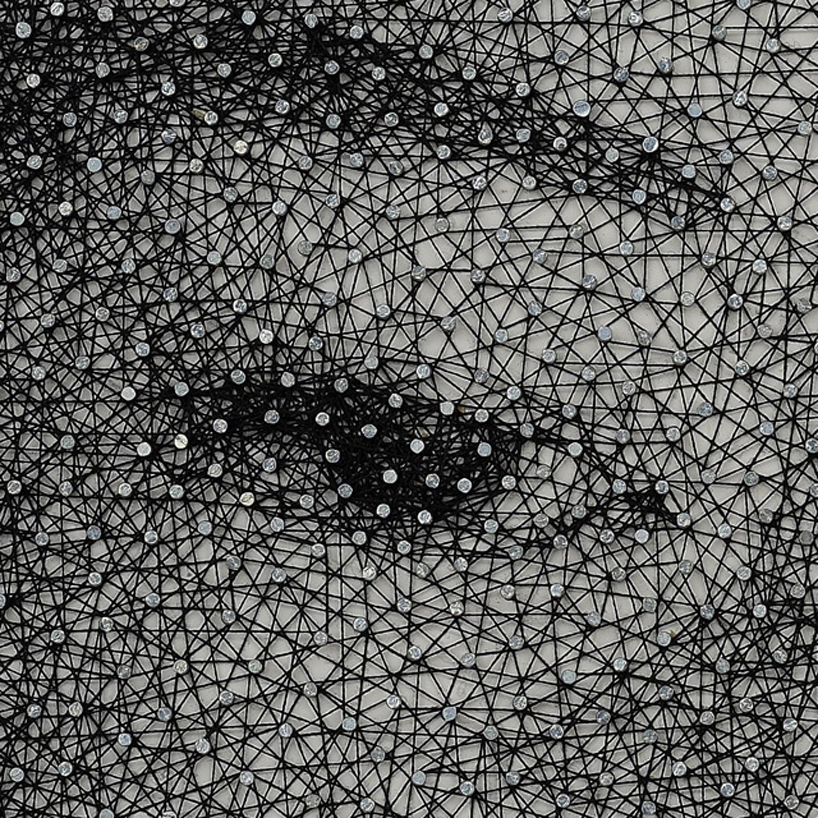
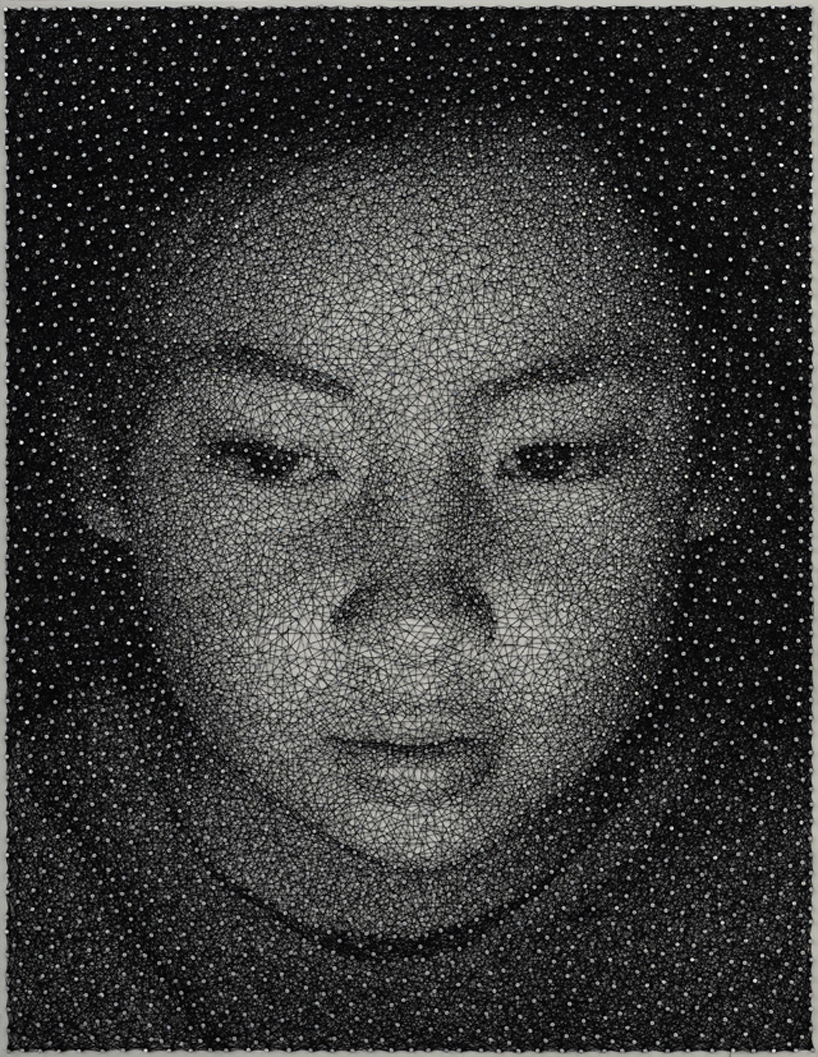
Kumi Yamashita‘s “Constellation – Mana no.2″ is comprised of only three elements: a wooden panel painted white, more than 7,000 tiny galvanized nails and a single, unbroken black sewing thread.  Rodrigo at designboom observes, “The highly intricate multidimensional textures of the compositions bring out a realistic and almost organic quality to the faces.” A close-up of Yamashita’s piece after the jump:

dish_kumi-2

(Images courtesy of Kumi Yamashita Studio)

The Definition Of Futility

Kate Chisholm reviews two new books about Samuel Johnson, beginning her essay with this charming description of the idiosyncratic writer:

There is a particular challenge in trying to pin down, quantify, assess the literary achievement of a dictionary-maker who has spent years searching for the elusive, chameleon-like meanings of even the most mundane of words. Samuel Johnson, though, offers his own validation for such an enterprise in the preface to his great Dictionary of 1755, in which he confesses that he set out to codify the language only to realize before he was even halfway through that no such thing is possible. Instead of giving up, Johnson persisted, even while recognizing the futility of his ambition, and understanding too well that “one enquiry only gave occasion to another, that book referred to book, that to search was not always to find, and to find was not always to be informed; and that thus to pursue perfection, was, like the first inhabitants of Arcadia, to chase the sun, which, when they had reached the hill where he seemed to rest, was still beheld at the same distance from them”.

Who could fail to admire the frank, unvarnished modesty of such a man? Yet such parings have their critics. Not everyone wants to admit a world in which there is so much futile industry, pained creation, and in which nothing can be concluded.

After The Apocalypse

Robert Macfarlane considers the way Cormac McCarthy’s The Road isn’t the usual novel about apocalyptic events:

Until Cormac McCarthy’s novel…apocalypse had always seemed a baroque affair, lavish in its melodramas of asteroid strike, nuclear blast and tidal wave; populated by petrolheads in rabbit-skin loincloths and black leather dog-collars. McCarthy stole apocalypse’s thunder, and produced something far more terrible because more tentative. He saw that apocalypse is about aftermath rather than grand finale. He knew that the one thing more terrifying than dying in a global catastrophe is surviving it. The disaster is over and done with in a single sentence: “A long shear of light and then a series of low concussions.” What follows is the desperate business of endurance.

Why he finds it to be more than a tale of despair:

I have read “The Road” more, probably, than any other book. A tale so fiercely bleak, so cauterised in its vision, is still a page-turner. It has entered my soul as a black version of a possible future, its effects felt bodily first: the steady creep of chill, an urge to hold my children tight. Man and boy plod on, page after page, and I read on, page after page, puzzled at my own persistence.

Hope lurks in both activities. It survives in McCarthy’s language: austerely beautiful, and proving the paradox of apocalyptic art, that to annihilate the world one must also summon it into being. Hope is there, too, in the boy, whom the father strives so hard to protect, and whose presence brings the possibility, however faint, of life after ruin. And hope is there in the father’s memories of the land as it was before: brook trout finning against the current of mountain streams, green-wooded glens humming with life, birds flocking and shoaling in the air. A world, in fact, not wholly unlike our own, in which human relations with nature are not yet irrevocably broken. This great novel is an act of hope because it is a warning, a calmly urgent reminder of what we stand to lose. “You can read me a story, the boy said. Can’t you Papa? Yes, he said. I can.”

Mental Health Break

Jobson has details:

Montreal-based visual artist Carine Khalife produced, directed, animated this music video for the 2011 track Blown Minded, off the album Shapeshifting by Young Galaxy. The entire clip is comprised of oil paint on glass photographed above from a camera. Khalife explains her process a bit more on her site.

Devout Sinners

James V. Schall reflects on sin and faith:

We recognize that it is a Church of sinners. Just because one is a sinner, he is not therefore an unbeliever.

Often, it is just the opposite. Because I sin, therefore, I believe. What other alternative is there? Where else can I find even a claim for forgiveness? People, like Nietzsche, scandalized to discover within the Church practicing sinners, do not get it. The main point of Christ’s coming in the way He did was to redeem us in our sins, if we would.

Because we sin, it does not automatically follow that we cease to believe. Chesterton, a practically sinless man if there ever was one, on being asked why he became a Catholic, answered frankly: “To get rid of my sins.” And in The Everlasting Man, we read: “The Church is justified, not because her children do not sin, but because they do.”

The Limits Of Empathy

Paul Bloom identifies them:

[Jeremy] Rifkin and others have argued, plausibly, that moral progress involves expanding our concern from the family and the tribe to humanity as a whole. Yet it is impossible to empathize with seven billion strangers, or to feel toward someone you’ve never met the degree of concern you feel for a child, a friend, or a lover. Our best hope for the future is not to get people to think of all humanity as family—that’s impossible. It lies, instead, in an appreciation of the fact that, even if we don’t empathize with distant strangers, their lives have the same value as the lives of those we love.

That’s not a call for a world without empathy. A race of psychopaths might well be smart enough to invent the principles of solidarity and fairness. (Research suggests that criminal psychopaths are adept at making moral judgments.) The problem with those who are devoid of empathy is that, although they may recognize what’s right, they have no motivation to act upon it. Some spark of fellow-feeling is needed to convert intelligence into action.

But a spark may be all that’s needed. Putting aside the extremes of psychopathy, there is no evidence to suggest that the less empathetic are morally worse than the rest of us. Simon Baron-Cohen observes that some people with autism and Asperger’s syndrome, though typically empathy-deficient, are highly moral, owing to a strong desire to follow rules and insure that they are applied fairly.

Norm Geras’s perspective:

I think Bloom’s point must be taken. But what, really, is this point? That empathy isn’t self-sufficient? It certainly isn’t. To operate effectively it needs the assistance of reason and the weighing of empirical evidence. I agree with him too – as I’ve argued on my own account in a recent paper – that ‘it is impossible to empathize with seven billion strangers’. At the same time, how damning is it of empathy to point out that it is not all we require? Reason is also not all we require, but it is no less precious for all that. Empathy, in conjunction with other human faculties, is an invaluable way towards solidarity with others and humane action.