Vincent and Emily are robots designed to behave as a human couple:
In the artists’ words, “Disagreement is preprogrammed.” They elaborate: “Just like in each human relationship, it comes to misunderstandings: If Vincent sends positive signals by up and down movements, it is possible that Emily interprets even those signals as negative.” The result is a bizarre dance that seems highly conflicted and rarely at ease.
It’s up to the viewer to make sense of their relationship, and the instinct is to relate a drama that’s purely informatics in human terms. It’s a clever exploration of the meaning we invest in machines at a time when society is growing increasingly anxious and aware of the quick acceleration of artificial intelligence and the impacts it will have. Smarter, functional robots are poised to take our job–so goes the popular narrative–but they’ll never have the emotional intelligence to approximate the complexity of human relationships.
Gallery of stills from the exhibit here. Recent Dish on robots here and here.
Caitlin O’Neil compares writing to mixing drinks. But:
Mind you, I’m not advising mixing writing and drinking, even if Christopher Hitchens begged to differ. Hemingway and Faulkner, God love them, got away with it, but in my experience the only thing gained when writing while inebriated is confusion (and spelling errors). Drinking and writing are over-romanticized companions. Writing well requires more clarity, rigor and vision, not less. It involves getting closer to uncomfortable truths about ourselves and the world, not anesthetizing ourselves against them. If you find yourself craving a drink to dull the pain while you’re writing, you’re on the right track. But I’d recommend resisting the urge. Save the cocktail for later, when you’ve put down the pen.
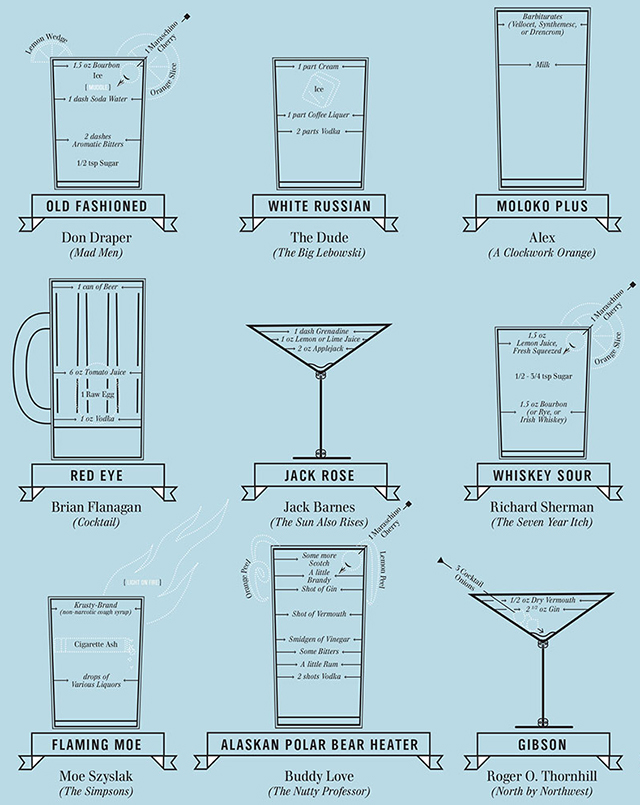
After the jump is a portion of the Cocktail Chart of Film & Literature, a “catalog of 49 drinks culled from great works of film and literature”:
IDEAS: Are there… old curses that 21st-century people would be surprised to hear about?
MOHR: Because [bad words] were mostly religious in the Middle Ages, any part of God’s body you could curse with. God’s bones, nails, wounds, precious heart, passion, God’s death—that was supposedly one of Queen Elizabeth I’s favorite oaths.
IDEAS: Have religious curses like that lost their power as the culture becomes increasingly secular?
MOHR: We still use them a lot, but we just don’t think of them as bad words. They’re very mild. If you look at lists of the top 25 swear words, I think “Jesus Christ” often makes it in at number 23 or something. … The top bad words slots are all occupied by the racial slurs or obscene—sexually or excrementally—words.
IDEAS: You mentioned Queen Elizabeth cursing. Do all kinds of people swear?
MOHR: Everyone swears. People tend to think lower-class people swear more, and this is an old idea. There are old [expressions] like, “He swears like a tinker.” The Victorians were convinced that the only people who swore were lower class, uneducated, horrible people. Modern studies do bear out that people in the lower working class…swear the most and use the worst words.
But also there’s this idea historically that aristocratic people swear a lot, and that’s also borne out by modern studies: People in the highest social classes [also] tend to swear more and use worse words. Not as bad as the people in the quote-unquote lower classes, but much worse than people in the middle class. There’s this idea that middle-class people are strivers, who really need to differentiate themselves from the lower class. One way they do that is by having very clean, very proper language.
Interesting[ly], there is good evidence that swear words are handled differently by the brain than non-swear words. In global aphasia, a form of almost total language impairment normally caused by brain damage to the left hemisphere, affected people can still usually swear despite being unable to say any other words.
Meet dabs, “a type of solidified hash oil also known as ‘concentrates,’ BHO (Butane Hash Oil) or more popularly, ‘wax’—so-named for its texture and glassy appearance”:
Most commonly created by a technique in which high quality pot is blasted with butane that is then extracted, these cannabis concentrates approach 70%-to-90% THC. Going on the basis of such super high purity alone, even the funkiest colored tricone crystal encased high-grade leaf start to look like steam technology in a fossil fuel world. Brad Gibbs, of Greenest Green, which has just opened a new state-approved lab in Denver Co., filled with $100,000 in equipment, specializing in BHO, says that the new product is so superior, buds will eventually disappear, at least among, “our generation,”—users under 40. “Dabs are the future of cannabis, both recreational and medicinal,” he adds.
Tiny amounts can be inhaled through a vaporizer, giving it “near invisibility to law-enforcement.” High Times investigated dabs back in 2012 and warned of the dangers of making it at home:
Assuming we’re able to dismiss the health risks, there is still the public-relations issue: namely, that because the techniques used to make and consume BHO bear an eerie resemblance to those used for harder drugs like meth and crack – and because its potency is so much higher than regular weed – dabbing is ripe for exploitation by the prohibition propaganda machine. At a time when the acceptance of marijuana among the general public is higher than ever, there’s a fear that seeing teenagers wielding blowtorches or blowing themselves up on the evening news might incite a new anti-pot paranoia that could set the legalization movement back decades.
A wedding poem can’t be too irreverent, too abstract, too weird, too long, or too sexual. It must speak to a private relationship in a public setting. (The poet’s own private lives mustn’t be too distasteful, either: Ted Hughes and Sylvia Plath are out.) Your grandmother should enjoy it, but so should your friends. Like the baby names favored by couples who have wildflower-and-mason-jar weddings, the poem must somehow be classic and unusual at the same time. It must summarize your love: the stories you tell about its past, its abundance in the present moment, and your deepest hopes for its future.
So who is today’s go-to poet?
[Kahlil] Gibran has fallen out of fashion, it seems, and been replaced by E. E. Cummings, whose “i carry your heart with me (i carry it in / my heart” recurs over and over in anthologies, anecdotes, and online lists of suggested readings. … You could look at Cummings as a favorite son for our era, because he enjoys a popular reputation as an experimental poet even though much of his work makes perfect conventional sense. “I carry your heart with me” is not exactly an indecipherable sentiment, but its punctuation and meter give it a frisson of sophistication. My first reaction to this is a snobbish one: Cummings as cliché.
But it’s not such a bad thing, or even an embarrassing one, that modern brides and grooms gravitate to the same poems over and over.
Despite our best attempts at uniqueness, we have generated a canon (as people do). And so what if the canon shifts over time (as canons do)? If, in 30 or 40 years, Cummings brands an early-21st-century wedding as indelibly as Gibran brands a 1970s wedding, well, so be it. Marriage means stepping into an ancient institution marked by hundreds of temporal particulars—everything from the cut of the bride’s dress to who is legally allowed to marry. We hope the marriage lasts forever, but we have to expect the wedding itself will age. Maybe we’ll all look back on our wedding poetry the same way we’ll look back on our wedding photos: with a fondness for those young, goofy people who had no idea how their tastes would change, or what was to happen to them.
Salman Rushdie ruminates on a writer’s relationship with race and geography:
“Western writers have never doubted that their subject matter is interesting—even if it’s very local or parochial,” he said, and advised all writers to “just make the same assumption.” He also noted that Western writers have also felt free to write about any place in the world, not just where they’re from, and “nobody calls them deracinated.” He was buoyed by the fact that Indian writers are now embracing this same freedom, and writing fiction set all around the globe, refusing “to be caged by origin.”
When asked if he had advice for young writers trying to escape being pigeonholed by where they’re from, Rushdie answered quickly and with a big grin: “No tropical fruit in the title… avoid that shit.”
Contemplating how TV shows become addictive, Andrew Romano looks to a study (pdf) that suggests certain formats command more of our attention:
Employing fMRI technology, [psychologist Uri] Hasson and his neuroscience colleagues screened four film clips—from Sergio Leone’s The Good, the Bad and the Ugly, Alfred Hitchcock’s “Bang! You’re Dead,” Larry David’s Curb Your Enthusiasm, and an unedited, single-camera shot of New York’s Washington Square Park—and then watched as viewers’ brains reacted. Their goal? To measure the degree to which different people would respond the same way to what they were seeing.
The results varied widely, depending on which film was shown. The unstructured, “realistic” video from Washington Square Park, for instance, elicited the same neurological reaction in only about 5 percent of viewers. Responses to Curb Your Enthusiasm were slightly more correlated, at roughly 18 percent; and The Good, the Bad and the Ugly ranked even higher, 45 percent. But ultimately, Hitchcock was the runaway “favorite”: a full 65 percent of the study’s cerebral cortices lit up the same way in response to the clip from “Bang! You’re Dead.”
Hasson’s conclusion was fascinating:
[T]he more “controlling” the director—the more structured the film—the more attentive the audience. “In real life, you’re watching in the park, a concert on Sunday morning,” Hasson tells me. “But in a movie, a director is controlling where you are looking. Hitchcock is the master of this. He will control everything: what you think, what you expect, where you are looking, what you are feeling. And you can see this in the brain. For the director who is controlling nothing, the level of variability is very clear because each person is looking at something different. For Hitchcock, the opposite is true: viewers tend to be all tuned in together.”
Is it possible, then, that the recent trend toward more structured, page-turning narratives on television might be generating ever-higher levels of cerebral correlation—and viewer engagement—in living rooms across the country?


 The Dish