Venezuelans find out the hard way why price controls are a bad idea – the entire country is running short of toilet paper.
Month: May 2013
Rumsfeldfreude
A reader catches Kai Ryssdal committing journalism:
I don’t know if y’all had a chance to listen to Donald Rumsfeld being torn a new one on Marketplace yesterday, but it was glorious to hear. Rummy was no doubt expecting softball questions about his new book Rumsfeld’s Rules and instead was grilled about how the wisdom in his book is in stark contrast to his work with Iraq and Afghanistan. I’ve never felt a man squirm through airwaves like that.
Listen to the whole interview here. Before he decided to commit war crimes, I knew Rummy as an acquaintance, stayed at his house in Taos, dined with him, and often argued with him. He’s fun to argue with, but when cornered, he simply shuts you down.
I remember asking him before the Iraq war why the US was firing Arab linguists just because they were gay. Didn’t we need every Arab linguist we could get? He point blank refused to admit it was happening at all. He openly asked how someone as allegedly smart as I was could be so misinformed. In front of others, he dressed me down for my ignorance. I did not give in, but I did make a mental note: this guy is dangerously out of touch with reality, even as he insists he alone grasps reality.
His invasion and occupation of Iraq alone should render the only response to his “rules book” a blast of hysterical laughter. Or the kind of honest interviewing you’d never get from Politico.
But this man should not be interviewed anyway. He should be arrested.
Behind The AP Investigation
A must-read by Shafer on the broader implications of a leaker or leakers within the administration prematurely divulging the existence of an inside mole in al Qaeda.
“Scandalzzzz”
A new poll finds the following:
The amount of attention Americans are paying to the IRS and the Benghazi situations is well below the average for news stories Gallup has tracked over the years. This overall lack of attention is due in part to Democrats’ and, to a lesser degree, independents’ lack of interest, which stands in sharp contrast to the significantly above-average attention among Republicans.
There’s a real issue about the outrageous abuse of power in the Cincinnati office of the IRS – and heads have, should, and will roll. But talk of impeachment, unhinged rants like Noonan’s, and the total lack of any constructive policy proposals, except repeal of Obamacare, does not rescue the GOP. If they’re not careful, and the rhetoric keeps intensifying, they’ll begin to look like paranoid fanatics. That didn’t work even when there was a presidential scandal – of president Clinton perjuring himself. Why would it when this president – so far – is not implicated in any of these stories in any way? Then there’s this polarization:
There is a 21-percentage-point gap between Republicans and Democrats in terms of following the Benghazi story closely, and a 27-point gap on the IRS story.
On Benghazi, Independents are more like Democrats. On the IRS, they’re more like Republicans.
Only At Politico
In the midst of their favorite political week in months, the editors ask the question we’re all asking of the current Obama doldrums: “What Would Cheney Do?” I kid you not. John Harris says that’s a question that often comes up in their office.
Cheney, a war criminal, remains one of their icons. But his chief lackey, Mike Allen, stays quiet. Good call, Mike.
Buying Good Press
First Oprah Moment…every developer at I/O…YOU’RE getting a Pixel and YOU’RE getting a Pixel and YOU’RE getting a Pixel..!!!!!
— Andy Ihnatko (@Ihnatko) May 15, 2013
Jeff Saginor is bothered by the $1,299 gift bag that Google gives away free to attendees of its annual Google I/O conference:
[T]his year at I/O, Google upped the ante, giving everyone in attendance a Chromebook Pixel—a laptop running Google’s own operating system, retailing for $1,299. It’s the equivalent of Apple handing everyone a MacBook Pro on the way out the door. It made headlines across the web. And it’s everything that’s wrong with tech reporting.
Technology events are not giveaways for Oprah’s favorite things—journalists don’t get to go home with bags full of expensive toys and then pretend to critically cover the companies that bribe them. As James Temple explains in The San Francisco Chronicle, tech writers will “tell you they’re routinely offered pricey gift baskets and all manner of smart phones, software, tablets and computers, often with no obligation to return or write about them.” And last year, Brad Stone of Businessweek wrote that reporters at a Spotify launch party in San Francisco were treated to $300 bottles of tequila as parting gifts. It happens constantly. Of course most reporters don’t accept the gifts. But the casual relationship undermines the nature of serious technology reporting.
Noonan Just Loses It
My late night screed on her deranged column today can be found here.
What IRS Scandal? Ctd
A few readers with tax expertise chime in:
All I do all day is advise c3s and c4s on this stuff (only liberal and nonpartisan ones – so I write this email as an ideological opponent of the Tea Party groups). And I can tell you Noam’s argument is off. Only a very experienced nonprofit tax lawyer is likely to know that c4s don’t have to file IRS Form 1024 in order to be recognized as tax-exempt. In fact, within the past few months, it was a topic of discussion on an email list of nonprofit tax lawyers, with the “experts” trying in vain to find confirmation from the IRS that these groups aren’t required to file.
Most importantly, the IRS deceptively tried to get groups to think they needed to file.
If you’re a grassroots group of activists trying to figure out the law without paying an expert, you’d never know you can skip the 1024. An activist would do some Googling and find IRS Publication 557, which says on pg. 57, as the first sentence of the section on c4s: “If your organization is not organized for profit and will be operated only to promote social welfare to benefit the community, you should file Form 1024 to apply for recognition of exemption from federal income tax under section 501(c)(4).” (Not the IRS used “should” rather than “must.” Who but a tax lawyer would notice?) In addition, earlier this year the IRS issued a new revenue procedure (Rev. Proc. 2013-9) that was intended to force c4s to file a form 1024.
So it’s only the big, well-funded c4s that would know enough to skip the 1024, and the IRS is changing its rules to try to get them to file, too.
Another:
An accounting professor here. Scheiber’s argument is weak at best. Yes, a social welfare organization can theoretically operate as a tax exempt entity without filing for 501(c)(4) status. However, being tax exempt is not the point. After all, PACs and Super PACs are also tax exempt entities. A social welfare organization cannot represent to the public (i.e., donors) that they are a 501(c)(4) without applying for recognition as such (by filing form 1024). What distinguishes 501(c)(4)s from (explicitly) politically-minded tax exempt entities is that they don’t have to disclose their donors. If a social welfare organization wants to represent to its donors that they will remain anonymous, the only way of doing so is applying for 501(c)(4) status.
For what it’s worth, saying these guys singled themselves out is even worse. The IRS chose to conduct a further review of a disproportionate sample of those who applied. That is, even among those who “singled themselves out”, the IRS further singled out tea party groups. Is it a big scandal? Maybe not. But it is unfair to dismiss the whole thing as meaningless.
The Global Fertility Decline

Martin Lewis wants more attention paid to it:
I find it extraordinary that the massive global drop in human fertility has been so little noticed by the media, escaping the attention of even highly educated Americans. The outdated idea that Mexico has a crushingly high birthrate continues to inform many discussions of immigration reform in the United States, even though Mexico’s TFR (2.32 in 2010) is only slightly above that of the United States.
It almost seems as though we have collectively decided to ignore this momentous transformation of human behavior.
Scholars and journalists alike continue to warn that global population is spiraling out of control. A recent LiveScience article, for example, quotes a co-author of an April 2013 Science report who argues that “the poorest nations are caught in a downward spiral that will deplete resources and cause a population explosion.” The article goes on to argue that “with the world population slated to hit 9 billion by the year 2050, many scientists and others worry that unchecked population growth and increasing consumption of natural resources will cause dire problems in the future.”
Although the LiveScience article notes that the original report focused on sub-Saharan Africa, it does not mention the fact that high birthrates are in fact increasingly confined to that part of the world, or that fertility rates are persistently declining in almost every country in Africa, albeit slowly. Many African states, moreover, are still sparsely settled and can accommodate significantly larger populations. The Central African Republic, for example, has a population of less than 4.5 million in an area almost the size of France.
(Chart from Mark Perry)
Quantifying Conflict
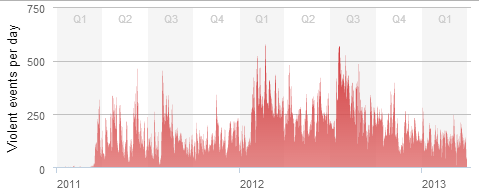
New Scientist created the above graphic, which tracks the number of violent events per day in Syria since the beginning of 2011 as calculated by the Global Data on Events, Location and Tone dataset:
As Western leaders ponder intervention, the resulting view suggests that the violence has subsided in recent months, from a peak in the third quarter of 2012.
Jay Ulfelder pushes back:
The reason GDELT’s count of violent events has diverged from other measures of the intensity of the violence in Syria in recent months is probably something called “media fatigue.” Data sets of political events generally depend on news sources to spot events of interest, and it turns out that news coverage of large-scale political violence follows a predictable arc. As Deborah Gerner and Phil Schrodt describe in a paper from the late 1990s, press coverage of a sustained and intense conflicts is often high when hostilities first break out but then declines steadily thereafter.
 The Dish