Face Of The Day

Animal Rescue Group Takes In Cats And Dogs Displaced From Oklahoma Tornadoes

Melissa Lipman, a veterinarian technician volunteer, cares for a dog rescued from the ruins after a deadly tornado struck near Oklahoma City at the Tri County Humane Society in Boca Raton on May 30, 2013 in Boca Raton, Florida. Workers at the animal shelter brought 65 dogs and 15 cats back from the disaster zone last night with plans to treat the animals for injuries, give them needed shots and adopt them out to families in about a week. By Joe Raedle/Getty Images.

Fined For Hiring Americans

John Judis identifies a problem with the immigration bill denying Obamacare access to formerly undocumented immigrants – due to Obamacare’s employer mandate, “employers will be able to save from $2,000 to $3,000 a year by hiring a new immigrant over an American citizen”:

The bill’s denial of coverage doesn’t only give immigrants an advantage over citizens when it comes to new hires. It also gives larger businesses that employ immigrants a reason to drop insurance altogether. If they offer insurance to one employee, they need to offer it to all employees, including immigrants. But if they deny it to everyone, they’ll only pay fines for workers who are citizens.

Why this is a big issue:

As a Center for Immigration Studies report has shown, most jobs thought to be filled only by immigrants are, in fact, filled by a majority of native-born Americans. That includes 64 percent of grounds-maintenance workers, 66 percent of construction laborers, 73 percent of janitors, 51 percent of maids and housekeepers, and 63 percent of butchers and meat processors. Even on farms, the native-born constitute at least a third of the workforce. What seems to have misled people like [Lindsay] Graham is that many of the workers in these occupations are Hispanic—Graham has reported finding only “Hispanics” at some South Carolina workplaces—but Hispanic citizens make up a growing percentage of the American working class, and they too could lose employer health insurance because of immigration reform’s Obamacare loophole.

Iran Non-Election Update

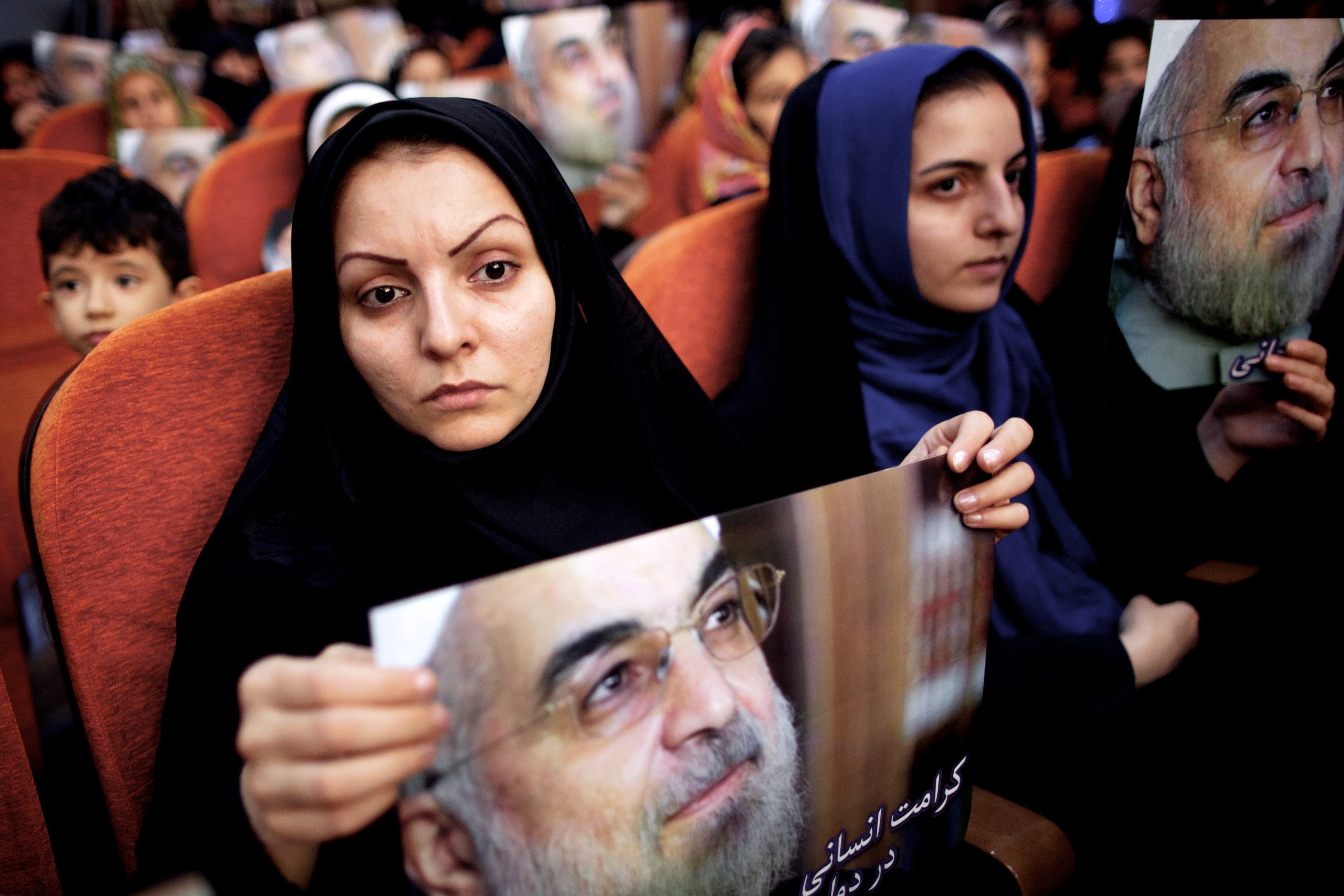
IRAN-POLITICS-VOTE-ROWHANI

Abbas Milani zooms in on the aftermath of Rafsanjani’s disqualification:

On the one hand, sources representing the conservative ruling coalition deny that Rafsanjani’s fitness to serve as president has been rejected. “His fitness was simply not confirmed,” these sources claim. Other sources, like the daily Keyhan, the most reliable reflection of Khamenei’s views, have suggested that Rafsanjani in fact owes the Guardian Council a debt of gratitude. Reformists and opponents of the regime, Keyhan claims, were planning to use Rafsanjani against the regime, and the rejection of his candidacy saved him from this fate of becoming a puppet of the opposition, and of the U.S. and Israel. (By this logic, the man who is responsible for deciding what is “expedient” for the regime is somehow incapable of deciding what is expedient for himself.)

And lest there be any doubt about Khamenei’s real source of power, consider his first major appearance after the Guardian Council announced its list of approved candidates: He asked the Iranian people to vote for those who will stand up to the enemy, and said that those who were not allowed to run have nothing but themselves to blame—all while surrounded by [Revolutionary Guard (IRGC)] commanders and other military officials. A couple of days later, Iran’s police chief—another IRGC commander—announced that 300,000 policemen will be on hand on election day to forcefully abort any attempted demonstrations.

Milani sees the upcoming election as little but the regime’s continuing quest to consolidate power:

Unless there is a deus ex machina, Khamenei is unlikely to get the political “epic”—massive voter turnout—he repeatedly says the regime needs and wants. Instead, Iran is more likely to take yet another step toward becoming a Praetorian despotism dominated in every domain—politics, construction, oil, media, even soccer—by the IRGC.

Gareth Smyth goes over the campaign rhetoric thus far:

[N]either [the perceived frontrunner Saeed] Jalili nor any other candidate has so far offered much in the election other than banalities – despite Iran’s mounting problems, which now centre on the reduction of oil exports from 2.2m barrels a day to 1.1m in the past year due to tightening western sanctions. … In the face of 13% unemployment and 32% inflation, candidates have been slow to advance specific ideas for improving economic growth the IMF projects at -1.3% for 2013, or to explain how they might finance productive investment with lower oil sales cutting government revenue in the financial year ending in March from a budgeted $117bn (£77bn) to $77bn.

But a silver lining in this week’s news: the US relaxed the Iranian sanctions on laptops and mobile phones in an effort to help Iranians use technology to overcome the regime’s propaganda.

(Photo: Iranian supporters hold posters featuring Hassan Rowhani, moderate Iranian presidential candidate and former top nuclear negotiator, during one of his electoral campaign rallies in northern Tehran on May 30, 2013. Rowhani, the only cleric in the race, says his experience in leading talks with the so-called P5+1 group – the United States, Russia, China, France, Britain plus Germany – could help resolve the nuclear standoff. By Behrouz Mehri/AFP/Getty Images)

Quote For The Day II

“There’s something about realizing that marriage is opt-in — which it is now, marriage is always opt-in, at any moment you can opt out — it’s almost like you have to earn your partner’s presence in your life. … You cannot take them for granted in a way that you could when it was one woman, one man, for life,” – Dan Savage, in conversation with yours truly a couple of nights ago at the New York Public Library.

Dan and I just also recorded a podcast together. It will be part of a series of conversations called “Andrew Asks Anything” that we’ll be releasing exclusively to subscribers this fall. Stay tuned.

Explain This, Mr Carlson

EOP_Complex

Dish readers do what they do best:

I shared the same concern regarding the disclosure of IRS Commissioner Shulman’s visits to the White House.  But they were quickly assuaged when I looked at the actual data, which can be downloaded here.  Your reader on your updated post seems absolutely correct – looks like many (if not most) of those visits were about health care. I engaged in a cursory review of the first 20 or so Shulman entries, and virtually all were with individuals involved with the health care reform proposal.  In particular, the contact for most of the initial meetings was Nancy-Ann Deparle, the Deputy Chief of Staff for Policy, who was at the center of shaping health care reform.  One entry specifically notes that it was for the “bi-weekly health reform deputies meeting.”

I did not review all the entries, and it is conceivable that there are others that raise suspicions.  But the log make one thing very clear: “visiting the White House” does not mean a meeting with the president.  Typically, it means (and apparently did in Shulman’s case) meetings with policy wonks and other staff.  Given Shulman participation in such policy meetings, it is hardly surprising that he was there frequently, or that a lower-level official might be present at the White House far more often than a cabinet secretary.

Finally, let’s remember our source here.  Today, the Daily Caller had an article on the nomination of James Comey to head the FBI.  The article describes Comey’s role in a highly successful Virginia law enforcement program targeting gun violence through higher penalties, that was supported by the NRA.  The headline regarding this former No. 2 at the Bush Justice Department?  “Comey, anti-gun Chicago-trained enforcer, reportedly tapped to run the FBI”.

This is who is now taken seriously in this debate.

I am sorry to give this crap any air. But it’s worth putting it out there if only to expose even further the toxic bullshit that Tucker Carlson now peddles under the guise of journalism.  Another reader:

I just downloaded the logs for Shulman’s visits, most of the visits are with Nancy DeParle (40) or Sarah Fenn (54), both of whom were deeply involved in health care policy.  The only other person to have more than 10 visits was Jason Furman from the CEA (11).  If the White House was hatching a conspiracy, it seems hard to believe these would be the people doing it.

Another explains the above map:

One basic fact that has not been reported clearly is that when people say they visited the “White House” they are often talking about any one of the three buildings in what is referred to as the “EOP” Executive Office of the President complex. This includes the Eisenhower Executive Office Building (formerly the Old Executive Office Building or OEOB), Treasury and the White House (WH), among others.

If you look at the White House visitor log data in the “meeting_loc” column, you can see where in the EOP visitors were headed. There are listings for WH, NEOB (the New Executive Office building), and OEOB (the old executive office building).  I’ve only looked at the file for 2009-2010, but you’ll see that only 3 out of Shulman’s 25 visits were to the WH, all the others were to OEOB, and 17 of those 22 visits list Nancy Deparle as the person he was visiting.  If this pattern holds through 2010-2012, the significant majority of his visits were to the office building next to the White House.

Claims that Shulman was an IRS chief “uniquely at home in the White House” – as the Daily Caller puts it – are meant to conjure up images of Obama, senior staff and Shulman in the Oval Office plotting Nixonian dirty tricks against enemies.  But the data points to a more mundane reality.  When senior staff with offices in the OEOB wanted to talk with the IRS Commissioner about the ACA, he was expected to come to them.

Another resourceful reader:

Visit the visit log at whitehouse.gov and do a search for Julius Genachowski (chairman of the FCC, a non-cabinet level post fairly equivalent to the Commissioner of Internal Revenue, as both are presidential appointments for essentially independent agencies created by acts of Congress). Genachowski has been in his position about the same length of time as Shulman. According the records, he’s been logged as visiting 142 times. So someone who serves in a similar position to Shulman’s, for a similar length of time, has been signed into the White House roughly the same number of times.

Every other name on the Daily Caller’s list (with the exception of Thomas Perez, who has been Asst. USAG for Civil Rights since 2009) is either of a current or past member of the Cabinet (who, as even the Caller points out, are highly unlikely to have every visit registered), many of whom served only relatively brief tenures (at least compared to Shulman). Joe Biden himself has only been signed in seven times … and I imagine he’s been in the White House more often than Shulman and Genachowski combined.

In other words, this chart is straight up apples-to-oranges. Apples-to-apples (Shulman-to-Genachowski) is a more apt comparison, and one that indicates that the President doesn’t really owe you (or anyone else) an explanation. Yet another great big nothing-burger from the Right Wing Scandal Mill.

Obamacare’s Inequalities


Where the States Stand

TNC covers them:

[I]if you look at a map of which states are refusing the Medicaid expansion, and then look at this report from the Urban Institute, a troubling (if predictable) trend emerges. Approximately a fifth (about 18 percent) of all people who will remain untouched by the Medicaid expansion are black. When you start drilling down to the states where those black people tend to live, it gets worse. In Virginia and North Carolina, 30 percent of those who are going to miss out are black. In South Carolina and Georgia, the number is around 40 percent. In Louisiana and Mississippi, you are talking about 50 percent of those who would be eligible for the expansion but who will go uncovered.

You look at Latinos and get a similar (and to some extent worse) picture.

In a follow-up post, he considers how these facts will impact entire communities:

What the state won’t cover, private citizens must. Those citizens will tend to be black. The people who will have to drain their savings will be black. The people who will take out second mortgages will be black. The people who will pick up second jobs (if they can even get them) and miss parenting time will be black. You can multiply this out across social policy, and see how a wealth gap might be perpetuated.

Policing Facebook

Amanda Marcotte praises the site for cracking down on content containing hate-speech against women:

This is good news, because things had gotten ugly. Women Action & the Media collected some examples of offensive posts, which included images of women who had been murdered, young girls being raped, and pictures of women tied up or assaulted with “joking” encouragement for men to rape and beat women. In one case, the example (a picture of a murdered woman with the caption, “I like her for her brains”) included a response from Facebook saying that the image didn’t violate its terms of service.

Jillian C. York dissents:

For years, activists all over the world have complained of arbitrary takedowns of content and unfair application of Facebook’s “real name” policy. Along with breastfeeding moms are people like Moroccan atheist Kacem Ghazzali, whose Facebook pages promoting atheism in Arab countries were regularly removed.  Before he rose to fame as the man behind the January 25 protests in Cairo, Wael Ghonim experienced a takedown of his famous “We Are All Khaled Said” page because he was using a pseudonym.  And not a week goes by where, as director for international freedom of expression at the Electronic Frontier Foundation, I don’t receive emails from individuals from the United States to Hong Kong telling me their account was deleted “for no good reason.”

This happens because the company is merely unequipped to deal with the sheer number of complaints it receives on a daily basis. One billion users undoubtedly translates into millions of reports through Facebook’s system, a system about which the company is famously opaque.  Whether these reports are fed through an algorithm or dealt with individually remains unclear, but what is certain at this point is that, like the atheism example above, many such reports are false positives. So while Facebook is well within its rights to determine what types of speech it wants to host, the company is inconsistent at best at managing its own policies, and at worst, biased in those policies.

Alyssa zooms out:

[T]here is no “YouTube Community” or “Facebook Community” with an agreed-upon set of standards for what constitutes hate speech or inappropriate content. There are multiple communities that are in some cases violently at odds. And if social media or technology companies want to keep some of their users–and as it seems, some of their advertisers–those companies may have to decide between their user communities when they come into conflict.

This is in violation of both tech-libertarian ideals and market principals that suggest that internet communities should be able to regulate themselves successfully, editing out offensive content and expelling members who don’t adhere to stated or unwritten codes of conduct. In reality, this has proven to be less true. Gated communities like the pay-to-play site Ask Metafilter, or heavily moderated sites like Ta-Nehisi Coates’ blog at The Atlantic exist, but they’re considered exceptions rather than the general rule, which tends more towards a consensus around sentiments like “don’t read the comments.” Sites like Facebook and YouTube aren’t so much communities as platforms on which many communities, some of them dedicated to the eradication of the ideas or sentiments expressed by others, can operate.

Shafer compares Facebook to the TV networks of old:

At the risk of reading Facebook’s mind, I suspect its capitulation has less to do with expunging transgressive content from its pages than protecting the flow of corporate advertising dollars that prop up its $56 billion market cap. Radio and television broadcasters were equally sensitive to protests and boycotts back in the old days when their business models — like Facebook’s — were providing a free, advertiser-supported service.

Whole “standards and practices” divisions were established at the networks to sanitize TV shows lest they offend. This CNN timeline of TV censorship gives you an idea of how aggressively corporate censors worked to keep such obscene words as “pregnant” off the air, to obscure Elvis Presley’s gyrating pelvis, to block the bare navels of Gilligan’s Island‘s Mary Ann, I Dream of Jeannie‘s Jeannie, and Gidget from the visual field of viewers.

But as radio and television began to migrate from their free venues to paid ones, that which was once forbidden has become almost compulsory. Smutty talk and naked bodies that would have given a network censor a brain hemorrhage back in the 1960s have been proliferating on every channel — even on the free channels!

The Obama Nerds Go NGO

Ted Greenwald checks in with the Big Data brains partly responsible for the president’s reelection:

[S]ome veterans of the campaign’s data squad are applying lessons from the campaign to tackle social issues such as education and environmental stewardship. Edgeflip, a startup [Rayid] Ghani founded in January with two other campaign members, plans to turn the ad hoc data analysis tools developed for Obama for America into software that can make nonprofits more effective at raising money and recruiting volunteers. … In Chicago, Ghani’s hometown and the site of Obama for America headquarters, some campaign members are helping the city make available records of utility usage and crime statistics so developers can build apps that attempt to improve life there. It’s all part of a bigger idea to engineer social systems by scanning the numerical exhaust from mundane activities for patterns that might bear on everything from traffic snarls to human trafficking. Among those pursuing such humanitarian goals are startups like DataKind as well as large companies like IBM, which is redrawing bus routes in Ivory Coast (see “African Bus Routes Redrawn Using Cell-Phone Data”), and Google, with its flu-tracking software (see “Sick Searchers Help Track Flu”).

Working for non-profits doesn’t have the same draw as other Big Data opportunities:

But one thing stands in the way of this vision: a lack of data scientists interested in applying their skills to social problems. … “A lot of the people who have the skills to do this kind of work end up working for Facebook, Google, or the latest online ad network,” [Ghani] says. “[I want to] show them that the same kind of data is available here, and the impact is bigger.”