Like me, Conor is opposed to using IQ scores to determine immigration eligibility. He observes that “barring the hypothetical low IQ people would imply that intelligence determines worth, and that our project as a nation is intimately tied to constantly maximizing material wealth”:
I wouldn’t go so far as to say that recruiting human beings with impressive skills is illegitimate. In fact, I think it is prudent, and I’m glad that lots of talented scientists, athletes, artists, and programmers want to come here. More, please. I’m glad that lots of farm workers and janitors want to immigrate too. I recognize that the economic contributions of the two groups are different, but I don’t conclude that the low skill immigrants are less worthy of citizenship or less valuable citizens. Are they kind? Honest? Wise? Fun? Hardworking? Inclined to embrace core American values as articulated in the Declaration of Independence? To what extent do they participate in the civic process? Do they raise children who flourish? Do the best of their ethnic traditions and cultural insights enrich the American character? Do they contribute to the common defense? Are they invested in their new country? It’s amazing how often bygone immigration debates have focused on a couple narrow metrics to the exclusion of all else. There are so many important traits, and seemingly no one clamoring to measure or recruit for most of them.
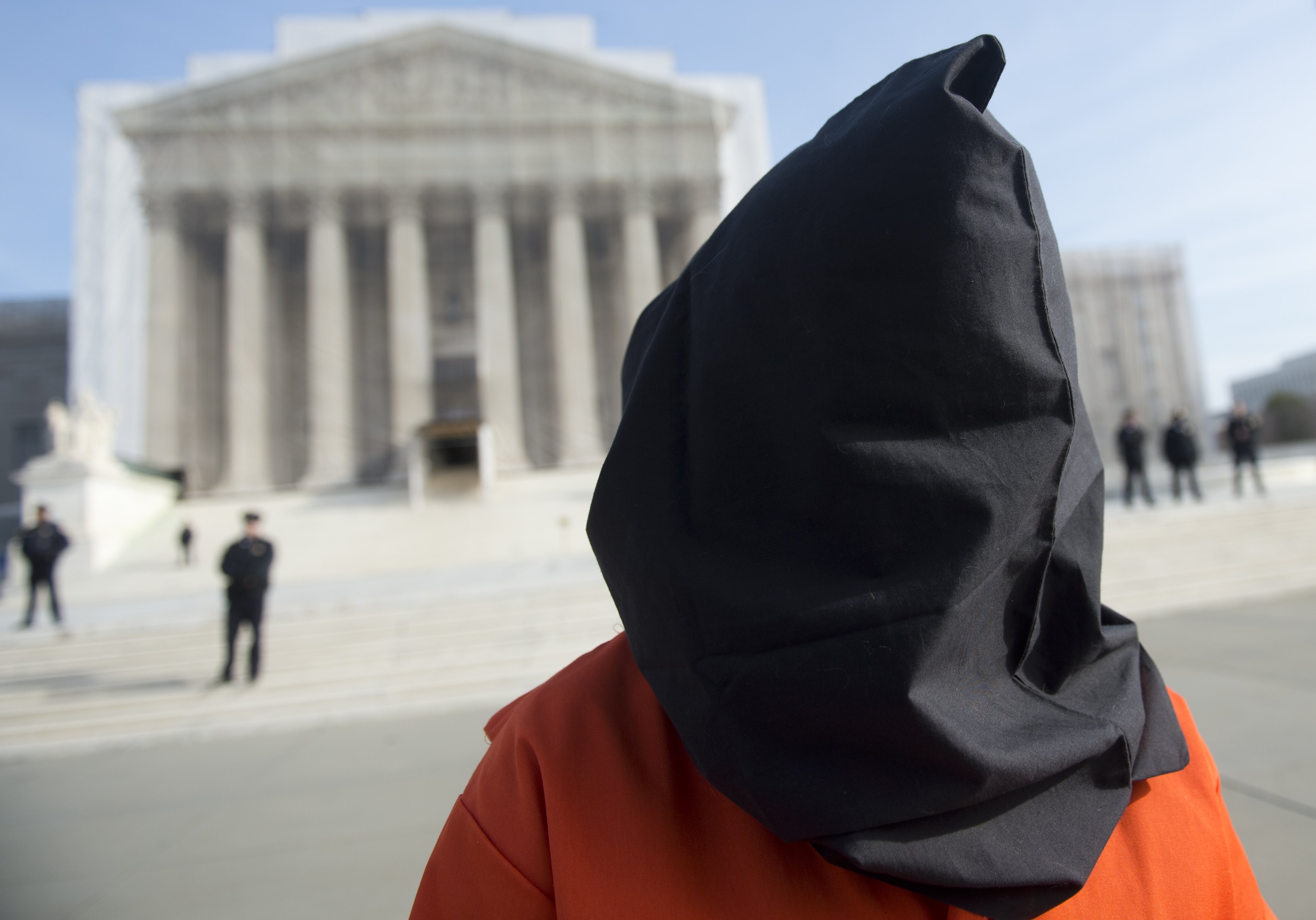
Daniel Klaidman reports something I’ve also picked up from my sources: that “Obama plans to address both Guantánamo and drones—another festering, controversial element of the administration’s national-security agenda—in a broad ‘framing’ speech that will try to knit together an overarching approach to counterterrorism.”
The speech could well serve as the White House’s opening shot in its new campaign to solve the Guantánamo riddle. But Obama’s critics will be skeptical—likely branding it another attempt to bend the arc of history with mere eloquence. It would fit a pattern on rule-of-law issues, they say, in which Obama’s lofty rhetoric is rarely followed by resolute action—especially when it comes to standing up to Congress. According to this narrative, Obama expresses righteous indignation, but then is persuaded by his political team that the time is not right to fight. Or he threatens to veto legislation that shackles him on Guantánamo, but then fails to go through with the threat. The dynamic, critics say, creates a self-fulfilling cycle that emboldens congressional Republicans and weakens the president.
There’s plenty of evidence to support this interpretation of events. On the other hand, it also arguably downplays the blunt reality that any president needs to prioritize his policy initiatives. When Team Obama began its bid to close Guantánamo in 2009, it was still trying to stave off economic depression, save the banking system, and bail out the auto industry. Later, Obama chose health-care reform as his signature domestic initiative—an all-consuming political struggle that left the White House with little bandwidth to fight on multiple other fronts. Something had to give. For Obama, it was Gitmo.
His supporters also argue that instead of giving up, Obama has shifted to a long-road strategy, which sometimes requires backing down from epic confrontations in the hope that over time the politics will turn his way. In at least one area—prosecuting suspected terrorists in civilian courts—that approach may be working. Though Obama caved to criticism and backed down on trying KSM in court back in 2011, he subsequently decided to have a string of captured terrorists tried in the civilian justice system, the latest being Dzhokhar Tsarnaev, the surviving Boston bomber. Over time, the criticism has dwindled to barely a peep.
(Photo: A protestor wears an orange prison jump suit and black hood on his head during protests against holding detainees at the military prison in Guantanamo Bay during a demonstration in front of the US Supreme Court in Washington, DC, on January 8, 2013. By Saul Loeb./AFP/Getty Images)
As a Dishhead and an officer in the National Guard, I feel I should chime in on this issue. It’s been a disgraceful year, and the reforms called for by Sen. Gillibrand are badly needed. Frankly, the UCMJ needs to be completely overhauled and brought into the modern era. Sodomy shouldn’t still be codified, for instance. Commanders with no legal experience have way too much power over their troops, and as was seen with the Air Force officer who overturned a sexual assault court martial finding of guilt, it’s prone to secrecy and misuse.
But culture needs to change too. Have a stop over at the military subreddits and read the comments on any story dealing with anything regarding rape, sexual assault, gender issues, or sexual harassment. It’s endless choruses of “False accusations are the norm! Female soldier/Marine/airman/sailor was asking for it! You can never trust women when left alone!” with only the occasional sane person chiming in. Unfortunately, it’s an accurate reflection of the private talk that goes on in barracks, company areas, and motor pools.
That’s how you get SHARP coordinators charged with sexual abuse. That’s how you get the Air Force’s head of sexual assault prevention charged with sexual assault. That’s how you get the most lauded military officer in recent history embroiled in an adultery scandal with another military officer.
Another:
As someone (female) who served for six years in the enlisted side of the Navy, and was subject to quite a bit of “programming” on a myriad of subjects, I call bullshit on this reader. One-hour powerpoints once a quarter is not taking anything seriously. Allowing C.O.s to judge cases that might effect their manning in a negative way is not taking rape seriously.
To address the reader’s point directly, this is not an amorphous societal issue that one can hand wave away as something that will eventually fade with the cultural tides. This is a very specific issue of women having been poorly integrated into some parts of the military, seen as interlopers, and therefore deserving of any ill-treatment they might get. With a terribly bitter culture that says anything a military woman gets was ill-gotten, that a woman isn’t a real soldier or sailor, that any improvements in her standard of living must have come at the expense of a man, it’s very easy for the majority that would never do these things to look the other way.
I don’t know what would help the issue, but I know what doesn’t. Stop the “programming”. It’s designed principally to legally insulate the commander, and it implies that rape is an issue of enlisted who are dumb animals that don’t know any better. It does nothing to address male victims (I saw some appalling statistics on male rape at the 32nd St base in San Diego), and ignores officers who think that droit de signeur is still a thing. Do a better job integrating women into the professional culture, and bring more women into the service overall.
I can’t believe this is the issue that prompted me to write after eight years of reading. Thank you for raising contentious issues.
I don’t know, Andrew. I think you may be a closet cat person. Re-read what you wrote about Dusty; it’s a perfect description of a relationship with a cat.
Another:
I had a dog when I was a kid, then had cats for 20 years – still have one now – and then we got a rescue dog two years ago. The dog is affectionate, loyal (any time you get up, she has to go with you), good with kids, beautiful, healthy. And a pain in the ass. It isn’t just the need to walk her, the barking, the propensity to bolt if you don’t have a good grip on the leash. Rather, it’s that she wants, and deserves, more attention than I can give her, with three young kids, a wife and a cat to boot, a job and a baseball team to help coach.
I think this is why most of the childless people I know prefer dogs. If you have a lot of time and attention (and maybe money) to lavish on a pet, and want something that will be equally devoted in return, a dog’s your best bet. If you don’t, it’s cats all the way.
Dusty is indeed a bit of a cat. Eddy is far more high maintenance. If I don’t give her an hour-long walk every day (I had to cut it short yesterday for a Dish meeting) she will simply poop in the apartment. Or she will so emotionally manipulate me I can be sad all day because I may be neglecting her. Dusty really couldn’t give a damn how I feel about her, as long as she gets her food. But she pisses randomly in the apartment too. But not out of anger. Just because she can.
Waldman asserts that the semantic argument over Benghazi has been ignoring one basic fact:
[H]ere’s what nobody seems to get: Benghazi was not a terrorist act. Or an act of terror. Or an act of terrorism.
As it happens, there’s a nice succinct definition of terrorism in U.S. law, section 2656f(d) of Title 22 of the United States Code, which reads, “the term ‘terrorism’ means premeditated, politically motivated violence perpetrated against non-combatant targets by subnational groups or clandestine agents.” So why wasn’t Benghazi terrorism? Because the people targeted weren’t civilians. As TheWall Street Journal has reported, “The U.S. effort in Benghazi was at its heart a CIA operation, according to officials briefed on the intelligence. Of the more than 30 American officials evacuated from Benghazi following the deadly assault, only seven worked for the State Department. Nearly all the rest worked for the CIA, under diplomatic cover, which was a principal purpose of the consulate, these officials said.” CIA officials are not civilians.
That doesn’t make their deaths any less tragic or painful for their families, but it’s the truth. Nor is a CIA outpost a civilian target.
Charles Mills makes the case dispassionately (and if you have the time, it’s well worth a full listen):
Since I really want to get to the bottom of this, it’s also worth quoting TNC’s latest post on the subject at length:
When the liberal says “race is a social construct,” he is not being a soft-headed dolt; he is speaking an historical truth. We do not go around testing the “Irish race” for intelligence or the “Southern race” for “hot-headedness.” These reasons are social. It is no more legitimate to ask “Is the black race dumber than then white race?” than it is to ask “Is the Jewish race thriftier than the Arab race?”
The strongest argument for “race” is that people who trace their ancestry back to Europe, and people who trace most of their ancestry back to sub-Saharan Africa, and people who trace most of their ancestry back to Asia, and people who trace their ancestry back to the early Americas, lived isolated from each other for long periods and have evolved different physical traits (curly hair, lighter skin, etc.)
But this theoretical definition (already fuzzy) wilts under human agency, in a real world where Kevin Garnett, Harold Ford, and Halle Berry all check “black” on the census. (Same deal for “Hispanic.”) The reasons for that take us right back to fact of race as a social construct. And an American-centered social construct. Are the Ainu of Japan a race? Should we delineate darker South Asians from lighter South Asians on the basis of race? Did the Japanese who invaded China consider the Chinese the same “race?”
Andrew writes that liberals should stop saying “truly stupid things like race has no biological element.” I agree. Race clearly has a biological element — because we have awarded it one. Race is no more dependent on skin color today than it was on “Frankishness” in Emerson’s day. Over history of race has taken geography, language, and vague impressions as its basis.
“Race,” writes the great historian Nell Irvin Painter, “is an idea, not a fact.” Indeed. Race does not need biology.
TNC’s commenters push back in exactly the same way I would. “UDDanB” writes:
– When my wife was pregnant, we saw an OB. She gave us a pamphlet about cystic fibrosis testing. I don’t recall the exact numbers, but the pamphlet said that roughly 1 in 30 Caucasians carry the recessive gene. She didn’t recommend testing because she said the chance that my wife (who is Japanese) has the recessive gene as well is almost incalculably low.
– I know a Jewish couple who just got tested for Tay-Sachs prior to marriage. They said their doctor recommended that they do so (citing the much increased chance of this disorder among Jewish couples).
This is exactly what Andrew Sullivan is talking about. To convince ourselves that all alleged differences among humanity are entirely ginned up in a social context is plainly nonsense to anyone who has ever talked to a doctor about anything similar to the above. The word “race” is a pedantic distraction here – TNC is, of course, correctly that the colloquial use of that term has evolved over time (and is usually flat out inaccurate). Maybe what I describe above is best formulated as “subgroups with genetic differences”- ok, fine. Lets have the primary debate using that term.
I think that reclassification is very helpful, although I’d call it “subgroups with genetic similarities“, i.e. subgroups with specific genetic ancestries that make them different from others. This makes sense from a Darwinian perspective, as TNC notes. Before humankind entered its hyper-mobile modern era, members of the same subgroups in particular places and environments obviously developed more genes in common with each other than with outsiders (skin color is just a superficial one). So we get this sentence in the NYT piece about Angeline Jolie’s genetic marker for breast cancer:
Any woman with ovarian cancer should consider being tested, as should Ashkenazi Jewish women with breast or ovarian cancer.
Is that sentence racist? Of course not. It merely recognizes biological traits that are common in one genetic ancestry rather than others. (Interestingly, the first version of the article simply state “Jewish women” and then added “Ashkenazi.” That’s almost a perfect example of how race can obscure reality, which is that Jews come from two distinct ancestries, Ashkenazi and Sephardim.) But the social racial category – Ashkenazi Jew – does actually correlate with a specific, biological genetic marker. Or take the gene CCR5, which provides immunity from HIV infection. It is not found in Africa – because it was a genetic variation that became more dominant in European populations during the Black Death. In that case, “race” in its crudest sense can be a shorthand for predicting the likelihood of certain genetic variations. But it won’t tell you in any specific case. Most “white” Europeans do not carry CCR5.
If we are discussing “subgroups with genetic differences,” we avoid the pitfalls of race as an overly-broad category. But we do not deny biological genetic differences in these subgroups, which can correlate with various degrees of accuracy with our crude racial terminology.
It’s really futile and I would argue self-defeating for liberals to deny this reality. These days, you can actually find out the exact subgroups with genetic differences that your DNA most closely resembles. You do that by spitting into a beaker and then sending off your DNA sample to Ancestry.com. Here’s what happens:
Once your results have been processed … you can log into your account and see an approximate composition of your ancestral DNA, which dates back around 500 years. For example, if your grandparents were half Polish and half Irish, your DNA results wouldn’t necessarily reflect that closely, but they would show you roughly where your family came from 10 generations ago.
Here’s how the science works:
Basically, your DNA is tested using several hundred “markers,” and compared using the “signal” those markers share strongly in common with geographic populations worldwide. Some markers have a very strong association with a specific location, making the results much more reliable, while others — such as those associated within central Europe, France, and Germany — are much less so, making that fine of a distinction often difficult to assume with a high level of accuracy.
These “subgroups with genetic differences” are real. Homo sapiens would be a bizarre exception to natural selection if they weren’t. And these genetic variations have changed within the last 500 years. Imagine how much they might have changed over hundreds of millennia, with subgroups largely separated from each other and adapting to very different challenges, diseases and climates. Commenter “kochevnik” addresses this point here:
Both the cases [UDDanB] mentioned do point to higher likelihoods of congenital disorders among certain ancestries (although if I’m not mistaken, Tay-Sachs is more an issue among Ashkenazi Jews, not Jews as a whole).
But in both cases a particular ancestry leads to a recommendation test for a particular gene. You don’t get cystic fibrosis because you are white. There is a higher likelihood that that condition will occur if you are white, which triggers to a test to find the actual gene that causes the disorder.
In the case of race and IQ, it’s comparing test scores to self-reported categories, the labels of which have been influenced by US history. No one has (as far as I can see) just made the case that x gene leads to y IQ score.
Not yet, but they are hard at work in China trying to figure it out. A lab partly funded by the government is examining the genome of 2,200 individuals with stratospheric IQs of over 160. They intend to compare those genomes with people of average IQ and see where the genetic differences are. This is not quack research – although it is a daunting scientific challenge with something as genetically complex as intelligence. Scientists have discovered a series of genes that regulate height, for example. But intelligence will require an enormous number of DNA studies before we get a clue. But the idea that genetics has nothing to with subgroups in human history or intelligence is bizarre. TNC responds:
The example I am more familiar with is sickle cell which is more prevalent among African-Americans than it is among “Caucasians.” But what do we mean by Caucasian? It’s obvious from this map that sickle-cell affects a lot more people than just “blacks”–including some who in America would be called “Caucasian.”
I appreciate your point. (No sarcasm at all.) I am not saying that there is no point in asking a patient about their ancestry. I am saying that the minute you say “Caucasian” you have entered the realm of race and social constructs, because “Caucasian”–like black–is a term defined by actual people, with actual agendas.
On this we can agree. “Race” as a term is very nebulous. But human subgroups with similar ancestries can have group differences in DNA – and intelligence is highly unlikely to have no genetic basis at all (although most now believe its impact is greatly qualified by cultural and developmental differences).
But what I really want TNC to address is the data. Yes, “race” is a social construct when we define it as “white”, “black,” “Asian” or, even more ludicrously, “Hispanic.” But why then does the overwhelming data show IQ as varying in statistically significant amounts between these completely arbitrary racially constructed populations? Is the testing rigged? If the categories are arbitrary, then the IQs should be randomly distributed. But they aren’t, even controlling for education, income, etc.
That’s the core problem with debunking the Richwine thesis. The policy inferences are repellent to me. But the data are real. And they correspond to our socially constructed racial categories. There’s no correlation between intelligence and height, for example, or between intelligence and gender (except arguably at the extreme extremes). So why would our constructed and arbitrary racial categories yield such dramatic IQ differentials? Remember this holds true even when controlling for class, money and education. The answer is: we can only guess. Once they find a specific genetic pattern for intelligence, as they are looking for in China, we may find out.
Poor Steve Miller, the now former acting IRS director:
He’s just a fall guy. He wasn’t director for most of the period in question (though he was serving in the agency). And both he and his predecessor acted properly and swiftly to shut down the inappropriate criteria when it was brought to their attention.
But someone had to be fired. Otherwise President Obama wouldn’t seem like he was taking action. And Obama actually didn’t have many choices for whom to fire. It’s hard for the president to axe ordinary employees at the IRS at will. The agency is insulated from the executive branch — in part due to fears that a president will fire employees if they don’t discriminate against groups or individuals who’re fighting his agenda. In this case, that insulation is actually protecting employees who might have discriminated against conservative groups from being fired by the White House. Now there’s an unintended consequence for you.
Update from a reader:
Miller wasn’t as uninvolved as it may seem at first glance.
He was the head of the exempt org division where the trouble started for several years, and then was promoted to the deputy commissioner for services and enforcement – the exempt org boss’s boss. So though he wasn’t running it directly when all this happened, it bore his imprint. Lois Lerner, who ineffectually addressed the issue in 2011, was his protegee and subordinate. And he has a reputation for getting into the details at work – something he uncharacteristically failed to do in this case.
The biggest deal of all is that Miller may well have obstructed the work of Congress, a criminal violation, by not revealing what he knew about the targeting in letters and hearing testimony after he learned of it.
Yes, it did stop cold once he became aware of the issue. But it was an issue for two-and-a-half years before he became aware of it. The people who kept him in the dark never seem to have paid a price. And then he apparently kept Congress in the dark in turn. Not sure what that makes him, but it’s not quite an innocent victim.
Another:
I thought I would point out that Steve Miller’s title was acting commissioner, not acting director. A minor point, but there is a distinction.
It turns out that the applications the conservative groups submitted to the IRS—the ones the agency subsequently combed over, provoking nonstop howling—were unnecessary. The IRS doesn’t require so-called 501c4 organizations to apply for tax-exempt status. If anyone wants to start a social welfare group, they can just do it, then submit the corresponding tax return (form 990) at the end of the year. To be sure, the IRS certainly allows groups to apply for tax-exempt status if they want to make their status official. But the application is completely voluntary, making it a strange basis for an alleged witch hunt.
So why would so many Tea Party groups subject themselves to a lengthy and needless application process? Mostly it had to do with anxiety—the fear that they could run afoul of the law once they started raising and spending money.
But that seems like a pretty valid anxiety given that political 501(c)4 groups have been denied tax-exempt status in the past. Chait and Bouie buy Scheiber’s argument. Nick Gillespie not so much:
Scheiber makes great hay out of the idea that 501(c)4 groups don’t have to get cleared by the IRS before they can start their engines. If they want to, they can file at year’s end and hope for the best. In Scheiber’s take, to pre-emptively apply – that is, to try and actually follow the law – is a sign of a persecution complex and “neurosis.”
Any accountants or experts in this field care to weigh in?

 The Dish