Ask Sue Halpern Anything: Canine Virtues

The author of A Dog Walks Into a Nursing Home: Lessons in the Good Life from an Unlikely Teacher, which comes out today, explains what seems to matter most to the elderly as they approach the end of their life, and how that inspired her book:

It’s a moving and important thought as we rush through our lives and careers, seeking the next step, never fully inhabiting where we are now or adequately appreciating the people we love. We are in a culture seemingly designed to make us forget our mortality, to place goods like “celebrity” or “money” or “success” over the classical virtues of fortitude, prudence, restraint and justice, let alone the Christian ones of faith, hope and random love of others. And the trouble with this culture is that it does not make us either happy or virtuous. Dogs, it appears, know better.

Ask Anything archive here.

Racism In The World

racism-map3

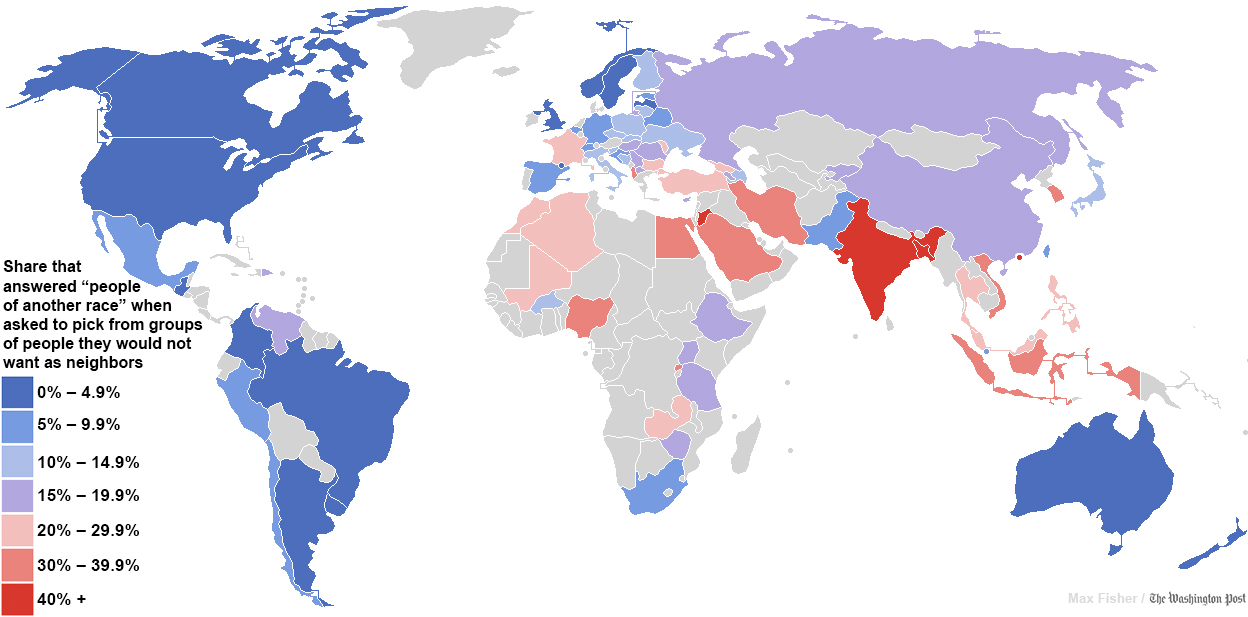
First you have to find a measurement for racial prejudice. I think Swedish researchers hit upon a rather good data point:

The survey asked respondents in more than 80 different countries to identify kinds of people they would not want as neighbors. Some respondents, picking from a list, chose “people of a different race.” The more frequently that people in a given country say they don’t want neighbors from other races, the economists reasoned, the less racially tolerant you could call that society. (The study concluded that economic freedom had no correlation with racial tolerance, but it does appear to correlate with tolerance toward homosexuals.)

Leave that fascinating parenthesis behind for a moment and what do we find? Max Fisher’s map above shows us. And the racist, imperialist Western powers turn out to be among the most tolerant. Money quote:

People in the survey were most likely to embrace a racially diverse neighbor in the United Kingdom and its Anglo former colonies (the United States, Canada, Australia and New Zealand) and in Latin America. The only real exceptions were oil-rich Venezuela, where income inequality sometimes breaks along racial lines, and the Dominican Republic, perhaps because of its adjacency to troubled Haiti. Scandinavian countries also scored high.

And the most racist? India, Jordan, Bangladesh and Hong Kong. There’s also one stand-out of racial intolerance in Europe: France. Duh. My favorite line from Max’s piece:

The Middle East not so tolerant.

I might also note that one common factor in the most prejudiced countries seems like Islam to me, with India and Hong Kong And Vietnam the obvious exceptions.

Update from a reader:

Just wanted to let you know that your post is a little bit misleading about the research you’re citing. The original paper by the Swedish researchers was about the effect of economic freedom on tolerance. It found that people in more open economies are less hostile to gays but not to people of other races. The data they used were based on responses to the World Values Survey. Max Fisher used that survey data to make his map. The Swedish researchers did not make the map, did not collect the survey data, and were not making any point about colonialism or Islam. Their paper was ONLY about the effect of economic conditions on tolerance and was more about tolerance for homosexuality, not racism.

Obama In The Storm

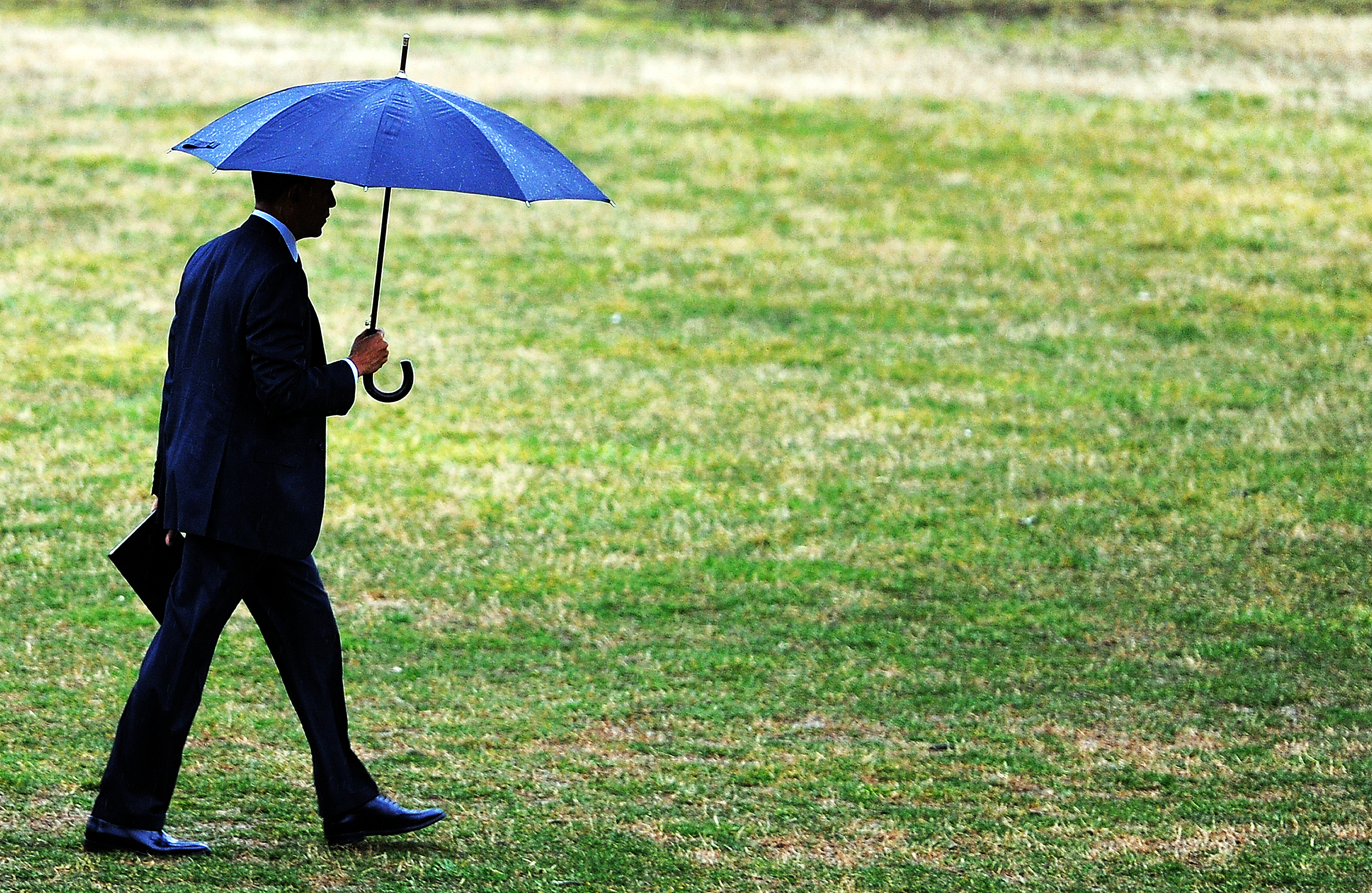
US President Barack Obama uses an umbrel

What would normally be seen as good news for the president is now being spun into bad news. Given our current state of knowledge, it does not appear that the president had any direct role in the inter-agency tussle over how to describe chaotic events in Benghazi. Equally, there doesn’t seem to be – so far – any indication that the IRS Cincinnati office shenanigans reach to the Treasury, let alone the president. On the broad subpoenas for the AP in a leak investigation, the DOJ was being egged on by Congressional Republicans, although it is perfectly fair to say that the Obama administration has been far more focused on pursuing espionage charges than any recent administration.

The Watergate analogy, deployed rather cavalierly by George Will today, is the reverse of what we are seeing. The president was not directing any of this. The attorney general recused himself from the AP investigation. The IRS outrage came after repeated calls from Congressional Democrats for the IRS to give 501(c)4s extra scrutiny because they were – pretty obviously – campaign appendages. A flavor of one letter:

We strongly urge you to fully enforce the law and related court rulings that clearly reserve 501(c)(4) tax status for legitimate nonprofit organizations. And we urge you to investigate and stop any abuse of the tax code by groups whose true mission is to influence the outcome of federal elections.

On Benghazi, it seems to me we have a classic inter-agency tussle over how to present the facts – but also a reasonable process to hammer out a consensus. The Benghazi emails released yesterday do not seem that scandalous to me.

So the critique now is that the president is not sufficiently in charge, that he is a bystander to his own administration. I have to say this has some appeal as a general critique, but it isn’t borne out by these scandals. The IRS is rigorously independent of the White House – and the Cincinnati office was picked as a place to investigate the 501(c)4s because it was far away from Washington and therefore seen as more neutral. The reason to look closely at those new groups was perfectly legitimate, even if the partisan implementation is abhorrent. On the AP subpoenas, the decision was rightly made by the DOJ, independently of the president.

If we are to blame the president, are we really saying that we want a president involved in or directly monitoring these procedures?

Should he make a call on subpoenaing AP phone records? Nope. Should he be in the middle of an inter-agency fight over whom to blame for the Benghazi attack? Nope. Should he have known about and stopped partisan bias at the IRS? On that last question, arguably yes. It was in the news; there were vocal complaints about disparate treatment; there were calls to investigate. It’s not unreasonable to think that a president concerned about this should have instructed the acting head of the IRS to make sure no politics was involved.

But even that last one is a stretch. And if Obama had been that involved in the minutiae of all this, here is what the GOP would now be saying: 1. He’s another micro-managing Jimmy Carter; and 2. He’s a control freak out to persecute us. Hovering above all this, as David Ignatius notes, is the context of a Washington where everyone is so terrified of scandal, they ensure they do not have direct knowledge of what’s going on below them. Holder recused himself; Obama must now be relieved his fingerprints are nowhere near the IRS; on Benghazi, Clinton was hassled because of what a civil servant, Victoria Nuland, said in defending her turf and agency.

And hovering above it still is the media lull after Obama’s re-election. Ratings are down. This is the first blood in the water since Obama took office four and a half years ago – a record you might think would be relevant to our current discussion. So we have the frenzy; and the hyperboles; and then the slow discovery of the actual detail. All of this is part of our system. And it’s better than any alternative. But it’s a distortive lens to view politics through, when we have a still-critical long-term fiscal crisis, a climate emergency, implementation of healthcare reform, and immigration reform to focus on.

Obama has made the right call in firing the interim IRS head, releasing all the Benghazi emails, and pledging a full investigation in the IRS matter. The rest is Washington’s need for conflict and partisan advantage. But this too, I suspect, will pass, unless there really is something in there that we do not yet know.

(Photo: US President Barack Obama uses an umbrella as he walks under rain to board Marine One after visiting wounded service members at the Walter Reed National Military Medical Center in Bethesda, Maryland, on March 2, 2012. By Jewel Samad/Getty.)
The Paranoid Style

Charles C. W. Cooke offers up some “praise”:

By reminding its citizenry that government tyranny is not an abstract concept, the IRS has done America a considerable favor. “Strange how paranoia can link up with reality now and then,” wrote Philip K. Dick in A Scanner Darkly. Indeed. Next time an authoritarian explains how, say, a national gun registry will be just swell — and labels its naysayers as neurotic — his opponents will have a new and useful shorthand: “IRS scandal.”

Why, you might ask, do I use “paranoia,” instead of the more palatable “skepticism”? Paranoia, after all, is an involuntary reaction — less of a tendency to “wait and see” than a recipe for constant fear. I will tell you why: because reflexive suspicion of government power is a magnificent and virtuous tendency, and one that should be the starting point of all political conversation in a free republic.

Jonah Goldberg agrees that the “fear of tyranny, healthy and unhealthy, are American traits, not right-wing ones”, but is less gung-ho about embracing the word “paranoia”:

If you know in your gut something is wrong, but you lack the ability to distinguish your emotions and instincts from facts and reason, it is all the more likely you’ll succumb to paranoia — and that’s a bad thing.

Cooke doubles down:

The word “skepticism” isn’t quite strong enough for me because one can be convinced from a position of skepticism, “Look, we’re not doing anything bad. How about it?” As a general rule, I want people far more afraid of the government than that would allow. I want people saying, “I don’t care how safe you say it is, I’m just not doing it. Ever.” There is never going to be a government or a society in which “tyranny is not just around the corner,” to borrow a phrase from the president. Never, ever. And there are never going to be people who can be trusted to rule.

What Will Drones Do?

Drones Agriculture

Use of domestic drones is expected to increase greatly in the near future. Many of the applications are more mundane than you’d expect:

[T]he vast majority of drones in the United States will probably be used for agriculture. According to a recent report from the Association for Unmanned Vehicle Systems International (A.U.V.S.I.), a trade group, over ninety per cent of the U.A.V. industry’s possible economic impact in 2015 (or about two billion dollars) will be agricultural. Drones can be used to more precisely spray crops, keep track of growth rates and hydration, and identify possible outbreaks of disease before they spoil a harvest.

Interactive version of the above map here.

The Anti-Equality Money Dries Up

Last month, Stephanie Mencimer reported that the Mormon Church has largely excused itself from the marriage equality fight. Her follow up on the subject includes more good news:

[Fred] Karger, the California activist who helped call attention to the church’s Prop. 8 role, believes that without the Mormons’ money and organizing clout, the fight has been left to a handful of extremely conservative Catholic groups such as the Knights of Columbus and NOM, none of which has much in the way of grassroots organizing skills. Indeed, a whopping 90 percent of NOM’s funding comes from only about 10 individuals. According to the most recent IRS filings available, it raised nearly $3 million less in 2011 than it did in 2010, a reduction of about one-third. In 2012, according to Human Rights Campaign, gay marriage proponents in four states considering marriage bills outraised NOM by $20 million.


Writing Within The Lines

Noreene profiles “New Girl” show-runner Liz Meriwether:

“Some of the beauty of writing for network is that there are so many things you can’t do, but that sort of pushes you to do things you didn’t even think you could do to get around that,” says Meriwether. “I do miss going there, I really do, and I hope—I want—in the future to write something that gets a little bit dirtier and goes there a little more. But it has been a really good exercise for me in learning not to rely on that, in learning, like: OK, so we can’t show boobs, we can’t say the word ‘dick,’ we can’t just say the most shocking thing. We have to come up with a way around it.”

One way around the obstacles was to anchor the show in a character who is a bit of a prude. Jess’s girlishness was something critics initially found off-putting about the show, but Meriwether wasn’t creating a symbol, after all. She was looking for things she found funny, then finding means for getting them across. And so there was a whole episode in the first season during which Jess is afraid to say “penis.” As Meriwether delights in recounting, in that context, standards and practices allowed five instances of the word. This year, she and her writers tried to get seven penises into an episode; that was too much.

During a debate over network TV, Willa Paskin compares “New Girl” to “Girls”: 

Why is “New Girl” downgraded so drastically because you’ve seen something like it before? I get that originality counts, but I think this is part of the strain of Book Report-ism that has crept into TV-watching (in the corner of the universe that writes about “Girls” on the internet a ton, where I live). We watch TV for pleasure! There is no shame in that! If “New Girl” makes one laugh and smile a ton, if it is super-super enjoyable and pleasant, that is awesome, period. If its version of self-asphyxiation sex did not launch a million blog posts and New York Times op-eds, that’s fine. It has a different set of intentions than “Girls,” among them trying to make millions of people laugh. Which is crazy hard to do! Originality is important, but I think the fixation on it obscures the way that even the very best, most original things riff on what came before—the way that “The Wire” functioned as a genre cop show, where the gang got back together at the start of each season; the way that “Mad Men” works as a melodrama; the way that “30 Rock”’s workplace is structured almost exactly like “Mary Tyler Moore”—and backseats pleasure like it’s something lesser than, instead of being the whole point. TV is not homework, and that is one of the very best things about it.

Mind The Historical Gap

Naomi Alderman’s main problem with historical fiction, both in books and film, is the failure “to imagine how minds were different in different eras.” An example:

[Y]ou get horrors like the moment in Gladiator (which is in general a very good, very Roman-feeling movie) where Commodus berates Marcus Aurelius for not having loved him as a boy. What nonsense. No Roman man would have asked for this from his father, nor would a Roman father have apologized for it. A Roman man might have been justly condemned for not teaching his son the manly virtues, but love…? Irrelevant. One has to understand that people really did think differently in the past.

Protecting The Leakers

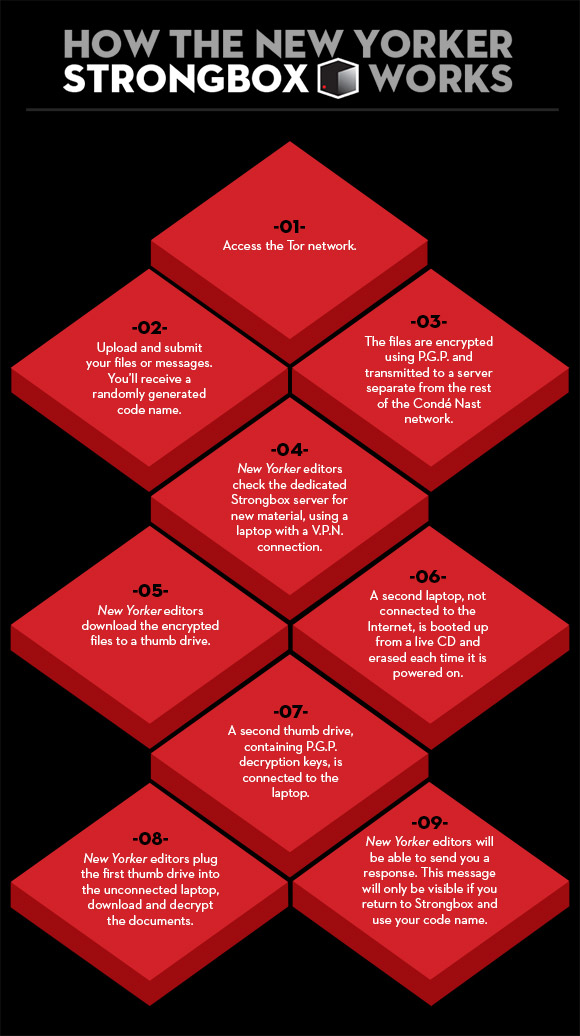
Strongbox

The New Yorker announces a new way for whistleblowers to leak classified documents, created by the late Aaron Swartz:

[He] was not yet a legend when, almost two years ago, I asked him to build an open-source, anonymous inbox. His achievements were real and varied, but the events that would come to define him to the public were still in his future: his federal criminal indictment; his leadership organizing against the censorious Stop Online Piracy Act; his suicide in a Brooklyn apartment. I knew him as a programmer and an activist, a member of a fairly small tribe with the skills to turn ideas into code—another word for action—and the sensibility to understand instantly what I was looking for: a slightly safer way for journalists and their anonymous sources to communicate. …

By December, 2012, Aaron’s code was stable, and a squishy launch date had been set. Then, on January 11th, he killed himself. In the immediate aftermath, it was hard to think of anything but the loss and pain of his death. A launch, like so many things, was secondary. His suicide also raised new questions: Who owned the code now? (Answer: he willed all his intellectual property to Sean Palmer, who gives the project his blessing.) Would his closest friends and his family approve of the launch proceeding? (His friend and executor, Alec Resnick, reports that they do.) The New Yorker, which has a long history of strong investigative work, emerged as the right first home for the system.

Nicholas Weaver compiles instructions for leaking to outlets that don’t have a Strongbox-like feature. Image from the New Yorker.