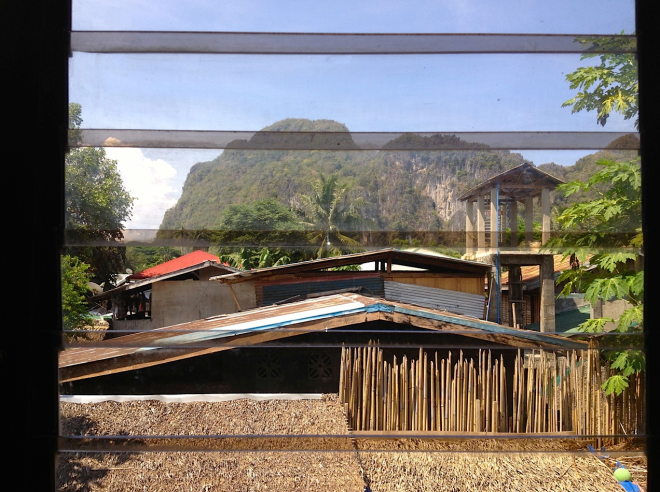
A reader writes:
It could be anywhere tropical. The coconut tree, the papaya plants, the bamboos – I am tempted to call it in some place in India, but the high cliffs are not what you typically see in India. It could be some other Asian country, but somehow the word Guatemala is screaming in my head. And I refuse to scan the entire country looking for this particular area – sorry. Neither my back, nor my brain, is quite cut up for that kind of effort.
Another:
Never actually tried to answer before, but this looks suspiciously like Cuamba, Mozambique. I traveled through this region when trying to get from Malawi to the coast of Mozambique. There is a somewhat sketchy old train line from Cuamba near the Malawi border to Nampula near the coast. It crosses Niassa province, once of the poorest but most beautiful parts of Africa. Niassa is peppered with rock formations lke the one in this week’s contest.
Another:
I’m guessing the photo was taken in Krabi, Thailand. The vegetation, the karst rock formations, the type of construction, the thatching on the roof, all points to Krabi. If that’s the view from a hotel, I’m a little sorry for the tourist who shot it. Weird mix of beauty and the mundane. But, hey, I’m also envious: He or she’s in Thailand!
Another:
The geography of in this week’s photo reminds me strongly of the limestone formations found on Thailand’s Andaman Coast. My guess is that the photo was taken on the isthmus of Ko Phi Phi Don. Satellite photos are not helpful, but this photo shows a red roofed home on the far end of the isthmus which could line up with the hills in the contest photo if the perspective is right. A friend and I took the ferry to Ko Phi Phi Don from Phuket in August of 2006 when the island was still very much in recovery mode from the 2004 Tsunami. We loved the island enough that we made an unplanned overnight stay with only the shirts on our backs and paid about $9 for a shack near the beach. The window frame in the contest photo reminds me very much of that shack. There were many interesting people on the island, ranging from Danish economics students to an American military contractor on leave from Afghanistan.
Another:
Could be any of the Andaman Sea islands of Thailand, or even Krabi on the mainland, but this looks vaguely reminiscent of Phi Phi Don (and I’m not going to go searching through ours of images to try to match up the cliffs). If so, this is probably from a bungalow set back a bit from the beach and main road on the Ton Sai Bay side (I think they call the area “View Point”). This was one of the places devastated in the Boxing Day Tsunami in 2004. We were back in 2009 and the recovery was in full swing – too much so, in fact. The place was fast on the road to over-development and we escaped after two days (e.g., the south end of Koh Lanta was our favorite).
Another:
The nap of the felt on that tennis ball in the corner is clearly of a type sold only in the Lesser Antilles. Given that and some clues apparent only to me, I am certain that this photo was taken from Room 4F at the Still Beach House in Soufriere, St. Lucia. Wait – Is that a mango?
Another:
The geography and the hanging tobacco remind me a lot of a visit to Viñales, in the Cuban province of Pilar del Río during my undergraduate career at Berkeley. On one of the days there we visited an old tobacco plantation and we hiked a couple of mogotes, those hills in the background. I might be wrong, but thanks for bringing back those wonderful memories.
Another:
I may be continents off, but as soon as I saw the photo, it reminded me of the many villages along the Mekong River, particularly the region between the Golden Triangle of Thailand and Luang  Prabang, like the one in the photo below which I took last summer. Since the writing on the water tower is in English, my first thought was that this was in Myanmar, and it may be, but my gut is saying Laos. This looks like a very small village, but I suspect it isn’t, because theres too much concrete and that would make it too impossible. Since many of the slow boats that make this journey stop in Muang Pakbeng overnight, and there are plenty of hostels and guest houses there that look out on the outskirts of this small town, I’m going to guess that’s where this was taken.
Another:
Vang Vieng, Laos is a station on the backpackers’ SE Asia grand tour with spectacular karsts along the river. VV is the halfway point on the amazing bus ride from Vientiane to Luang Prabang. Parts of Laos are changing rapidly but the charm and good nature of the people has not yet been badly compromised by tourism but I fear it eventually will be. People need to eat and be sheltered and kids need education and unfortunately tourism is one the few revenue streams in very poor country. Part of me says, “Go now!” while another says, “Stay away.”
Another:
The eroded limestone mountains plus the tropical foliage leads me to guess this is a photo from a room in a hotel somewhere on Ha Long Bay in Vietnam. My parents were Americans in South Vietnam during the war. Dad was there working on malaria eradication and my mother was a French language intelligence collector for the CIA. I was born in that Saigon in 1965, but my mother and I were evacuated two weeks later. Some day I will have to go back to the country of my birth.
Another:
You’ve got to be kidding with this one!
It could be a million places in the tropics. The dramatic peaks in the background looks like those which rise from South Pacific islands which I’ve visited, but the green is less intense. It’s probably in Central America some place, but for kicks I’m going to say it’s Pago Pago, American Samoa.
Another gets closer:
For some reason, Sumatra popped into my head immediately upon seeing this. Have I been to Sumatra? No. Do I know anything whatsoever about Sumatra, other than its general location? No. Have I done an exhaustive (or even non-exhaustive) Google search to bolster my claim? Again, no. Nevertheless, this is my guess. I’m stuck working the weekend in a hotel in California. (The very same hotel from which I took the picture in Contest # 144.) It’s a beautiful and dry 88 degrees outside, but I’m inside. I needed a break and I knew it was VFYW day, so here I am, gazing at what may or may not be Sumatra. Thanks for the distraction!
Another gets really close:
Very challenging this week. The only clues I could use (besides general tropicalness) were the watertank (“Bestank” is a Philippines company), cliffs are mostly in the Palawan Islands, and the presence of satelite dishes indicated some level of power usage and a southern view (assuming northern hemisphere). Lots of swanning about the Palawans, trying to narrow it down but no success. I’m sure others will have nailed it; we have such a sophisticated crew here!
A previous winner gets incredibly specific:
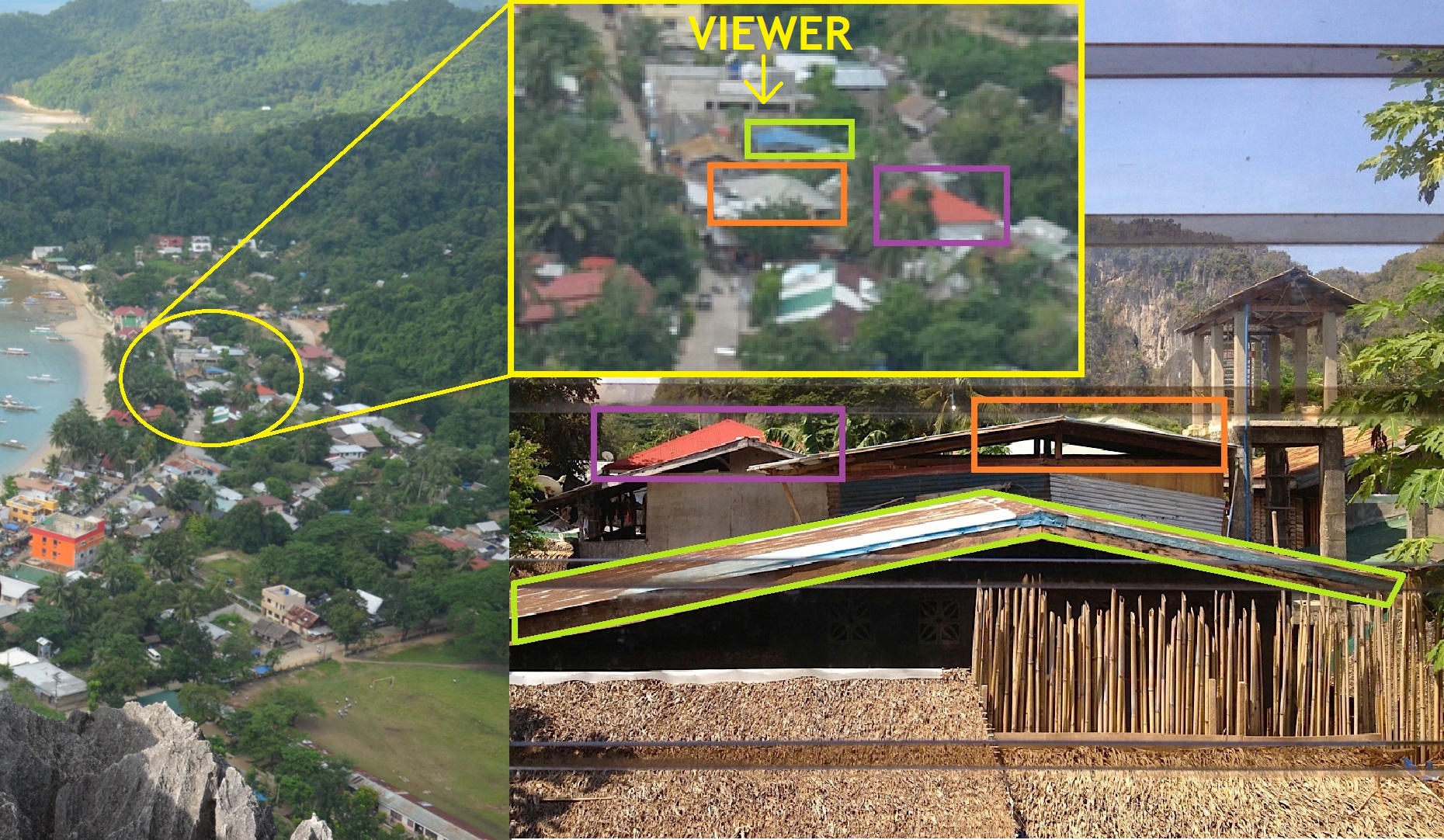
A brutal contest with a deceptive start. It only took me a few hours to find that this view is from El Nido, Palawan, Philippines. So, sick with flu, I went to sleep thinking that I would quickly find the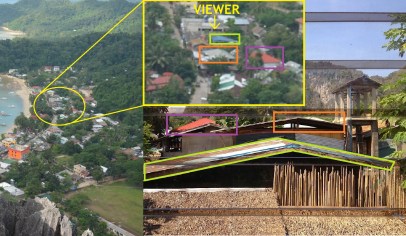 actual window when I woke up. Ha. Two full days and one bottle of Dayquil later and I was still searching. See, the thing about resorts in developing nations is that the small inns and hotels are constantly rebuilding and expanding – as in, every year. And in the tropics, the roofs have a fun way of rusting into oblivion every year too. The upshot is that online searches are really hard because the architecture changes so much. This was especially true here because your viewer stayed at a building that’s only two years old.
That building is the new expansion at “Rosanna’s Cottages” that sits on M. Quezon street (not the beach). The window is on the second floor, possibly in room #15, and looks towards Taraw Peak at a heading of 204.46. For the curious, the coordinates are 11°10’57.39″ N, 119°23’32.92″ E. 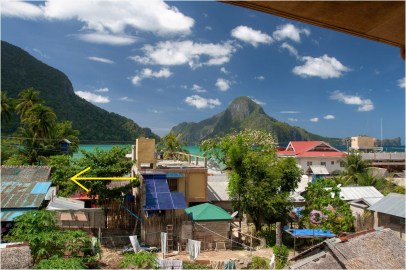 Unfortunately, recent satellite maps only show a copse of trees on that spot; they were torn down for construction. Next time a Dish viewer goes to El Nido, I recommend the Four Seasons; it shows up on a map like you wouldn’t believe.
Attached is a combination image. On the left is a 2011 view from the cliffs looking down on the town and your viewer’s location, circled in yellow. On the right side is a magnified area from that shot inset into your viewer’s photo. The purple, orange and green boxes match up the three roofs seen in both images (the blue roof in your viewer’s foreground has rusted considerably in the past two years). Also attached is an oblique image of the actual window showing the direction your viewer was facing, and one of their building’s front.

But the prize this week goes to a reader who has guessed a difficult view in the past without yet winning and who has participated in 12 total contests:
I’m sure in a few weeks I’ll be Google-mining trailer parks in Hickspit, Alabama, but as far as this view is concerned, thanks for forcing me to closely examine paradise. Wow.
As one of your less worldly Dishheads, the key for me this week was correctly identifying the steel gravity water tank. An hour or so in we had our manufacturer, based out of the Philippines. From there, image search “Philippine cliffs” and bam – El Nido! Done and wrapped up by 9:30 Saturday night.
But wait. It’s become apparent over the last few months that the Window View’s new obsession is picking non-Streetviewable locations, and as is often the case, getting the last few blocks became untenable. To me, anyway. I think I’m close, and I’ve attached a murky overhead in the block near where Calle Real meets Osmena St., but I can’t get inside the room this week, despite searching the entire wonderful town of El Nido for the right set of louvered windows.
I hope I’m closest, but under the assumption I’m not, I hope somebody won who can give me the right search criteria so I’ll know what I did wrong. I’ll set my laptop on fire if this one goes to the “I got married in that shanty” crowd.
(Archive)
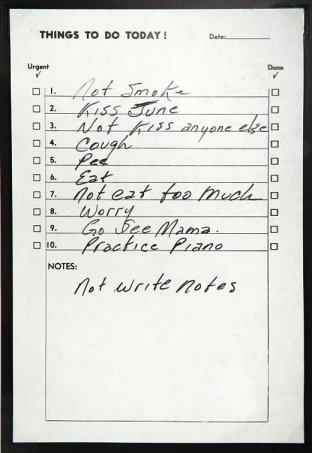 Occasionally, lists provide a therapeutic benefit, as if the very act of writing something down can help keep chaos at bay. (The famously apprehensive Alfred Hitchcock once shared the order in which he had come to anticipate the surge of adrenaline preceding an anxiety attack: “1: small children, 2: policemen, 3: high places, 4: that my next movie will not be as good as the last one.”) If the internet itself can be considered a kind of list, then Google is the über-list, and indeed, once online, you can massage the formal qualities of the list-as-template to chronicle your own peripatetic priorities…. For that matter, there is Craigslist. (And not to be outdone, Angie’s List!) Finally, for those of us determined to make our own mortality the defining feature of all essential decision-making, there is the recent phenomenon known as the “100 Things To Do/Eat/See/Before You Die” list: in common parlance, we call this a bucket list.




 The Dish