Fisker Automotive, which received millions from the federal government, is in financial trouble. Michael Grunwald defends the government’s investment, and others like it:
Companies that receive tax breaks and subsidies fail all the time. Ordinary Americans who get tax deductions and subsidies fail too. Success is not guaranteed in a capitalist economy. The loan program provided a jump start, not a free ride. But Solyndra’s failure has overshadowed a spectacular boom in the -solar industry, which has grown more than tenfold since Obama took office. Fisker’s failure could overshadow similarly impressive growth in plug-in electrics; there were almost none on U.S. roads before 2008, and now there are more than 100,000. During a presidential debate, Mitt Romney memorably lumped in Tesla Motors with Fisker as an Obama-supported “loser,” but Tesla just had its first profitable quarter and is on track to pay back its federal loan five years early. Its Model S has won the big car-of-the-year awards and received the highest Consumer Reports score of any car since 2007; its reviewers have sounded like teenage boys reviewing porn. So who’s the loser?
The larger point is that overall, as an independent review by Republican Senator John McCain’s finance chairman confirmed, the Energy Department’s $40 billion loan portfolio is performing well. It’s also transforming the energy landscape with America’s largest wind farm, a half-dozen of the world’s largest solar plants, cellulosic biofuel refineries and much more. Obama didn’t support one company or one technology; he supported all kinds of plausible alternatives to fossil fuels. He didn’t pick winners and losers; he picked the game of cleaner energy. And we’re winning. The U.S. has doubled its production of renewable power. Our carbon emissions are at their lowest levels since the early 1990s. And after decades when the U.S. invented products like solar panels and lithium–ion batteries only to see them manufactured and deployed abroad, we’re finally making green stuff at home. For example, not only are we generating twice as much wind power, we’re making twice as many of the components for U.S. wind turbines.
The upcoming presidential election has already taken a dramatic turn, with both former president Rafsanjani and Ahmadinejad-ally Mashaei entering the race over the weekend. Next they will be vetted by the regime’s Guardian Council, along with hundreds of lesser-known candidates. Gary Sick attempts to unpack the political calculus, suspecting the news may indicate waning political influence from Ayatollah Khamenei:
I thought that the Supreme Leader had decided unequivocally that there was to be no repetition of 2009, i.e. no credible individuals challenging the existing system and no mobs in the street with grievances after the vote. He had even talked about eliminating the presidency entirely, in favor of a parliamentary system. … [Mashaei and Rafsanjani entering the race] implies that Khamenei was either unable or unwilling to exercise control of the process or that his objectives were quite different from what we had understood from his observable actions and words. At a minimum, these candidates were willing to put Khamenei in an embarrassing position by publicly ignoring his well-known preferences, apparently without concern for the consequences.
Of course, it is still possible that the Guardian Council will simply disqualify all but the “safe” candidates, despite the past history of leaders like Rafsanjani and their intimate association with both the Leader and the revolution. That would confirm the cynical interpretation of Iran’s leadership after 2009 — that it realized the revolution was dead and there was no need to pretend that it was about anything other than raw power.
Meanwhile, the top reformist candidates from 2009, Mousavi and Karroubi, are still under house arrest and probably won’t play a direct role in this election. What’s left of the reformist camp?
Iran’s reformists have been politically crippled since the disputed 2009 Presidential election, with leading members in prison or under threat of detention, parties banned, and communications disrupted. Curbed in Parliament for almost a decade, they were split over participation in the 2012 Parliamentary elections and won only a small fraction of the vote.
Despite much speculation, a campaign by former President Mohammad Khatami, in office from 1997 to 2005, has not emerged. Khatami’s latest statements ruled out his involvement in the election. In Khatami’s absence, the leading reformist hopeful is Mohammad-Reza Aref, former first vice president under Khatami. Aref said on April 5 that reformists had “boosted their relations” with the Supreme Leader. Mostafa Kavakebian, who presents himself as a leader of the faction in Parliament but who is disliked by many reformists for failing to support the challenge after the disputed 2009 Presidential election, has also declared his intention to stand.
In the current circumstances of regime pressure, neither candidate nor the reformist movement is likely to be of any significance in the race.
With a month to go before polling day there is plenty of scope for further drama. Observers say one crucial question is whether Ahmadinejad’s controversial former aide – Esfandiar Rahim-Mashaei, who is loathed by Khamenei and his supporters – will be allowed to run. If he is disqualified some believe that the outgoing president, who remains in office, will turn openly on Khamenei – perhaps by spilling the beans on what really happened in 2009 or by refusing to rig the results again. It is also tantalisingly unclear whether Rafsanjani will be a serious candidate or intends rather to play the role of kingmaker.
Farideh Fardi predicts that Rafsanjani’s entry will unleash “an intense battle over the direction of the country”:
Unlike 2005, when Rafsanjani was challenged by both conservatives and reformists, this time he will be coming in with solid support from the reformists.
It is true that the reformists are also a herd of cats, but few doubt [reformer and former president] Khatami’s ability to convince the herd to rally behind Rafsanjani. In fact, most reformist and centrist candidates have already said that they will withdraw if Rafsanjani runs. The exception may be former nuclear negotiator Hassan Rowhani, but, without support from Rafsanjani or Khatami, he will not be a significant candidate anyway. In effect, if Rafsanjani is qualified by the Guardian Council and if he chooses not to back off in favor of another candidate, the conservatives will be facing a centrist/reformist consensus candidate who may even peel away some of their own, particularly the ones in the commercial sector and many in the clerical community in Qom and elsewhere. …
Rafsanjani’s entry into the fray with solid support from Khatami and his followers will force the conservatives not only to scramble for a consensus candidate, but also search for one who is relatively popular or at least better known.
Rodger Shanahan is waiting to see who makes it out of the vetting process:
The fact that these candidates have registered in such dramatic fashion makes for increased interest in the race, but there is no guarantee they will appear on the final ballot. The Supreme Leader wields significant influence over the candidacies, and the the ability of these two men to survive the vetting of the Council of Guardians is anything but assured. Only ten out of 800 hopefuls survived the Council’s deliberations in 2001; in 2005 it was six out of more than 1000.
The economy is the highest priority for most Iranians, and the public’s belief as to whether any of the final candidates can offer some relief in this area will ultimately determine the turnout. The backroom manoeuvrings and positioning of putative candidates is likely to dominate the period until the confirmation of candidates and the three-week election campaign.
At the same time, the Guardian Council may charge Ahmadinejad for illegally endorsing his protegé and chief of staff, Mashaei. For more on the race, head over to Enduring America’s election guide.
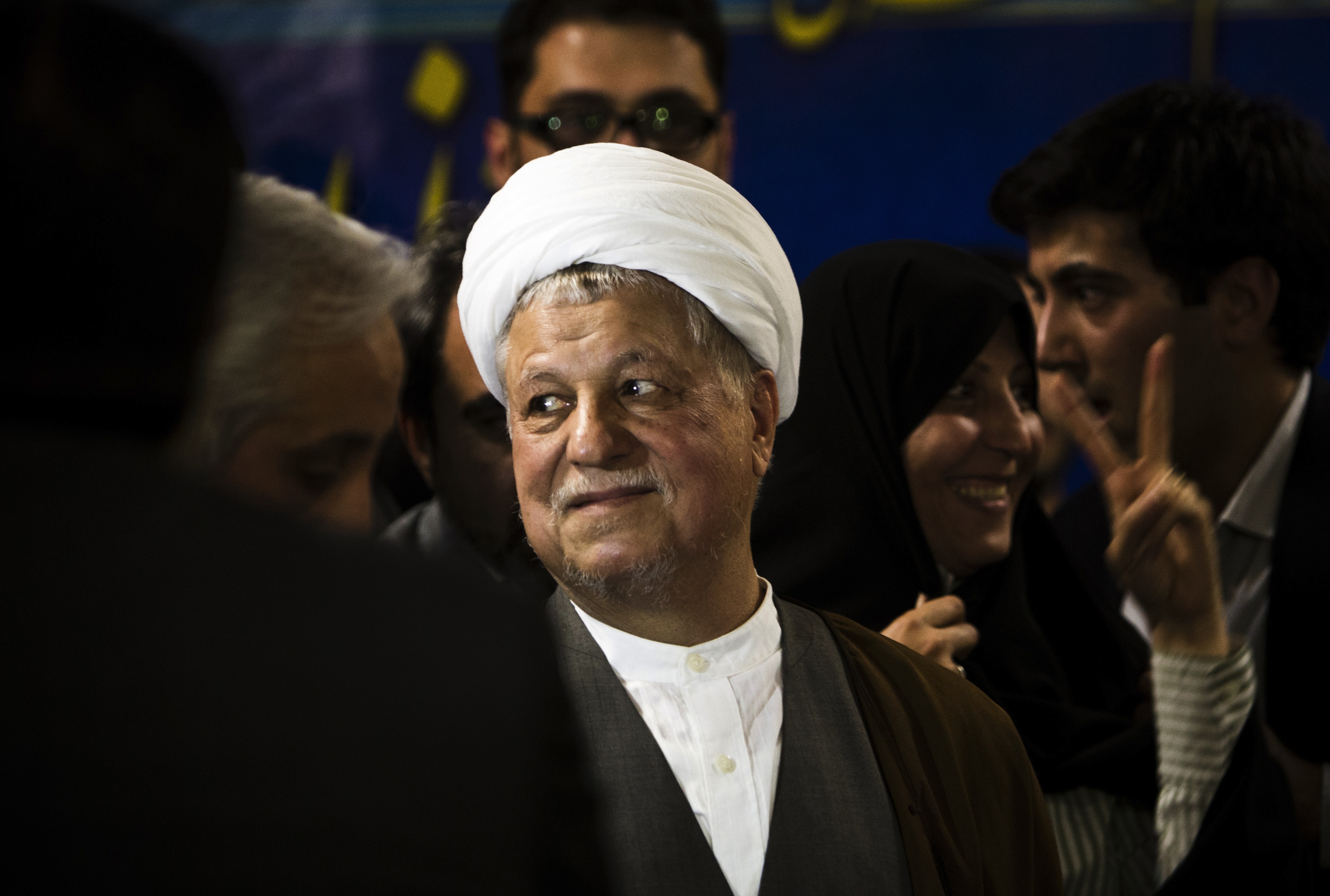
(Photo: Former Iranian president Akbar Hashemi Rafsanjani arrives to register his candidacy for the upcoming presidential election at the interior ministry in Tehran on May 11, 2013. By Behrouz Mehri/AFP/Getty Images)
David Barash reflects on our primate need for foes and our tendency to be “especially prone to exaggerating them”:
“Whoever lives for the sake of combating an enemy,” wrote Nietzsche, “has an interest in the enemy’s staying alive.” It is reported that at the end of the Third Punic War, after Carthage had finally been destroyed and pillaged, her people killed or enslaved, her land sown with salt, a kind of sadness came over the victorious citizens of Rome, an awareness that with their defining struggle behind them, they would never be the same.
All too often, nationhood, or even selfhood, is defined by one’s opponents. Imagine: Ahab without Moby Dick, the Hatfields without the McCoys. As each has been defined by the other, enmity has subtly been transformed into dependence. If Moby Dick had died of old age, or in the sweet embrace of a giant squid, or by someone else’s harpoon, Ahab would probably have mourned rather than celebrated. But Ahab was a fictional character, while the rest of us—and our enemies—are very real. Equally real is the fact that sometimes these enemies go away, leaving us frustrated, empty, and strangely alone.
This is especially true about Americans and terrorism. The reaction to the home-grown pressure-cooker bombs by two losers in Boston reveals the degree of the 9/11 PTSD the country is still reeling from. And the panic and hysteria doesn’t actually help the war on Jihadist terror. We gave the Tsarnaev brothers what they craved: full metal media orgasm. They may have killed three people in a horrifying attack – but it led to saturation coverage (yes, we joined in) and to the publicity post-Qaeda Jihadists live for.
In that sense, Pete King is as big an unwitting recruiter for Jihadist terrorism as he was a very witting supporter of Irish terrorism against innocent civilians. He once gave mass-murderers money; now he gives them publicity. What we haven’t yet figured out is that once we have disabled the organized terror groups like al Qaeda, the best thing we can do with rogue Jihadists is to treat them with withering contempt.
At times, many Republicans like King almost seem unconsciously to want there to be another 9/11 – to justify their inability to move past that event.
And so they unwittingly go apeshit over any hint of terrorism – from Fort Hood to Benghazi – as if merely calling it that will do anything but help the terrorists gain publicity and attention. I’m not saying we shouldn’t cover these attempts at mass murder or fail to call them what they are; I’m saying we should also put them in better perspective. Take what happened over the weekend in New Orleans. A Mother’s Day parade, of all things, was assaulted by three men with guns. Nineteen people were injured including two children. If there’s a definition of terror, it would be attending something as routine as a parade and find it turning into a potential bloodbath. And yet, this news is nothing compared to what it would be if the perpetrators were Jihadists.
It’s that disproportion that troubles me – because it gives terrorists more incentives. Sometimes the best way to defeat terrorists is both to prevent them by law enforcement, surveillance, etc, as we are doing, but also to ignore them when necessary, to refuse to change our way of life (like putting an entire city under curfew), and to be less afraid of the boogeyman.
And the point of this kind of strategy is to hit terrorists where it truly hurts: the oxygen supply of hysterical reaction and coverage. I have not changed my mind about the seriousness of the threat of religiously-inspired terror. But I have changed my mind about how best to defeat them. As a country, we began the journey back from Cheneyism in the last years of Bush. Obama has done a huge amount to both defeat the Jihadists and to defuse their message. But the rest of us need to do more.
In a pitch-perfect parody, Michael Deacon imagines the Da Vinci Code author’s innermost struggles:
The critics said his writing was clumsy, ungrammatical, repetitive and repetitive. They said it was full of unnecessary tautology. They said his prose was swamped in a sea of mixed metaphors. For some reason they found something funny in sentences such as “His eyes went white, like a shark about to attack.” They even say my books are packed with banal and superfluous description, thought the 5ft 9in man. He particularly hated it when they said his imagery was nonsensical. It made his insect eyes flash like a rocket.
Renowned author Dan Brown got out of his luxurious four-poster bed in his expensive $10 million house and paced the bedroom, using the feet located at the ends of his two legs to propel him forwards. He knew he shouldn’t care what a few jealous critics thought. His new book Inferno was coming out on Tuesday, and the 480-page hardback published by Doubleday with a recommended US retail price of $29.95 was sure to be a hit. Wasn’t it?
I’ll call my agent, pondered the prosperous scribe. He reached for the telephone using one of his two hands. “Hello, this is renowned author Dan Brown,” spoke renowned author Dan Brown. “I want to talk to literary agent John Unconvincingname.”
Maria Popova gives my early writing on the politics of homosexuality – from 1993 on – the classic Brain Pickings treatment. I met Maria at a recent PaidContent panel and immediately fell in love with her – not sexually, of course, but as kindred spirit. She still retains the spirit and energy of the early blogosphere – because she does what she does because she loves it. That’s all. No pageview counting, no SEO gaming, no “sponsored content” shenanigans – just her enthusiasm for reading writers. Yep: writers. Not content-producers. Writers.
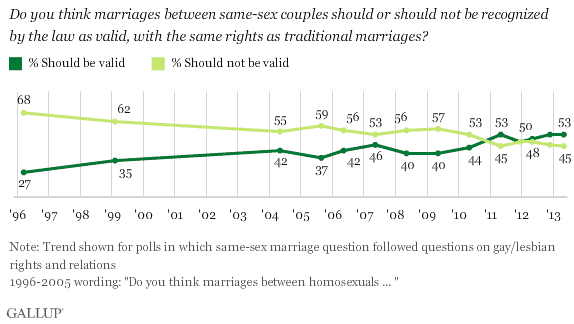
One way of looking at my first book – written in 1994, when I thought I might have only a few years left – is to look at how the discourse has changed on homosexuality since then – and especially how the core issues of the military and marriage made possible a new paradigm for gay equality. This was fiercely resisted at the time by many in the gay movement itself, and I became something of a pariah. Eventually, they got it.
Basically, we have close to doubled the number of Americans backing marriage equality in around two decades. It is hard to think of a more successful persuasive strategy. And it’s because of that success, grounded now in democratic decision-making, and in the strong empathy of many straight friends, family and co-workers, that we now have almost 12 states with marriage equality and the federal prohibition on its last legs. Opposition has never polled lower and support has never polled higher.
I find this evidence for not wanting the Supreme Court to pre-empt this long democratic deliberation. Yes, ensure that the federal government returns to its traditional role as deferrer to states when it comes to what a civil marriage license is. But then be patient. Better to win by hearts and minds, as we are, than to cut off that process and give opponents a genuine reason to cry foul.
For me, so far, we don’t have the full set of facts, which is why getting the Inspector General’s report – and, in due course, a Congressional investigation – will help us sort out who was responsible and why. But what we do know is bad enough: what appears to be politicized auditing by the IRS in an election cycle. Here’s the best spin Ezra can muster:
The IRS is supposed to reject groups that are primarily political from registering as 501(c)4s … If they’re going to do that, then they need some kind of test that helps them flag problematic applicants. And that test will have to be a bit impressionistic. It will mean taking the political rhetoric of the moment and watching for it in applications. It will require digging into the finances and activities of groups on the left and the right that seem to be political even as they’re promising their activities are primarily non-political.
If we’re not comfortable with that, then we need to either loosen the definition of 501(c)4s or create a new designation that gives explicitly political groups the benefits of the 501(c)4s (namely, they don’t have to pay taxes and they can keep their donors anonymous). But either way, as I wrote on Friday, the only way to make sure this doesn’t keep happening is for the IRS — or the Congress and White House that control it — to make some tough decisions about 501(c)4s.
Where might an enterprising, public-spirited I.R.S. agent get the idea that a Tea Party group deserved more scrutiny from the government than the typical band of activists seeking tax-exempt status? Oh, I don’t know: why, maybe from all the prominent voices who spent the first two years of the Obama era worrying that the Tea Party wasn’t just a typically messy expression of citizen activism, but something much darker — an expression of crypto-fascist, crypto-racist rage, part Timothy McVeigh and part Bull Connor, potentially carrying a wave of terrorist violence in its wings.
I’d just note here that this is about the weakest link to the president or administration imaginable. The argument is that Obama generated paranoia about right-wing extremists and this caused lower-downs to check right-wing groups more assiduously than others. As Jesse Walker notes:
Douthat is speculating here, and this is hardly the only possible explanation for what happened at the IRS.
Best-case scenario, the employees really were just choosing the most inept and unconstitutional method available to sort the legitimate 501(c)(4) applicants from the fakers. Worst-case scenario, we’re looking at some old-fashioned, deliberate, Kennedy- or Nixon-style political harassment via the taxman. And of course all sorts of combinations of motive are possible, too. I look forward to reading the inspector general’s report, and I hope a serious Congressional investigation follows.
How the always-process-never-principle First Read expects the story to play out:
[T]he IRS news is a political gift to a Republican Party whose base was strained on immigration (remember that Heritage Foundation study?) and even on guns (remember the tough questions Sens. Kelly Ayotte and Jeff Flake were getting?). Now, you’re seeing a GOP base united by two things they absolutely dislike: President Obama and the Internal Revenue Service. The news also is a gift to Republicans like Mitch McConnell, Lindsey Graham, or any incumbent Republican in Washington hoping to avoid a tough primary in 2014 — they get to demagogue the heck out of this story and show they will stand up for the Tea Party.
Yes, this is a real weapon they can use – unlike the idiotic dancing on a pin of the Benghazi fooferaw. But, as the president himself said, that’s not the real issue here. The real issue is who politicized what must remain an apolitical process. Those people and those directly above them need to go – as soon as we have all the facts. Waldman goes into more detail:
The truth is that a great many of the groups that request 501(c)(3) and 501(c)(4) status, of all ideological stripes, are basically pulling a scam on the taxpayers. Maybe that’s a bit harsh, but at the very least they’re engaged in a charade in which they pretend to be “nonpartisan” when in fact they are very, very partisan. For instance, nobody actually believes that groups like the Center for American Progress on the left or the Heritage Foundation on the right aren’t partisan. When there’s an election coming, they mobilize substantial resources to influence it. They blog about how the other’s side’s candidate is a jerk, they issue reports on how his plans will destroy America, and they do all sorts of things whose unambiguous intent is to make the election come out the way they want it to. CAP and Heritage, along with many other organizations like them, are 501(c)(3) charities, meaning as long as they never issue a formal endorsement and are careful to avoid any express advocacy, they can maintain the fiction that they’re nonpartisan (keep getting tax-deductible contributions, which are easier to obtain than those that aren’t tax-deductible).
And that fiction is even more exaggerated when you get to the (c)(4) groups, particularly the new ones. For instance, when Karl Rove’s Crossroads GPS applied for 501(c)(4) status, it explained to the IRS that it was a social-welfare organization for whom influencing elections wouldn’t be its primary purpose.
Like me, Drum sees reason for Republicans to be upset:
Conservative groups are as outraged as liberals would be if the Bush-era IRS were flagging groups with “environment” or “progressive” in their names. So even if, as seems likely, this whole thing turns out to have been mostly a misguided scheme cooked up by some too-clever IRS drones, it doesn’t matter. Conservatives are right to be outraged and right to demand a full investigation. They suspect there might be more to it, and so would I if the shoe were on the other foot. We need to find out for sure whether this episode was just moronic, or if it had some kind of partisan motivation.
What’s really unfortunate about all this is that it will probably put an end to any scrutiny of 501(c)4 groups, and that’s a shame. The IRS should be scrutinizing them, and it should be doing it on an ongoing basis.
Michael Macleod-Ball and Gabe Rottman of the ACLU worry more broadly about selective enforcement of regulations:
Although the IRS claims this was an honest mistake, these revelations are troubling on many levels. For instance, there are several proposals circulating in Washington right now that would make it much easier for the IRS and other regulators to force political groups to disclose their donors. These disclosure requirements would apply even when the group is advocating purely on an issue of public interest, from clean air to abortion, and would apply to groups of all political persuasions and not just to groups supporting or opposing candidates for office.
The ACLU has expressed concern with these disclosure requirements precisely because they open the door to selective enforcement. Such concerns are often dismissed as speculative and overly pessimistic, but the IRS apology shows that concerns over selective enforcement are prescient. Those in power will always be tempted to use political speech restrictions against opposing candidates or causes.
Previous Presidents, including great ones like Roosevelt, have used the IRS against their enemies. But I don’t think Obama ever wanted to be on the same page as Richard Nixon. In this specific case, he now is.
There can be little doubt that some officials in the IRS showed terrible judgment and made inexcusable errors. The need for an investigation is obvious. What’s more, even the way in which the IRS has handled the apology is a mess, quietly making a bumbling announcement on Friday morning, as if that would make the story go away.
But before we start casually accusing the White House of Nixonian tactics based on literally nothing, let’s try to keep our heads on straight. It’s an ugly enough controversy without Beltway pundits turning this into something it’s not.
Amen. A president cannot monitor issues like this on a daily basis – unless he really is Nixon. And Joe’s instinctual reaction last Friday – legitimate outrage – needs to be tempered by what the president said earlier today.
The Kochs are the conservative analogues of Buffett and George Soros; the sinister bogeymen who supposedly pollute American democracy with ideological propaganda. Details that run counter to these simple narratives are often ignored. Politico, for instance, “revealed” last year that David Koch supports same-sex marriage, wants military spending cut, and wouldn’t rule out tax increases to balance the budget. Only one of those positions (the last one) is surprising, considering Koch ran as the Libertarian Party vice-presidential candidate in 1980. It was a scoop freely available in a 2010 New York magazine profile of Koch, which pointed out that “he thought the Iraq War was folly, and supports stem-cell research and gay marriage.”
But the caricature has endured:
[T]he Kochs have been transformed into “the Kochs.” There was never any suggestion that the David Koch Theater at Lincoln Center (so named in 2008 after he made a $100 million donation) would only stage David Mamet plays, Ronald Reagan film festivals, and Elia Kazan retrospectives, yet the protesters descended, demanding a name change. The Kochs gave $100 million to MIT, underwriting a cancer-research center. But this was, said one critic, mere “manufacturing consent” for their reactionary views. The $20 million to the ACLU—which was heavily criticized by some conservatives—didn’t matter either, because they also underwrote candidates who don’t support the ACLU.
Commander Chris Hadfield is one of the most memorable astronauts to have gone into space, so it was fitting that his farewell moment to the world saw him record the first ever music video from space. Ahead of his return to Earth on Monday after five months at the International Space Station (ISS), the 53-year-old Canadian astronaut fittingly covered the David Bowie classic ‘Space Oddity’ in a poignant video. Hadfield has maintained strong links to folks at home, having entertained his 700,000-plus Twitter followers with regular photos and commentary, and taken part in a Reddit AMA interview, but music was always a focus for hom. He recorded the first song in space last December, and, speaking before his latest mission, he admitted that he would record a range of songs in space. Here he discusses playing music in space in more detail.
Alex Knapp notes that this is likely Hadfield’s last trip because “cuts by the Canadian government have forced the space agency to cut back its manned program, meaning that no Canadian astronauts are likely to spend anytime in space soon”:
I’m willing to bet that it was with the knowledge that his current space mission is likely his last that led Hadfield to produce this poignant cover version of David Bowie’s Space Oddity. He recorded the vocals and guitar while on board the International Space Station. Piano and other musical accompaniment were provided by folks down on Earth. The video itself is gorgeous, featuring some amazing shots of Earth through the windows of the space station as Hadfield sings Bowie’s famous tune.
To remain transparent about our experiment in reader-supported web-journalism (subscribe [tinypass_offer text=”here”]!), here’s a graph from the last two months, once the meter was in place, and the original flood of subscriptions subsided from long-time Dishheads. What does it tell us?
The “conversion rate” in blue is defined as the number of sold subs divided by the number of unique viewers in any given week. The “user reach” in red is simply the number of unique readers who encounter our meter message asking them to subscribe to continue full access to the Dish.
You can see that the number of readers hitting the meter is pretty consistent, once it kicked in (March, basically) without the early distortion of the numbers by the flood of early start-up money. And the percentage of those deciding to sign up has varied from 1.6 percent to 3.8 percent since then. The average since March 10 has been 2.8 percent – a little higher than the industry average. The bumps may have been driven by news events. The second bump was right around our 24/7 coverage of the Boston bombings.
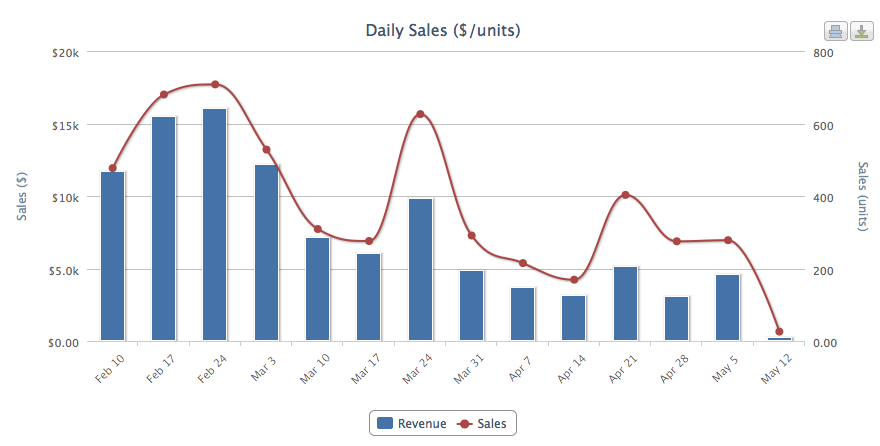
Weekly sales for the last ten weeks look like this:
The sharp drop at the end if just a function of this being Monday, the first of a new week. That’s an average of over $6,000 a week overall. In the second half, this has stabilized to around $4,000 a week. We have no idea if this will continue, but the numbers now seem to be going up and down a little within the same ballpark. If it does continue exactly like this, we should reach a final gross revenue total of around $800,000. If it fades, think more like $750,000. There are now 23,000 or so readers who have used up their read-ons. If you’re one of them, you could instantly nearly double the subscription numbers for this blog for just [tinypass_offer text=”$1.99 a month or $19.99 a year”].
Subscribe [tinypass_offer text=”here”]! And make it happen!
 If they’re going to do that, then they need some kind of test that helps them flag problematic applicants. And that test will have to be a bit impressionistic. It will mean taking the political rhetoric of the moment and watching for it in applications. It will require digging into the finances and activities of groups on the left and the right that seem to be political even as they’re promising their activities are primarily non-political.
 The Dish