Ask Sue Halpern Anything: Having Fun In A Nursing Home

In our first video from author Sue Halpern, she explains what surprised her most about working at a nursing home over the past four years with her therapy dog, a Labradoodle named Pransky:

Her new book, A Dog Walks Into a Nursing Home: Lessons in the Good Life from an Unlikely Teacher, was inspired by that experience. It comes out on Thursday. From Kirkus’ review:

When faced with the beginnings of empty-nest syndrome, Halpern [decided] to invest time in others as a way to fill her day. … She expected to meet and “learn something about old people, and about the therapeutic value of animals in a medical setting, and about myself in that setting, which was alien and not a little scary.” With Pransky at her side acting as an icebreaker, Halpern experienced the seven virtues of life: “love, hope, faith, prudence, justice, fortitude [and] restraint.” Witty and compassionate, the author introduces readers to the lives of many of the residents, providing insight into the last stages of a person’s life.

Halpern is the editor of the The New York Review of Books‘ ebook series NYRB Lit and a scholar-in-residence at Middlebury College. She is also the author of six books, including Can’t Remember What I Forgot: The Good News from the Frontlines of Memory Research and Migrations to Solitude: The Quest for Privacy in a Crowded World.

Our Ask Anything archive is here.
Quote For The Day

“I understand the impulse for America to “do something” in Syria. I grasp the logic behind funding some of the militias fighting Bashar Assad, even if America’s history of funding militias may be propelling Afghanistan and Iraq toward civil war.

But there’s something disgraceful about our tendency to wax moralistic about preventing suffering in countries in which we have not yet intervened while we brazenly ignore the suffering we have helped cause in the countries in which we have. If we’re going to debate intervention in Syria, let’s also debate intervention in Afghanistan and Iraq, countries where we have accrued grave moral obligations, obligations that don’t end just because we’ve decided it’s easier to focus our attention someplace else,” – Peter Beinart, calling out the cheap moral amnesia of those like Leon Wieseltier.

The War On Clinton Begins Again

A new ad from Karl Rove on Benghazi:

Tomasky Avlon analyzes:

This American Crossroads ad matters because of its unsubtle purpose: a pre-emptive strike against a potential Clinton presidential campaign in 2016. Remember that through 2008, Clinton was widely considered the most polarizing figure in American politics. The days of Hillary as Republicans’ favorite member of the Obama cabinet are over.

Yes, that period in which Fox News treated the Clintons as the “good Democrats” ended, for some reason, with the re-election of Obama. Go figure. Pete Spiliakos sees the ad as a waste of money:

[T]he ad is a waste as anything other than a reminder (to donors) of the existence of American Crossroads. It is basically an attack ad for a presidential campaign that is three years in the future against a person who might well not be the Democratic nominee. You can imagine such an ad possibly making a difference if this week’s Benghazi hearing had taken place in October 2016. The idea that this is somehow shaping the political environment of 2016 or 2014 is absurd. By that time, I doubt any persuadable voter is going to be thinking “Must vote against the Democrats because of something something Benghazi.”

I don’t know. What we have on the right right now is a confluence of delusions buoyed by an unending fuel of rage. There are sane, nice Americans out there whom Roger Ailes and Rush Limbaugh have persuaded by daily carpet-bombing. But I have to say this ad seems like over-reach to me. It gives the Democrats a very good reason to argue that all of this Benghazi brouhaha is really about the 2016 general election, after it was all about the 2012 election. It failed last time. It will fail again – unless you consider Butters’ avoiding a primary challenge a success.

But look how they love to demonize her. And note how the clip fastens on the moment that Clinton lost her cool. The right knows they can do to Hillary what they cannot do to Obama: get under her skin.

The Brilliant Underperformance

I confess to an addiction to Arrested Development. Aaron and I have watched it for years – on and off. It’s the purest character drama and also yet the purest sight-gag, one-liner comedy. It’s the combination of that Mitchell Hurwitz writing with a no-duds crew of brilliant actors that make this da-da fantasy so effortlessly scrumptious. Will Leitch admires its enduring cultural power, citing the show’s unprecedented return from the dead seven years after cancellation:

Arrested Development didn’t just foretell the viewing culture of 2013; it might have created it. The television world is so fractured and niche now that the shows we watch have become an important signifier of who we are—who we want to be seen as, anyway. I’m a Louie person but not a Community person. I’m a Breaking Bad person but not a Homeland one. And if I saw on your Facebook wall that you were an Arrested Development fan, well, I could bet you and I were gonna get along just fine. Which we did: That incredible ­camaraderie within the accidental, haphazard, seemingly pointless community of Arrested Development obsessives is one large reason the show eventually got resurrected. That kind of collective action would have been insane to imagine in 2006. That a tiny fan base could rally to revive a show a season after it went off the air? Maybe. But seven years later? It feels like a major evolutionary event.

Still, he doesn’t expect the reboot to increase the show’s modest commercial clout:

As geeked out as we all are that Arrested Development has returned, let’s not start pretending that the show is somehow mainstream, that its giddy weirdness could ever be called mainstream. Netflix has already ruled out a second season for the show, though Hurwitz himself has expressed interest. He’s also planning for the Netflix episodes to lead into a movie, and as exciting as that is for me and the rest of us superfans, I can’t imagine the movie ever becoming a hit. It is very possible that Arrested Development is about to be the first show to underperform in three different ­distribution channels.

IMHO, a movie would be a terrible idea. Arrested Development is quintessentially a TV show, like Doctor Who. It’s its quickness, randomness and TV-ness that make it so different.

Previous Dish on the show’s return here and here.

Iran’s Suffocation Of The Press

Over the past few years, the theocracy has increasingly cracked down on journalists:

The pattern of rotating critical journalists in and out of prison has sown fear and self-censorship across the entire press corps, according to [Committee To Protect Journalists (CPJ)] research. At least 68 Iranian journalists fled into exile between 2007 and 2012 due to harassment and the threat of imprisonment, according to CPJ research. Only Somali journalists have gone into exile in higher numbers during that period.

(Hat tip: Max Fisher)

Big Brother Behind The Wheel

Greg Beato imagines that Google’s driverless cars will further erode personal privacy:

In time, Google will know when you arrive at work each morning, how many times a week you go to Taco Bell, how long you spend at the gym. As illuminating as our searches and other online behavior might be, there’s still some room for ambiguity. Maybe you’re doing all those searches on “brain tumor” because a relative is sick, or you’re doing some sort of report, or you’re simply curious. Combine that info with the fact that you start visiting the hospital every week, however, and Google knows you’ve got cancer.

The driverless car, in short, is a data detective’s dream, a device that can discern when you get a new job, how many one-night stands you have, how often you go to the dentist. As demarcation lines between the real world and the virtual world continue to blur, autonomous cars will function not so much as browsers but links, the way we get from one appointment or transaction opportunity to the next. In theory, Google will determine the route to your desired destination based on distance, available infrastructure, and current traffic conditions. But what if Google, which already filters cyberspace for you, begins choosing routes as a way of putting you in proximity to “relevant content”?

It’s Good To Be Coach

[Re-posted from earlier today.]

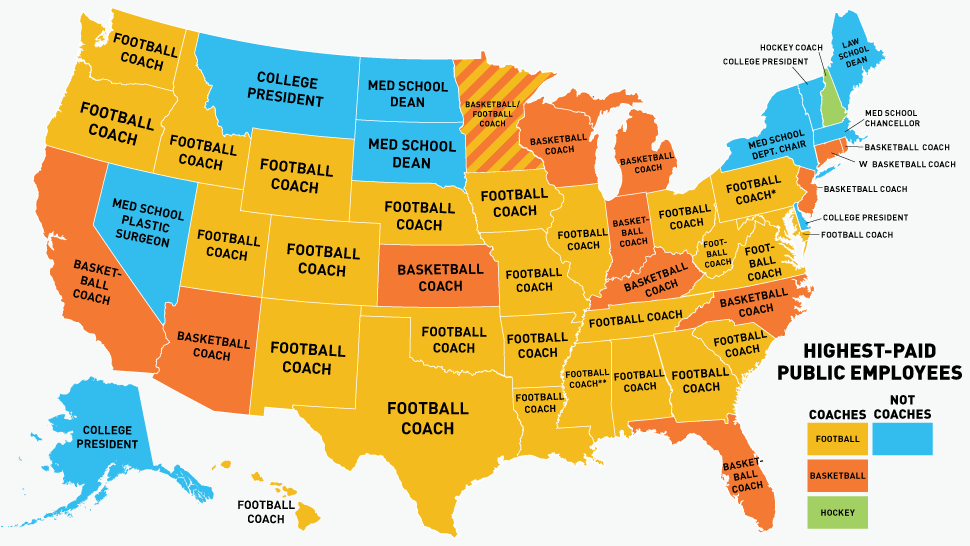
This Deadspin graphic, which went viral last week, identifies the highest paid public employee in each state:

Highest Paid

The accompanying article by Reuben Fishcher-Baum argues that coaches don’t deserve such wealth:

Looking at data from 2011-2012, athletic departments at 99 major schools lost an average of $5 million once you take out revenue generated from “student fees” and “university subsidies.” If you take out “contributions and donations”—some of which might have gone to the universities had they not been lavished on the athletic departments—this drops to an average loss of $17 million, with just one school (Army) in the black. All this football/basketball revenue is sucked up by coach and AD salaries, by administrative and facility costs, and by the athletic department’s non-revenue generating sports; it’s not like it’s going to microscopes and Bunsen burners.

Richard Vedder singles out college presidents, who are the highest paid in only four states:

The Chronicle of Higher Education tells us the median salary of public university presidents rose 4.7 percent in 2011-12 to more than $440,000 a year.

This increase vastly outpaced the rate of inflation, as well as the earnings of the typical worker in the U.S. economy. Perhaps, most relevant for this community, it also surpassed the compensation growth for university professors. Moreover, the median statistic masks that several presidents earned more than double that amount.

He goes on:

My associate Daniel Garrett analyzed the relationship between presidential compensation and academic performance for 145 schools, using the Forbes magazine rankings of best colleges. … Adjusting for enrollment differences, no statistically significant relationship was observed between academic quality and presidential pay.

Foreign Language Requirements

James Harbeck highlights some of the world’s most challenging linguistic quirks:

Some languages have a situation called diglossia, in which the written form actually represents a different dialect from the spoken form. The numerous (and not all mutually intelligible) dialects of Arabic are written in a different version of Arabic from what’s spoken. The same is true of Tamil and Sinhala: the spoken versions of the languages are now different in not just sound but some points of grammar and vocabulary from the official standard written versions.

That’s a lot harder than just having an awkward writing system. It gets to be like needing to know two languages. It’s like having an everyday spoken language that’s like what you hear in, say, rap music, or country music, or teenage slang, and having to read and write everything like you see in Shakespeare.

Relatedly, Olga Khazan examines a recent study on how immigrants assimilate into their new countries, based on how dissimilar their native language is:

By examining nine host countries, 70 sending countries, and 1,559 test scores, he then found that immigrants who come from languages that are most linguistically dissimilar have the worst literacy scores in their new host countries. A Turk in the Netherlands, the author posits, has about the same linguistic proficiency scores as a native who has little or no primary schooling. …

The awkward thing here is that there aren’t that many linguistically-similar Danes or Swedes banging down the doors to U.S. visa offices. Most of our immigrants come from Mexico (though they’ve dwindled significantly in recent years), while most holders of high-skilled worker visas are from Asia. But it seems like if the U.S. wants those individuals to perform their best economically, it could offer some sort of welcome package of its own — in the form of some generous language assistance.

The Weekend Wrap

dish_annie hall

This weekend on the Dish, we stepped away from politics to share the cultural coverage that fascinated us the most. In matters of religion and philosophy, Cass Sunstein reviewed the doubt-driven thought of Albert O. Hirschman, Ollie Cussen praised Anthony Pagden’s new history of the Enlightenment, Daniel Dennett offered a tip for assessing arguments, and a new study suggested that people who often talk in terms of “I” and “me” tend to be more depressed. Giles Fraser found that being a burden can be beautiful, Rod Dreher noted how you can find meaning in unexpected places, and John Waters talked about how nuns inadvertently inspired him. Christopher Brittain revealed which churches are growing the fastest, Julian Baggini described Kierkegaard’s leap of faith, and Dan Siedell connected his fascination with modern art to his religious life.

In literary coverage, Maria Popova cataloged the writing advice of famous authors, Alexander Aciman grappled with translating Proust, William Faulkner proved better on the page than the screen, and Orwell led the way for modern war correspondents. Keith Gandal deciphered one of The Great Gatsby‘s mysteries, S. Hope Mills mused on the meaning of not finishing books, Tom Shone defended sentimentality in film, and Jess Nevins found the source of H.P. Lovecraft’s longevity. William S. Burroughs also lived the chemical life, Words Without Borders featured a poet crushed by propaganda, L.E. Sissman compared writing poetry and writing ad copy, and Alex Dimitrov discovered poetic inspiration in using Grindr. We featured the work of poet Killarney Clary here and here.

In assorted news and view, Buddy Bradley marveled at a FILMography project, Doctor Science considered NC-17 rating from the perspective of a fanfiction reader, and Tom McCormack recalled the novel equipment used to film Vertigo. David Banks rooted the ethos of the Internet in the Cold War’s rivalry, Emily Witt embedded with a pornography shoot, and Amy Fleming offered a rundown of menu mindgames. Graeme Wood detailed the disturbing policy that the nation of Georgia used to tackle its prescription drug problem, Brain Pickings highlighted the history of the modern coffee industry, and Tim Fernholz looked to California’s manicure industry to understand the benefits of low-skilled immigrants. Hathos alert here, MHBs here and here, FOTDs here and here, VFYWs here and here, and the latest window contest here.

– M.S.

(Photo: Annie Hall, 1977, and FILMography by Christopher Moloney)

“The New Yorkiest Show Of All Time”

Jonathan Zeller marks the 15th anniversary of the Seinfeld finale by ranking the 15 “New Yorkiest” episodes of the sitcom. Number two on the list? “The Maid”:

While Elaine’s quest to retain a 212 phone number amid the introduction of the 646 area code—which has now become firmly entrenched—doubtless rings true to some New Yorkers (in fact, it’s still timely), the most Manhattan mileage in this one comes from Kramer’s sad attempt to maintain a “long-distance” relationship with a girlfriend who’s moved downtown. While, as the Official Guide to NYC, we must note that New York’s transit system and street grid make it easy to navigate the five boroughs, it’s also true that the City is very neighborhood oriented; sometimes it’s tough to muster the mental energy to, say, leave Brooklyn and visit a friend way uptown in Manhattan. Sadly, Kramer and his girlfriend get into a fight and he gets lost at First (Avenue) and 1st (Street)—”the nexus of the universe.” While NYC’s legendarily confusing lineup of Ray’s pizzerias—Famous, Original, both and neither—have given way to a single dominant chain of Famous Original Ray’s Pizza, the outpost of the latter that Jerry asks about during a panicked pay-phone call from Kramer still stands not too far from Katz’s Delicatessen (though Kramer, disoriented by his surroundings, insisted, “It’s just Original, Jerry!”).