“The Chemical Life” Ctd

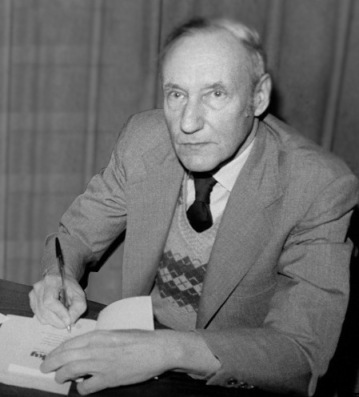
Popova provides a glimpse into William S. Burroughs’s daily routine, taken from James Grauerholz’s introduction to the novelist’s final journals:

On a typical day in the last year of William Burroughs’s life he would awaken in the early morning and take his methadone (he became re-addicted to narcotics in New York in 1980, and was on a maintenance program the William_S._Burroughs_at_the_Gotham_Book_Martrest of his life) and then return to bed. If the day were Thursday, I would arrive at 8:00 A.M. to drive him to his clinic in Kansas City, or — after he had finally earned a biweekly pickup schedule — take him out to breakfast, so that his house could be cleaned. At about 9:30 A.M. on all other mornings William would arise and — in his slippers, pajamas, and dressing gown — make his breakfast, sometimes a salted soft-boiled egg with toast, or perhaps fresh-squeezed lemonade, and two cups of very sweet tea. Feeding his many cats at the beginning of each day took up considerable time, only after which would he shave and dress himself, by about noon.

William might have visitors at midday, or he might make an outing to his friend Fred Aldrich’s farm for some target shooting with other gun enthusiasts. Otherwise, he passed the afternoon looking through his gun magazines or reading an endless stream of books, sometimes works of serious fiction but more often in the category of pulp fiction, with an emphasis on medical thrillers, stories about police and gangsters, and — his favorite — science-fiction scenarios of plague ravaging the world…

William liked to go outside in the afternoon and walk in his garden, sometimes practicing throwing a knife into a board propped up against the little garage. But in his last year, he could usually be found lying down for an afternoon nap of an hour or two. One or more of his friends would arrive at 5:00 or 6:00 P.M. to join him for cocktails and make dinner. William’s daily cocktails — which had started religiously at 6:00 P.M. when I first met him in 1974 — now commenced at 3:30 sharp. After the first vodka-and-Coke and a few puffs on a joint, he often wrote in his new journal books until he was joined by his dinner companions.
Recent Dish on writers and their drugs here.

(Photo: Burroughs in 1977, via Wikimedia Commons)

In Search Of Marcel’s Meaning

Alexander Aciman notes that “countless translators have struggled with these famous opening lines” from Proust’s In Search of Lost Time: Swann’s Way, which are emblematic of his distinctive prose style:

Longtemps, je me suis couché de bonne heure. Parfois, à peine ma bougie éteinte, mes yeux se fermaient si vite que je n’avais pas le temps de me dire: « Je m’endors. »

Nobody seems to be able to agree whether to translate the verb of the principal clause as a conditional or a past participle, because while in French it is obviously the latter, it seems to act as the former. We’ve had various degrees of “went to bed early,” “used to go to bed early,” “would go to bed early,” each meaning more or less the same thing, but none hitting the nail directly on the head. Scholars have found these lines, at once, undeniably charming and a huge pain to work with.

According to Aciman, a typical English translation renders the lines, “For a long time I would go to bed early. Sometimes, the candle barely out, my eyes close so quickly that I did not have time to tell myself ‘I’m falling asleep.'” He imagines the way other novelists might have written the passage. Here’s David Foster Wallace:

I am lying in bed early in the evening. A burnt honey colored candlewick sits on my rosewood bedside stand sending blades of smoke into the French countryside air. I am falling asleep, maybe my eyelids are closing or I have just started dreaming, but I don’t realize it yet.

And Bret Easton Ellis:

I always go to bed early. That’s what mom tells me when she kisses me goodnight. She blows out my candle and says “you always go to bed early.” Although I really am tired, I haven’t realized it yet and I try to stay awake longer. I do that until I see I am already sleeping.

Verse And Purse

In a 1972 interview, L.E. Sissman compares writing poetry and writing ad copy:

Copywriting should always be precise, true, purposely literal. Poetry should always be ambiguous—i.e., capable of being read different ways at different levels. You work for compression but you’re building a skyscraper on your little plot. Obviously, I don’t mean copywriting should be devoid of humor, nuance, or colloquialism, but I think it ought to give the reader as honest an account of the good points of the product or service as possible, and without equivocation or weaseling …

Copywriting is evanescent and poetry is, the poet hopes like hell, perduring, but there are a lot of similarities otherwise. Copywriting teaches you to say exactly what you mean in the fewest possible words the first time around and under pressure of time [as does journalism]. This is a valuable lesson for the poet.

Where NC-17 Thrives

Doctor Science considers the controversial rating from the perspective of a fanfiction reader:

As you probably have heard, a majority of fanfic involves romance and/or sex. Most fanfic is read and written by women, and despite the conventional wisdom that women “don’t like porn”, it’s usually the case that, all other things being equal, more sexually-explicit fanfic is the most popular. This has been known ever since the late 90s at latest, when writers started putting hit counters up on their websites and saw that stories labeled “NC-17” consistently got the most hits. Women definitely *do* like porn, as long as it’s the kind of porn they like.

In fanfictionland, then, “NC-17” is not at all the kiss of death it is for movies — on the contrary, it tends to pull readers rather than otherwise. NC-17, MA, Explicit are all marks of the good stuff, not marks of shame. People still like and read plenty of things that are equivalent to G or PG movies, but there is no shred of community disapproval (and plenty of cheers of approval) for extremely sexually explicit material, at least if it’s marked clearly enough that Net-Nanny-type programs can keep the kiddies out if their parents think that will work.

The Open-Source Author

Jess Nevins credits the longevity of H.P. Lovecraft’s work to his innovative approach to readers:

Lovecraft was the first author to create an open-source fictional universe. The crossover, the meeting between two or more characters from discrete texts, is nearly as old as human culture, beginning with the Greeks if not the Sumerians. The idea of a fictional universe open to any creator who wants to take part in it is considerably newer. French authors like Verne and Balzac had created the idea of a single universe linked through multiple texts, and following them, the dime novels and story papers of the late nineteenth and early twentieth centuries had established the idea of ongoing fictional universes, but those universes were limited to magazines published by the original stories’ publishers. It was Lovecraft who first created a fictional universe that anyone was welcome to take part in. Both during his lifetime and immediately afterward, other authors made use of Lovecraft’s ideas and creations in their own stories and novels. Lovecraft’s generosity with his own creations ultimately gave them a longevity that other, better writers’ ideas and characters did not have.

The View From Your Window Contest

Screen Shot 2013-05-10 at 11.26.51 PM

You have until noon on Tuesday to guess it. City and/or state first, then country. Please put the location in the subject heading, along with any description within the email. If no one guesses the exact location, proximity counts.  Be sure to email entries to contest@andrewsullivan.com. Winner gets a free The View From Your Window book. Have at it.

Stop-And-Piss

Graeme Wood describes the disturbing policy that Georgia (the country) used to tackle its prescription drug problem:

[President Mikheil Saakashvili] mandated as aggressive a drug policy as any country has attempted since Mao Zedong threatened to execute all Chinese opium fiends and “cured” about five million of them overnight. If you think New York’s stop-and-frisk rule is invasive, try Georgia’s: Cops can stop anyone at any time for no reason and force him to urinate into a cup. Fifty-three thousand people were stopped on the street in 2007, or about one in 20 of the young men in Georgia. About a third of those passed dirty urine; first-offenders were levied a fine of several hundred dollars. One more dirty test amounted to a criminal offense.

“There was such an unprecedented drug war,” Otiashvili says. “What was going on—and still goes on—in Georgia doesn’t happen anywhere. No country puts people in the prison for a positive urine test.”

Orwell In Spain

His coverage of the Spanish Civil War, Homage to Catalonia, is a model for modern war reporters:

Orwell’s brilliant firsthand account of the conflict stands apart from and well above the I-was-there school of emotive, narcissistic war reporting we witness too often today. He also attempts to put his personal experiences into some proper political context, in two chapters now removed (at his request) from the narrative text and published at the end as appendices.

Here, Orwell closely interrogates and challenges the ‘official version’ of events in Barcelona, put about by the Communists and their many international apologists to justify their brutal repression of the non-Stalinist left. As he unravels the twisting of truth by propaganda organs such as the CPGB’s Daily Worker, you can almost see the ideas he was soon to express in his novels Animal Farm and Nineteen Eighty-Four. He is also cutting about the way that the Communists simply branded their opponents as ‘Social-fascists’ and ‘Trotsky-Fascists’ to avoid engaging in important political arguments. Many who express their admiration for Orwell today have yet to absorb his point that screaming ‘Fascists!’ in the faces of those you disagree with is not the same thing as making your case. ‘Libel’, as he concludes, ‘settles nothing’.

Hitchcock’s Artillery

On the 55th anniversary of Vertigo, Tom McCormack recalls the novel equipment used to create the film’s title sequence, an “obsolete military computer called the M5 gun director” from WWII:

[Computer animation pioneer John Whitney] was hired to complete the seemingly impossible task of turning [Saul] Bass’s complicated designs for Vertigo into moving pictures. A mechanism was needed that could plot the shapes that Bass wanted, which were based on graphs of parametric equations by 19th mathematician Jules Lissajous; plotting them precisely, as opposed to drawing them freehand, required that the motion of a pendulum be linked to motion of an animation stand, but no animation stand at the time could modulate continuous motion without its interior wiring becoming tangled. …

The M5 was used during World War II to aim anti-aircraft cannons at moving targets.

It took five men to operate it on the battlefield, each inputting one variable, such as the altitude of the incoming plane, its velocity, etc. Whitney realized that the gun director could rotate endlessly, and in perfect synchronization with the swinging of a pendulum. He placed his animation cels on the platform that held the gun director, and above it suspended a pendulum from the ceiling which held a pen that was connected to a 24-foot high pressurized paint reservoir. The movement of the pendulum in relation to the rotation of the gun director generated the spiral drawings used in Vertigo’s opening sequence.

The M5 weighed 850 lbs and comprised 11,000 components, but its movement was dictated by the execution of mathematical equations; it was very much a computer Whitney’s work on the opening sequence for Vertigo could be considered an early example of computer graphics in film—and a clever détournement of military equipment.