How Barbaric Is Force-Feeding? Ctd

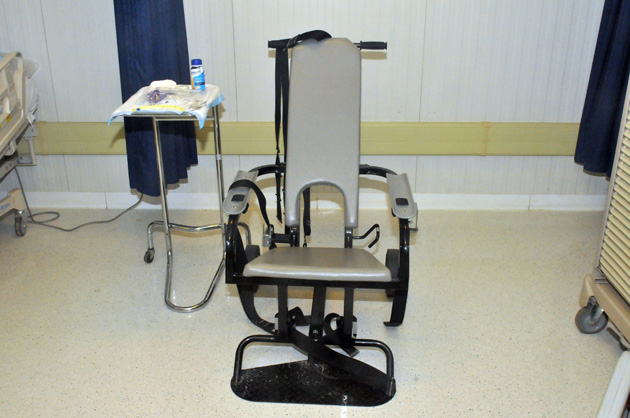
gitmo-feeding-chair630

Dave Gilson describes a series of government photos from the Gitmo hunger strike:

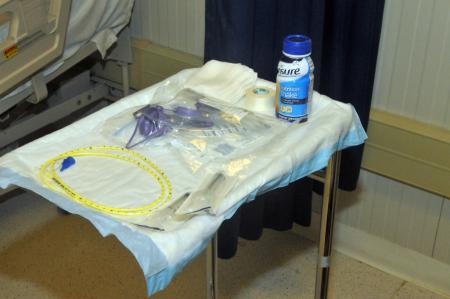
Though they do not show any of these frantic scenes, recently released military photos offer a window onto how Guantanamo has been dealing with the unprecedented protest: A “feeding chair” where detainees are force-fed sits next to a tray of feeding tubes and a bottle of butter pecan Ensure; guards deliver meals through “bean holes” in detainees’ cells, only to throw away the uneaten food; hospital beds behind chain-link fences with rings for shackles beside them. Other images in the series, taken in early April by Sgt. Brian Godette of the Army 138th Public Affairs Detachment, depict scenes from Camps V and VI, where most prisoners are held: a sign asking soldiers to respect praying detainees, a stuffed recliner in the “media room” that looks almost normal until you notice the ankle restraints.

A professor from the Naval Academy Anne-Marie Drew visited and penned her reflections in the Jesuit magazine, America. What struck her most was the epistemic closure of the guards there:

The staff is not sadistic. They are not Nurse Ratched. Rather they fiercely believe in the American ideals of 450x299_q75justice and fairness and decent treatment of those in our custody. They want to change the public view of the camps, a view the staff believes is distorted.

Nowhere was this belief more apparent than outside the medical bay when a medical staffer explained force-feedings. With professional calm and compassion, she explained that when we force-feed the detainees, we are taking care of them. We cannot let them starve. The tacit subtext was clear: we are, after all, the United States of America, founded on a Judeo-Christian culture. Inmates are not being mistreated during the procedure, for we are not a country that mistreats others.
She gets to the core of the problem in America, as the country still refuses to look what it is doing and has done clearly in the eye:

Because we think of ourselves as benevolent, as Christian, we cannot conceive of ourselves as cruel. As individuals, we make up stories we can live with. As a nation, we do the same. Thus, we try to convince ourselves that force-feeding reflects benevolence and our role as caretakers. We think of force-feeding as one more safeguard for the detainees… But force-feeding is not such a safeguard. It is a violation of a fundamental human dignity, a dignity these detainees do not abdicate when we incarcerate them.

It’s the same mindset that believes that when Americans torture prisoners, it somehow isn’t torture. Because we have internalized our moral superiority – indeed all but turned it into a national religion – we can do no wrong. What would be torture if authorized by Khamenei is somehow not torture if authorized by Cheney. As Rudy Giuliani – perhaps the most unreflective of all American exceptionalists – put it, waterboarding isn’t always torture, even though it has been designated such by every legal ruling ever made on it. Why? Because

It depends on who does it.

As a Catholic, Giuliani should know that it doesn’t. Evil knows no geographic boundaries. And Americans are not somehow super-humans. So where are the bishops? Michael Shaw reflects on the photos:

Although photos from Gitmo have typically excluded the prisoners themselves, not seeing them and knowing they are wasting away makes their absence here that much more palpable. …

Scenes of olives being delivered that will never be eaten, or full Styrofoam containers getting chucked in the trash, or bottles of Ensure on patient trays next to surgical tubes (to make sure you don’t die on us while the world is watching) can’t help but prompt us to see the prisoners in our own minds (or even imagine we’re getting the treatment).

While the government and the military pretend these photos maintain an adequate level of abstraction, however,  to me they do the opposite. In waging a war of wills at the most primitive level, these photos, if highly institutional, somehow take me back to Abu Ghraib. Torturing a man for information, or out of sadism or to keep him alive, is still torture. And as for breaking the will, well, martyrdom is martyrdom, whether it’s by jetliner or by leaving us with rotting containers full of bananas.

My take on the morality of force-feeding here.

(Photos by Sgt. Brian Godette, Army 138th Public Affairs Detachment)

Watching The Earth Evolve

Dubai Coastal Expansion

Darrell Etherington calls our attention to a cool new project from Google that uses satellite imagery to track changes in land use since 1984:

The result is a series of interactive time lapse images that progress year-by-year, showing exactly how things have changed in key areas like the Brazilian Amazon Rain Forest, booming metropolitan areas like Las Vegas and Dubai, and the progress of large bodies of water like the Aral Sea.

It’s stunning to watch the Amazon rainforest virtually disappear, or see the building creep across the desert in Vegas, or watch the Columbia Glacier vanish entirely. Google worked with the U.S. Geological Survey, NASA and TIME magazine to build the Timelapse project, and went to Carnegie Mello University’s CREATE Lab to build the final HTML5 site that makes the animations interactive and browsable.

Watch your planet dry up here!

Whitewater Round II

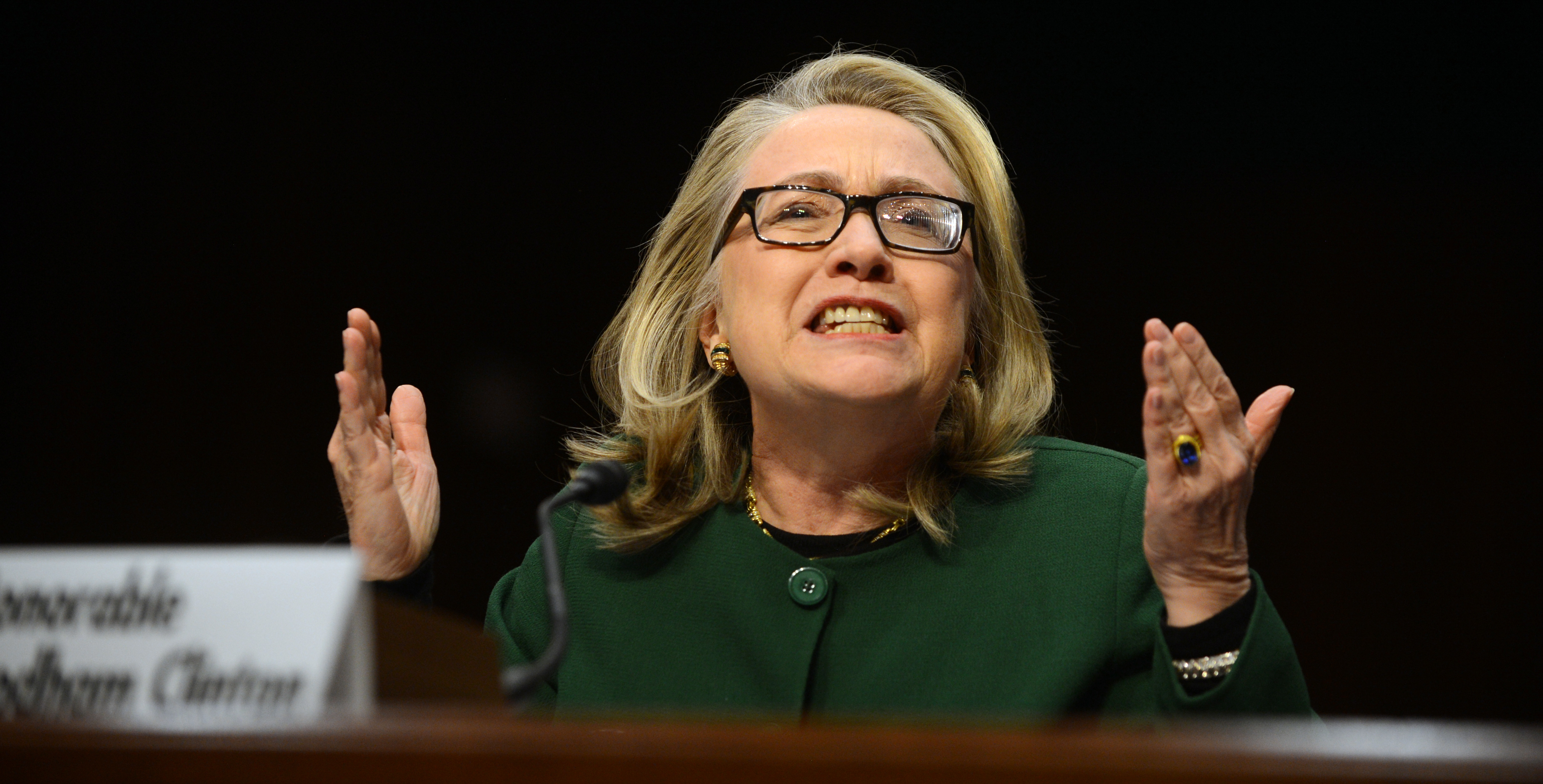
US-LIBYA-ATTACKS-CONGRESS-CLINTON

Well, they finally have something. The talking points provided by the CIA were pushed back against and effectively edited by the State Department’s spokesperson, Victoria Nuland. The key emails, it seems to me, are the following. Nuland showed classic bureaucratic in-fighting as the CIA sought to highlight its own warnings, ignored by State. The reference to elements of al Qaeda in the country, highlighted by the CIA:

“could be abused by members (of Congress) to beat up the State Department for not paying attention to warnings, so why would we want to feed that either? Concerned …”

That’s prima facie evidence of politically spinning the facts. The “either”, however, refers to previously mentioned legitimate wariness of tipping off the Jihadists that the US was onto them. Notice how the second statement was utterly unnecessary – and purely political, defending State and Clinton. And even when the specific reference to Jihadist elements in Libya was removed, Nuland still cavilled:

“These changes don’t resolve all of my issues or those of my buildings (sic) leadership.”

My building’s leadership? Who can that mean but Clinton?

As Joe Klein has noted, these are venial sins, not mortal ones. And the premise of the Republican argument that immediately including the possibility of a pre-planned Jihadist attack would have deeply wounded the Obama campaign seems ludicrous to me. He decimated al Qaeda in Af-Pak and killed bin Laden, but a minor, if foolish, attempt at unnecessary spin after an embassy siege would have undone this legacy in the eyes of voters? Come off it.

All of this is a grotesque over-reaction – for transparently political purposes. The GOP does not know any more how to propose constructive policies that actually might improve the lives of Americans. But they sure know how to construct a “scandal” into a mountain when it is only a bump in the tarmac.

It all reminds me of Whitewater.

At its core, there really was nothing of anything there. God knows we tried to find something – and as editor of a pro-Clinton magazine, I probably went too far in proving our independence. But it is also true – as we discovered in the 1990s – that the Clintons cannot resist giving their enemies a slim reed of fact upon which to build their demonization machine. In the end, all perspective is lost altogether – and you end up impeaching a president.

I think this is the context in which to understand this. The Obama administration has been remarkably scandal-free. Former Secretary of State and possible presidential nominee, Hillary Clinton, is now Fox News’ path to even more money, and GOP’s path to appearing relevant and destructive to an Obama second term. An opposition legitimately exists to find venial sins like Nuland’s, but when they are then transformed by a massive media campaign into something that is worse than Watergate and Iran-Contra combined, it becomes a farce.

Compared with the Republicans’ pure partisanship and politicking, Nuland’s is pretty minor. But it still exists. As does the pattern of the Clintonistas’ giving their enemies a sword to plunge into them. The thing about Hillary is that, unlike Obama, these persistent, delusional, political creeps get under her skin. She then makes mistakes. Which gives them more fodder … and it’s back to the 1990s we go.

This time, however, the GOP has nothing positive to propose after they have slimed their bete noire. So their nihilism is even starker. They need to recall, for their own good, where over-reaching led them to in the late 1990s. But Clinton needs to recall, for her own good, why she endured so much hazing in the 1990s. She emerged from the State Department seemingly free of it – as the GOP tried to leverage her against Obama. Now she is alone – and they will not rest until they have destroyed her.

(Photo: US Secretary of State Hillary Clinton testifies before the Senate Foreign Relations Committee on the September 11, 2012 attack on the US mission in Benghazi, Libya, during a hearing on Capitol Hill in Washington, DC, on January 23, 2013. By Saul Loeb/AFP/Getty.)

Blessed Be The Time Lord, Ctd

A reader writes:

I am reminded of an observation that George Orwell made about England:

The common people are without definite religious belief, and have been so for centuries. The Anglican Church never had a real hold on them, it was simply a preserve of the landed gentry, and the Nonconformist sects only influenced minorities. And yet they have retained a deep tinge of Christian feeling, while almost forgetting the name of Christ.

In that spirit, I view the Doctor as a very English interpretation of Christ:  An eccentric fellow who wanders about doing good deeds, will bend the rules in the causes of justice and compassion, attracts followers who seek to emulate his example — and of course, periodically gives his life so that others may live, and is then resurrected.

Exactly. Jesus with a sonic screwdriver and a sense of fun.

Comedian-In-Chief

Ben Yagoda applauds Obama’s executive wit at this year’s Correspondents’ Dinner:

He’s got impressive comedy chops to start with: the poker face, the sense of the proper cadence of a line, the willingness to pause for a long beat while he looks off into the middle distance, in the manner of Hope or Benny. He has a trademark delivery, the way he barks out a huh! after setting down a premise. And nothing but God-given talent can explain his skill at milking or playing off a bit. The only wall this president wants to tear down is the fourth one, as he deftly riffs on the joke he’s just made:

I’m also hard at work on plans for the Obama Library. And some have suggested that we put it in my birthplace, but I’d rather keep it in the United States. (Laughter.) Did anybody not see that joke coming? (Laughter.) Show of hands. Only Gallup? Maybe Dick Morris? (Laughter and applause.)

Then, at another point:

Of course, everybody has got plenty of advice. Maureen Dowd said I could solve all my problems if I were just more like Michael Douglas in “The American President.” (Laughter.) And I know Michael is here tonight. Michael, what’s your secret, man? (Laughter.) Could it be that you were an actor in an Aaron Sorkin liberal fantasy? (Laughter.) Might that have something to do with it? (Applause.) I don’t know. Check in with me. Maybe it’s something else. (Laughter.)

Now, note the Dick-Vitalesque “second term, baby” in his opening bit, the “what’s your secret, man?” and “check in with me” in the one above. The truly remarkable thing about Obama as standup is that he really is the coolest guy in the room. This may be the nerd prom, but he is no nerd. Hearing him deliver jokes, you sense he’s actually listened to his teenage daughters talk (“I was like … “) and paid attention to what they’re interested in. (“Take the sequester. Republicans fell in love with this thing, and now they can’t stop talking about how much they hate it. It’s like we’re trapped in a Taylor Swift album. [Laughter.]“)

Are Small Donors The Solution?

Ezra Klein doesn’t believe that limits on the size of campaign contributions will be a panacea for our political woes:

We tend to assume “small donors” hail from that mythical, much-beloved class of people known as “ordinary Americans.” They’re not. Even if tens of millions of Americans are donating, hundreds of millions of other Americans aren’t. The tiny minority that donates is different from the vast majority that doesn’t: They’re much, much more ideologically polarized. What individual donors tend to want, [senator Chris] Murphy [D-CT] said, is partisanship. “When I send out a fundraising e-mail talking about how bad Republicans are, I raise three times as much as when I send out an e-mail talking about how good I am. People are motivated to give based on their fear of the other side rather than on their belief in their side.” …

Just as big money is corrupting, small money is polarizing. And it’s polarization that probably poses the bigger threat to American politics right now. Big money, for example, generally wants to raise the debt ceiling. Small money is one reason Republicans in Congress came close to breaching it.

Mijin Cha pushes back:

Where to start? Well, how about with the most recent election, in which highly ideological big donors played a critical role in moving the GOP to the right —  both during the primaries and the general election.

Think of a mega donor like Foster Friess, a hard right Christian conservative, who single-handledly kept Rick Santorum in the race and helped foster a climate in which Mitt Romney tacked right. Or think of the role played by the Club for Growth, which spent over $20 million to help knock off moderate GOP Senate and House candidates in the primaries. Or how about those Koch brothers, the life-long libertarians, who spent tens of millions of dollars in the last election cycle.

One reason the Republican Party finds it so hard to move in a more moderate direction is because deep-pocked groups like the the Club for Growth and NRA threaten to primary any congressional member who steps out of line. It’s these well-financed enforcers that are the main problem, not Michele Bachman’s small donors.

Maligning Millennials

This embed is invalid


Marc Tracy unloads on Joel Stein’s new cover-story (paywalled), which tries to take millennials down a peg:

[W]here it does say things, Time and Stein reveal themselves to be guilty of taking culturally and ethically specific ideas about how people should live their lives as normative facts. …

[F]rom Stein’s opening litany: “[Millennials’] development is stunted: more people ages 18 to 29 live with their parents than with a spouse, according to the 2012 Clark University Poll of Emerging Adults.” For one thing: it’s the economy, stupid! Thousands of words on, Stein dutifully nods toward other possible valid reasons for this development, such as greater, technologically enabled control over fertility. But that is not even the point. “Stunted” is one of those words that linguist Paul Roberts would have called “colorful.” Stein is making not only a forensic observation, but also a moral judgment. Millennials are delaying maturity, leaving home, marriage, having children, and the rest—and that is wrong of them. Thank God Joel Stein is here to set us right!

And from later on:

“They’re financially responsible; although student loans have hit record highs, they have less household and credit-card debt than any previous generation on record—which, admittedly, isn’t that hard when you’re living at home and using your parents’ credit card.” “Responsible,” too, is a moral word masquerading as an empirical one. To write an article about young people that minimizes student debt at a time when it, indeed, is at a record high, is astonishing enough. To imply that, in contrast to low household and credit-card debt, all of this student debt is not “responsible” betrays an incredibly poor understanding of how student debt has gotten as high as it has.

One of the most popular Dish threads from last year was “Letters from Millennial Voters” – read it all here.

The Fracking Debate

Readers continue it:

I’ve been following Josh Fox’s “Ask Anything” series with particular interest. As a native Pennsylvanian, I’ve been outraged by the gas industry’s aggressive and arrogant rush to turn Pennsylvania’s forests and farmlands into industrial areas.  As recently documented by this USGS report, this rapid industrialization of Pennsylvania’s forests with so many new roads and pipelines is fragmenting habitat that is really important for wildlife (among other apparently expendable things like clean water, air, public recreation, solitude, etc.).  The USGS released another report in March about the habitat fragmentation issue, which receives almost no coverage whatsoever.

A reader complained that “it’s obvious that Fox isn’t at all interested in presenting a fair (but biased) assessment.” That may be true. But I’m fairly more concerned about the gas industry’s propaganda that permeates the media. You cannot turn on cable TV without seeing an ad about the amazing benefits of “clean” natural gas. Give me a break. You may be able to say that burning natural gas is “cleaner” than coal or oil, but it is certainly not “clean,” particularly when you consider the process of exploration, development, production and transportation.

As for Mr. Fox’s presentation, full disclosure: I’ve never seen Gasland, so I’m not sure how the issues were presented.  But the reason I never saw Gasland is because I’ve lived Gasland.

I grew up in the oil and gas fields of northwestern Pennsylvania.  I’ve seen firsthand what happens when the oil and gas industry infiltrates and dominates your area.  Anyone wanting to know how good turning your region over to the oil and gas industry is need look no further than the “incredibly prosperous” towns of Oil City, Warren, and Bradford in northwestern Pennsylvania.  I invite anyone to visit these towns to see the rewards that await you if you only sign over your mineral rights for some short-sighted profits.

Unfortunately, the rest of Pennsylvania is getting to know all too well the reality that has existed in northwestern Pennsylvania for more than a century thanks to the oil and gas industry.  So much of Pennsylvania’s state forests in the north-central part of the state have been leased to the oil and gas industry over the last several years that the agency charged with managing those state forests, the DCNR, is concerned about its ability to maintain its status as a “sustainably managed” system by the Forest Stewardship Council.  Between Governors Rendell (a Democrat) and Corbett (a Republican), there’s been a bipartisan appeasement to the oil and gas industry that simply sacrificed hundreds of thousands of acres of state forest land, consequences be damned.

Finally, you state that “if it provides energy while lowering carbon emissions, I’m for it.”  Please, get out of Manhattan and for god’s sake visit some of the areas in Pennsylvania where “fracking” is allegedly “lowering” our “carbon emissions.”  I guarantee you it will take no longer than 10 minutes to see how ridiculous a statement that is.  Regardless, Bill McKibben repeatedly cautions that the only number that matters is the global amount of carbon in the atmosphere.  Thus, even if America allegedly reduces its emissions by transitioning away from coal to natural gas, that reduction only matters if that coal remains in the ground and is not dug up and shipped overseas to be burned.  Do you think the coal industry is just going to stop extracting coal because America relies more on natural gas?

Another suggests:

The dissenters that you published may want to read this article, “Fracking Would Emit Large Quantities of Greenhouse Gases,” in Scientific American.

Another reader:

I’m opposed to fracking. When I was still working for a newspaper, I did a couple of stories about people who were investigating fracking, so I wasn’t dealing directly with sources who were doing fracking or having their landfracked. I am intrigued by fracking because I took a couple of courses in geology in high school and so the actual process of fracking was something I wanted to know more about. I became opposed to fracking for several reasons.

First, I don’t like the way fracking disregards property lines on the surface, so that it’s difficult to allocate where the natural gas comes from and who should profit; I don’t like the unsettled law and I don’t like having mineral rights separated from surface rights (mostly because I grew up in a state where there wasn’t much mining or oil drilling).

Second, I don’t like the way fracking pumps undisclosed chemicals into geological strata to free up natural gas. Iffracking used water and say, baking soda, I’d say fine, go for it. Those are known quantities over the long run. But I am seriously concerned about water quality and have been for years, and I worry that we don’t know enough about how all aquifers are recharged to say with authority that fracking chemicals won’t circulate into aquifers eventually. I am very conservative about messing with water sources.

Third, I don’t trust regulation or corporations in general in the long run. Fracking advocates say the casings for the wells are securely enclosed and will last for years, protecting the water supply. That may be true. But there will be fracking contractors who don’t adhere to state-of-the-art standards and there will be weak or unethical regulators, so there will be instances of failure. Until we know how costly failure will be – in terms of water resources damaged, maintenance and containment of fracking fluids, and maintenance and containment offracking wells 50 to 100 years from now, I don’t trust fracking. I would want to see long-term bonds posted for each individual well-head, and I would also want to see regulators who don’t make mistakes or get complacent by doing active research on maintaining water quality and mitigating well failures.

My problems with fracking are that I can’t trust government to take in enough money to pay for problems caused by fracking many years from now. I can’t trust government to keep that money only for dealing with fracking without wasting it. I can’t trust corporations to always put water quality and public safety above profit margins, and I don’t trust lawyers, lawmakers or the courts to protect the rights of individuals when it comes to profits from resource extraction that can’t be tracked in ways that reflect the ownership interests of people who own the land at the surface, whether or not they always owned the mineral rights, never owned the mineral rights, or sold the mineral rights.

I think protecting the water supply is more important than lowering carbon emissions through fracking, but that leads to another discussion I won’t get into here – my bias is toward solar-powered roofs on every house and solar-powered skins on vehicles, with distributed energy production that decreases reliance on a grid powered by fossil fuels; I also favor funding more research into nuclear power production through fusion rather than fission.

Previous Dish on fracking here.

Face Of The Day

Julia Gillard Visits Papua New Guinea

Traditional dancers perform ahead of the arrival of Australian Prime Minister Julia Gillard at Jackson International Airport on May 9, 2013 in Port Moresby, Papua New Guinea. The trip is the first official visit for Gillard to the Pacific Island nation and the first visit since former prime minster Kevin Rudd visited in 2007. The three-day visit will include trips to a local market and primary school as well as tours of the Exxon Mobil Liquefied Natural Gas plant and the Bomana War Cemetery. By Chris McGrath/Getty Images.