If you haven’t absorbed his brilliance enough yet, here’s The Krugman Times. The bearded gray lady.
Month: May 2013
Quote For The Day III
“I accepted the invitation to the Presidential Conference with the intention that this would not only allow me to express my opinion on the prospects for a peace settlement but also because it would allow me to lecture on the West Bank. However, I have received a number of emails from Palestinian academics. They are unanimous that I should respect the boycott. In view of this, I must withdraw from the conference. Had I attended, I would have stated my opinion that the policy of the present Israeli government is likely to lead to disaster,” – Stephen Hawking.
Breaking The Ice
Radiosilence details the mesmerizing journey seen above:
The Nathaniel B. Palmer is an icebreaker operated by the US National Science Foundation. Cassandra Brooks, one of the 37 scientists the ship can accomodate for missions of up to 75 days and deep in the Antarctic winter, shot this timelapse video of the ship doing its stuff over a two month period while traveling through the Ross Sea.
Brooks has been blogging about her trip as well. Watch an additional video of the work done on the ship here.
What Really Made The South Republican? Ctd
Sean Trende emails the Dish:
I came across your readers’ factcheck of my earlier piece. This subject is near-and-dear to my heart, and an area where I’ve devoted quite a bit of writing. I think a lot of the confusion comes from the fact that I’ve written pretty extensively about this elsewhere (namely my book, which you were kind enough to link). So in some areas I didn’t fully explain myself. Here, my goal was actually to avoid some of the thornier issues of causation as much as possible and to stick to the more factual question of whether 1964 represents some “sudden realignment” hypothesis we hear so often. That latter point may be of purely academic interest, but it is misstated so often in popular media that I figure it must have some sort of general salience.
My big picture view is that there are really four southern realignments: the mountains in the 1860s, the cities from the 1920s to the 1950s, the rural areas in the 1960s-90s, and the upcountry, Jacksonian areas in the 2000s and 2010s. All of these really do have separate causes. My main beef is that everyone acts as if the third realignment, which was heavily racialized in many respects, is the entire story.
It is true, as the first reader notes, that the Republicans didn’t fare that well in presidential elections in the South in the 1920s. My point is just that if you look at the results closely, you see the seeds of GOP ascendency here. In 1924, Coolidge got 2% of the vote in South Carolina. But there were three counties where Coolidge exceeded 10%: Beaufort, Charleston, and Georgetown. Not accidentally, these were three of the more urban counties in the state at the time, if barely so.
Similarly, in Florida Coolidge carried Pinellas (St. Petersburg) and Palm Beach counties, and came close in Orange (Orlando) and Dade counties. Coolidge carried Arlington in Virginia. The trick is that these places were relatively urban, but still small (Dade County cast 11,000 votes; Pinellas 6,000; Arlington 3,000). As they grew, the Southern Republican Party grew. In other words, the *template* sprung up in the 1910s and 20s, even if the effects were minimal at the time (think of it like the Hispanic vote in the 1960s: still heavily Democratic, too small to make a difference, but in retrospect an important datapoint).
It’s wrong to write off 1928 as an exception due to Smith’s Catholicism. That played a huge role, but contemporaneous accounts ascribe an almost-equal role to the fact that he was a “wet” on prohibition. It showed the party would have trouble if it became too northern, ethnic, urban, and liberal. In fact, there’s a pretty high correlation between the counties Hoover won, and those Ike won. And again, the urban template is there: Hoover wins Texas because he gets 61% in Dallas County, 56% in Harris (Houston) and 69% in Tarrant (Ft. Worth). Ike got 63%, 58%, and 58% in 1952, but won the state by a wider margin because those areas grew. Ike does worse that Hoover in the highland South, where racial issues were less salient (though arguably less intense) and the prohibition issue was more important in 1928, but made up for it because the urban counties were larger than in 1928.
I actually do compare the South to the country as a whole in an earlier piece, which I referenced. As an aside, I don’t know why your reader would exclude Texas and Florida, especially in this time period, and especially since they were home to some of the bigger centers of growing Republican strength in the South. If you include them, the South drops from 23.4 percent more Democratic than the nation in 1932 to 18.2 percent more Democratic in 1944 (if you use two-party vote, it drops from 22.2% to 20.2%). On average, the South was 21% more Democratic than the country as a whole during FDR’s term, compared with 27% from 1904 through 1924 (25% including 1928).
These aren’t huge drops, but then again, my claim was that the huge drops occurred in 1952. Also, remember that a drop in Democratic vote share of six points corresponds generally to a 12 point diminution of the point spread.
As for MS and SC, I concede in the piece that MS was a state where Goldwater made a real breakthrough, along with AL and, to a lesser extent, GA. But SC had been a very close state in 1952 and 1960. It may have swung big from 1916 to 1964 toward Goldwater, but most of that swing from 1944 (88% Roosevelt) to 1952 (51% Stevenson). That’s the whole point: By 1964, the GOP was mostly there in most of the southern states.
Obviously what was going on on the Democratic side was important, as both readers note. But again, I don’t really spend a lot of time on causes in the piece; it’s just a fact that the South had been a swing region for the 12 years prior to Goldwater, regardless of what the reason was. I certainly don’t mean to suggest that race had nothing to do with it. I think a lot of the switch in the 1950s and early 60s had to do with the fact that, post-1948, racist southerners had no place to go on segregation.
But – and this might seem to be splitting hairs too finely – the question of why Southern Democrats left the Democratic Party is somewhat distinct from why they voted Republican. If the parties were on equal footing on segregation-and given the Eisenhower Administration’s record on civil rights, I’m not sure I’d go that far-why did so many southerners turn to the GOP? And why was it uneven, with urban areas moving at a much faster pace than rural ones? My view – incidentally, borrowed from Shafer and Johnston’s convincing, data-driven “The End of Southern Exceptionalism” – is that if the South had stayed poor and rural, it would have stayed Democratic or started a third party after the ’48 convention. Why? Because this is what the poor, rural South did.
This goes to most of what the second reader writes. Obviously this story is well-known to specialists, but the “1964-as-sudden-turning-point” is nearly ubiquitous in the commentariat. Even political scientists like Tom Schaller in Whistling Past Dixie make reference to it. And I certainly don’t deny that Republicans exploited racial tensions, nor that they often ran racist candidates, especially in the post-1964 period, in order to win over rural southern whites; in fact, I’m pretty sure I said as much in the piece.
Sorry about the length. I could write about this for hours, and feel blessed that I can. Love this stuff!
Turning Pro-American
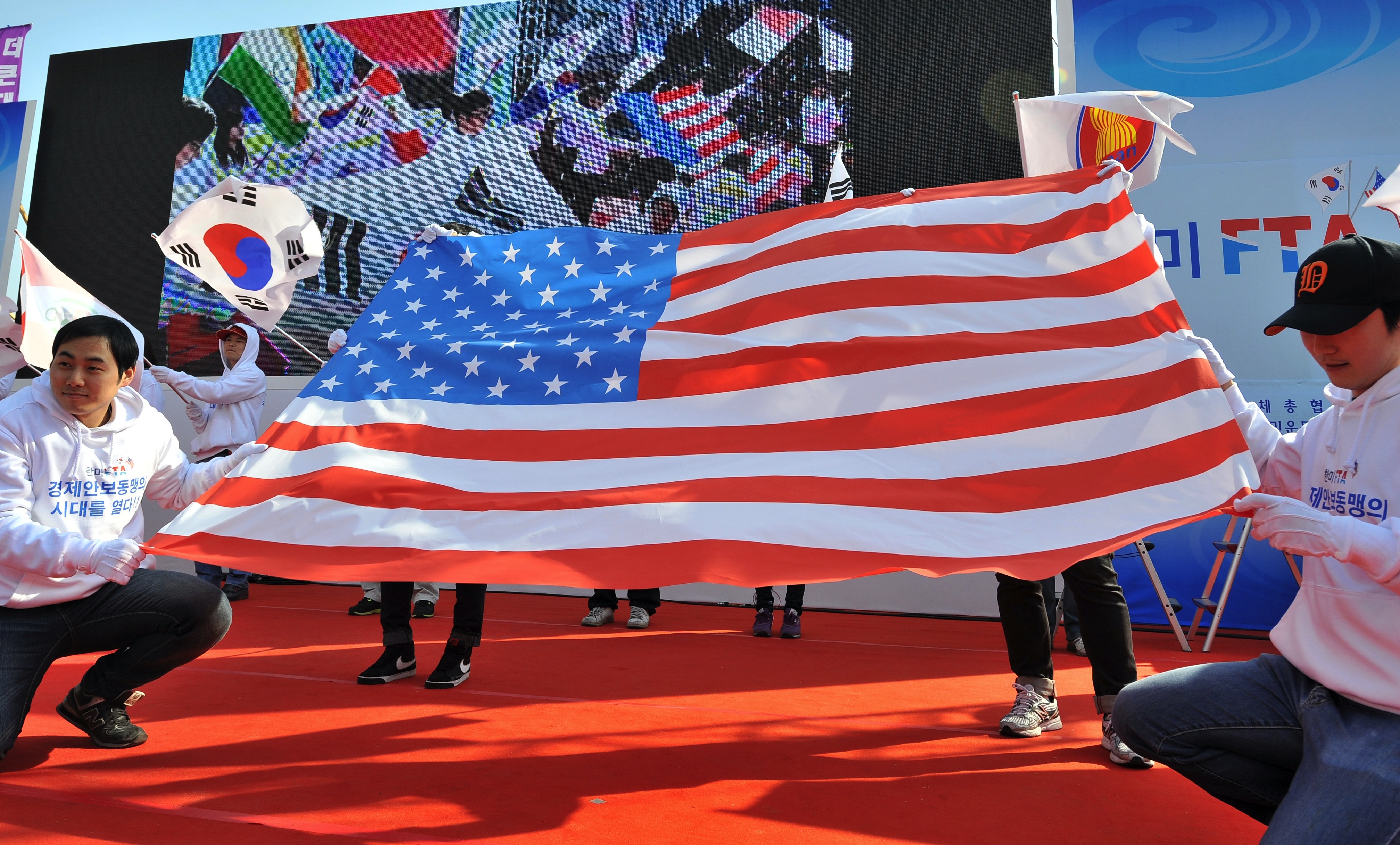
Max Fisher spotlights South Korea, which had one of the lowest opinions of the US at the start of the millenium but now stands out as fervently pro-American:
As South Korea transitioned from military dictatorship to democracy, and from a poor rural country to an advanced urban society, Koreans started to feel “new stirrings of nationalism arising from their country’s rapid economic growth and political liberalization,” historian Jinwung Kim has written. That nationalism manifested, in part, as a rejection of “Korea’s ‘big brother,’ the United States,” Kim wrote. Research by Katherine H.S. Moon, an academic at Wellesley College, linked the “rejection of authoritarianism” and growing national consciousness to “resurgent nationalism” and a newly mainstream anti-Americanism. …
In the mid-2000s, though, South Korea started downgrading its Sunshine Policy [rapprochement with North Korea] and shifting back toward the U.S. Partly this was due to internal politics, which saw power shift from the pro-Sunshine left to the pro-American right. But North Korea also helped, reneging on past agreements, aggressively expanding its nuclear weapons program and, in the process, alienating South Korea and accelerating Sunshine’s demise.
(Photo: South Korean conservative activists display a US flag during a rally to support South Korea-US free trade agreement in Seoul on March 15, 2012. A long-delayed free trade agreement between the United States and South Korea took effect amid praises from their leaders but also sparking scattered protests. By Jung Yeon-Je/AFP/Getty Images)
Face Of The Day

Chinese actress and UNEP goodwill ambassador Li Bingbing sticks out her tongue after receiving temporary tribal markings from members of the Samburu tribe in Samburu game reserve on May 8, 2013. Li Bingbing was on an official visit to the Samburu reserve in Kenya to highlight issues of Africa’s poaching crisis. By Carl de Souza/AFP/Getty Images.
The Degree Of Inequality
Jeffrey Selingo, author of the new book, College (Un)bound, addresses wealth disparity when it comes to college degrees:
[College] was always seen as the great leveler in this country, especially after World War II. One of the most disturbing numbers I came across in research for this book was that if you come from a family with a family income above $90,000, you have a 1 in 2 chance of getting a bachelor’s degree by the time you’re in your mid-20s. If you come from a family under $35,000, you have a 1 in 17 chance. One of the fears, and one of my fears, is that we might become a country where the next generation is less educated than the generation that preceded it.
An excerpt from his book:
Even as more of our citizens need an education past high school, elite colleges are making themselves even more exclusive, proudly boasting each spring about the smaller and smaller percentage of applicants they have accepted (in 2012, Harvard rejected nine in ten applicants, including at least 1,800 high-school valedictorians). At the 200 colleges that are most difficult to get into, only 15 percent of entering students in 2010 came from families in the bottom half of incomes in the US (under $65,000). Nearly seven in ten students on those campuses come from the top income group (above $108,000).
The result is that the US higher-education system is becoming less of a meritocracy. In the last decade, the percentage of students from families at the highest income levels who got a bachelor’s degree has grown to 82 percent, while for those at the bottom it has fallen to just 8 percent.
College (Un)bound also tackles the luxury amenities that schools increasingly offer students. Alan Jacobs illustrates:
A major part of the problem is that colleges and universities have invested more strenuously in amenities than in education, with the assumption that students absorbed in the delights of their dining halls and climbing walls won’t notice that their teachers are largely underpaid adjuncts who have to jump from course to course and college to college to try to get something close to minimum-wage levels of pay. (Consider this: “About 70 percent of the instructional faculty at all colleges is off the tenure track, whether as part-timers or full-timers, a proportion that has crept higher over the past decade.”)
You want to think some about amenities? Then read Freddie DeBoer’s account of his visit to the France A Cordova Recreational Sports Center at Purdue University.
The Cordova Recreational Sports Center is five stories and about 338,000 square feet— not a misprint— of Gleaming Fitness Palace. I don’t say “gleaming” loosely. Like most new construction at American universities, the GFP is a beautiful melding of glass and steel, designed, no doubt, by some pricey architect.
The Original Men’s Magazine
Brett McKay stumbled across it:
Several years ago I was wandering the stacks at the University of Tulsa library when I happened to chance upon an old, pink book with the words “Police Gazette” gilded on the spine in fancy script.
I don’t know why, but I took it off the shelf and started to thumb through it. Inside I found page after page of 19th-century newspaper re-prints that featured big, bold, and inflammatory headlines along with cool illustrations of bare-knuckle pugilists, old-time strongmen, and lots of women in bloomers slugging each other senseless.
Little did I know that the musty book in my hands was a collection of facsimiles of America’s first hugely popular men’s magazine: The National Police Gazette. Intrigued by what I saw in the book, I began researching the history of the Gazette and discovered that it was the magazine of American men living in the late 19th and early 20th centuries. Not only was the Police Gazette insanely popular, but it played a large role in shaping modern America’s idea of rugged and rebellious manhood and pioneered the pillars of much of today’s male-orientated media. The Police Gazette’s content consisted of a mish-mash of true-crime stories, gossip, sports, and pictures of buxom babes; basically, it was Sports Illustrated, National Enquirer, and Maxim rolled into one weekly magazine.
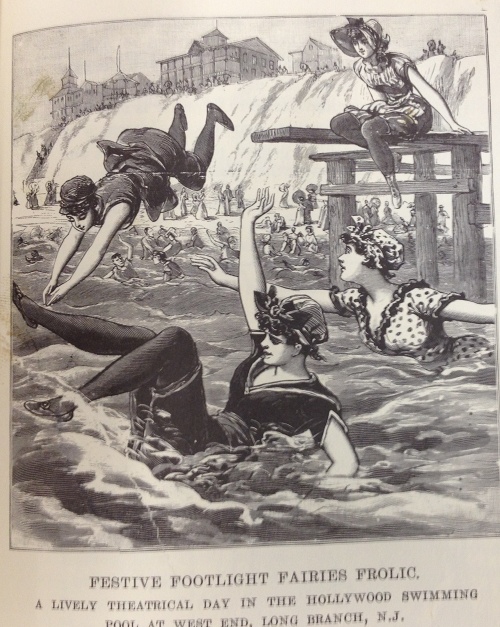
He captioned the above illustration, “A few Footlight Favorites frolicking in their swimsuits. Hubba hubba.” A somewhat more revealing scene after the jump:

Many more images here.
How Food Eats Up Time
S Abbas Raza fasted for a week with his wife:
I was struck by how much of the day I normally spend attending to my digestive needs: thinking about what I would have for lunch or dinner; shopping for groceries (which we do almost daily); cooking — in my case, elaborate Pakistani meals most evenings; then actually eating, washing dishes, cleaning up, even moving one’s bowels. Eliminating the simple act of eating frees up much more time than you’d think. In addition to the couple of hours of daily exercise we kept up throughout, we took long walks in the mountains (we live in the Alps), did crosswords (rather slowly), surfed the net and fooled around on Facebook, and we still always had more time to fill. I realised that meals provide needed punctuation to the day, and without them our days seemed strangely lacking in structure.
The Outlandish Heroes Of The Internet
Gene Demby wonders whether we are laughing with or at Charles Ramsey, the man who helped three women escape from their captor in Cleveland:
On the face of it, the memes, the Auto-Tune remixes and the laughing seem purely celebratory. But what feels like celebration can also carry with it the undertone of condescension. Amid the hood backdrop — the gnarled teeth, the dirty white tee, the slang, the shout-out to McDonald’s — we miss the fact that Charles Ramsey is perfectly lucid and intelligent. “I have a feeling half the ppl who say ‘Oooh I love watching him on the internet!’ would turn away if they saw him on the street,” the writer Sarah Kendzior tweeted. [Antoine] Dodson and [Sweet] Brown and Ramsey are all up in our GIFs and all over the blogosphere because they’re not the type of people we’re used to seeing or hearing on our TVs. They’re actually not the type of people we’re used to seeing or hearing at all, which might explain why we get so silly when they make one of their infrequent forays into our national consciousness.
Aisha Harris is on the same page:
It’s difficult to watch these videos and not sense that their popularity has something to do with a persistent, if unconscious, desire to see black people perform. Even before the genuinely heroic Ramsey came along, some viewers had expressed concern that the laughter directed at people like Sweet Brown plays into the most basic stereotyping of blacks as simple-minded ramblers living in the “ghetto,” socially out of step with the rest of educated America. Black or white, seeing [Michelle Clark] and Dodson merely as funny instances of random poor people talking nonsense is disrespectful at best. And shushing away the question of race seems like wishful thinking.
But Elahe Izadi thinks Ramsey can be “both a hero and a meme”:
While it may feel uncomfortable to focus on Ramsey’s funnier lines, to pretend otherwise—that there was no humor whatsoever in his interviews—is to ignore a big chunk of who Ramsey is.
He repeatedly told his tale with a plain-spokenness that feels fully him and unrehearsed; he wasn’t performing. He also expressed exasperation at the mini-media firestorm: When a local TV reporter asked him to tell the story once more, he replied, “Again?!” And his most-quoted line was a refreshingly unsubtle commentary about racism in America: “I knew something was wrong when a little pretty white girl ran into a black man’s arms. Something is wrong here—dead giveaway, dead giveaway,” he said. As the reporter began to move away, Ramsey finished his thought. “Either she’s homeless or she’s got problems. That’s the only reason she’d run toward a black man.”
In a hyper-controlled media environment, people long for that kind of unscripted “real talk” from genuine people who aren’t trying to manipulate their images for personal gain. And that’s a big part of the reason why Ramsey is compelling. He didn’t seek this fame, and so far he’s said he doesn’t want reward money for his actions (and even if he did, we could hardly begrudge him that). Rather than exploring Ramsey just for laughs, a meme done right could be a way of celebrating him for who he is: a hero who helped rescue kidnapped women.
 The Dish