Federal employees stage a demonstration protesting the federal budget sequester on May 7, 2013 in New Yor City. Hundreds of federal employees from the National Treasury Employees Union (NTEU) were joined by Internal Revenue Service (IRS), employees as well as agents from Customs and Border Protection (CBP) outside at New York’s Federal Plaza. By John Moore/Getty Images.
Month: May 2013
Neuroscience’s Big Data Problem
Tim Verstynen objects to Obama’s BRAIN Initiative – which aims to map all neuronal activity in the human brain – on the grounds that neuroscientists have no trouble producing data but have failed to form the unifying theories necessary to understand that data:
The Human Genome Project was useful because the core theory of how sets of deoxyribonucleic acid pairs build proteins and other molecules was already well understood. As soon as they had their DNA road maps, biologists knew how to drive their cars around to get to new places.
Unfortunately, in neuroscience we’re still learning how to drive our cars. As the neurologist Robert Knight is fond of saying, twenty years ago we knew 1% about how the brain works and now we’ve doubled it.
We don’t have core fundamental theories that will allow us to make sense of the data that we will get from large research initiatives like BRAIN and the Human Connectome Project. So we can get our detailed maps of the brain all we want, but it won’t make any more sense to us than it does now…. If the President and the federal funding agencies really wanted to find cost-effective ways of understanding the human brain they would start by providing more infrastructure for building better theories of how the brain works first.
Previous Dish on neuroscience-in-infancy here.
Great Lake Shipwrecks Are History
Edward McClelland recounts the story of Dennis Hale, the sole survivor of the SS Daniel J. Morrell, an iron-ore ship that capsized during a blizzard on Lake Huron in 1966, killing 28 men. McClelland zooms out:
Melville wrote that the Great Lakes “have sunk many a midnight ship, with all her shrieking crew.” But there hasn’t been a Great Lakes shipwreck since the Edmund Fitzgerald sank [in 1975]. There may never be another. The decline of the steel industry means fewer ships ply the Lakes. Doppler radar alerts sailors to the violent storms that sank the Morrell and the Fitz. No longer paid tonnage bonuses, captains have no motivation to persist through rough seas, risking the lives of their crews.
(The lyrics to Gordon Lightfoot’s “Wreck of the Edmund Fitzgerald”, seen above, are here.)
The Radius Of Bliss
A recent study (pdf) measured happiness by tracking geolocated tweets:
Overall, the happiest tweets were those composed far from home. Messages sent from 1,500 miles or more away included more positive and food-related words (beach, new, great, park, restaurant) and fewer negative or profane ones (no, don’t, hate, can’t, damn). The next happiest group of tweeters were those close to their homes, who used more words like lol, love, like and good. The least happy tweeters were those who weren’t quite at home but weren’t far from it, either. The researchers associated this distance (about half a mile) with a bummer of a daily commute.
So, even if you can’t take a vacation in the near future, remember the moral of the story, as the study frames it: “Individuals with a large radius use happier words than those with a smaller pattern of life.”
The View From Your Window
Cross-Reading
Noah Berlatsky thinks through the interest many men have for books by and about women:
Part of the answer is simple enough—men and women aren’t, or don’t have to be, all that different. Lots of women enjoy shooting the bad guys with James Bond; I can identify quite easily with Bella’s feelings of isolation, depression, and romantic angst. Men aren’t from Mars and women aren’t from Venus; we’re both from Earth, and as such it’s not all that hard to talk to each other.
But if similarity can be engaging, so can difference. For me, and I’d guess for a lot of men, part of the appeal of reading women writers is precisely the chance to know, or to be, someone else. Just as women are often fascinated by men, men—of whatever sexual orientation—are often quite interested in women. I know women read and enjoy Pride and Prejudice, too. But as far as I’m concerned, Jane Austen wrote [it] so guys like me can fall in love not just with Elizabeth’s eyes or even with her wit, but with her whole self there on the page. Same with Dorothea in Middlemarch, or Dana in Kindred. If you’re interested in how women think and feel—and what guy isn’t interested in that?—then the best place to go is to books by women.
Books by female writers aren’t just the best place to go to learn about women, though. They’re also often the best place to go to learn about men.
The Most Dangerous Place To Be A Journalist?
Hamza Mohamed describes the life of a journalist in Somalia, where four have already been killed this year:
After the death of many of our colleagues we in the media industry here in Somalia have developed a unique way of greeting each other. “You are still a live?” One will ask with a smile. “Dead people don’t walk or talk,” the other will respond with laughter. Behind the smiles and laughter are serious safety worries.
Meeting or bumping into fellow journalists is becoming a luxury. Because of the alarming number of targeted assassinations against journalists many of us are choosing not to gather in groups to socialise or stray far from their work place – even for work. Every chance we meet could be our last one. Every journalist here knows a colleague who has been killed. It is also not rare to see journalists who’ve survived attempts on their lives.
His daily routine could come straight out of a spy novel:
Depending on who your employer is and the last story you worked on, our morning usually starts with phone calls to next-door neighbours who also double up as our lookouts before leaving the house. We change houses many times a year – I don’t know where my closest colleagues live. I will be surprised if they said they knew where I live. …
The few who can afford to buy second hand cars usually jump into their tinted vehicles and speed off to work. Tinted windows are a must as they help lower the profile of the occupant. But most journalists here don’t earn enough to afford their own car. They’ve to brave the streets and take public transport to get to work. Taking public transport vehicles makes you a sitting duck.
Despite that peril, a reporter is more likely to be killed in Iraq or Syria, the two most dangerous beats at the moment.
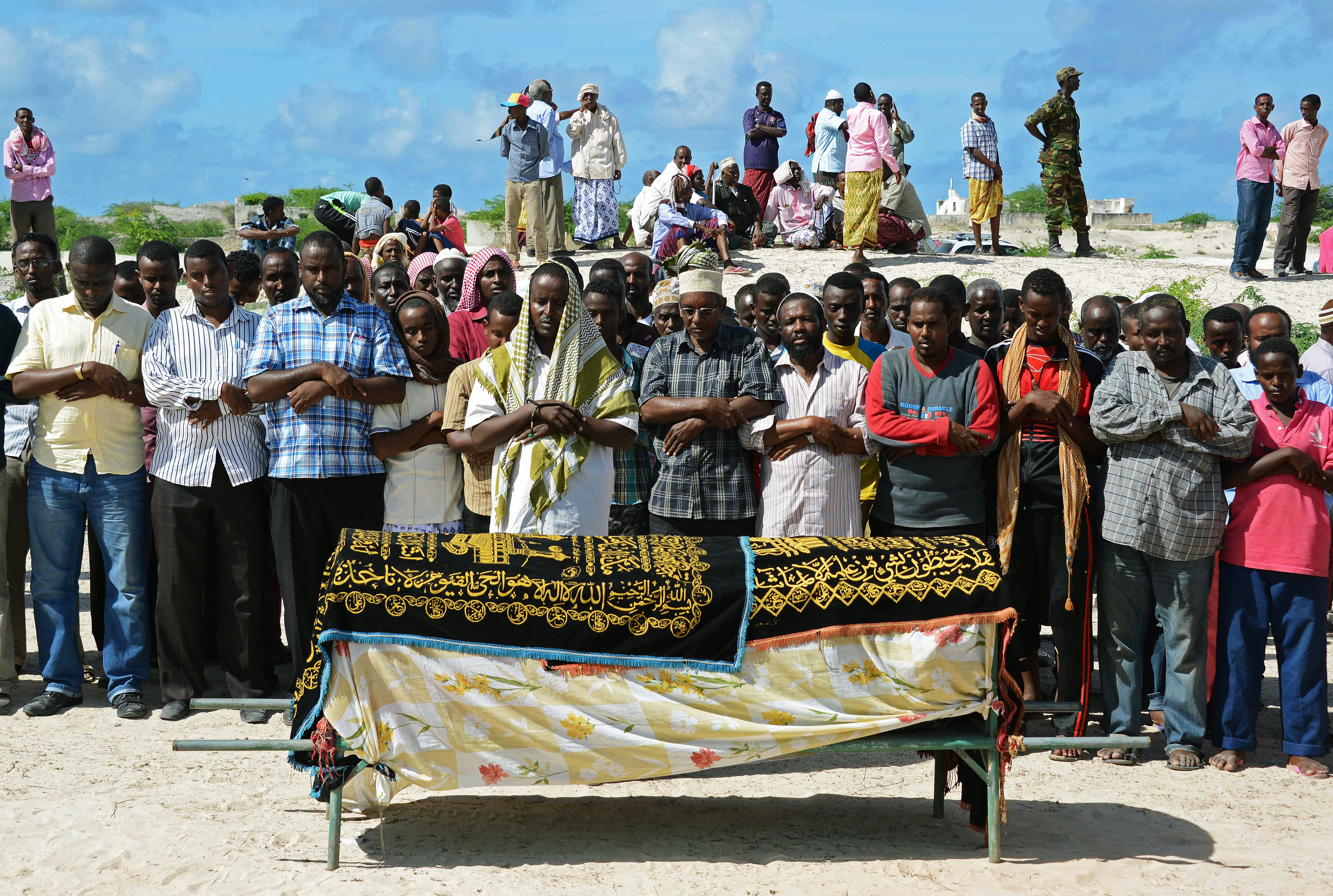
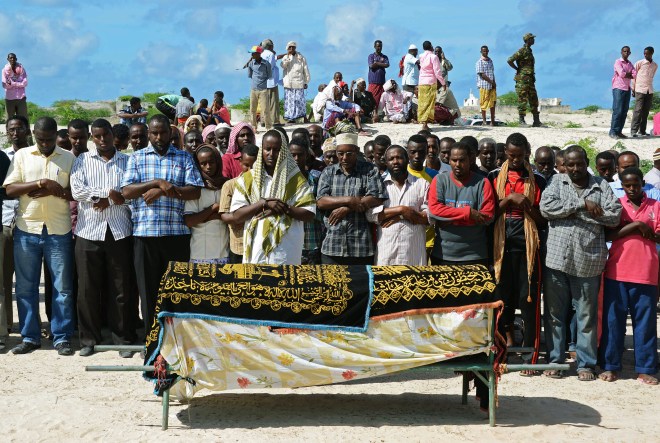
(Photo: Mourners pray beside the coffin of Somali journalist Mohamed Ibrahim Rageh in Jazira on the outskirts of Mogadishu on April 22, 2013. Rageh worked for Somali National Television and Radio Mogadishu and was shot dead by unknown gunmen as he reuturned home. Rageh is the fourth reporter to be murdered in Mogadishu this year. Somalia is one of the most dangerous places for journalists to work, with at least 18 media workers killed in 2012. By Mohamed Abdiwahab/AFP/Getty Images)

Who Are Syria’s Rebels?
These are the folks John McCain can’t wait to send arms to:
According to American officials and nongovernmental groups that work in the region, the overwhelming majority of the rebels are fighting for an Islamic republic. Al Nusra, like the other Al Qaeda affiliates, wants to do away with the Syrian state altogether and reëstablish the Islamic caliphate. “The Islamists are the majority,’’ Elizabeth O’Bagy, an analyst for the Institute for the Study of War who has travelled to rebel-held areas several times, said. The small number of non-Islamists among the rebels are often socialists, she told me, and are referred to by their peers with an English word: “hippies.”
Mental Health Break
Media Media Solipsism
I’m guilty of it too at times. But sometimes the best reminder that the general public doesn’t give a damn about journalists or journalism are the ratings … (And yes, this meta-media-media post doesn’t help.)