The View From Your Window Contest: Winner #152

Screen Shot 2013-05-04 at 11.54.44 AM

A reader writes:

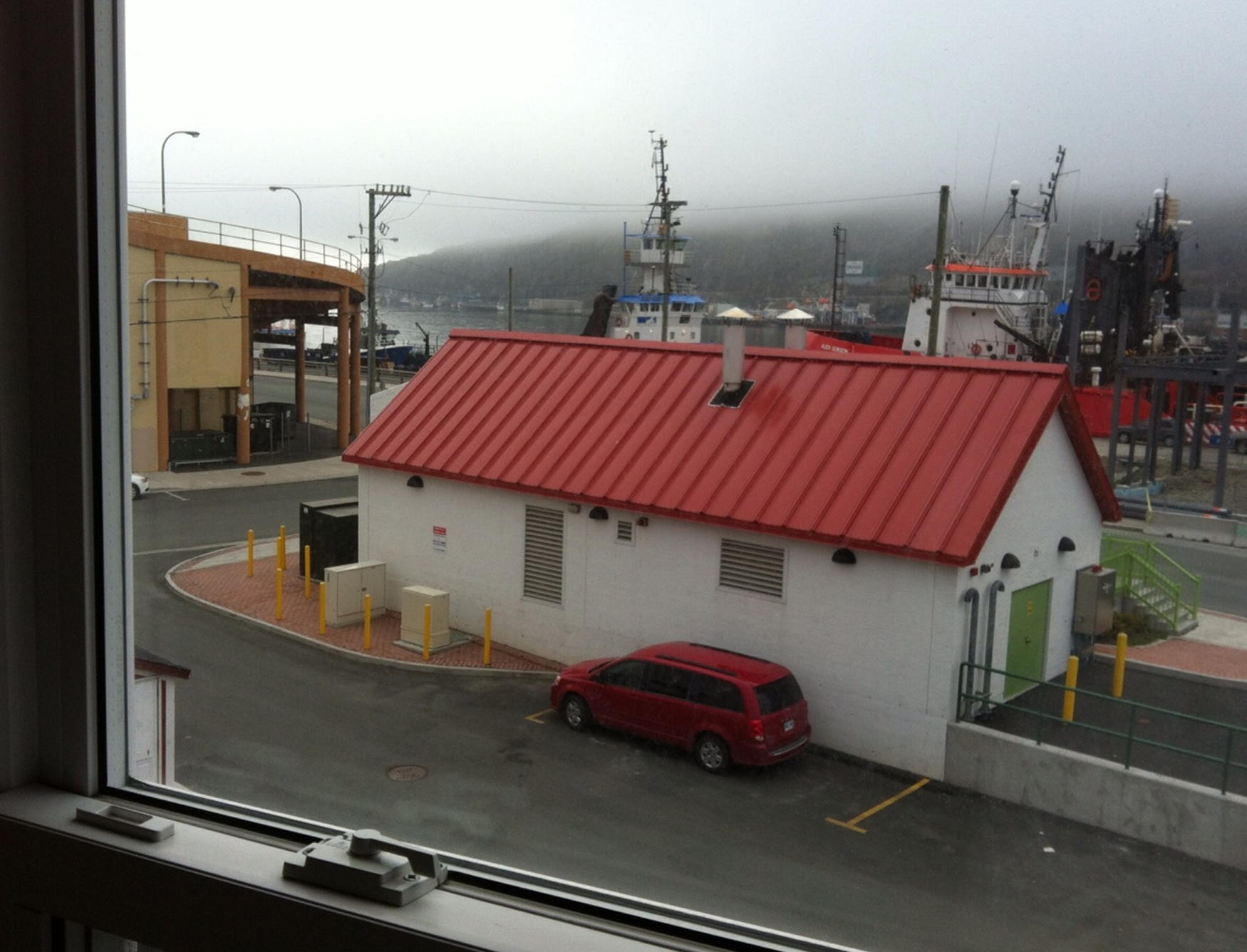
The fogged-in, treeless channel with fishing vessels and the red-roofed single building. I see the North Coast of Iceland. (Though as good a guess might be Invercargill, New Zealand, which has the same look at the diametrically opposite side of the world.)

Another:

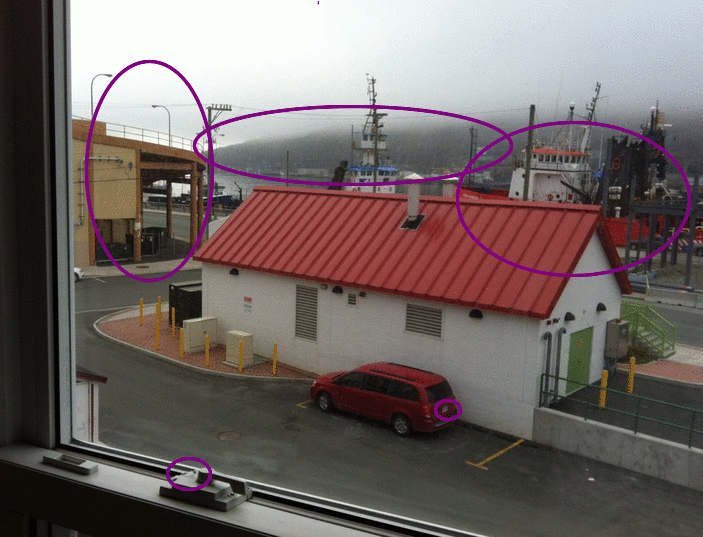
Reykjavík? Plainly, this is Iceland. No other country in the world has such distinctive window latches.

Another:

Not a lot of time to look around this week, so after what appears to be a left hand drive car, chimneys instead of air-conditioning, I am going to guess Scotland.  Google gave me some obvious fishing villages to start, and Lewwick seems to be a real chance.

Another:

Norway?, Scotland?, Ireland?, Newfoundland?, wait! – that van is a Chrysler product so USA or Canada only – plus the license plate isn’t extra wide like in Europe. Newfoundland?, Victoria?, Puget Sound?, zoom in on the license plate, wait! – isn’t that an Oregon license plate? Sort of looks like a little bit of green in the middle of a white plate so could easily be the Doug Fir tree. Of course, someone from Oregon could easily drive up to the Puget Sound or B.C. but I’ll go with the better odds: Oregon. Columbia River or Pacific Coast? Those boats make me think coast for some reason.

So where on the Oregon coast would there be a harbor like that? First thought to pop into my mind: Astoria, Oregon. Where in Astoria though? I used to live in Oregon but I’ve never been to Astoria and I’m not one of those people who spend hours on Google Earth trying to pinpoint locations for these contests and it’ll probably turn out to be New Guinea or Uruguay or someplace like that anyway. I wonder what the next post is about …

Another:

From the looks of the port city and the building under construction on the right side of the photo, I’m guessing this was an area impacted by the Tohoku earthquake and tsunami in March 2011. I remember seeing a YouTube video of a port being inundated with a shopping center on the shoreline. In looking online, I couldn’t find the name in the particular video, so I will guess Kesnessuma, in the Miyagi Prefecture.

Another:

I’m going to Norway at the end of the month.  This VFYW looks a lot like the pictures I’m seeing in the travel books I’m using to plan my itinerary.  The weather looks about right for this time of year and the scene kind of matches my preconceived idea of what the Norwegian fjords and ports will be like.  There are a lot of places I could choose, but I’m going with Stavanger.

Another:

Well, not much to go on this week, but here is my reasoning: the cars and the license plates look American but the building in the foreground has a Scandinavian feel to it. It also seemed to me like the red and white boat looks a lot like many in the Coast Guard’s fleet. And where would there be cold and damp weather still at this time of year? So I googled where there are Coast Guard stations in Alaska, and it turns out that there is one in Petersburg, Alaska. Plus, the town’s nickname is “Little Norway” because it was founded by a Norwegian, and on Google Earth you can see many of those red-roofed buildings. So maybe the photo is taken from the Morning Mist Bed and Breakfast, second floor?

Another nails the right location:

It’s a bit ironic that while on a business trip in Bangkok, a very exotic location for me, you publish a photo of a place that I consider very familiar, also through work. We’re overlooking the harbor of St John’s, Newfoundland, a beautiful place that is very fishing oriented, which is what draws a Massachusetts-based marine biologist like me to it. The harbor entrance is off to the left, and you can’t see Tower Hill, a very nice place to overlook the city and the Atlantic Ocean. St. John’s is way out into the Atlantic, and nearby Cape Spear is the furthest east one can go on the North American continent. The people are very, very friendly, and they like to drink and play music and sing, and they like you to come along, too.

I know I won’t win – this one is too easy, and I frankly detest the minute detail of winners who determine which hotel room, how high, la la la. That’s just silly. So I’m just happy to know after many years of reading your blog, I finally nailed one, as well as I care to.

A cool view of the hotel:
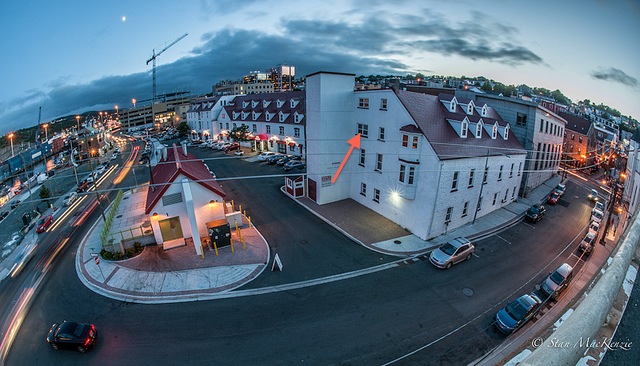
image (3)

Details from another reader:

My spouse lived at the Murray Premises Hotel for a few weeks back in 2010, as part of the Opera on the Avalon Festival, and we visited her there for the last week. Her room was in an annex that faced Water Street, on the other side of this view, near where George Street connects – so if any readers know St. John’s they know that we had to wear earplugs to bed. George Street is perhaps the booziest party street on the planet – and that’s not hyperbole. To quote Wikipedia: “The street has the most bars and pubs per square foot of any street in North America, and is known to have bars that are open later than most others throughout Canada.” There was a 24-hr restaurant directly across the street where revellers would go to eat after the bars closed, then come out and barf into the street.

The photo is taken, I believe from the second floor of the Murray Premises Hotel, facing Harbour Drive. The parkade (as we call them here in Canada) is on the corner of Harbour and Beck’s Cove as part of the Bowring Downtown Centre (Bowring was originally a Newfoundland company est. 1811, a huge company with ships, provisioning, and trade on a worldwide scale in the late 19th and early 20th century – now is a gift store chain). If I’m not mistaken the photo is taken from just outside (or perhaps inside – I can’t quite remember the layout) of the breakfast room.

A local snaps a photo:

StJohnsHarbour

It happens, it really does happen! One sees the View from your Window Contest and says: I know that place!  Even better: That’s here!   I’ve seen other people have such reactions; I never dreamed that I’d be the same one day.

Another reader:

This is a view from the second floor of the Murray Premises Hotel overlooking St. John’s cove.  I recognize it because my mother did some demographic research on the 1918 flu there and I spent a few weeks with her in the summer.

Another:

Having Lived in Newfoundland for six years while going to school, I recognized this location immediately.  The big Irving oil sign on the opposite hill was a dead give away.  Still my favorite place on earth, would move back in a heartbeat if I could.

Another:

St John’s is a wonderful place with friendly people and appalling weather. After a business trip there years ago, while filling out my expenses back at home, three and a half time zones away, I noticed for the first time that the charming waitress who had served us in a downtown restaurant had left her phone number on the back of the receipt. Nothing like that had ever happened to me before or since. Regrets, I have a few …

Another:

image

I’ve been reading The Dish for yonks, but I’ve never actually sent am email on any topic.  I’ve certainly never been tempted to enter the VFYW contest.  I follow it avidly each week, but mostly to marvel at how people are able to pinpoint such exact locations from such scant clues.  Normally, the best I can do is narrow it down to continent.  But this week, I knew instantly and without a shadow of a doubt.  It was an instant recognition of home. I live on the mainland now, but I was born less than a mile away from where that photo was taken. That is St. John’s harbour.  That is Newfoundland’s characteristic rain, drizzle, and fog.  That is the Bowring building in the corner.  That is a view from the Murray Premises.

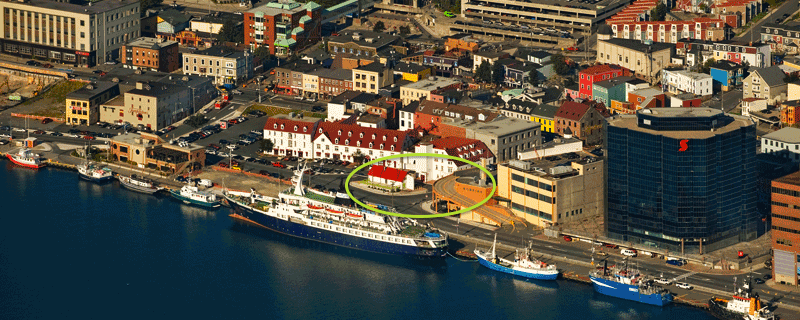
I don’t expect to win.  Having never entered before, I wouldn’t win any kind of tiebreaker, and if the location was obvious to me, it must be obvious to others.  But when I went to verify the location, I saw that Google street view doesn’t actually have data for the corner of Harbour Drive and Becks Cove.  So maybe it will be a tough one for Dishheads without local knowledge?  Probably not. But just in case, I’ve attached from the Murray Premises website that shows the scene from the opposite side of the harbour in much nicer weather. It seems like the picture has been taken from the third floor, and I’m guessing the most easterly window.
So very close. The following reader zeroes in on the correct third-floor room:

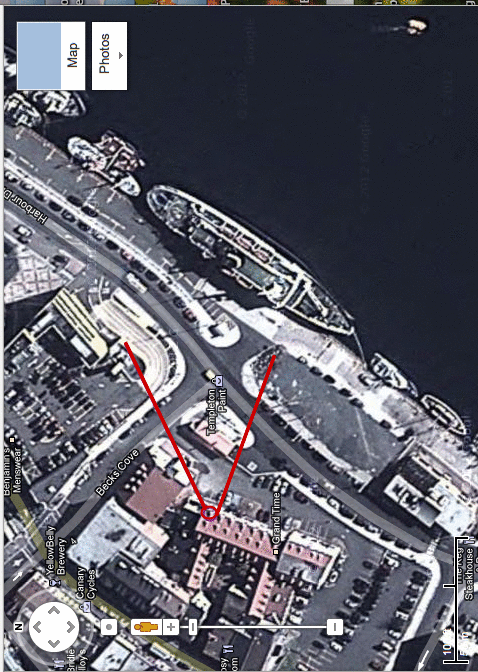
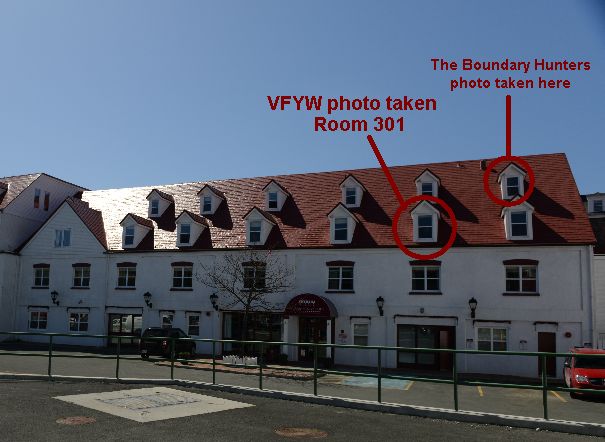
This is the Murray Premises Hotel, located on the town’s harbor in the block created by Harbour Drive, Beck’s Cove, Water Street, and Bishop’s Cove. If my estimation of the sight lines is edited original piccorrect, it’s taken from the bedroom of suite 301, or from this picture, the window furthest to the right and the lower one poking out from the roof. This picture shows the hotel with the the little red-roofed building (a paint shop, apparently) and the little overpass parking exit which are visible from the picture.

The first thing I noticed was that the car in the foreground seemed American-ish with an American-style license plate. I’ve never been to Canada, but I guess they use them there, too? I suspected that this placed the photo in British Columbia, Alaska, Washington, or Eastern Canada. I also saw the word “lock” on the window lock, so that confirmed some suspicion.

Next, I tried to identify the ships. The red one’s name is visible, but I couldn’t make out anything, really. I tried looking up ship prefixes, but none seemed to match what I was guessing. In doing this, though, I found Canadian Coast Guard ships that were painted in similar patterns. I have no google map w guidelinesreason to think this ship is a coast guard ship, but in looking through the CCG pictures, I found a link to St. John’s. This link provided another to a cool little ship-tracking site, so I looked through and didn’t find anything in St. John’s with a similarly-shaped name or a similar-looking boat. Silly me, I didn’t think about the fact that ships move, so I played on that site looking at other places in Eastern Canada.

At one point, though, I just thought, “No, St. John’s looked right.” So I went back and started looking at Panoramio pictures and street views, and of course, after about five minutes I saw the overpass. The area in front of the hotel seems to be under construction, and there was no street view. But right after the street view jumped past it, I turned it around and there was the overpass, street lights and all. From there, I just found the hotel name on the map, followed it to the website, looked at pictures to confirm, etc. And, you know, e-mailed the hotel to find out the room number. The woman who replied, Kim, was surprisingly nice given the oddity of my request.
An even more ambitious effort – and this week’s winner, given the reader’s long track record without yet clinching the prize:

The key to solving this week’s VFYW contest (in under five minutes) was identifying the red vessel Murray Premisesin the background of the photo.  Turns out there aren’t too many red vessels with ALEX as part of their name.  The ALEX GORDON is an “anchor handling vessel”, built in 1975 and its most recent known port visit, according to this site, was St. John’s,  Newfoundland.  Some quick googling confirmed this was the sight of the photo and the hotel from which the photo was taken is the Murray Premises.

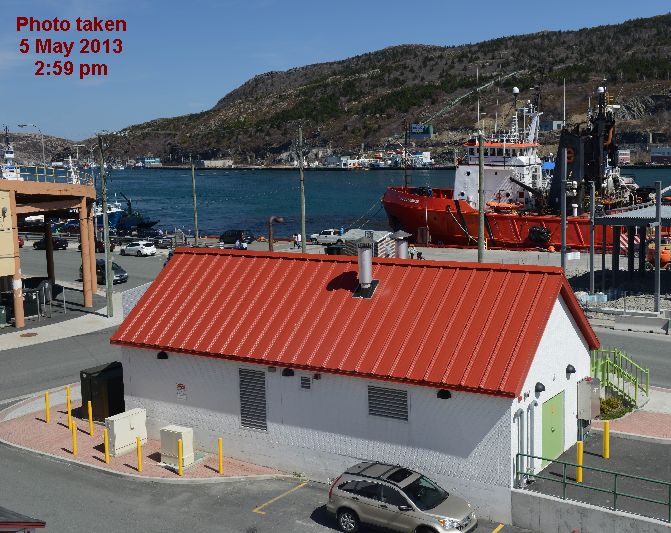
I figured quite a large number of people would also quickly identify the photo location so I thought about what kind of “added value” I could bring to my contest entry.  It suddenly occurred to me, and I’m probably letting the cat out of the bag for future VFYW contests revealing this, that I could utilize a hobbyof mine – geocaching – to help identify the room number and get pictures at the location.  I looked signs_681up the closest geocache to Murray Premises and emailed the owners of the geocache and asked them if they could help me out. And did they ever!  “The Boundary Hunters” went down to hotel and took several photos for me.  They identified the room from which the VFYW photo was taken as room 301.  Unfortunately that room was occupied but they did their best to recreate the photo and were able to access the window one up and one over. The ALEX GORDON is still docked at the same location and the weather has much improved from the time when the contest photo was taken.
Details from the submitter:

This one was taken this morning as the fog was lifting on St John’s Harbour. I took it from our room in the Murray Premises, a small hotel at 5 Beck’s Cove between Water Street and Harbour Drive in what was once a mercantile warehouse built in 1846 and where my husband and I are enjoying a romantic weekend getaway. It’s room 301 … is that specific enough?

(Archive)

Dwight Obama

The parallels between Eisenhower’s and Obama’s foreign policies pile up. Does this Stephen Ambrose quote sound familiar?

Eisenhower’s outstanding achievement was to avoid war. However irresponsible Republican emotional appeals to the anti-Communist vote may have been, and despite the Russian shift to the offensive in the Cold War, Eisenhower refused to engage American troops in armed conflict. He was not immune to intervention, nor to provocative rhetoric, nor to nuclear testing, nor to the arms race (within strict limits), but he did set his face against war. It became the Democrats’ turn to complain that the United States was not “going forward,” that it was not “doing enough,” that America was “losing the Cold War.”

It helps to have a president who actually knows what war is.

Quote For The Day

Screen shot 2013-05-07 at 12.10.59 PM

“There are many ways of making one’s fortune in journalism. As for us, I don’t need to say that we arrived poor in this newspaper and are also leaving it poor. Our sole wealth has always been in the respect we bore for our readers. And if it is the case that that respect was reciprocated, then that was, and will remain, our only luxury,” – Albert Camus, in a farewell to the readers of Combat, a clandestine newspaper of the French Resistance.

That quote is worth repeating in the desperate marketplace of online journalism. I was joshed by a friend the other night about my lack of a business strategy for growth, my attempt to minimize the intrusion and extra work required by an advertizing model, my dismay at the blurring of editorial and advertizing in “sponsored content” and so on. None of this made much sense to my friend as part of a strategy to make as much money as possible.

But that was never the strategy in the first place. I’ve even decided not to take a salary this year at all in order to invest in the Dish itself and keep it afloat. We’re still chugging along steadily in revenue, and we are brainstorming about new sources of income (stay tuned), but it remains unlikely that we will reach our target of $900,000 by the end of the year, even though we have already brought in gross revenue of around $680,000 – three-quarters of the way there. The most passionate readers have already joined. It gets harder after that. If you’re still on the fence, read the Dish regularly, and are frustrated by using up all your free read-ons, [tinypass_offer text=”please subscribe”]. It’s only [tinypass_offer text=”$1.99 a month”] – about as cheap an entry cost for any quality journalism as you can get.

But I didn’t start this blogging thing to be rich. I started it to be free. As long as it can pay me something like a real salary by the second year, I’ll be happy.

The real luxury, as Camus wrote, is our respect for you, our readers. And the knowledge every day that it is reciprocated. That’s simply priceless.

Intervene In Syria? Just Say No, Ctd

ISRAEL-SYRIA-CONFLICT

Fareed Zakaria is, as usual, a sane voice in the escalating crisis:

Would U.S. intervention–no-fly zones, arms, aid to the opposition forces–make things better? It depends on what one means by better. It would certainly intensify the civil war. It would also make the regime of Bashar Assad more desperate. Perhaps Assad has already used chemical weapons; with his back against the wall, he might use them on a larger scale. As for external instability, Landis points out that if U.S. intervention tipped the balance against the Alawites, they might flee Syria into Lebanon, destabilizing that country for decades. Again, this pattern is not unprecedented. Large numbers on the losing side have fled wars in the Middle East, from Palestinians in 1948 to Iraq’s Sunnis in the past decade.

If the objective is actually to reduce the atrocities and minimize potential instability, the key will be a political settlement that gives each side an assurance that it has a place in the new Syria. That was never achieved in Iraq, which is why, despite U.S. troops and arms and influence, the situation turned into a violent free-for-all. If some kind of political pact can be reached, there’s hope for Syria. If it cannot, U.S. assistance to the rebels or even direct military intervention won’t change much: Syria will follow the pattern of Lebanon and Iraq–a long, bloody civil war. And America will be in the middle of it.

Anyone who wants to insert the US into such a bloody, violent, increasingly sectarian civil war needs his or her head examined. We couldn’t control or even understand one while we were occupying Iraq – and, as Fareed notes, scores of thousands were murdered under our very noses, with millions of refugees. An entire country is afflicted with communal PTSD of the most severe kind. Last month, the deaths in Iraq’s continuing civil war reached a post-occupation record of 700. And that’s after we invaded, occupied and tried to set up a non-sectarian government.  What are the odds we can guide yet another sectarian civil war from the skies?

Brent Sasley claims that the recent Israeli strikes on Syria can succeed where the US can’t because their goals are pragmatic and limited:

[Israel’s] goal is to prevent weapons and technology from reaching its primary enemy in this specific arena, namely, Hezbollah (the Syrian military is no match for Israel). It doesn’t see itself as responsible for everything else, including interfering in the succession process being played out so violently, protecting civilians from the horrific atrocities being committed against them, and influencing the outcome of the civil war and, from there, the region. All this is reserved for later consideration or others to deal with. Jerusalem defines its responsibilities, rather, as its immediate security needs and the near-term future effects of its actions. Washington’s abilities are much greater, its goals are much broader, and its responsibilities are much bigger. Comparing Israel to the US under these conditions isn’t helpful for understanding America’s actions thus far or its capabilities for doing more.

Michael Koplow agrees – and goes further:

[T]o those who incessantly insist that Israel is of absolutely no strategic worth to American interests and is nothing but an albatross around the neck of the U.S., I’d submit that having the Israeli military around to prevent transfers of Iranian-furnished weapons to Hizballah and to make sure that Assad’s delivery systems for chemical weapons also stay right where they are, all while battlefield-testing American weapons in the process, is pretty useful right about now.

Justin Logan adds that “only a terrifically secure country could have as poor and astrategic a debate about war as the one we’re having” on Syria:

In fairness to [liberal hawks], they are carrying the torch of a time-honored American tradition of foreign policy thinking. Historically, debates over foreign intervention in the United States have featured liberal analysts against realists and the military. In the 1950s, President Eisenhower reportedly had to admonish his activist Secretary of State John Foster Dulles to calm down: “Don’t do something, Foster, just stand there!”

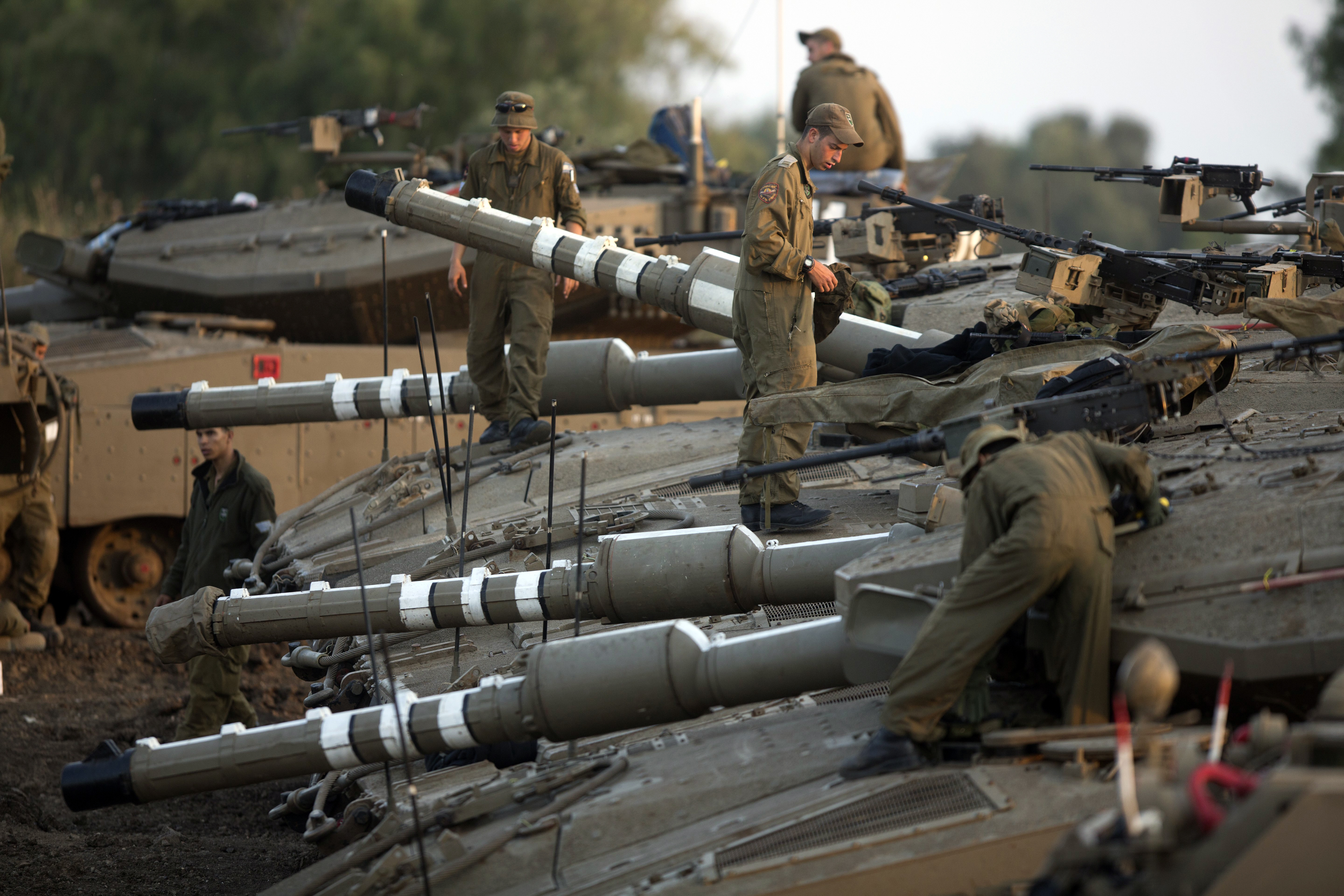
(Photo: Israeli soldiers walk on the top of their Merkava tanks deployed in the Israeli annexed Golan Heights near the border with Syria, on May 6, 2013. UN chief Ban Ki-moon has appealed for restraint after Israeli air strikes on targets near Damascus which prompted Syrian officials to warn ‘missiles are ready’ to retaliate. By Menahem Kahana/AFP/Getty Images)

Marriage Equality Update

The tide keeps coming in: the Minnesota House has now scheduled a floor debate on legalizing civil marriage for gay couples. And the omens look good:

House Speaker Paul Thissen has said that the bill would not be brought to a vote unless they had secured the 68 votes that would be needed to pass the legislation. A number of DFL lawmakers representing districts that supported last fall’s proposed constitutional amendment to ban gay marriage have voiced their support of the marriage equality bill in recent weeks.

The governor has said he will sign the bill and the Senate is regarded as friendlier toward it than the House. Delaware looks set to legalize marriage equality today – following Rhode Island. That would be three more states in a few weeks.

A Keynesian For Now

The economics debate in this country these past few years is almost a microcosm of the problem with John_Maynard_Keynesideological politics. In response to the worst recession since the 1930s, the right immediately rejected Keynes’ core analysis of the Great Depression and turned any idea of stimulus or spending and borrowing to tackle the recession into a gloom-ridden, terrifying harbinger of hyper-inflation and insurmountable debt. The zero House votes for the Obama stimulus reflect that rigid lockdown of the mind. We know where this aversion comes from – the misappropriation of Keynesian emergency economic management as a general theory of full employment and growth in the 1960s and 1970s. And there is a strong argument that misreading Keynes in that era of hubristic liberalism was indeed an error that needed a correction.

But that doesn’t rebut Keynes’ central claim about our current predicament: that in a liquidity trap, austerity is counter-productive and fears of inflation are over-blown. Bartlett:

The core insight of Keynesian economics is that there are very special economic circumstances in which the general rules of economics don’t apply and are, in fact, counterproductive.

This happens when interest rates and inflation are so low that there is no essential difference between money and bonds; money, after all, is simply a bond that pays no interest. When this happens, monetary policy becomes impotent; an increase in the money supply has no stimulative effect because it does not lead to additional spending by consumers or businesses.

This is not an eternal ideology – determined as “on the left” and therefore impermissible on the right or center. It’s a specific analysis of a specific problem, which happens to be where we are now. A true conservative would throw ideology aside and look at the real world. Which is the difference between today’s GOP and a genuine conservative, like Bruce. I’m not a Keynesian for ever. But I am a Keynesian for now.

Where No Humans Have Gone Before

photo

The atmospheric carbon dioxide reading taken at the Mauna Loa observatory in Hawaii is expected to reach 400 parts-per-million this week. Andrew Freedman puts that number in its historical context:

The news that CO2 is near 400 ppm for the first time highlights a question that scientists have been investigating using a variety of methods: when was the last time that CO2 levels were this high, and what was the climate like back then? There is no single, agreed-upon answer to those questions as studies show a wide date range from between 800,000 to 15 million years ago. The most direct evidence comes from tiny bubbles of ancient air trapped in the vast ice sheets of Antarctica. By drilling for ice cores and analyzing the air bubbles, scientists have found that, at no point during at least the past 800,000 years have atmospheric CO2 levels been as high as they are now.

That means that in the entire history of human civilization, CO2 levels have never been this high.

This is a new era – in which humanity has the power to change the entire climate of the planet so that it is more clogged with carbon than at any time since homo sapiens took dominion. This is the mark of dystopian science fiction – except that it’s real, and apparently unstoppable. What right does one species have to change the world’s climate so structurally it will destroy countless other life-forms? Greg Laden reminds us nonetheless about the seasonal variations in CO2 levels:

There is a lot more land in the Northern Hemisphere that goes through a dramatic cycle in plant activity, with most plants playing (or even being) dead over the winter and springing to life in the Spring. The Southern Hemisphere has much less land. So a small amount of CO2 moves into the atmosphere over the Northern Hemisphere winter and into spring, and then moves back into newly grown plant tissue during the northern growing season.

So, right now, CO2 should be at a short term peak. The range of this variation is around 8 ppm, so if we hit, say, 401 ppm next week, expect that value to go back below 400 ppm in a few weeks. In other words, we can and should note that we are probably hitting the 400 ppm barrier, but then later when we drop slightly below, temporarily, 400ppm, the climate science denialists will be all over that claiming that there is no global warming. Cuz they’re morons. In a few years … certainly by the end of the present decade …. the low values will be over 400 ppm unless something dramatic happens.

The Euro On Life Support?

One of the currency’s core German founders, Oskar Lafontaine, is getting gloomier:

“The economic situation is worsening from month to month, and unemployment has reached a level that puts democratic structures ever more in doubt … The Germans have not yet realized that southern Europe, including France, will be forced by their current misery to fight back against German hegemony sooner or later.”

The very language speaks of the scale of the problem, as the German economy is now faltering as well. In Britain, the fringe right United Kingdom Independence Party or UKIP just proved in local elections that it is less fringe than David Cameron would like. It won more than 25 percent of the national vote. Cameron recently promised a national referendum on whether to stay in or get out – the first such vote since 1975. This is an excruciating parliamentary exchange.

Now comes Thatcher’s former Chancellor, Tory grandee Nigel Lawson, to argue that Britain should leave the EU entirely:

“I think that, if the thing is on balance good for the economy – which I believe it is; this was not something I just did off the cuff, this was something to which I had given a great deal of thought over a very long time, and I’ve no doubt that it’s good for the economy. If it’s good for the economy, then of course it’s good for jobs.”

The centrifugal forces in Europe now appear stronger than those holding it all together. And with each year of extra austerity, they grow stronger.