Mapping A Better Future

How a group of 12-year-olds in a Calcutta slum improved their community:

Like so many slum neighbourhoods, the notorious Nehru Colony doesn’t officially exist, meaning it has no access to government services such as sanitation and electricity. The youngsters set out to literally put themselves on the map. They went door to door, taking photos with their mobile phones, registering residents and detailing each child born in the colony. Information is then sent by SMS text to a database that links the data to a map hand-drawn by the kids, which is overlaid to GPS coordinates. By registering their existence on Google Maps the group has doubled the rate of polio vaccination from 40% to 80%, decreased diarrhoea and malaria rates in the slum, and is lobbying for electricity.

Escaping North Korea

Ann Shin’s new documentary The Defector follows a North Korean smuggler, “Dragon,” as he escorts five defectors out of the country. Shin describes how she shot the film under extremely strict conditions:

We had to take DSLR cameras that looked like tourist cameras, since we went to China on tourist visas. We had to hide all our hard drives and halfway through our trip I shipped one of the hard drives out. I was constantly hiding my shoot notes in my luggage so they wouldn’t be found. And we took a lot of B-reel shots of the landscape in case we got caught and officials wanted to see our memory cards—then we could show them our stupid tourist shots.

We shot with the DSLR cameras often just hanging around our necks, from the chest. The soundman was brilliant—he was really risking his livelihood, because if we were caught he’d be in a Chinese prison for sure. He had a portable recorder, which he stuck in a man-pouch and he’d just kind of walk next to whoever was talking. On buses or trains he’d just get close to our subjects and blend in with everybody. He just disappeared. Meanwhile he was collecting great sound without having to use a boom or a mic.

The experience changed Shin’s opinion on smugglers:

In the end, I thought Dragon… he can be aggressive, he can be intimidating, he doesn’t have the greatest bedside manner, but he knows what he’s doing. He lives by his word, so in his own way he’s principled. … [Smugglers] exist because governments and NGOs are failing people in certain circumstances.

Face Of The Day

Pakistan Prepares For General Election

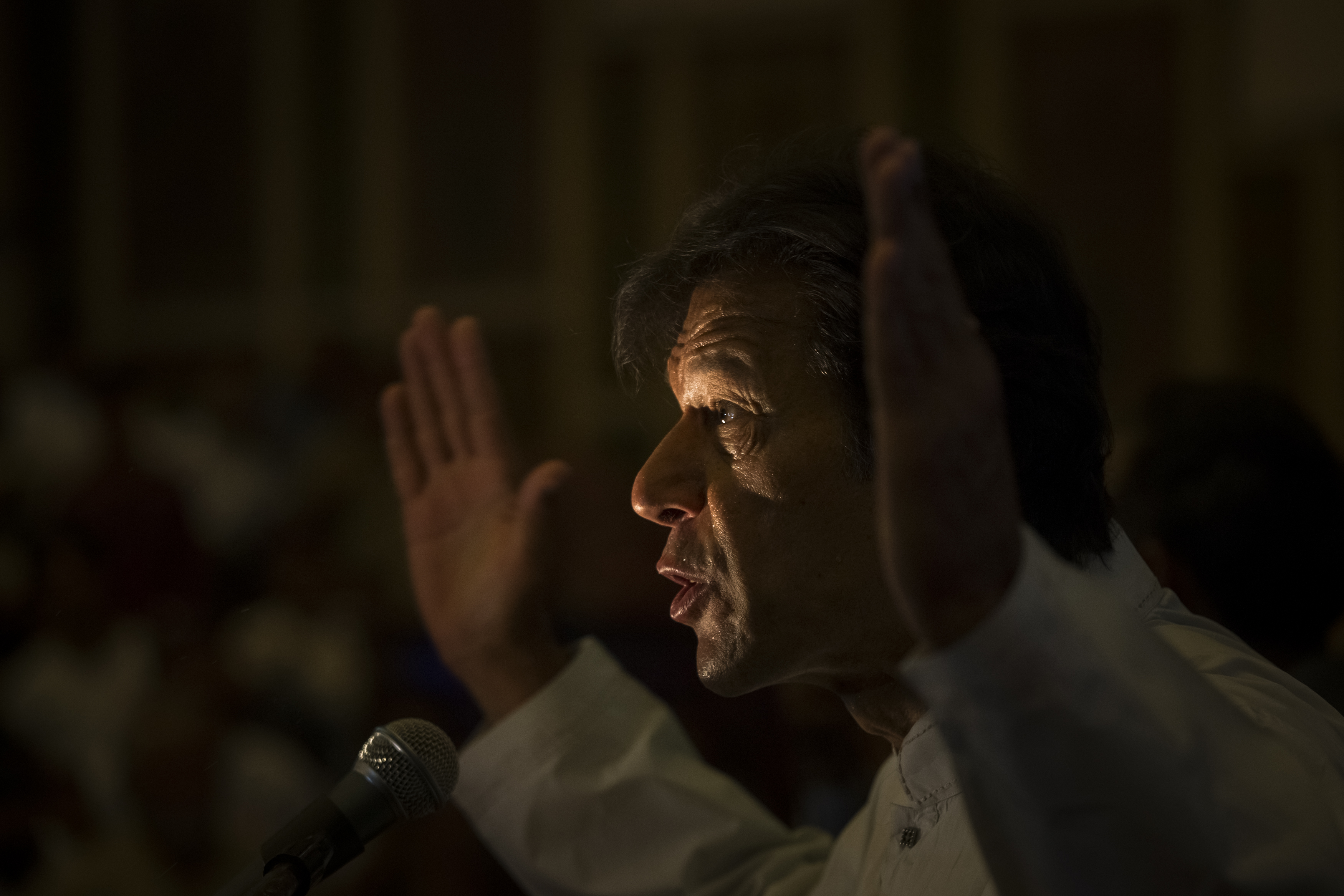
Imran Khan, chairman of the Pakistan Tehrik e Insaf (PTI) party, addresses party volunteers and supporters during a rally for volunteers in Lahore, Pakistan. Parliamentary elections are due to be held on May 11. Imran Khan and Nawaz Sharif of the Pakistan Muslim League-N (PMLN) have been campaigning hard in the last weeks before polling. By Daniel Berehulak/Getty Images. Previous Dish on Khan here.

Eye-Scanning Through Security

Iris-recognition technology is now being used at the Dubai airport, with an automated two-gate system:

Scanning your passport opens the first gate; an iris print opens the second. Once the system is fully deployed, the company says it will bring wait times down from 49 minutes to 22 seconds. A private company called Clear is already trying this on an opt-in basis in the US. In exchange for a quick iris scan, their service will let you skip security in half a dozen American airports.

The bargain is simple enough: In exchange for one more biometric, you get to skip an hour in customs, or the indignity of a TSA checkpoint search. And as an ID technology, it simply works better. It’s less invasive, harder to fake (although still possible), and more effective at everything we want ID tech to be good at.

Previous coverage of iris scanners here and here.

Immeasurably High

Before we settle on a legal driving limit of marijuana intoxication, scientists are still working out how we could even gauge it:

The Swedish company SensAbues is offering something of a fix. A study published in the Journal of Breath Research last week found that its proprietary breath-testing device can detect recent use of a wide range of drugs, including prescription meds, cocaine, and marijuana. … [But the] device only detects the presence of marijuana, not whether a driver has consumed enough to be impaired. And even more problematic from a cop’s point of view: The filter samples have to be analyzed in a lab—which means no instant field results.

Previous Dish coverage on pot and driving here, here and here.

Lipstick On A Plath

Michelle Dean challenges the thesis of Pain, Parties, Work, Elizabeth Winder’s fashion-oriented examination of Sylvia Plath:

The haunting thing about Plath’s story is how the pretty things, the lipstick, the affair with the romantic Yorkshireman — what Malcolm once called “the girls’ book” nature of her life — eventually soured. Whether it soured because of clinical depression or righteous feminine rage doesn’t much matter. The point is that, whatever feminine pleasure Winder insists she took in “clothes, makeup, magazines, and food”, it did not ultimately sustain her. At some point, the mindset Winder tries to reclaim for Plath here (or her for it) wouldn’t do any more. Think of those lines from “Daddy,” by now so famous its cadences sound like they must have been chiseled in stone somewhere:

You do not do, you do not do,
Any more, black shoe
In which I have lived like a foot
For thirty years, poor and white,
Barely daring to breathe or Achoo.

Winder tries to force Plath back into the shoe we all know she could no longer stand.

(Photo: Porsche Brosseau’s recreation of the scene in Plath’s The Bell Jar “when Esther takes a bunch of her sleeping pills and burrows her way into a dark, tight space in her mother’s cellar.”)

Awlaki Again

Glenn has now conceded that religious extremism seems to be the main motive behind the Boston bombings, so our real difference is now simply when that became obvious (a legitimate debate) and whether the younger brother Al-Alwaki-booking2was as motivated by religion as his older brother. I suspect a mixture of actual, hidden religious fanaticism and family dynamics, and this piece in the NYT remains required reading on that fact.

But Glenn insists that Anwar al-Awlaki was merely exercising his American constitutional rights in speaking out for violence against the American government, and as such was not a legitimate target at all. We’ve gone through all this before and yes, the First Amendment does apply to abstract calls for violence against the US government.

But Anwar al-Awlaki was not just abstract. Ask cartoonist Molly Harris, now in hiding after participating in “Draw Mohammed Day”. In Inspire, the magazine where the Tsarnaev brothers found their bomb instructions, Awlaki wrote of eight Western cartoonists:

“The medicine prescribed by the Messenger of Allah is the execution of those involved.”

So this was a specific threat of violence against specific people – including a specific American – for exercising their freedom of speech. She remains under fatwa, protected by the FBI. Glenn’s response to that point would be:

https://twitter.com/ggreenwald/status/331510136537481216

This, I guess, is where I differ. The sliver of difference between Awlaki threatening to murder Molly Harris himself – while calling on all other Muslims to murder her while ensconced in Yemen – is not one I consider salient.

If a mob leader orders a hit, he is not exercising his First Amendment rights. He is ordering a hit.

When that mob leader has called law-abiding American Muslims “traitors” to the true nation of Islam, when he has left the country and changed his name and joined the group designated as the enemy in wartime by the US Congress, when he has celebrated individuals who have murdered others – and been in communication with them, as with the Fort Hood shooter – then I do not recognize him as engaging in the world of ideas.

I recognize him as engaging in the world of religious murder and the incitement to religious murder. From the grave, he helped murder some more in Boston. And not members of the US military or representatives of the US government. He gave the instructions and inspiration to murder an eight-year-old boy who was waiting to see his dad finish a marathon.

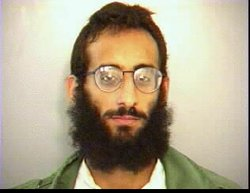
(Photo: San Diego Police Department mug shot of Anwar al Awlaki after he was arrested in San Diego on April 5, 1997. As reported by KPBS San Diego.)
The Widower’s Love

Joyce Carol Oates reviews Julian Barnes’ memoir, Levels of Life, about losing his wife of 30 years:

Barnes quotes E. M. Forster: “One death may explain itself, but it throws no light upon another” – yet Levels of Life suggests that a single death, if examined from a singular perspective, may throw a good deal of light on the universal experiences of loss, grief, mourning, and what Barnes calls “the question of loneliness”. “I already know that only the old words would do: death, grief, sorrow, sadness, heartbreak. Nothing modernly evasive or medicalising. Grief is a human, not a medical, condition.” The epiphany – or rather one of the epiphanies, for Levels of Life contains many striking, insightful aphorisms – towards which the memoir moves is the remark of a bereaved friend: “Nature is so exact, it hurts exactly as much as it is worth, so in a way one relishes the pain . . . . If it didn’t matter, it wouldn’t matter”.

In the more intimate passages here, Barnes would seem to be making the tacit point that the creation of art is inadequate to compensate for such loss. “You put together two people who have not been put together before . . . . Then, at some point, sooner or later, for this reason or that, one of them is taken away. And what is taken away is greater than the sum of what was there. This may not be mathematically possible; but it is emotionally possible.” …

Levels of Life ends on a tentatively hopeful note – not optimistic, but rueful. “There is a German word, Sehnsucht, which has no English equivalent; it means ‘the longing for something.’” This is the obverse of the widower’s more particularized loneliness, which is the “absence of a very specific someone”. The final, perfectly honed lines of the memoir suggest the balloonist’s quasi-mystic, Romantic expectation: “All that has happened is that from somewhere – or nowhere – an unexpected breeze has sprung up, and we are in movement again. But where are we being taken?”.

Apples To Apples, Dust To Dust

Rowan Jacobsen raises concern about lost apple varieties:

In the mid-1800s, there were thousands of unique varieties of apples in the United States, some of the most astounding diversity ever developed in a food crop. Then industrial agriculture crushed that world. The apple industry settled on a handful of varieties to promote worldwide, and the rest were forgotten. They became commercially extinct—but not quite biologically extinct.

Alex Tabarrok pushes back:

The innovative Paul Heald and co-author Sussanah Chapman (pdf) show that the diversity of the commercial apple has increased over time not decreased (pdf).

It is true, that in 1905 W.H. Ragan published a catalog of apples with some 7000 varieties. Varieties of apples come and go, however, like rose varieties or fashions and Ragan’s catalog listed any apple that had ever been grown during the entire 19th century. (Moreover, most varieties are neither especially good nor especially unique). At the time Ragan wrote, Heald and Chapman estimate that the commercially available stock was not 7000 but around 420 varieties. What about today?

The Fruit, Berry and Nut Inventory for 2000 lists 1469 different varieties of apples, a massive gain in terms of what growers can easily find for sale. The Plant Genetic Resources Unit of the USDA, in Geneva, New York, maintains orchards containing an additional 980 apple varieties that are not currently being offered in commercial catalogs. Scions from these trees are typically available to anyone who wishes to propagate their variety. The USDA numbers bring the total varieties of apples available to 2450.

In fact, there are more than 500 varieties of apples from the 19th century commercially available today–thus there are more 19th century apples available today than probably at any time in the 19th century!

(Photo by Jeff Kubina)

Should We Kill Cursive? Ctd

A reader differs with the previous ones:

Why do so many cursive defenders use the defense of the sentimental value of handwritten notes vs. emails as some sort of strength inherent to cursive? As a product of architecture school, I write almost entirely in capital lettering, and my wife generally prints as well. Yet somehow we still find the notes/letters/cards that we write to each other to be meaningful and cherished, despite their utter lack of cursive.

In today’s world, cursive is a luxury, not a necessity. If someone chooses to spend their time learning and perfecting it, more power to them. If a school wants to offer cursive courses to individuals such as that, that’s great too. But to force every student to spend a significant amount of time learning a skill that’s nowhere near necessary anymore is just silly. Doubly so when you consider some of the far more useful skills (like basic personal financial planning) that schools tend to leave out.

Another dissenter:

I’m 26.  I was taught cursive in elementary school, and I used to be pretty good at making my writing look pretty, but I found it slow and irritating.  I was mercifully instructed in middle school that I did not need to write in cursive any more and never looked back.  The most I can do at this point with any degree of speed is sign my name.

That came back to bite me in the ass when I took the SATs and GREs.

When you take those exams, there is a paragraph you have to write in cursive that you attest that you are who you say you are, and aren’t cheating.  It took me nearly the entire time allotment and I nearly ran out of space on the lines provided.  By the end I just printed and connected the letters after I had finished the sentence. I still remember that as the most stressful part of either exam.

Another had a similar experience:

This cursive discussion is giving me flashbacks to one memorable panic attack that nearly blew my LSAT before it even began. For anyone who’s ever subjected themselves to the sado-masochism of the LSAT , they may recall one particular pre-test registration section that requires not filling in bubbles, but for each test taker to transpose a statement certifying their identity and their adherence to the test rules. It sounds simple enough, until the proctor instructs you to, “Write this statement IN YOUR NORMAL HANDWRITING.  It must NOT BE PRINTED.”  (I am NOT the only person for whom transcribing that short paragraph in “script” or “cursive” posed a serious fucking problem.)

The exam was in a massive gymnasium at UMass Boston with about 300 other people. I don’t know whether it was just test-day nerves that made me freeze up, or more likely the fact I hadn’t written anything in cursive/longhand longer than my signature since about 4th grade or so. But I began to shake uncontrollably; I couldn’t even put my pencil to the paper because my hand was so spastic. Even gripping and trying to steady my writing hand and pencil with the other hand couldn’t stop it. And then all at once, I drew a complete blank on even the most basic, grade school ups-and-downs and simple swoops to create even a single letter. Shaking, just staring horrified at lines of illegible chicken-scratch when the proctor called out over the mic that we had one minute before the exam would begin.

And that was when the full-body seizing began. Thinking back, I’m pretty sure I’d stopped breathing entirely. When I started blacking out, I managed to raise my hand, and then somehow yell out to the proctor and 300 horrified test takers, “I think I’m having a medical emergency!” It wasn’t til the proctor got me breathing again and swigging some OJ that I finally got my shit together, only to then have to take that fucking test for five fucking hours.

I’d never had a panic attack before, and haven’t had one since.  Hell yes, kill cursive.

Read the whole thread here. More reader thoughts on our Facebook page.