A determined pitbull ends up training for the rings:
A YouTube commenter:
Legend says he never let go
A determined pitbull ends up training for the rings:
A YouTube commenter:
Legend says he never let go
Larison dutifully picks apart Keller’s case for intervention:
Keller claims that “we have a genuine, imperiled national interest, not just a fabricated one,” and he is referring to the danger of a failed state serving as a haven for terrorists, but all of the proposed options for intervention involve hastening the failure of the Syrian state and aiding in the empowerment of jihadist groups. If the U.S. has an interest in preventing state failure in Syria, that is a reason to avoid intensifying and prolonging the conflict by backing the opposition.
Keller completely ignores his second lesson later in the op-ed when he mentions chemical weapons use, which causes him to overlook some new information that ought to make a difference in his thinking. According to reports over the weekend, U.N. investigators have determined that sarin may have been used by anti-regime forces. It’s possible that the investigators have it wrong, but it makes absolutely no sense for the U.S. to lend support to forces that are willing to use chemical weapons.
Max Fisher scrutinizes the Sarin reports at length. In one way, Larison agrees with Keller that “Syria is not Iraq”:
Unlike Iraq, there would be no fig leaf of a Security Council resolution that hawks could hide behind to defend the war, and there would likely be even less multilateral support for a Syrian war than there was for the invasion of Iraq.
Later, Larison sets his sights on another liberal hawk:
James Rubin demands that the U.S. ensnare itself in Syria’s conflict, and then has the gall to say this:
Second, it is astonishing to hear so much hand-wringing about the possibility of America entering another Middle Eastern war. That’s not going to happen; even the most hawkish of hawks are not proposing some sort of U.S. invasion.
Rubin is being disingenuous here, since even the measures that he calls for would require the U.S. to commit acts of war against the Syrian government. Of course the U.S. might be entering another war in the region. That is what Syria hawks want the U.S. to do, and it is absurd to claim otherwise.
Syria hawks are not yet proposing an invasion, because they know as well as anyone that there is no political support for that in the U.S. or in any other country. That doesn’t mean that an invasion or the preparation for an invasion won’t happen if the U.S. starts using force in Syria. The first thing to remember about all interventionist arguments is that they always minimize the costs and risks at the beginning while exaggerating the danger of “inaction.” When an interventionist dismisses the idea that ground forces may be necessary to achieve the goals he wants, he is usually trying to sell the audience on a bad policy that he knows the audience would reject if they were confronted with the full costs of “action.”
My thoughts on the matter here.

Hof, Iceland, 8.56 am
I recently wrote that “talking about the Israel lobby in exactly the same way that everyone talks about the gun lobby is not and never has been ipso facto anti-Semitism.” Pascal-Emmanuel Gobry doesn’t fully disagree but thinks there are good reasons we treat the lobbying groups differently. The core of his post:
Our society, quite reasonably in my view, has developed a taboo against the use of words associated with group hatred, as a way to stigmatize said hatred. White people can’t use the n word in contemporary polite American society because that word is associated with the memory of white people who used that word and bought and sold black people as chattel… So we stigmatize it … Expressions like “Jewish lobby”, which carries the anti-Semitic trope that Jews are a shadowy clique that secretly controls the government have been — for centuries, around the world, to this very day in some places — used as spurs to mass violence.
This is an important point that lays bare the problem. One of the tropes of anti-Semitism has indeed been the notion that secret, powerful cabals of Jews somehow control the world from behind the curtain. That’s why I think Gobry is right to stigmatize a phrase like the “Jewish lobby” and why Chuck Hagel was right to apologize for that phrase. But “Israel lobby”? Or “Greater Israel lobby”, as I prefer to use? Not so much.
That phrase recognizes the existence of a lobby as powerful as the NRA, and just as distortive of rational public policy. It also recognizes that the Israel and Greater Israel lobbies are increasingly Christianist rather than Jewish, as the Christian fundamentalists in America find common cause with the Jewish fundamentalists on the West Bank. The Americans who show up for new settlement openings are increasingly called Huckabee.
But Gobry won’t even allow for such a neutral phrase:
Yes, phrases like “The Israel Lobby” are redolent of anti-Semitism. Yes, using crypto-anti-Semitic language is stigmatized by any decent society worthy of the name.
This is where I think the rhetorical game is rigged. Note the qualifications: phrases “like the ‘Israel Lobby'”; “redolent of”; “crypto-anti-Semitic”. It reminds me of Leon Wieseltier accusing me of “something much darker” than anti-Semitism, in order to be able to state that he never accused me of being an anti-Semite. It’s bullying blather. But it does have the advantage of making the Israel Lobby the only such lobby to be rendered immune from being described as exercizing control over the Congress like the NRA, even if it does.
This blog will avoid such a double standard for the simple purpose of telling the truth, as I can best discern it.
Hunter Oatman-Stanford looks at the rise of Calvin Klein underwear:
Interestingly, Calvin Klein’s first range of underwear in the 1980s was made in the same factories as Jockey.
Even though we think that Calvin Klein invented this idea of the brand name in the waistband, Jockey was doing that in the 1950s. But what Klein did was to make the rise slightly lower, to make the fit slightly tighter. …
Through the 1970s, you had this explosion of color and pattern, but Klein went back to a classic simplicity that was reflected in the form of the man in the advertising. So you had this statuesque, athletic body in a very classic, simple, white garment. The question, really, is about what was being sold: Suddenly, men were presented for sale in the way that women had been in advertising. One of Calvin Klein’s biggest impacts wasn’t on underwear but on the presentation of men in popular culture.
“Syria threatens Israel, says airstrikes near Damascus open door to ‘all options’” – Washington Post headline today.
“Israel enforces ‘red line’ with Syria airstrike on weapons bound for Hezbollah, officials say” – Washington Post, on the news that Israel had actually bombed Syria’s capital city.
So Syria “threatens” Israel, but Israel was only “enforcing a red line”. There’s a mindset here that is not exactly open to neutral reporting. The assumption that the US and Israel can do anything militarily with obvious justification, while our enemies are barred from even threatening to retaliate, can become a form of solipsistic blindness.
War is war. We should be as subject to its laws as anyone else. Or we become as lawless as Middle East states’ foreign policies (including Israel’s).
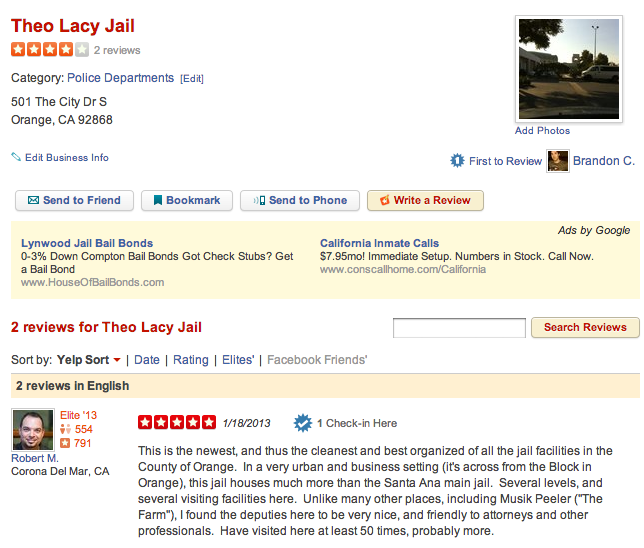
Tom Vanderbilt is often afflicted by it:
In the days before the Internet, eating at an unknown restaurant meant relying on a clutch of quick and dirty heuristics. The presence of many truck drivers or cops at a lonely diner supposedly vouchsafed its quality (though it may simply have been the only option around). For “ethnic” food, there was the classic benchmark: “We were the only non-[insert ethnicity] people in there.” Or you could spend anxious minutes on the sidewalk, under the watchful gaze of the host, reading curling, yellowed reviews, wondering if what held in 1987 was still true today. In an information-poor environment, you sometimes simply went with your gut (and left clutching it).
Today, via Yelp (or TripAdvisor or Amazon, or any Web site teeming with “user-generated content”), you are often troubled by the reverse problem: too much information.
As I navigate a Yelp entry to simply determine whether a place is worth my money, I find myself battered between polar extremes of experience: One meal was “to die for,” another “pretty lame.” Drifting into narrow currents of individual proclivity (writing about a curry joint where I had recently lunched, one reviewer noted that “the place had really good energy, very Spiritual [sic], which is very important to me”), I eventually capsize in a sea of confusion. I either quit the place altogether or, by the time I arrive, am weighed down by a certain exhaustion of expectation, as if I had already consumed the experience and was now simply going through the motions.
Recent Dish on the “paradox of choice” here.
(Screenshot of prison reviews on Yelp)

Moynihan investigates Islamic extremism on the web:
I decided to try an experiment: I would spend seven days creeping through the Internet using disposable IP addresses, inhabiting the milieu of radical sites and Facebook pages. In Manhattan coffee shops, on subway platforms, between tasks at work, I would take up residence in the darkest corners of the Web—and see what I could learn about the fetid swamps where self-made jihadists are allegedly born.
His big takeaway? It works – by numbing followers to violence:
The further I crawled down the extremist rabbit hole and the more caved-in skulls and headless corpses I saw, the more I found that my natural revulsion, usually an uncontrollable instinct, was easier to suppress.
And it wasn’t just my revulsion to violence that seemed to dull: the casual Jew hatred, homophobia (yes, there were references to the “sick” revelation that NBA player Jason Collins is gay), and sexism (“The beauty of a woman lies in her SILENCE rather than her SPEECH”) were so eye-glazingly common that after a week of uninterrupted consumption, I found myself scrolling past it without a second thought.
Americans were jarred by a gruesome—and now iconic—photo of Boston Marathon spectator Jeff Bauman being rushed toward an ambulance, one of his legs blown off below the knee. In the universe of electronic jihad, such images are banal. To be a social-media jihadi for a week is to be reminded of French essayist Alain Finkielkraut’s admonition: “Barbarism is not the inheritance of our pre-history. It is the companion that dogs our every step.”
My earlier take on the Boston jihad here.
(Screenshot from the al Qaeda magazine Inspire, supposedly an inspiration to the Boston bombing suspects.)
The environmental activist and the filmmaker describes what most shocked him while making Gasland Part II:
Readers are starting to dissent over the series:
I haven’t seen Gasland, and until you posted the Q/A with Josh Fox, I didn’t have an opinion about him one way or another. As a resident of NE Ohio, sitting on top of the Utica Shale, I have been following the issues surrounding the exploitation of shale gas, and I’m genuinely undecided on whether the benefits of “fracking” outweigh the risks. Listening to Josh Fox’s responses did nothing to advance my understanding of this complex issue. It’s obvious that Fox isn’t at all interested in presenting a fair (but biased) assessment. No, he’s an activist/filmaker in the mode of Michael Moore, and I suspect Gasland, like Roger and Me or Sicko, is more propaganda than journalism.
Anyone who is paying attention to this issue, and who doesn’t have an ideological ax to grind, knows that the evidence is far from clear concerning the nature and extent of water contamination and methane emissions related to natural gas extraction. But you wouldn’t know it if Fox was your only source. He cites one study by a team from Cornell University for the proposition that fracking will result in greenhouse gas emissions greater than or equal to coal. Ten minutes on the Internet will show you that this doesn’t represent the consensus view on this issue. Far from it: the study to which he refers is highly-disputed and seems to be something of an outlier, and those who have criticized it are not simply gas industry shills (as Fox likes to label his critics), but independent researchers. Same goes for water contamination, where the evidence is nowhere near as clear as Fox makes it out to be. As a non-scientist I can’t independently judge who’s right on the data; but as a lawyer I know a half-baked argument when I see one, and the intellectually dishonest way that Fox presents this issue while ignoring or mischaracterizing contrary evidence gives me pause.
Then there’s his use of a false analogy that equates risk management for passenger air travel to that for natural gas drilling and groundwater contamination.
Fox asks why we would tolerate a 30-50% failure rate for gas well casings when we expect aircraft to be designed and built to operate without catastrophic failures 99.99999% of the time. First, how are these even comparable? A small defect on a critical component of an aircraft can lead to catastrophic failure. What is the risk associated with a cracked well casings, and what is the likelihood that it will lead to a catastrophic failures resulting in human deaths? How do “fracked” well casings differ from conventional well casings with respect to groundwater risks? How often do well casing failures lead to groundwater contamination, and how severe is the contamination? (If there are a million gas wells operating worldwide, and 30-50% of them fail, that’s a lot of poisoned groundwater. You’d think there would have been an uproar about this long ago.) If you’re determined to compare the gas industry to the transportation sector, why pick air travel? As a society we tolerate 40,000 automobile traffic-related deaths each year, plus billions of dollars in property damages. We do this because we’ve determined that the benefits of the automobile vastly outweigh the risks.
Clearly, Fox the activist isn’t much interested in an honest discussion of benefits vs. risks. He simply wants to advance his agenda by appealing to people’s emotions and fears. That’s fine, but I can’t understand why the Dish lets this go without posting some contrary views.
Another contrary view:
I claim no particular expertise on the issue of whether, on balance, increased extraction of natural gas through hydraulic fracturing is a good thing for the environment and our economy, in relation to our current methods of energy generation or other feasible alternatives. I am, however, familiar enough with the debate to know that Josh Fox is at last half-full of shit. For example, he cites “the Cornell study” as if it were undisputed proof that fracking will result in greater greenhouse gas emissions than coal over the short-to-medium term, and that such emissions will be about equal over the long term. Among the experts who were not impressed with the study’s metholodology were several other members of the Cornell faculty (pdf), who concluded:
The data clearly shows that substituting natural gas for coal will have a substantial greenhouse benefit under almost any set of reasonable assumptions. Methane emissions must be five times larger than they currently appear to be before gas substitution for coal becomes detrimental from a global warming perspective on any time scale. The advantage of natural gas applies whether it comes from a shale gas well or a conventional gas well. Scientifically the prescription for reducing green house emissions is clear: substitute gas for coal while minimizing methane emissions using proven and available technology, and then move toward low carbon energy sources as quickly as technically and economically feasible.
For Fox to cherry-pick one highly disputed study, and not even acknowledge that it doesn’t represent a consensus view among experts, is intelluctually dishonest. So, by the way, is the slimy way he attempts to conflate the natural gas industry with the tobacco business by noting that their respective trade groups used the same PR firm, Edelman. So the fuck what? Edelman has represented thousand of companies. Does Fox want to equate Starbucks, Heinz, Butterball Turkeys and Samsung with Big Tobacco?
Josh Fox’s Gasland Part II will air on HBO this summer. His other Ask Anything answers are here. Full AA archive here.


 The Dish