The Skyline From Below

dish_vh-page033

In his series “Verical Horizon,” photographer Romain Jacquet-Lagreze captures upward-looking views of Hong Kong skyscrapers:

[Jacquet-Lagreze‘s] interest in photography began during his period of working in Los Angeles and Tokyo, and subsequently blossomed into a passion after his arrival in Hong Kong. Stunned by its architectural “race to the sky”, he felt the need to use his camera to share his feelings about the city. The geometry of the urban environment and the vivid lives it shelters are the aspects of Hong Kong that inspire him most.

More amazing photographs here.

(Photo: from Vertical Horizon, published by Asia One, 2012)

Yes, Of Course It Was Jihad, Ctd

A couple of points that may inform two long-running debates between me and Glenn Greenwald. The first is the motive for the Boston bombings. Of course, we should always wait for the full evidence, and there is always an interplay between a particular psychological journey and religious fanaticism. I’ve said that from the get-go. But we can now pretty safely say – as we could pretty quickly – that the bombings were an almost text-book case of Internet Jihad, a chilling example of how fundamentalist zeal can become murderous right here in our midst, with no necessary international network.

Money quote from a profile of Dzhokhar:

After Mr. Tsarnaev emerged as a suspect in the bombing, Mr. Lamichhane said, a mutual friend from the University of Massachusetts recounted his last conversation with Mr. Tsarnaev, two weeks before the marathon. Mr. Tsarnaev told their friend, “God is all that matters. It doesn’t matter about school and engineering,” Mr. Lamichhane said. “He said, ‘When it comes to school and being an engineer, you can cheat easily. But when it comes to going to heaven, you can’t cheat.’ ”

Five words: “God is all that matters.” If some secular liberals could grasp that a modern human can say those words and mean them, they would have a better grasp of our core predicament. The religious conversion was relatively recent – and had an obvious effect:

A second Chechen friend since boyhood, 18-year-old Baudy Mazaev, said that the older brother and their mother, Zubeidat Tsarnaeva, “had a deep religious epiphany” about two or three years ago. At the time, Tamerlan’s new devotion only irritated Dzhokhar, he said. During one visit about two years ago, he said, Tamerlan ordered him and Dzhokhar to sit and forced the two teenagers to read a book about the fundamentals of Islam and prayer… In February 2011, roughly when the boys’ mother embraced Islam, she separated from her husband, Anzor, a tough man trained in the law in Russia who was reduced in Cambridge to fixing cars in a parking lot. The two divorced that September, and Anzor returned to Russia, followed later by his ex-wife. Tamerlan filled the void as head of the family’s American branch. On Twitter, Dzhokhar wrote that he missed his father.

Fundamentalism took over that family. It drove the father away. The second point worth noting (and relevant to a debate Glenn and I have conducted) is the man who personally seemed to have inspired and help train the Tsarnaev brothers from the grave – Anwar al Awlaki:

Two U.S. officials tell The Daily Beast that, during his hospital room interrogation, Dzhokhar told FBI agents that he and his brother were influenced by the Internet sermons of Anwar al-Awlaki, the American-born preacher who was killed in a U.S. drone strike in Yemen in September 2011…

We know Awlaki influenced the Tsarnaevs at least indirectly, through one of AQAP’s main propaganda organs. According to law enforcement sources, Dzhokhar has admitted to the FBI that he and his brother learned how to the build pressure cooker bombs they allegedly used in Boston from the terror group’s English-language Internet magazine, Inspire. For much of its existence, Inspire was run by Samir Khan, an American propagandist for AQAP who was close to Awlaki and was ultimately killed in the same U.S. drone strike that killed the Yemeni-American cleric.

It seems to me that Anwar al-Awlaki was clearly complicit in the Boston marathon bombers and that the bulk of his propaganda was about inciting domestic terrorism in the US along the Tsarnaev lines. That makes him a little more than an icon for the First Amendment. It makes him a traitor allied with forces that want to kill American citizens.

The Grilling Of Howie Kurtz

A remarkable interview on his own show:

This embed is invalid


The Daily Download thing I remain befuddled by. But it may simply have been a career insurance policy – developing skills in web-TV. Obviously, er, not a successful strategy. But CNN and Kurtz deserve props for this brutal grilling. They seem to get why a media critic cannot become his own story.

A FISA Rubberstamp

David Kravets looks at the approval rate for the Foreign Intelligence Surveillance Court:

A secretive federal court last year approved all of the 1,856 requests to search or electronically surveil people within the United States “for foreign intelligence purposes,” the Justice Department reported [last] week. … The 2012 figures represent a 5 percent bump from the prior year, when no requests were denied either. The secret court, which came to life in the wake of the Watergate scandal under the President Richard M. Nixon administration, now gets the bulk of its authority under the FISA Amendments Act, which Congress reauthorized for another five years days before it would have expired last year.

Greenwald sees this as an indication of how a “drone court” might function:

[D]oes anyone believe that a “drone court” would be any less of a mindless rubber-stamp than the Fisa court already is? Except for a handful of brave judges who take seriously their constitutionally assigned role of independence, the vast majority of federal judges are far too craven to tell the president that he has not submitted sufficient proof that would allow him to kill someone he claims is a Terrorist. The fact that it would all take place in secret, with only the DOJ present, further ensures that the results would mirror the embarrassing subservience of the Fisa court.

Will Obamacare Make America Healthy? Ctd

w-medicaid2

Ezra Klein takes the long view of the Oregon Health Study, which showed little to no improvements in health among Medicaid enrollees over a two-year period:

[T]he study was simply too small, with too few sick people, to show the kind of quick health changes the researchers were looking for. Sharply increasing the number of people who are managing their diabetes and mental health, getting colonoscopies and mammograms, and making regular trips to the doctor sure seems like the kind of thing that will improve long-term health outcomes. Other studies with a less rigorous — but still credible — design and a longer timeframe have shown that states that expanded Medicaid saw a six percent drop in death rates among the newly insured group. …

I’ve seen my doctor a few times over the last two years. None of those visits had any measurable impact on my health. But if something had been wrong on one of those visits, the story would be very different. I have health insurance not because it improves my health on any given day, but because regular access to the medical system will, presumably, improve my health over time.

I get that. But if expanding Medicaid does not make people measurably healthier, the cost and benefit equation needs reviewing. I do think the study needs replicating and needs to be undertaken on a longer time scale. But, as it stands, it’s a strong argument for universal catastrophic insurance, which includes mandatory check-ups for preventive care. Drum takes issue with the study’s methodology. Beutler’s criticism:

[The] Oregon study was not designed to address the excess deaths issue, just like studies on insurance’s impact on mortality aren’t designed to test its impact on various health measures across the population. But of course, most real-world excess death studies link tens of thousands of deaths a year to uninsurance. That’s a very small percentage of the millions of uninsured in the United States. But I doubt even Medicaid’s loudest critics would shrug off 10,000 or 20,000 preventable deaths a year in most other contexts.

Chait responds to the digs from conservatives:

Okay: The case for Medicaid expansion is not as strong as I had thought. Now for the caveats: The case for Medicaid expansion is overwhelmingly strong. If a study found that puppies survive steep falls at a higher rate than expected, then you could say the case for throwing puppies out of skyscraper windows has marginally weakened, but would remain extremely strong. Indeed, data notwithstanding, either throwing puppies out of skyscrapers or throwing people off Medicaid are both acts of sadism.

The United States has very high levels of income inequality, a very stingy welfare state, and is the only advanced economy that does not guarantee access to medical care. The Oregon study does not raise particular questions about the efficacy of Medicaid; it raises questions about the efficacy of medical care in general. Measuring the impact of medicine is just really hard to do, yet almost nobody would volunteer to follow this frustrating fact to its logical conclusion and forgo the benefits of modern medicine.

Yes, but since Medicaid is paid for entirely by others, it seems only fair that they be persuaded that it’s actually value-for-money. Douthat’s take on the study:

[I]f it turns out that health insurance is useful mostly because it averts financial catastrophe — which seems to be the consensus liberal position since the Oregon data came out — then the new health care law looks vulnerable to two interconnected critiques.

First, if the benefit of health insurance is mostly or exclusively financial, then shouldn’t health insurance policies work more like normal insurance?

Fire, flood and car insurance exist to protect people against actual disasters, after all, not to pay for ordinary repairs. If the best evidence suggests that health insurance is most helpful in protecting people’s pocketbooks from similar disasters, and that more comprehensive coverage often just pays for doctor visits that don’t improve people’s actual health, then shouldn’t we be promoting catastrophic health coverage, rather than expanding Medicaid?

Liberals don’t like catastrophic plans because, by definition, they’re stingier than the coverage many Americans now enjoy. But this is where the second critique comes in: If the marginal dollar of health care coverage doesn’t deliver better health, isn’t this a place where policy makers should be stingy, while looking for more direct ways to improve the prospects of the working poor?

He puts the point delicately, but it’s a very powerful one, it seems to me. Pete Spiliakos builds on Ross’ recommendations:

Republicans could argue for moving health care financing to a model of catastrophic health insurance coverage, plus coverage for routine preventive care, plus health savings accounts to pay for non-catastrophic health care costs. James Capretta has been working on this [pdf]. Republicans would be able to plausibly argue that their plans would maintain the health care security of middle-class families while reducing health care premiums and expand health insurance coverage for low-earners at lower cost to taxpayers than Obamacare. Republicans can be the party of health care security and more take home pay and lower spending. C’mon people. You can do this.

If we had a sane and pragmatic GOP, this would have been the critique in the first place, together with a program for national catastrophic insurance on the lines Spiliakos suggests. That would have elevated and deepend the debate all round – but ideology and partisanship obscured it. Barro believes the Oregon report reveals insight into a key weakness of the ACA:

Obamacare relies mostly on bureaucratic approaches to achieving cost control. … [Liberals] are right to note that conservatives’ preferred alternative to Medicaid expansion (leaving tens of millions of people uninsured) would be worse for quality of life. But the lesson of the Oregon Health Study is nonetheless that there’s cost-effectiveness information out there that Medicaid and other health insurers aren’t exploiting. And even though conservatives have generally done a terrible job of explaining why, conservative ideas about increasing consumer direction in health care could help to exploit that information and make health care more cost-effective — without repealing Obamacare or stopping the Medicaid expansion.

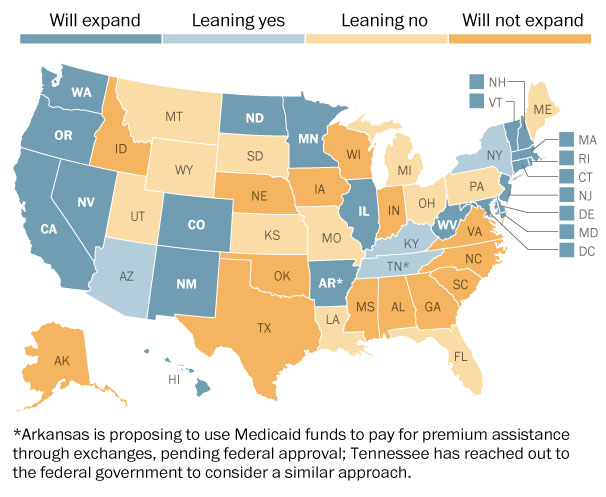
I have become far less confident that patients can act as real consumers in the healthcare marketplace. There’s such an imbalance of knowledge and the consumer is almost always desperate for a solution, with no leverage to bargain with. Meanwhile, the Florida legislature just adjourned without providing funds for a Medicaid expansion, “join[ing] 24 other states that have either decided against expanding Medicaid, or are leaning in that direction, according to analysts at Avalere Health [who created the above chart].”

A Couple Of Words On Niall Ferguson, Ctd

A reader writes:

The man who apologizes with real contrition and full acknowledgement of the depth and wrongness of his failure is perhaps a greater man than one that never puts his mouth wrong.  God knows we have plenty of shit banging around on the inside of our heads. It is in the base nature of man to wish to demean his fellow and exalt himself.  When it leaks out/misfires, it the mark of a true human being that can fall on his sword in contrition.

Other readers aren’t willing to let Niall off the hook:

Please try to separate your personal relationships from the bigoted nasty things some people say in public. Ferguson’s apology is insincere at best, since he has apparently held those views for many years:

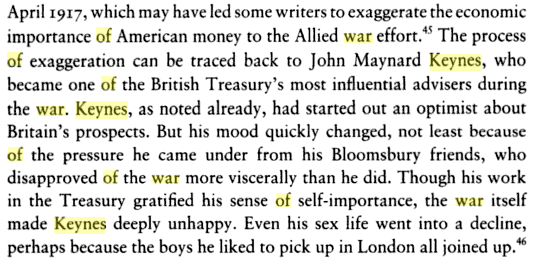
[A]s pointed out on Twitter by Justin Wolfers, there’s this passage in Ferguson’s 1999 bookThe Pity of War:

Screen shot 2013-05-04 at 3.08.43 PM

So it seems this is a theory Ferguson has held for a while, that Keynes’ boy-kissing affected his policy somehow. It wasn’t an “off the cuff” remark he made at a conference when Ferguson thought he was just speaking to his finance bros who wouldn’t mind a little joking about the gays with their theory. It’s an argument he made in print and published fourteen years ago.

And from page 400 of The Pity of War:

There is, however, no question that a series of meetings with one of the German representatives at Versailles added an emotional dimension to Keynes’ position. Carl Melchior was Max Warburg’s right-hand man (……..) It may be that Keynes’ subsequent declaration that he ‘got to love’ Melchior during the armistice negotiations at Trier and Spa obliquely alluded to a sexual attraction. As we have seen, Keynes was an active homosexual at this time. However, it seems more likely that Keynes was simply captivated by the sound of his own pessimism…..

I read both those passages and I simply see a historian dealing with the facts of Keynes’ private life. I don’t see any homophobia in there myself. Another reader:

No doubt there is much to say about Niall Ferguson’s lapse into the homophobia latent in our culture, and his apology, and also about the truths of gay life in all of its dimensions. But shouldn’t this also be an occasion to reflect on Ferguson as an intellectual who claims special expertise on economic history and economic policy and international affairs? Keynes, after all, famously wrote on all of these subjects. How could a scholar so mangle Keynes’s quotation about “the long run,” as you noted?

Ferguson’s assertion about Keynes’s economic thought was no passing mistake. It was programmatic. It was ideological. It was about dogma – not history, not economics as a scholarly field. And it was in that context that Ferguson’s deployment of homophobia was not accidental, no matter that homophobia is not a character trait of Ferguson. The issue here is not only homophobia, but also intellectual bad faith.

Another notes:

Small sidepoint: Adam Smith, who said that Burke was “the only man I ever knew who thinks on economic subjects exactly as I do, without any previous communications having passed between us,” was a lifelong bachelor who never had children.

Rumsfeld vs The Rule Of Law

dogs2

A fascinating post at Empty Wheel has a legal argument that is beyond my expertise to judge. But it does include a detail from the dark days of 2001 – 2006 that helps underline how central torture was to the Bush-Cheney administration’s entire approach to counter-terrorism, and how passionately they believed in torturing prisoners. On December 30, 2005, the Congress finally banned torture by the US military in the Detainee Treatment Act. No “cruel, inhuman or degrading treatment” was allowed – a broader category than the torture techniques Bush and Cheney cribbed from totalitarian states. What did Rummy do?

In spite of this clear command, the same day Congress passed the DTA, Mr. Rumsfeld modified the Field Manual to include the cruel, inhuman and degrading techniques described above. He karpinski-rummyadded ten pages of classified interrogation techniques that apparently authorized, condoned, and directed the very sort of violations that Plaintiffs suffered. To the best of Plaintiffs’ knowledge, the December Field Manual was in operation during their detention. It was not replaced until September 2006, shortly before Mr. Rumsfeld resigned.

If anyone still thinks that torture somehow happened without the active involvement and close control of Donald Rumsfeld and Dick Cheney and George W. Bush, you need, alas, to look at the facts. These men had contempt for the rule of law, contempt for Western civilization and contempt for the very country they were trying to defend.

Whatever else these individuals were, they were not conservatives. They were lawless radicals, intent on war crimes. And it appears they will never be held accountable by the very rule of law they ignored and abolished.

The Carnivore’s Carbon Footprint

It’s pretty big:

In their report, [World Bank advisers Robert Goodland and Jeff Anhang] note that when you account for feed production, deforestation and animal waste, the livestock industry produces between 18 percent and 51 percent of all global greenhouse gas emissions. Add to this the fact that producing animal protein involves up to eight times more fossil fuel than what’s needed to produce an equivalent amount of non-animal protein, and you see that climate change isn’t intensified only by necessities like transportation and electricity. It is also driven in large part by subjective food preferences — more precisely, by American consumers’ unnecessary desire to eat, on average, 200 pounds of meat every year.

Meanwhile, Mark Bittman’s new book, VB6, recommends going vegan before 6 pm as a way to eat environmentally and lose weight, with the added benefit that “I can eat whatever I want in the evening, thus hanging out with my friends without appearing weird.” Tyler Cowen is on board:

As I’ve argued in my own An Economist Gets Lunch, eating less meat is the most socially beneficial change in your dietary habits you can make.  Here’s one very good way to do it. Of course the economist in me wonders why Bittman chose “vegan before 6 p.m.” rather than after 6 p.m. or for that matter after some point closer to the middle of the day.  Is it simply two meals vs. one?  Or is it that the prospect of meat and dairy in the evening makes vegan eating during the day more tolerable, whereas the opposite would require too much retrenchment to be sustainable?