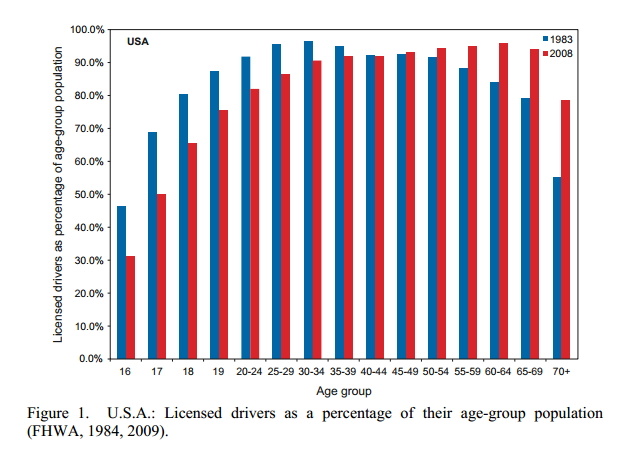
The Young And The Carless, Ctd

dish_driverdata

Brian Merchant believes that the car’s dominance in American culture has been eclipsed by Facebook and Brooklyn:

I’m evidence, I guess—once one of those wide-eyed car lovers, I moved to Brooklyn from car-heavy southern California and sold my Ford. I haven’t regretted ditching it at all. Brooklyn certainly isn’t the only model, but it has become a “global brand” for hip urbanity … Young, affluent people now overwhelmingly want to be able to walk or bike to artisanal restaurants, sweaty music venues, and bars stocked with organic beers. That’s partly why places like Charlotte are focusing on walkability. That’s in no small part Brooklyn’s doing/fault.

But the other explanation for the decline in driving is more interesting: the rise in internet use amongst the same demographic that used to be so eager to hop behind the wheel. A study conducted by researchers at the University of Michigan discovered that “a higher proportion of internet users was associated with a lower licensure rate,” which they found to be “consistent with the hypothesis that access to virtual contact reduces the need for actual contact among young people.”

Relatedly, Felix gives a thumbs up to NYC’s new bike-share:

Don’t worry about safety. I wore a helmet, many people won’t, it’s all OK. There’s a paradox here: the less safe you look and feel, the wider a berth cars give you. If I’m zooming down the street on a singlespeed, taxis will happily zoom past me, with inches to spare. But if I’m wobbling down the street on a CitiBike, not so much.

In fact, there’s very little evidence that helmet use reduces bike-injury rates. Certainly if you fall on your head, you want to be wearing a helmet. But CitiBikes, for one, are big and heavy and much less precarious than most bikes. They’re hard to fall off of, and they make it almost impossible to go flying over the handlebars.

Recent Dish on the the decline of driving among the young here.

Unhappy, Unhealthy

Earlier this month, the blogosphere weighed in on an Oregon study that found that Medicaid enrollees, when compared to non-enrollees, had lower rates of depression but little difference in things like cholesterol and blood pressure. Bill Gardner pushes back against one headline writer’s claim that enrollees were “happier but not healthier”:

[M]ental illness isn’t just about happiness: Mental illness kills. Sometimes by suicide, of which mental illness is a principal cause. But most of the excess deaths among the mentally ill are caused by diseases such as cardiovascular disease or cancer.  In a sense, mental illness amplifies the risk or lethality of physical health problems. This occurs for many reasons.  Mentally ill people are more likely to develop tobacco, alcohol, and substance abuse addictions. Mentally ill people also experience high levels of stress from the loss of jobs, marriages, and families. Chronic diseases such as diabetes require intensive daily self-care routines and mental illness undermines a patient’s ability to carry these out.

Obamacare’s Other Mandate

Josh Barro suggests scrapping the ACA’s employer mandate:

Over time, the portions of Obamacare that encourage employer provision of health care are likely to be vulnerable. Employers hate the mandate, and argue (correctly) that it discourages job creation. Republicans want to repeal it. And Democrats may not remain totally averse to weakening it, since doing so would move more Americans into portable, government-subsidized coverage — that is, one step closer to the liberal single-payer vision.

If the employer mandate is weakened, Obamacare would become more expensive to taxpayers but less damaging to the economy and job creation. The health care exchanges would become the increasingly dominant venue through which Americans get insurance. Obama’s promise that you can keep that health plan you like would become less and less true. And we would be better off for it.

Even if the employer mandate isn’t weakened, Ezra suspects that few employers will drop coverage:

[T]he fraction of employers actually affected by the health law’s mandate is very small. “You’ve got 5.7 million firms in the U.S.,” says Wharton’s Mark Duggan, who served as the top health economist at White House’s Council of Economic Advisers from 2009 to 2010. “Only 210,000 have more than 50 employees. So 96 percent of firms aren’t affected. Then if you look among those firms with 50 or more employees, something on the order of 95 percent offer health insurance. So it’s basically 10,000 or so employers who have more than 50 employees and don’t offer coverage.” Those companies probably employ around one percent of American workers.

Wheels Of Fashion

Leah Binkovitz Daniel London surveys the short-lived “bicycle craze” of the late 19th century:

From decorated chain-guards to novelty cycling bells to handle-bar revolvers, consumers spent more than $200 million on bicycle sundries in 1896 alone, as opposed to only $300 million on the bicycles themselves that same year. Nowhere did the consumer culture surrounding the bicycle manifest itself more than in the area of attire. By sporting the latest styles, wheelmen and women sought to project a public image of taste and wealth for their peers to appreciate.

She considers the corresponding trends today:

Bicycling today is often depicted and perceived as a marker of identity: It sanctions its owner’s hip credentials and attitude in the same way that the Victorian cycle did dish_bicyclesuitgentility and respectability. We see it in advertising, as in Jack Kane custom race bicycles’ “It’s more authentic to who I am.” We see it in articles and websites on bicycle fashion. We see it in the perceptions of some non-cyclists, who see riders as “entitled,” out-of-touch hipsters.

The danger here is that history may be repeating itself and the practical benefits of the bicycle are once again hostage to the whims of fashion. Will people still lobby for bicycle lanes when they are no longer seen as marker of progressiveness? Will the health and environmental benefits of riding a bicycle be forgotten when it is no longer championed by the stylish and well off? It happened before, and it may happen again, if the bicycle love surrounding us becomes merely a craze. This time, the wheel should be here to stay. No matter the outfit. No matter the accessory.

(Image: “The Bicycle Suit”, cartoon from Punch, 1895, via Wikimedia Commons)

Overstay Overkill?

Paul Rosenzweig wonders why Congress continues to focus on biometric exit scans to identify immigrants who overstay their visas. If the current version of the immigration bill passes, “foreigners leaving from the 30 busiest airports in America would be required to undergo outbound fingerprinting”:

[E]ven if it were to work it wouldn’t be worth it.  Right now, with our [current] exit system in place, the rate of verified overstays outstrips our capacity to search out those who remain in the US and deport them.  As Secretary Napolitano put it in 2013 testimony, DHS “vet[s] all overstays for national security concerns, [and] also leverage[s] existing capabilities to close out overstay leads. We now vet all potential overstays and refer leads to ICE based on national security and public safety priorities for further review.”  In other words, we don’t have the resources right now to track everyone who overstays – so what would be the value of an even more comprehensive list.

Has Battery Swapping Gone To A “Better Place”?

While Tesla basks in the afterglow of paying back its DoE loans nine years ahead of schedule, Israeli electric car infrastructure company Better Place has filed for bankruptcy:

Better Place aimed very high, trying to make real the vision of a world where depleted electric car batteries could be swapped rapidly for fully charged ones. The task apparently proved too difficult for the startup: After burning through about $850 million of private investor money, it couldn’t raise money anymore and had to file for bankruptcy. … Better Place’s bankruptcy could be the final nail in the coffin of battery swapping, as there aren’t many others doing this, and if it couldn’t be done with all the resources that they had, smaller startups probably won’t succeed either.

Todd Woody concludes that Better Place should have been “more like Tesla”:

Better Place’s business model depended on spending hundreds of millions of dollar building out its network before it could begin to sign up first paying customers. That turned out to be an extremely capital-intensive proposition. Each battery switch station cost about $500,000 and Better Place needed to deploy dozens, even in a small country like Israel. And once stations were built, the customers didn’t come. …

Tesla, on the other hand, is following consumer demand in scaling the manufacture of its Model S electric sports sedan and the build out of its network of Supercharger charging stations, which add 150 miles of range in 30 minutes to the already-long range car. While Tesla designed the Model S to be capable of battery swapping, the company believes the future lies in fixed-battery electric vehicles capable of going 200 miles to 300 miles (322 kilometers to 483 kilometers) on a charge and that will use a network of fast charging stations deployed on highways to make long-distance trips.

Joe Romm shrugs at the news:

Yes, lots of people put money into the company — but a lot of experts on alternative-fueled vehicles and electric cars had big doubts this business model made any sense.

ACA Ambivalence

Jonathan Bernstein is ignoring the polling numbers on Obamacare until it takes effect because he doubts Americans “have strong views of a law that they know little about and that has all sorts of components”:

Look, the Affordable Care Act is unpopular! After all, a new CNN poll finds 43 percent of respondents support Obamacare, while 54 percent oppose it. Look, the Affordable Care Act is popular after all! Or at least government intervention to achieve universal health insurance is popular. Yes, 54 percent oppose the ACA, but almost half of those think it’s not liberal enough. Wait — those can’t both be right, can they? The answer is more basic: Neither of them are. Conservatives convinced by this poll’s headline number that everyone hates Obamacare are wrong; so are liberals convinced that everyone really loves it are wrong, too. …

In the long run, what will really matter is whether the various programs included in the ACA actually work. If they do, they’ll be impossible to repeal (although fights over, for example, subsidy levels will become standard political fights). If implementation goes badly — if the exchanges are impossible to navigate, or large employers really do suddenly stop offering health insurance as a benefit — then new changes won’t take long.

Steve Benen, however, predicts divergent views to remain beyond implementation:

Now, because of state-by-state differences, there will be quite a bit of variety in outcomes. If you live in California or another state dominated by Democratic officials, you’ll likely have a very positive impression of how the law is being implemented, and how it benefits you, your family, and your community. If you live in, say, Texas, you’re likely to have a very different kind of experience. …

It’s not necessarily an explicitly partisan matter — I’m not saying that Democrats are necessarily better at health care governance. Rather, the point is, Democrats don’t have an ideological axe to grind when it comes to trying to sabotage federal health care law. Rick Perry, however, does. To be sure, these red-state residents won’t be left out entirely, and they’ll still benefit from all kinds of consumer protections and expanded access that they’ll really appreciate, even if they don’t yet realize the available benefits. But the full benefits of implementation will elude them for a while in ways blue-state residents won’t have to deal with.