The Profanity Treatment

In the late 1950s, Charles E. Dederich, a member of Alcoholics Anonymous, developed his own recovery program called “Synanon.” At its center was “The Game”:

The Game consisted of a dozen or so addicts sitting in a circle. One player would start talking about the appearance or behavior of another, picking out their defects and criticizing their character. But as soon as the subject of the attack tried to defend him-or herself, other players would join the barrage, unleashing a no-holds-barred verbal onslaught.

Vulgarity was encouraged—“talk dirty and live clean,” said Dederich—and so the other members would accuse the defendant of real and imagined crimes, of being selfish, unthinking, of being a no-good, ugly, diseased cocksucker who was too weak to go straight and was too much of an asshole, junkie, cry-baby motherfucker to admit it.

Faced with this unrelenting group assault, the recipient would eventually have little choice but to admit their wrongdoing and promise to mend their ways. Then the group would turn to the next person and begin all over again.

“The first time it hits you, it absolutely destroys you,” remembered a former Game player. “No matter how loud you scream, they can scream louder,” recalled another, “and no matter how long you talk, when you run out of breath they’re there to start raving again at you. And laughing.” Emotional catharsis was the aim. There were only two rules: no drugs, and no physical violence. It was vicious, but it actually seemed to work. “One cannot get up,” remarked Dederich, “until he’s knocked down.”

Some NSFW fodder seen above.
Parchment Or Person?

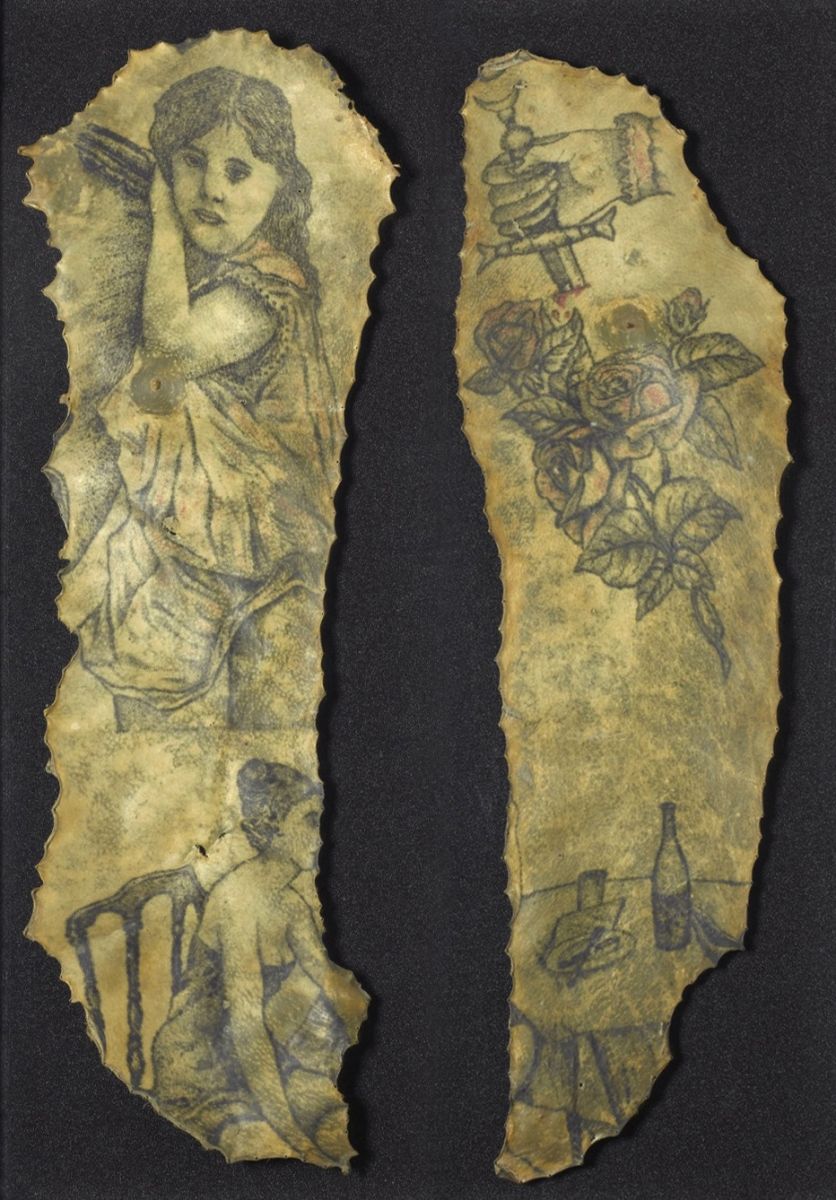
Helen Lewis scours the 300 tattooed “slivers of skin from the 19th and early 20th centuries” currently held in London’s Blythe House:

So how do you harvest a tattoo? These days you’d use a dermatome, a gadget invented in the 1930s that slices off a fine layer of the epidermis and is now used for skin grafts. In the 19th century, you had to use a scalpel and care; many of the Wellcome [Collection] specimens are of different thicknesses or marked with slashes, or have scalloped edges from being stretched and pinned during preservation. Some are thick and soft like leather; others are scratchy and stiff like card; some are translucent when you hold them to the light.

A sample of the collection:

“Guess what that is.” I can feel my brow furrowing as I regard what looks like an L-shaped piece of parchment with a small doodle on it. Disconcertingly, in the hinge of the shape, there is a clump of hair. “It’s an armpit,” says [Gemma Angel, tattoo historian], tucking it away. She holds up a pair of eyes, preserved separately, and grins. “These are from buttocks. I think it’s so that when you turn your back, it’s like, ‘Lads, I’m still watching you.’”

Studying old tattoos involves certain precautions. The collection Angel is working with has been preserved with formaldehyde, so we have to turn on a nozzled fume extractor that she calls the “elephant’s trunk” every time we take a piece of skin out of its wrapper. Despite the trunk, the smell of preservative hangs in the air and I can feel a headache being born somewhere in my sinuses. My hands are sweating uncomfortably in their latex gloves.

What I’m not feeling is queasy – and this surprises me, because touching other people’s buttocks and armpits, once they’ve been detached from the people themselves, ought to be slightly disorientating. However, the tattoos look so much like they are on parchment that it’s hard to remember they once sweated and tingled and hurt. The only moment of connection I have is when Angel holds up an intricate chest piece – complete with nipples – against her torso, to show off its impressive size. “Big guy, huh?” she says.

(Photograph © Gemma Angel, courtesy of the Science Museum, London.)

The People Behind The Porn

A very NSFW trailer for an interactive documentary, I Love Your Work, about nine young women in lesbian porn:

In an interview, filmmaker Jonathan Harris describes the moments of unexpected intimacy caught on film:

For someone like Dolores, who was doing porn for the first time, she definitely felt like a changed person immediately after her scene on set. That morning, she was full of confidence and bravado, and after her orgasm scene a much more human, fragile side of her emerged. There’s a scene in the film, right after she has her orgasm on set and everyone is buzzing around the studio, preparing for the next shoot, and Dolores is just standing against a black curtain, her bra in her hand, her long black hair extensions covering her breasts, with people dashing around her, and she’s just looking at the floor and touching her hair and in this deeply contemplative place, and to me, that’s one of the most beautiful moments in the film–just a really human moment, which reminds you that all the fantasies in the world are made by actual people, and the fantasies take something out of the people who make them.

How To Brand “Bad For You”

A profile of an electronic cigarette brand reveals how advertisers evaluate the market potential of unhealthy living:

[Geoff] Vuleta, the product-innovation consultant, told [e-cigarette developer Craig] Weiss about his experience working with Procter & Gamble on a new, rice-based Pringles. It was a low-fat snack, but the harder the company marketed its health benefits, the more indifferent consumers were.

“What they realized,” Weiss says, “was when people want something healthy, they walk down that aisle where they sell corrugated cardboard and rice cakes. When you walk down the Pringles aisle, you want the fat. You know it’s bad for you; that’s what you want.” Vuleta advised the company to rethink rice: Its role in Asian cooking was to absorb, and serve as a foundation for, all the flavor. As soon as P&G began marketing its new product as flavorful “Pringles Rice Infusions,” sales improved.

Understanding Literature

Critic and literary historian D. G. Myers observes a paradox:

The secret to understanding literature—any literature—is wide reading and long experience, which leaves the beginner practically worthless as a critic. Yet the only method for understanding literature is to read it as a critic—closely, that is, without any preconceptions. Perhaps the only exit from this paradox is to read literary history, which almost no one does anymore. Which is a tragedy and a surprise, since we live in a happy era for literary history…

His proposed syllabus is here.

Face Of The Day

tattoo-lids

What you’re seeing:

This man’s eyes are closed in this picture. His eyelids are tattooed with images of eyes. Since he had it done, he’s never lost a staring contest. He could sleep through a sermon or lecture and no one would ever know, but waking up next to him might be startling. Can you imagine his open casket funeral?

(Photo by Redditor burntout80)

The Heart Of Despair

For the novel Miss Lonelyhearts, Nathanael West used “almost verbatim” letters that were written to a newspaper during the Great Depression. Nathaniel Rich examines the lesson West drew:

The letter writers ask for help and wisdom, but all of their pleas can be reduced to a single question—the big question. It is posed most memorably by a cripple named Peter Doyle, who works merciless hours only to come home to a cruel, unfaithful wife. “What I want to no,” writes the semi-literate Doyle, “is what is the whole stinking business for.”

West examines all of the conventional answers, holding each up to scrutiny, before discarding them with disgust. A life devoted to pleasure; to art; to a self-sustaining agrarian existence; to exotic travel; to drugs—all are revealed to be foolish fantasies, one more ridiculous than the next. Happiness is a fraud, a sickness even. Life is the sum of suffering and tawdry pleasures. Man is a stupid, greedy animal. Depression is not only the spirit of the time—it is the eternal human condition. Even suicide is deemed absurd. West reserves the greatest disdain, however, for the consolations of religion. “If he could only believe in Christ,” he writes, “then everything would be simple and the letters extremely easy to answer.”

Rich concludes:

In a bleak era, Miss Lonelyhearts went farther than any novel in its contemplation of despair. The novel is, in fact, the purest expression of despair that American literature has produced, in any era. But it’s not all bad news. Art may provide no consolation in the final reckoning, but it still gives us our best chance to make sense of what Doyle calls “the whole stinking business.”

Artistic Communion, Ctd

Andrew O’Hagan contemplates writers whose work was informed by another medium:

[N]ovelists are so often attached to second art forms that wear their physicality or their beauty outwardly. Ernest Hemingway considered bullfighting an art form and, indeed, he thought writers should be more like toreadors, brave and defiant in the face of death. For Japanese novelist Yukio Mishima it was the art of the samurai – he loved the poise, the nobility, the control, tradition, all things you would say of good prose – and he died in a ritual self-killing. But most novelists take their influence seriously without letting it take over. They are emboldened by a love of opera, as were Willa Cather and the French novelist George Sand, or by modernist painters, as Gertrude Stein was, each of these brilliant women finding in the spaciousness and drama of the other art form an enlarged sense of what they themselves were setting out to deal with on the little blank page.

In The Guardian, O’Hagan invites six novelists to describe the second art that drives their passion.  John Lanchester names video games:

There’s a curious link between video games and the novel, and it is to do with the experience of being inside a world created by somebody else, but having the freedom to make up your own mind about what you find there. The novel takes you further and deeper inside someone else’s head, but the aspect of agency inside video games, the fact that you can make choices that genuinely affect the story, is fascinating and genuinely new. I’m sure that there’s going to be some hybridisation between the two forms: a new beast, slouching towards us carrying in one hand a Dualshock controller and in the other a copy of A la recherche du temps perdu. I’m eagerly looking forward to meeting the beautiful mutant.

Earlier Dish on novelist Ben Greenman’s inspiration over painter Amy Bennett here.

Propaganda Before The Pooh

During the First World War, British authors were conscripted to “rally support for the war as anti-war movements began sweeping across Europe as death counts rose and the horrors of trench warfare became known.” According to newly discovered documents, one of those conscripts included an unhappy A.A. Milne:

The documents include a collection of poems written by Milne, a well-known pacifist, in which he recounts his frustration as a wartime propagandist. His poems were found in a pamphlet called “The Green Book,” published when MI7b was disbanded in 1918. … “The Green Book” includes a collection of writings about the work the authors did for MI7b, including a poem by Milne about the moral difficulty he faced when asked to write propaganda. “In MI7b / who loves to lie with me / About atrocities,” Milne writes. “And Hun Corpse Factories / Come hither, come hither, come hither / Here shall we see / No enemy / But sit all day and blather.” …

Although Milne’s involvement in military intelligence isn’t very “Pooh-like,” it provides valuable insight into the author’s pacifist reputation and perhaps his motivation to write the peaceful childhood tales of Pooh, Piglet, Eeyore and Christopher Robin.