The Definition Of “Disease”

Gary Greenberg looks at why it has grown to include more and more afflictions:

The idea that disease is a biochemical entity originated only in the mid-nineteenth century, when scientists like Louis Pasteur began to spot pathogens under microscopes and chemists like Paul Ehrlich began to fashion drugs that could kill them. In the first century after those discoveries, the new idea wrought miracles, turning illnesses like strep throat and diabetes, which once routinely killed us, into nuisances.

But this idea has become a myth, a story that controls our understanding of the world. And the myth has spawned the tendency to try to turn all our suffering into the kind of diseases that can be identified and targeted in this fashion, in the hope that they will then go the way of smallpox and scarlet fever. In its thrall, we have come to expect from doctors what they cannot possibly give: a certainty, based in blood tests and tissue cultures, about everything that ails us and how to fix it. And our doctors have responded by trying to provide what we are asking for—in the case of psychiatry, a thousand-page-long catalog of psychological suffering cast in the rhetoric of scientific medicine.

When Dinner Becomes Theater

L.V. Anderson reviews Alison Pearlman Smart Casual: The Transformation of Gourmet Restaurant Style in America, a new indictment of foodie-culture and its discontents:

Well-heeled patrons have begun paying a premium for seating arrangements that give them a view of their food as it’s cooked. But the “work” they witness is a sanitized, aestheticized version of the labor actually required to keep a restaurant kitchen running—the live-action equivalent of food-porn programs like Barefoot Contessa. (Many restaurants with open kitchens relegate menial labor and ugly industrial equipment to enormous prep kitchens behind closed doors.) What makes this trend particularly galling is that it coincides with a spate of chef memoirs (like Bourdain’s Kitchen Confidential) that detail the demeaning demands, unpleasant working conditions, and disruptive hours of professional kitchen jobs. Foodies hypothetically know better—they know restaurants are built on the backs of grunts—but they pay extra not to help improve kitchen labor conditions, but to induce chefs to play-act a fantasy of leisurely, creative cooking. So much for foodie solidarity with the people who produce their food.

That Asparagus Aftersmell

From a primer on the pungent odor that Proust said “transforms my chamber-pot into a flask of perfume”:

Some people simply don’t smell anything different when urinate after they eat asparagus. Scientists have long been divided into two camps in explaining this issue. Some believe that, for physiological reasons, these people (which constitute anywhere from 20 to 40 percent of the population) don’t produce the aroma in their urine when they digest asparagus, while others think that they produce the exact same scent, but somehow lack the ability to smell it.

On the whole, the evidence is mixed. Initially, a pair of studies conducted in the 1980s with participants from France and Israel found that everyone produced the characteristic scent, and that a minority of people were simply unable to smell it. People with the ability to detect the scent, though, were able to smell it even in the urine of those who couldn’t smell it, indicating that the differences were rooted in perception, not production.

More recent studies, though, suggest the issue is a bit more complicated. The most recent study, from 2010, found that differences existed between individuals in both the production and detection of the scent.

The Nazis Were Better

That is indeed where you end up when you truly have to defend the Bush administration’s disastrous decision to set up a torture and detention camp without even basic due process or vetting. And so Ari Fleischer went there:

They [the Germans] followed the law of war. They wore uniforms and they fought us on battlefields. These people are fundamentally, totally by design different. And they need to be treated in a different extrajudicial system.

That “different extrajudicial system” was a torture camp. And pace Fleischer, it was indeed outside all laws, domestic and international, and most certainly against any basic laws of warfare, as championed by the US from George Washington to the Geneva Conventions.

But since Fleischer did bring up the Nazis, it’s worth noting that they devised the exact same torture techniques authorized by Fleischer’s bosses. In German, the term for “enhanced interrogation” was “Verschaerfte Vernehmung.” Its methods were close to identical. You can read all about it here and here. I’m guessing Fleischer has yet to come to terms with that fact.

Consumed With Grief

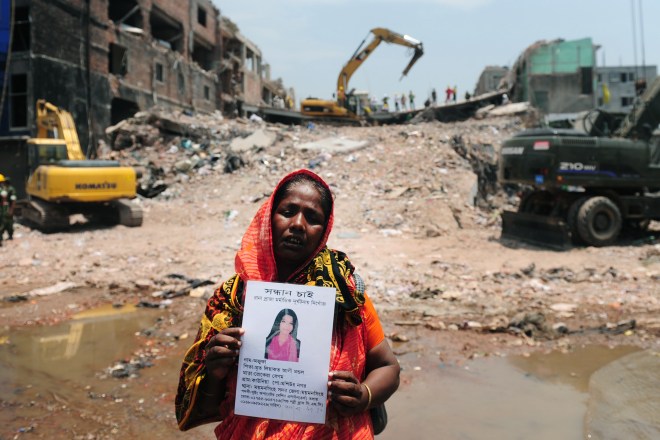
BANGLADESH-BUILDING-DISASTER-TEXTILE

David Von Drehle cautions against overreaction from Western consumers in the wake of the textile factory collapse:

It’s natural to look at the horror in Bangladesh and weigh a vow never to buy another t-shirt sewn in that country. But no one suffers more from a boycott than the impoverished workers for whom even an unsafe job is better than no job at all. Better to press our retailers, our fashion brands, our investors, and our governments to use their influence — their power — with foreign leaders to promote the idea that corruption is not just a moral problem; it’s bad business. Killing workers is no way to build an economy, nor will a system of bribes and spoils ever lift a nation to lasting prosperity. That’s a message even hard-hearted people can understand, and you need them to get things done.

Pope Francis has weighed in, characterizing the workforce of the collapsed Dhaka factory as “slave labor”.  Disney has already banned production [NYT] of its licensed goods in the country, but that move had been planned since March and affects less than 1% of their total business. Susan Berfield notes that it’s unlikely other brands will be able to take a similar stance:

For companies that rely more heavily on Bangladesh, simply shutting down operations isn’t really an option. For one thing, where would they go? Other low-wage countries are likely to have the same kinds of problems that Bangladesh does: lax regulation, corruption, and little history of support for workers’ rights. And Bangladesh, of course, relies on these companies. Bangladesh has quietly become the world’s second-largest apparel exporter, after China. As Bloomberg News reports, textiles contribute more than 10 percent of Bangladesh’s gross domestic product and about 80 percent of the nation’s exports, mainly to the U.S. and the European Union. So these retailers have some clout—but so far haven’t chosen to exercise it altogether.

The low wages throughout Bangladesh’s garment industry are the result of trying to poach business from China:

“There is no other reason why a company would be doing business there,” [says Elizabeth Cline, the author of Overdressed: The Shockingly High Cost of Cheap Fashion]. “These deaths are happening because they are trying to step into the shoes of China. The cost of labor, the costs are going up in China and fashion companies are trying to maintain their margins and trying to maintain their cheap prices, so they want Bangladesh to do what China was doing. But Bangladesh can’t do that.” It’s a numbers game, says Cline, Bangladesh has around 4,000 garment factories compared to China’s 40,000. The average wage for a garment worker in China is close to $200; the average for a worker in Bangladesh is $37.

Earlier Dish on the harsh economic breakdown of garments in Bangladesh here.

(Photo: A Bangladeshi family member poses as she holds up the portrait of her missing relative, believed to be trapped in the rubble of an eight-storey building collapse in Savar, on the outskirts of Dhaka, on May 3, 2013. The death toll from last week’s collapse of a garment factory complex in Bangladesh has passed 500 as the country’s prime minister said Western retailers had to share some of the blame for the tragedy. By Munir uz Zaman/AFP/Getty Images)

Newark Archbishop Myers Must Go

He has allowed a pedophile priest to continue working with minors, despite a clear legal agreement with the Bergen County Prosecutor’s Office that the priest must be kept away. Only this week were the police informed of the breach by the New Jersey Register. The story will make your blood boil. And it’s a test of the American hierarchy. Are they going to defend one of their own – or the children in their care?

Targeting The Student Vote

Ian Millhiser checks in on the latest proposed voter eligibility measures in Ohio:

Ohio Republicans now want to punish state universities that encourage students to cast a ballot. Under a budget amendment filed by Republicans in the Ohio House, state universities that provide documents enabling students to register to vote in their college town, rather than in the state where their parents reside, will be forbidden from charging those students out-of-state tuition. Thus, the amendment would effectively reduce the funding of state schools that assist their students in registering to vote.

This is the second GOP attempt to restrict college students from voting in just the past month. About a month ago, a North Carolina Republican lawmaker filed a bill that would raise taxes on families with college students if the student registers to vote at school rather than in their parents’ hometown.

Our Eagerness To Understand Bad Characters

Joanna Weiss thinks that television has heightened it:

[O]ur desire to piece together [the Boston marathon bombers’] narrative, to find the origin story of Tsarnaev’s radicalization, is an irresistible urge, and one that I think has less to do with the boy in those snapshots than with a habit we’ve learned from watching TV. And not just any kind of TV, but the prestige dramas that have made the last decade or so a golden era in the history of the medium.

The character-driven dramas on “quality TV” are, by and large, serialized stories about monsters. This was the innovation of The Sopranos, which reinvented the televised drama by specializing in moral complexity and revolving around a particular type of anti-hero. We’d long had TV villains who we loved to hate, perhaps best exemplified by J.R. Ewing on Dallas—a character who was cheerfully and unequivocally bad, who never asked for, or expected, the viewers’ sympathy. Tony Soprano, by contrast, wrestled with his decisions—if not always his conscience—right before our eyes. He was a bad guy we were invited to understand.

Alyssa argues instead that anti-hero shows “engage with a different set of questions, namely, how people doing extraordinarily deviant things manage to conceal their actions from the other people in their lives, and how people who are friends or family of people who turn out to be terrorists or killers manage to overlook clear warning signs that the people they love have strayed far from the norms of human behavior.”

What Does Obama Gain By Opposing Plan B?

The Obama administration is appealing a ruling that would have made emergency contraception available to all women, regardless of age, without a prescription. Will Wilkinson tries to understand the political calculus:

[I]t seems rather plausible that the survival of all-but-universal coverage of contraception under Obamacare is far more important in preventing unwanted pregnancy (and abortion, and child poverty) than a policy ensuring that 15-year-old girls, who are very unlikely to use it in time, can find Plan B at their neighbourhood CVS next to the aspirin. If a more or less symbolic concession to religious conservatives on a far less important controversy reduces hostility to the Obamacare contraceptive mandate, even just a little bit, then it may be well worth doing as a matter of women’s reproductive health.

I certainly don’t know that this is Mr Obama’s calculation, or that it’s not a miscalculation. But I do know Mr Obama goes in for this sort of thing. Witness the administration’s strategy of beefing up border security and hugely increasing deportations in order to soften the ground for comprehensive immigration reform.

Power with, not over.