Chart Of The Day

Muslim Death Penalty

Max Fisher created the above chart using data from a new Pew report (pdf):

According to Pew’s data, 78 percent of Afghan Muslims say they support laws condemning to death anyone who gives up Islam. In both Egypt and Pakistan, 64 percent report holding this view. This is also the majority view among Muslims in Malaysia, Jordan and the Palestinian territories.

It’s important to note, though, that this view is not widely held in all Muslim countries or even among Muslims in these regions. In Bangladesh, another majority Muslim South Asian state that has a shared heritage with Pakistan, it is about half as prevalent, with 36 percent saying they support it. Fewer than one in six Tunisian Muslims hold the view, as do fewer than one in seven Muslims in Lebanon, which has a strong Christian minority.

The view is especially rare among Central Asian and European Muslims. Only 6 percent of Russian Muslims agree that converts from Islam should face death, as do 1 percent of Albanian Muslims and, at the bottom of the chart, 0.5 percent of Kazakhs.

But look at Egypt, Pakistan, Jordan and Palestinians. How is it possible to have any sort of liberal democracy when religious conscience is worthy of the death penalty, for a hefty majority of citizens in those countries? More to the point: if you could pick a single country on earth least likely to become anything like a Western democracy, it would be Afghanistan. And yet US soldiers are still there trying to bring it about.

My guess is that this is hubris that future generations will look back on with amazement. We tried to do what? I’m just relieved George W. Bush’s errors will now be restricted to various canvases and easels.

Faces Of The Day

nativeamericans

In a restoration of a painting, the Vatican has found images of people who appear to be Native Americans:

The painting, by the Renaissance master Pinturicchio, was finished in 1494, just two years after Christopher Columbus first set foot in the New World. It has adorned the walls of the Borgia Apartments in the Vatican for 500 years but was only recently subjected to restoration work. The naked men, who appear to be dancing, were spotted by a restorer, Maria Pustka, as she removed centuries of grime.

I feel a History Channel Aliens Special looming on the horizon. But I find those faces mesmerizing.

America Can’t End The Syrian War

SYRIA-CONFLICT

The Obama administration is thinking about arming Syria’s rebels. But Ackerman finds that “there isn’t a magic menu of weapons Obama can give that will lead to a rebel victory”:

The U.S. Single Channel Ground and Airborne Radio System, a combat net radio that U.S. and allied troops use for transmitting voice and data, would enhance rebel communications and control over their makeshift soldiers. Humvees and five-ton M939 trucks can help mitigate the rebels’ transportation problems without being so large and ponderous that they’re easy targets for Assad’s air power. Anti-armor weapons like the AT-4 or the FGM-148 Javelin can assault his armored vehicles, and the iconic Stinger shoulder-mounted missile will make Assad’s planes and helicopters think twice about flying over rebel-held territory. Together, that weaponry would pressure Assad significantly.

But the most all those weapons could accomplish would be to force Assad “to cut out Aleppo,” [Christopher Harmer, a former U.S. Navy officer and analyst with the Institute for the Study of War] concedes. His forces would retrench to the Mediterranean coastal areas and down southward to Damascus, remaining in power. The stalemate would continue — along with pressure for the U.S. to dig deeper into the conflict.

(Photo: A Syrian man reacts while standing on the rubble of his house while others look for survivors and bodies in the Tariq al-Bab district of the northern city of Aleppo on February 23, 2013. By Pablo Tosco/AFP/Getty Images)

How Barbaric Is Force-Feeding?

Kent Sepkowitz describes the procedure, which many Gitmo prisoners have been subjected to:

During my training, I placed countless feeding tubes (and larger hoses to pump stomachs). Without trsuffragetteschquestion, it is the most painful procedure doctors routinely inflict on conscious patients. The nose—as anyone knows who ever has received a stinger from an errant baseball—has countless pain fibers. Some patients may scream and gasp as the tube is introduced; the tear ducts well up and overflow; the urge to sneeze or cough or vomit is often uncontrollable. A paper cup of water with a bent straw is placed before the frantic and miserable patient and all present implore him to Sip! Sip! in hopes of facilitating tube passage past the glottis and into the esophagus and stomach.

The procedure is, in a word, barbaric. And that’s when we are trying to be nice.

It’s a grotesque attack on a human being’s dignity. Here is how it was described by Vladimir Bukovsky in a must-read essay on torture when it was done by the Soviets:

“The feeding pipe was thick, thicker than my nostril, and would not go in. Blood came gushing out of my nose and tears down my cheeks, but they kept pushing until the cartilages cracked. I guess I would have screamed if I could, but I could not with the pipe in my throat. I could breathe neither in nor out at first; I wheezed like a drowning man — my lungs felt ready to burst. The doctor also seemed ready to burst into tears, but she kept shoving the pipe farther and farther down. Only when it reached my stomach could I resume breathing, carefully. Then she poured some slop through a funnel into the pipe that would choke me if it came back up. They held me down for another half-hour so that the liquid was absorbed by my stomach and could not be vomited back, and then began to pull the pipe out bit by bit.”

The method in Gitmo is unlikely to be as severe – but every time I have assumed simple decency from the US government with respect to “enemy combatants,” I have often been wrong. But some forced-feeding is rightly judged to be a form of cruel, inhumane and degrading treatment. The UN Rapporteur on Human Rights issued this statement yesterday:

According to the World Medical Assembly’s Declaration of Malta, in cases involving people on hunger strikes, the duty of medical personnel to act ethically and the principle of respect for individuals’ autonomy, among other principles, must be respected. Under these principles, it is unjustifiable to engage in forced feeding of individuals contrary to their informed and voluntary refusal of such a measure. Moreover, hunger strikers should be protected from all forms of coercion, even more so when this is done through force and in some cases through physical violence. Health care personnel may not apply undue pressure of any sort on individuals who have opted for the extreme recourse of a hunger strike.

You think it isn’t cruel or inhumane? Even in Soviet Russia, the practitioners could break down because doing this to another human being against his or her will is so traumatizing:

There had just been time for everything to start healing during the night when they came back in the morning and did it all over again, for 10 days, when the guards could stand it no longer. As it happened, it was a Sunday and no bosses were around. They surrounded the doctor: “Hey, listen, let him drink it straight from the bowl, let him sip it. It’ll be quicker for you, too, you silly old fool.” The doctor was in tears: “Do you think I want to go to jail because of you lot? No, I can’t do that. . . . ” And so they stood over my body, cursing each other, with bloody bubbles coming out of my nose. On the 12th day, the authorities surrendered; they had run out of time. I had gotten my lawyer, but neither the doctor nor those guards could ever look me in the eye again.

For America to be doing this now is, moreover, a direct result of both Congress’s and Obama’s failure of nerve on this hideous legacy of the dark years of Bush and Cheney. Leith Passmore thinks that the US has no good options:

The U.S. military is understandably wary of the potential fallout over inmate deaths. A member of the Irish Republican Army, Bobby Sands, starved to death in prison in 1981, and his death increased recruitment and sectarian violence. Force-feeding may prevent this type of martyrdom, but it also leaves the United States open to further accusations of state torture.

While Sands was starving himself in Northern Ireland, hunger striking terrorism suspects in West Germany were being forcibly fed. The treatment of Red Army Faction prisoners produced a groundswell of support for the prisoners’ cause and helped to recruit new members. The Red Army Faction survived for decades on the back of force-feeding.

In his recent comments, President Obama has shown an awareness of Guantánamo as a potential recruiting tool for terrorist groups. Neither the ethical nor the unethical treatment of prisoners will reduce that risk.

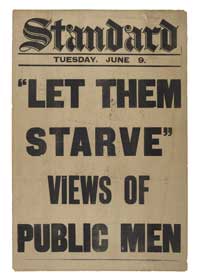
(Image: a newspaper from the period when activists’ for women’s suffrage were routinely force-fed in hunger strikes.)

Ask Josh Fox Anything: “We Have A Choice”

The Gasland filmmaker weighs in on whether or not the US can completely ditch fossil fuels and switch to renewable energy like wind and solar:

The Mark Jacobson renewable energy article for the US that Josh mentions is here (pdf). Jacobson’s plan for New York state is here. Elsewhere, Todd Woody profiles a new technology that reduces wind’s intermittency problem:

The rap against wind energy is that it’s fickle, generating massive amounts of electricity one hour and next to nothing the next. That plays havoc with the power grid and the problem is only growing as wind becomes a bigger part of the power mix. … But what if every wind turbine became a node in an energy internet, communicating with the grid and each other to adjust electricity production while storing and releasing electricity as needed? That’s the idea behind General Electric’s new “brilliant” turbine, the first three of which the company said today will be installed at a Texas wind farm operated by Invenergy.

The 2.5-MW windmill is something of a technological leap in an industry where turbines have gotten bigger and bigger but not necessarily smarter. The turbine’s software captures tens of thousands of data points each second on wind and grid conditions and then adjusts production, storing electricity in an attached 50 kilowatt-hour sodium nickel chloride battery. If, say, a wind farm is generating too much electricity to absorbed by the grid—not an uncommon occurrence in gusty west Texas—it can store the electricity in the battery. When the wind dies down, the electricity can be released from the battery and put back on the grid.

And related to yesterday’s video, in which Fox made a case for all fossil fuels being equally bad, Michael Levi, responding to a report indicating that there are sufficient worldwide coal reserves to warm the planet by 27° F, worries that we are not weaning ourselves off coal fast enough:

Even if the natural gas boom were to eventually spread from the United States to the rest of the world, coal-fired power could well continue to dominate much of the global energy system for decades. So natural gas doesn’t let us off the hook for a decade or two while we figure out how to make zero-carbon energy thrive. Indeed it doesn’t even give the United States a pass. In May 2012, fracking briefly spurred gas to pass coal as the top source of U.S. electricity. But as natural gas prices recovered, coal regained its top rank, a position most expect it to retain for decades to come. That won’t cut it if we’re going to seriously tackle climate change. To be certain, cheap gas makes it less expensive to cut our emissions, by shifting away from traditional coal. But we’ll still need governments to step in and tip the balance, whether through new regulations or a price on carbon that gives gas an advantage over coal. …

A shortage of fossil fuels isn’t going to save us from dangerous climate change. And plans that depend on one or another technological breakthrough are far too risky to bet our future on. We need to move forward with gas, using it to edge aside coal, even as we push ahead on a host of zero-carbon opportunities. That’s the best way to maximize the odds that we’ll ultimately be able to deal effectively with climate change.

Josh Fox’s Gasland Part II will air on HBO this summer. His other Ask Anything answers are here. Full archive here.

So Where Are They?

Eli Lake reports that some in the military believe the US simply does not know where Syria’s stockpile of chemical weapons is. Why? It’s gone mobile:

While U.S. intelligence agencies first saw reports that Syria was moving the weapons last year, the process has accelerated since December, according to these officials. Also worrisome, said two of the officials, is intelligence from late last year that says the Syrian Scientific Research Center—an entity responsible for Syria’s chemical-weapons stockpile—has begun to train irregular militias loyal to Syrian President Bashar al-Assad in how to use the chemical munitions.

The assessment that Syria is moving large amounts of its chemical weapons around the country on trucks means that if Obama wanted to send in U.S. soldiers to secure Syria’s stockpiles, his top generals and intelligence analysts doubt such a mission would have much success, according to the three officials. “We’ve lost track of lots of this stuff,” one U.S. official told The Daily Beast. “We just don’t know where a lot of it is.”

Some neocons will use this for a further rhetorical barrage against Obama’s inaction. But the major reason for inaction is that there are no good options. I can absolutely see the need to secure those chemical weapon sites, but it’s unclear how that could ever have happened. A mini-invasion last year to secure sites that are entirely under Assad’s control? No way. Bombing the sites from the air? Could be worse in its impact than a more limited purposeful use, if the chemicals disperse. A no-fly zone? Why wouldn’t the safe area we thereby establish not become a haven for al Qaeda-connected elements?

I don’t want to seem a callous monster here. Assad’s regime is a truly vile one, and what it has been doing to its own citizens is beyond horrifying. (The video above seems to show victims of a chemical attack but no definitive indication of who deployed them, although I assume Assad’s vicious regime.) But outrage is not a practically effective policy. Sometimes, inaction is our least worst option.

And if the US hasn’t learned that we need to become less engaged in the Middle East rather than more, then we truly are committed to national bankruptcy and a terror war without end.

The Conservative Case For Immigration Equality

Republicans are opposed to including gay couples in the immigration reform bill. Jonathan Rauch’s response is spot on:

Even from a conservative point of view—in fact, especially from a conservative point of view—it makes no sense to distort and disrupt gay families by depriving binational couples of the tools they need to care for each other. It makes even less sense to do that while providing aspiring newcomers with the tools they need to work, providing businesses with the tools they need to hire, and providing children who grew up in America with the opportunity to live as Americans. Unless your policy goal is to distort and disrupt gay families.

Gay rights advocates are correct to force the issue by demanding an amendment adding partner immigration to the reform bill now moving through the Senate. They are right to expect their Democratic friends, including President Obama, to support the effort, and thereby to force Republicans to announce their priorities. Just how much electoral support and moral standing does the GOP want to give up in order to affirm its hostility to homosexuals? The results would be, let us say, clarifying.

I am on the board of Immigration Equality for full disclosure. And it’s worth adding one point: the pain and stress caused by not having your core family relationship secure in your own country is intense. In London last year, I sat in a room full of diaspora gay Americans and their foreign-born spouses. It was an informational meeting. All I can remember vividly are the lines on the foreheads of those in front of me, the strain in their eyes, the fear in their belly.

Imagine the US government could split you from your spouse and make you live abroad if you want to stay together. Imagine it could happen today – or at any random moment in the immigration process. This is a form of sheer cruelty, a denial of basic human dignity. It is unworthy of a democratic country.

Will Obamacare Make America Healthy?

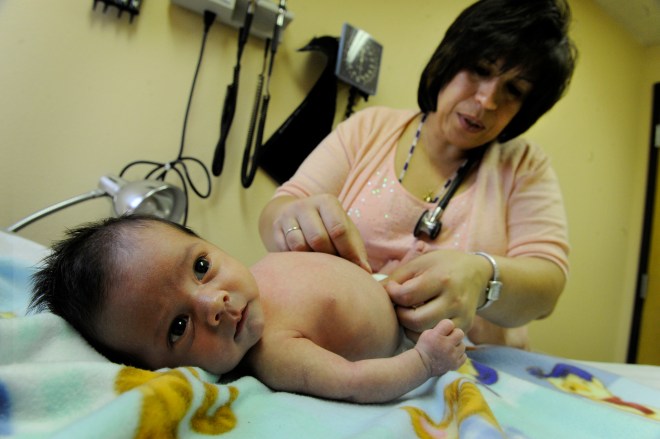
Medical Director Elisa Melendez examines Maximo Chavez, during his two week checkup at Clinica Tepeyac in Denver, CO, Thursday, March 22, 2012. His mother, Lilian Mendoza, says her family does not have insurance but hopes Maximo will qualify for Medicaid

A newly released study examined Medicaid effectiveness in Oregon, a topic of particular interest given that Obamacare greatly increases Medicaid coverage. Sarah Kliff summarizes the mixed results:

New Medicaid enrollees had less trouble paying their bills and saw significant improvements in mental health outcomes, with rates of depression falling by 30 percent. But on a simple set of health measures, including cholesterol and blood pressure levels, the new Medicaid enrollees looked no different than a separate group, who applied for the benefit but were not selected in a lottery.

Suderman pounces:

This study is perhaps the best and most important study of Medicaid’s health effects ever conducted, and it has huge implications for public policy—in particular for Obamacare’s Medicaid expansion, which is supposed to account for about half of the law’s increase in health coverage. Obamacare supporters had used the results from the study’s first year, which showed large gains in self-reported health, to argue that the law’s expansion of Medicaid was justified. The second-year results significantly complicate that argument.

Michael Cannon piles on:

There is no way to spin these results as anything but a rebuke to those who are pushing states to expand Medicaid. The Obama administration has been trying to convince states to throw more than a trillion additional taxpayer dollars at Medicaid by participating in the expansion, when the best-designed research available cannot find any evidence that it improves the physical health of enrollees. The OHIE even studied the most vulnerable part of the Medicaid-expansion population – those below 100 percent of the federal poverty level – yet still found no improvements in physical health.

Jonathan Cohn sees the study differently:

The big news is that Medicaid virtually wiped out crippling medical expenses among the poor: The percentage of people who faced catastrophic out-of-pocket medical expenditures (that is, greater than 30 percent of annual income) declined from 5.5 percent to about 1 percent. In addition, the people on Medicaid were about half as likely to experience other forms of financial strain—like borrowing money or delaying payments on other bills because of medical expenses.

That may sound obvious—of course people with insurance are less likely to struggle with medical bills. But it’s also the most under-appreciated accomplishment of health insurance: Whatever its effects on health, it promotes economic security. “The primary purpose of health insurance is to protect you financially in event of a catastrophic medical shock,” Finkelstein told me in an interview, “in the same way that the primary purpose of auto insurance or fire insurance is to provide you money in case you’ve lost something of value.”

Aaron Carroll is on the same page:

The reason I have insurance, and likely you do as well, is to protect you from financial ruin. When I get sick, I don’t sit at home and let the insurance take care of me. I get off my butt and use the health insurance as the means by which to get health care. Medicaid is about access. It’s just the first step in the chain of events that leads to quality.

Avik Roy counters this argument:

[W]e could have achieved the same outcome for a fraction of the price, by adopting the plan proposed by Florida’s Will Weatherford and Richard Corcoran: Offering low-income Americans a subsidy with which to purchase catastrophic coverage on the open market. That plan was foiled by people—including Republicans—who insisted on expanding Medicaid instead.

McArdle lowers her expectations:

Given this result, what is the likelihood that Obamacare will have a positive impact on the average health of Americans? Every one of us, for or against, should be revising that probability downwards. I’m not saying that you have to revise it to zero; I certainly haven’t. But however high it was yesterday, it should be somewhat lower today.

And Ray Fisman feels that “the findings should give pause to even those who are most committed to universal health insurance.” The lesson he draws:

[T]he Oregon experiment is yet another argument in favor of the increasingly common view that access to medical care is necessary but far from sufficient for good health. What’s the use in prescribing statins to reduce cholesterol to patients who don’t take their meds, continue to consume potato chips and soda unabated, and ignore health care providers’ pleas to walk more and drive less?

But changing habits, compliance, and lifestyles is a much taller order, and viewing health care in this way can make the Affordable Care Act, despite its enormous ambitions, seem almost too timid or narrow in its focus. It requires that our conception of health care go beyond a passive delivery system of waiting for patients to come into the clinic and get out into the community to reach patients in their daily lives.

(Photo: Medical Director Elisa Melendez examines Maximo Chavez, during his two week checkup at Clinica Tepeyac in Denver, CO, Thursday, March 22, 2012. His mother, Lilian Mendoza, says her family does not have insurance but hopes Maximo will qualify for Medicaid in the near future. Craig F. Walker, The Denver Post via Getty Images)


Rules Of Opinion Writing

One of Chait’s:

Don’t debate straw men. If you’re arguing against an idea, you need to accurately describe the people who hold them. If at all possible, link to them and quote their argument. This is a discipline that forces opinion writers to prove that they’re debating an idea somebody actually holds. And quoting the subject forces them to show that somebody influential holds it — if the best example of the opposing view is a random blog comment, then you’re exposing the fact that you’re arguing against an idea nobody of any stature shares. This ought to be an easy and universal guideline, but in reality, it’s mostly flouted.

TNC seconds him:

This is not only for the benefit of people who read you, but for your own. To paraphrase Douglass, a writer is worked on by what she works on. If you spend your time raging at the weakest arguments, or your most hysterical opponents, expect your own intellect to suffer. The intellect is a muscle; it must be exercised. There are cases in which people of great influence say stupid things and thus must be taken on. (See Chait on George Will’s disgraceful lying about climate change.) But you should keep your feuds with Michelle Malkin to a minimum.

“My First Rifle” Ctd

Screen Shot 2013-05-01 at 9.30.13 PM

A reader pushes back against this post:

It is not obscene to post pictures of happy kids with firearms on a company website. Cricket is marketing to parents. The term “marketing to kids” is more appropriate for campaigns that push something harmful into spaces where kids will be found, as with heavily-sugared cereals advertised on cartoon shows. Cricket isn’t doing anything like this. It is producing a rifle-sized appropriately for children to shoot. That’s not a terrible thing. Gun owners with kids generally want to share their interest with their offspring. If you are going to shoot with your kids, a rifle that fits them is a good thing to have.

There are sound reasons to teach children to shoot.

For one, none of us is getting any younger. It is not a given that I will be around for my kids when they reach an age when the editors of Mother Jones will be comfortable with them learning to shoot. For another, if you know teenagers, then you know that 18 is a lousy time to introduce something potentially dangerous to them. There is a litany of rules for safe firearm handling. Those are best learned early, before the age of risk taking and rejection of authority.

I don’t believe in the ever-elongated infantilization of kids. Ours have real responsibility and even authority appropriate to their development. I believe they will be better prepared for adulthood than others in their age cohort who will have been sheltered from everything significant until suddenly turned loose.

I’m raising my son to be careful with firearms and respectful of their potential to harm. So far he has earned numerous accolades from other adults for his safe gunhandling skills. I have a shortened version of a regular bolt-action rifle for my kids. It’s approximately the same size as a Cricket. But I also keep that rifle in a safe, because it is not his burden to bear.

The rifle that Cricket manufactures has a number of safety features particular to it that are not present on standard firearms. They did their part. They are not insidious or evil for posting pictures sent by proud and happy parents on their website.

(Photo: A screenshot from the “Kids Corner” section of Cricket’s website)