The Best Of The Dish This Weekend

This embed is invalid

 
Gay pride waxed this weekend, despite the greatest actor in the world’s threat to gay-bash someone by anally raping him with his boot. (Don’t worry, GLAAD has forgiven him). But the Sunday joy in New York and San Francisco was overwhelmed by the massive demonstrations in Cairo against the Muslim Brotherhood government. The Christianity of “redneck” Duck Dynasty proved far more Jesus-like than the Christianism often associated with the South (but not defining of it); and we noted the difference between “friending” acquaintances and actual friends. And the inimitable Maria Popova pondered George Washington at the age of 15.

The most popular posts of the last three days were on Arec Baldwin’s violent homophobia; and Tammy Duckworth’s classic takedown of a disability scam. Seriously, a politician at her best. The most popular post of the last week remains “David Gregory Is What’s Wrong With Washington.” It seems to have struck a chord. Peeps seem to dislike him even more than Peggy Noonan.

I write this with Provincetown in the distance – and hope to arrive there tonight. It’s been almost a month without a husband or two hound dogs. I need a fix.

See you tomorrow.

The Lion Of Blues

Jack Hamilton remembers Bobby Bland, the blues legend who died last week at age 83:

Jimi Hendrix once described the blues as “easy to play, but hard to feel;” Bobby “Blue” Bland made the blues as complex as a modernist novel, and effortlessly easy to feel. Bland may not have been the greatest blues singer of them all (though he’s certainly in the conversation), but he was arguably the most complete, melding the urbane smoothness of the pop crooner to the ferocious ecstasy of the gospel tradition.

He was called “the Sinatra of the blues,” a nickname that rankles a bit in its equivocating imprecision: Bobby Bland was, first and foremost, the Bobby Bland of the blues. But as comparisons go, one could suffer worse. Like Sinatra, Bland boasted such an extraordinary combination of technique, charisma and musical intelligence that his vocal performances were themselves an act of songcraft. The sides that Bland cut for Duke Records in the 1950s and 1960s unfold like riveting dramas; Bland could cycle through entire complex economies of emotion in a three-minute recording, bending notes, phrases, and whole songs to his will. His best performances make a word like “soul” seem woefully insufficient.

Anne Powers appraises Bland’s lasting influence, especially on black artists:

For the mostly African-American audience that supported Bland for much of his career, songs like “I Pity the Fool,” “Ain’t No Love in the Heart of the City” and the spiritual shout “Farther Up the Road” captured the joy and sorrow of life with both immediacy and complexity. Bland’s multidimensional music became a blueprint for generations of R&B singers, and more recently, a grounding element for hip-hop artists like and Drake. It’s easy to imagine these young stars as kids, watching their mothers dress up for a night out while the grave, reassuring sound of Bland’s singing drifted through the house. Bland’s music is the kind that can school anyone about the incomprehensible depths of love, the importance of dignity and the promise of the kind of good life that really might be within reach.

No Rain On Your Parade

http://vimeo.com/67904132

Amber Long captions a behind-the-scenes look at Rain Room, a remarkable installation currently at MoMA:

Rain Room, an installation by London-based artist collective rAndom International, is an experiment in sensory disruption. A 300 ft² room is rigged to create a constant downpour, but motion-detecting cameras stop the rain anywhere a person is present. The effect is one of being cloaked in dryness, which follows you wherever you go. The rain is actually so loud that the voice of a person a few feet away is drowned out, thus the lacuna of rain occupied by a body actually forms its own “room.”

Kevin Holmes adds:

The unusual nature of Rain Room fosters a variety of reactions and forms of engagement from the audience that seem to move it beyond being just an installation into a performative piece, an element rAndom International often capitalizes on by introducing dance performances where dancers move through the space alongside visitors.

You Are Worthless, Alec Baldwin, Ctd

This is now getting hilarious:

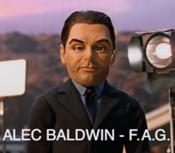
[T]he idea of me calling this guy a ‘queen’ and that being something that people thought is 175px-BaldwinTAhomophobic … a queen to me has a different meaning. It’s somebody who’s just above. It doesn’t have any necessarily sexual connotations. To me a queen… I know women that act queeny, I know men that are straight that act queeny, and I know gay men that act queeny. It doesn’t have to be a definite sexual connotation, or a homophobic connotation. To me those are people who think the rules don’t apply to them. This guy could blatantly lie, I mean blatantly lie about my wife on the internet and there are just no rules that apply to him, but that’s outrageous to me.

He somehow hasn’t come up with an explanation for why he desired to sodomize the dude with his boot, but decided not to because the dude would enjoy it too much. But we’ll wait. This raging bigot will surely come up with some reason for using that analogy that has nothing to do with homosexuality at all.

Again: the double standards for a liberal are simply astounding. Let us just stipulate that if Alec Baldwin is not a homophobe, then Mel Gibson must also now be cleared of any insinuation that he is an anti-Semite. And at least Gibson was drunk. What excuse does Baldwin have? Oh, I forgot, this one:

His rant, he said, was not “a call for violence against a specific person because they’re gay, it’s a call for violence against a person who lied about my wife.”

Seriously, bragging about calling for violence against someone is now exculpatory? Only in Hollywood …

M0re Dish on this douche here and here.

Cooking After The Crash

In the midst of an economic depression, Greeks have turned to a traditional staple – lentils:

Those who still have their jobs, even if they’ve seen their incomes plunge by a third or more, consider themselves lucky. But they no longer stock up on pork chops and imported Gouda cheese, as they did in better times. They eat out less too. On TV, there has been an explosion of “cook-on-the-cheap” shows, including one in which a portly, smiling chef teaches you how to make five elaborate three-course meals for just 50 euros a week. There’s also a bestselling cookbook, Starvation Recipes, based on tips from Greeks who survived the famine of World War II. (Sample: Save bread crumbs from the table in a jar to eat later.)

A recent Kapa Research poll found that 71 percent of Greeks find it difficult to get by on their current income. In supermarkets, shoppers talk about the prices — spending on groceries dropped 8 percent just in the first six months of last year, compared with the same period in 2011 — and about how little money is left over to pay property taxes and electricity bills. So everyone buys lentils.

And why shouldn’t they? A steal at a little more than $1.50 a pound today, lentils were born in Greece. Evidence of cultivation has been found in caves dating as far back as 11,000 B.C. They are ours, and they fueled an empire.

A Poem For Sunday

oldbible

“Mood” by Countee Cullen:

I think an impulse stronger than my mind
May some day grasp a knife, unloose a vial,
Or with a little leaden ball unbind
The cords that tie me to the rank and file.
My hands grow quarrelsome with bitterness,
And darkly bent upon the final fray;
Night with its stars upon a grave seems less
Indecent than the too complacent day.

God knows I would be kind, let live, speak fair,
Requite an honest debt with more than just,
And love for Christ’s dear sake these shapes that wear
A pride that had its genesis in dust,–
The meek are promised much in a book I know
But one grows weary turning cheek to blow.

(From Countee Cullen: Collected Poems, The Library of America, 2013, ed. Major Jackson. Poems © Amistad Research Center, Tulane University. Reprinted by permission. Photo by Patrick Keller)

A List To Live By

Maria Popova explores George Washington’s Rules of Civility & Decent Behavior in Company and Conversation, a list of 110 guidelines he penned when he was 15 years old:

Some, at the intersection of the dated and the timeless, expose the parallel progress of cultural conventions and technology: For instance, Washington admonishes against reading “letters, books, or papers in company” — the then-equivalent of looking at your iPhone during a dinner party. Some speak to the enduring importance of critical thinking: “Be not hasty to beleive flying Reports to the Disparag[e]ment of any.” Some advocate for the humanizing effect of compassion: “When you see a Crime punished, you may be inwardly Pleased; but always shew Pity to the Suffering Offender.” Some remind us of how our personal micro-culture shapes us: “Associate yourself with Men of good Quality if you Esteem your own Reputation; for ’tis better to be alone than in bad Company.”

The last item from the list:

Labour to keep alive in your Breast that Little Spark of Ce[les]tial fire Called Conscience.

Rejecting The Head Of State

https://twitter.com/Doranimated/status/351398167738204161

One year after Mohamed Morsi’s inauguration as president, hundreds of thousands of Egyptians are flooding Tahrir Square calling for his resignation. The protests are even more massive than the 18-day revolution that toppled Mubarak back in February 2011:

The scene on Sunday was a far cry from a year ago today, when supporters packed the square to celebrate Morsi’s inauguration. Now many are back to blame him for a stagnant economy, worsening security and an ongoing lack of basic services. Demonstrators waved red cards and chanted “irhal” – “leave”, and promised to camp in the square until Morsi resigns. Thousands more have joined marches headed for the presidential palace, and are expected to arrive around dusk. “It’s the same politics as Mubarak but we are in a worse situation,” said Sameh al-Masri, one of the organisers on the main stage. “Poverty is increasing, inflation is increasing. It’s much worse than Mubarak.”

The Tahrir protests are peaceful so far, but another wave of demonstrators marched to the presidential palace and the Muslim Brotherhood headquarters, where things got aggressive:

[S]everal dozen youths attacked the headquarters of Morsi’s Muslim Brotherhood on a plateau overlooking the capital. They threw stones and firebombs at the building, and people inside the walled villa fired at the attackers with birdshot, according to an Associated Press Television News cameraman at the scene. Earlier in the day, two offices belonging to the Brotherhood’s Freedom and Justice party, were attacked and ransacked in the city of Bani Suef, south of Cairo.

The AP reports that the protesters are made up of “secular and liberal Egyptians, moderate Muslims, Christians – and what the opposition says is a broad sector of the general public that has turned against the Islamists”:

They say the Islamists have negated their election mandate by trying to monopolize power, infusing government with their supporters, forcing through a constitution they largely wrote and giving religious extremists a free hand, all while failing to manage the country. With protesters from a range of social and economic levels in a festive atmosphere, the crowds resembled those from the 18 days of protests against Mubarak – a resemblance the protesters sought to reinforce, chanting the slogan from that time: “The people want to topple the regime.”

Cairo-based journalist Evan Hill reviews the path that led to this moment:

A journalist said it was as if Egypt’s body politic were rejecting a transplant and killing the nation in the process, a fledgling democracy’s auto-immune system gone haywire. …

If Morsi falls or steps down, millions of Egyptians will view it as a victory. Perhaps he could be succeeded by a salvation government, and some kind of stable progress will ensue, though the Brotherhood can hardly be expected to quietly allow their project to dissolve around them, and it would likely mean the return of the army to a guiding role. Revolutions come with chaos. History teaches us that many years may pass before a country comes out of such upheaval with a working government, satisfactory justice and reconciliation, and a consensus about national identity. But even in such a positive scenario, it is hard not to view the first two and a half years of Egypt’s revolution as a series of squandered promises.
The Write Way To Die

Tim Parks traces novelists’ deaths back to the themes of their work, arguing that both follow from a defining dilemma:

What I am suggesting is that a novelist’s work is often a strategy (I don’t mean the author need be aware of this) for dealing with some personal dilemma. Not just that the dilemma is “worked out” in the narrative, as critics often tell us, but that the acts of writing and publishing and positioning oneself in the world of literature are all part of an attempt to find a solution, however provisional, to some deep personal unease. In many cases, however hard the writing is pushed, the solution is indeed only temporary or partial, both author and work eventually succumbing. Obviously the easiest group of authors to look at in this regard would be the suicides, Woolf, Pavese, Wallace.

He closes with a meditation on Faulkner:

Whisky and writing intertwine throughout Faulkner’s life, feeding each other, blocking each other, never allowing him to achieve any stability, always acting out a salute to other men he feared he could not resemble. By the time he was fifty the end seemed inevitable. There are only so many times one can dry out in a clinic and fall drunk off a horse. It was actually something of a miracle that Faulkner outlived his dear mother for a year before one more courageous binge, one more salute to the truly brave, as he saw it, did him in, aged sixty-five.