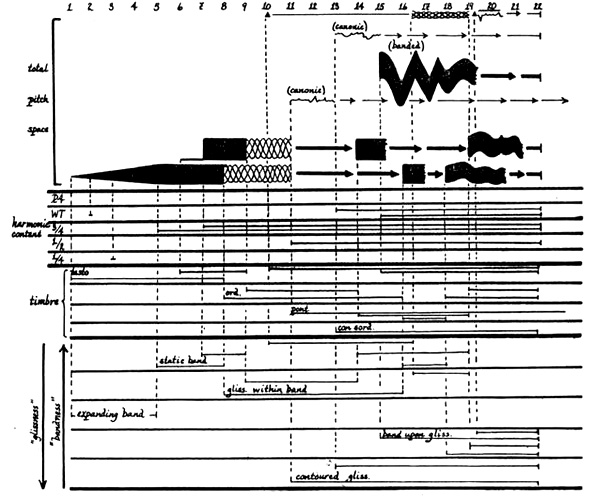
Jimmy Stamp reviews some of the stranger deviations from standard notation, like the sheet music to Krystof Penderecki’s “Polymorphia,” based on measurements of brain activity:
As the name suggests, the piece does indeed take various forms and changes dramatically from section to section. With “Polymorphia,” Penderecki was searching for new sonic possibilities and, if those possibilities include “terrifying haunted house music,” he absolutely nailed it. The composition is intended for 48 string instruments and emphasizes timbre rather than pitch, and the collision of sound generating bodies made of metal, wood, or leather – what music scholar Danuta Mirka refers to as the composer’s “primary materials”. The notation was inspired, in part, by electroencephalograms –visual measurements of brain activity. It eschews traditional measures in favor of a score divided into sections of variable length and, in some sections, further vertical divisions to mark each second, with a “total pitch space” describing the relative pitch of each instrument.
Earlier Dish on musical notation here.
 The Dish