Mona Simpson ponders why readers keep returning to Henry James’ Washington Square, a novel exploring “the terrible condition of being unable to love”:
We don’t read James for his stories. Despite their formal symmetries, they feel jerry-rigged. He borrows from melodrama, but lops off that genre’s gratifications, going realist on us at exactly the wrong moment. If Americans want a tragedy with a happy ending, Henry James delivers something more like a comedy with a haunting close.
We don’t return to James for his characters, either. It’s not quite possible to love them the way one may love Leopold Bloom or Mrs. Dalloway or even Lily Briscoe. They don’t feel real, exactly, though they’re the opposite of cardboard—a term suggesting characters made of appearances. James’s characters are all soul; they’re closer to ideas than to bodies. We know their sensibilities but not their details. …
We read James not for his stories or for his characters but for the one thing that can’t be adapted: his mind. We know it, in its arguments with itself, its endlessly refining discernment, its flickering shifts and glints of wisdom. We know those details the way we know Bloom’s love of organ meats and Mrs. Ramsay’s tendency to slough off her beauty with haphazard clothes.
No one else has given such fine attention to personal life as it’s thought, that wave and flutter in consciousness. Our stray wishes, our abiding hopes, our shame and constant fears—James attends to all the component parts of what we loosely call love, if only to show his characters coming up against their limitations.
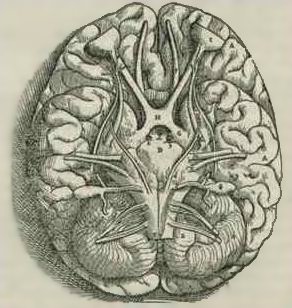
(Illustration: From the 1543 book in the collection in National Institute of Medicine. Andreas Vesalius’ Fabrica, showing the Base Of The Brain, including the cerebellum, olfactory bulbs, and optic nerve.)
 The Dish