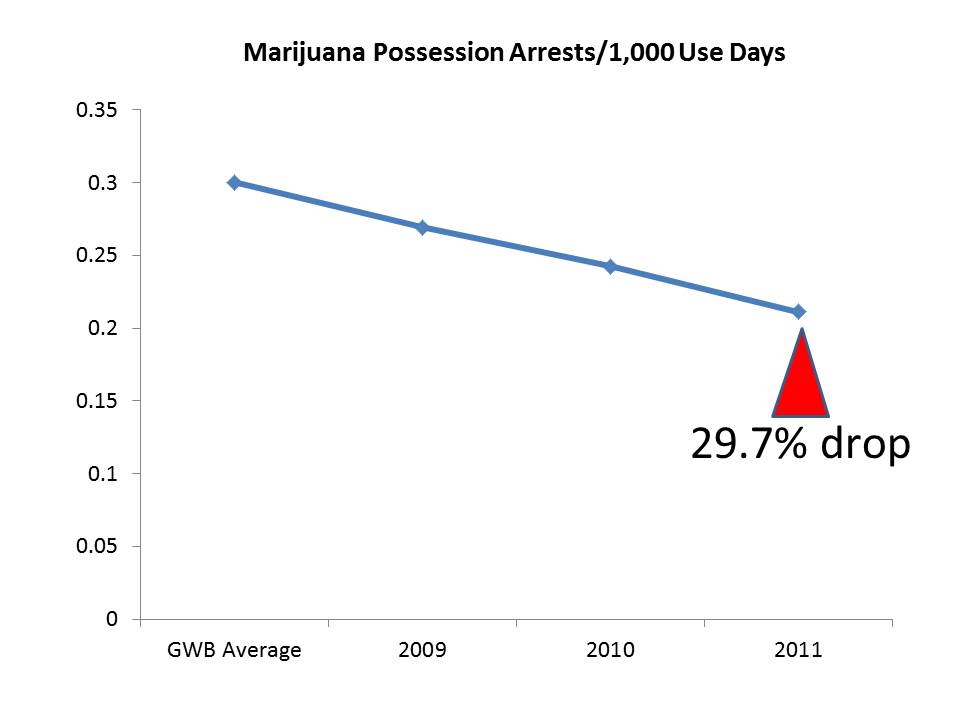
Keith Humphreys, focusing on the rate of marijuana arrests rather than the absolute number, finds that enforcement of marijuana possession laws is down under Obama:
As disappointed marijuana legalization advocates complained at the time, the first year of President Obama’s Administration saw an almost identical number of simple possession arrests (758,600) as did the last year of the George W. Bush Administration (754,200). But this represented a significant drop in enforcement intensity because Americans’ marijuana use increased by 10.6% that same year, from 2.55 Billion to 2.82 Billion aggregate days. As a result, in the first year of the Obama Administration, enforcement intensity was already lower than at any point in the GWB data. … For the last available year of Obama era data, 2011, enforcement intensity is down a remarkable 29.7% relative to the standard under the prior administration.
Pete Guither protests:
The first very obvious objection: the notion that arrests as a percentage of use is a statistic that has any relevance. There’s no evidence that law enforcement, all other things being equal, would actually arrest more people for marijuana possession if marijuana use goes up. So the fact that they didn’t isn’t evidence of some kind of lessening of enforcement emphasis.
Meanwhile, Doug Fine busts myths about marijuana legalization. He argues that legalization won’t lead to a major increase in marijuana use:
A 2011 University of California at Berkeley study, for example, showed a slight increase in adult use with de facto legalization in the Netherlands (though the rate was still lower than in the United States). Yet that study and one in 2009 found Dutch rates to be slightly lower than the European average. When the United States’ 40-year-long war on marijuana ends, the country is not going to turn into a Cheech and Chong movie. It is, however, going to see the transfer of as much as 50 percent of cartel profits to the taxable economy.
Kleiman thinks Fine is blind to the harms of legalization:
If admitting that cannabis in some form has medical utility makes it harder to persuade 14-year-olds not to get stoned all the time, I can make sense of parts the reluctance of parts of the prevention community to acknowledge the obvious, along with the reluctance of some enthusiastic anti-prohibitionists to admit that commercial availability and aggressive marketing will inevitably translate into higher rates of abuse.
Here’s what you tell 14-year-olds: yes, this is a legitimate and wonderfully relaxing drug, just like alcohol. But it really can harm the developing brain if you overdo it, and you’d be better waiting for adulthood before you try it. And look: I like it. As soon as parents admit their own pot use and talk rationally about it with their children, it will become infinitely less cool. I’m not blind to the possible problems, but the 14 year-old already has ways to find pot and every reason not to discuss it with parents. My view is that regulated legalization will make things safer for kids, not riskier.
(Image from Keith Humphreys)
 The Dish