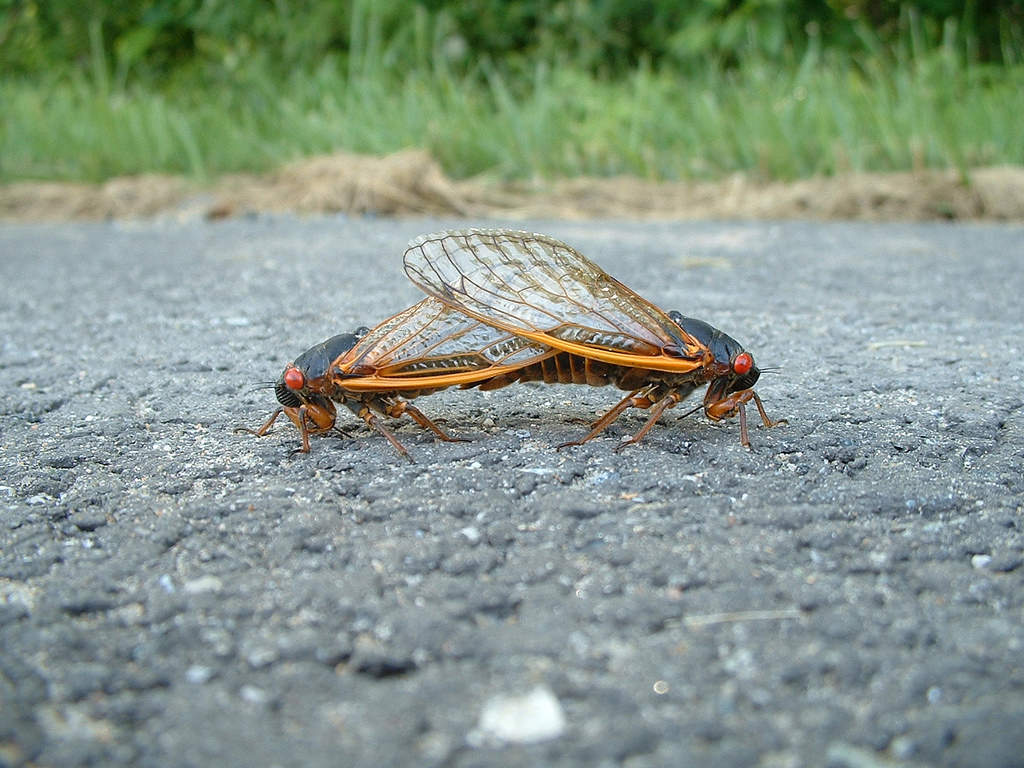
Casey Cep offers a literary primer for the current cicada craze:
Cicadas are a global species and an ancient one. They can be found in “The Tale of Genji,” Plato’s “Phaedrus,” and even “Aesop’s Fables.” Time-lapse photography may have enhanced our understanding of their life cycle, but poets have been cataloguing their summer songs for thousands of years.
Take Robert Hass, who describes in “Between the Wars” how one could hear “the slightly / maniacal cicadas tuning up to tear the fabric / of the silence into tatters.” The poem’s speaker is reading Polish history, but finds himself disturbed by the insects’ furious activity. When male cicadas sing for females, they do, as Hass says, shred and torture silence. The tiny tymbals of the cicada buckle several hundred times a second, like mallets on a kettledrum, already a blast that only amplifies when billions of the males sing simultaneously, each trying to attract a mate. Jorie Graham describes the music of the cicadas as “kindling that won’t take.” Her poem “The Errancy” begins with the tymbals of the male cicadas crackling like wood under flame: “The struck match of some utopia we no longer remember / the terms of.”
One version of the forgotten utopia of cicadas can be found in Plato’s “Phaedrus.” When Socrates runs into one of his students walking outside the Athenian city walls, the two settle by a shaded stream to talk. Socrates notices that their conversation is competing with the shrill sound of cicadas. The eavesdropping insects listen as teacher and student debate the virtues of friendship over erotic love, the blessings of madness, the immortality of the soul, the art of rhetoric, and the superiority of speech to written text.
Alan Burdick, in an essay on the mating rituals of the insects, found cicada researchers David Marshall and John Cooley also waxing poetic about them:
As one gets older, the presentation of youth can begin to feel apocalyptic. It is always rising up, always gaining in number—insistent, heedless, both a memory and a premonition. “Working with seventeen-year cicadas brings the past into a different kind of perspective,” Marshall told me. “The last time this brood was out was seventeen years ago; a lot has happened since then. You’re having those moments with every brood that comes up; it’s always seventeen years ago. Every year, I’m saying, basically, ‘Ah, this is the brood from ’96, we were in this particular place.’ ” It’s like when you hear a song on the radio, he said: “It takes you right back to where you were.” He added, “It certainly makes me think how old I’ll be next time. That’s always where your thoughts go when you think forward from a brood.”
(Photo by Flickr user superbatfish)
 The Dish