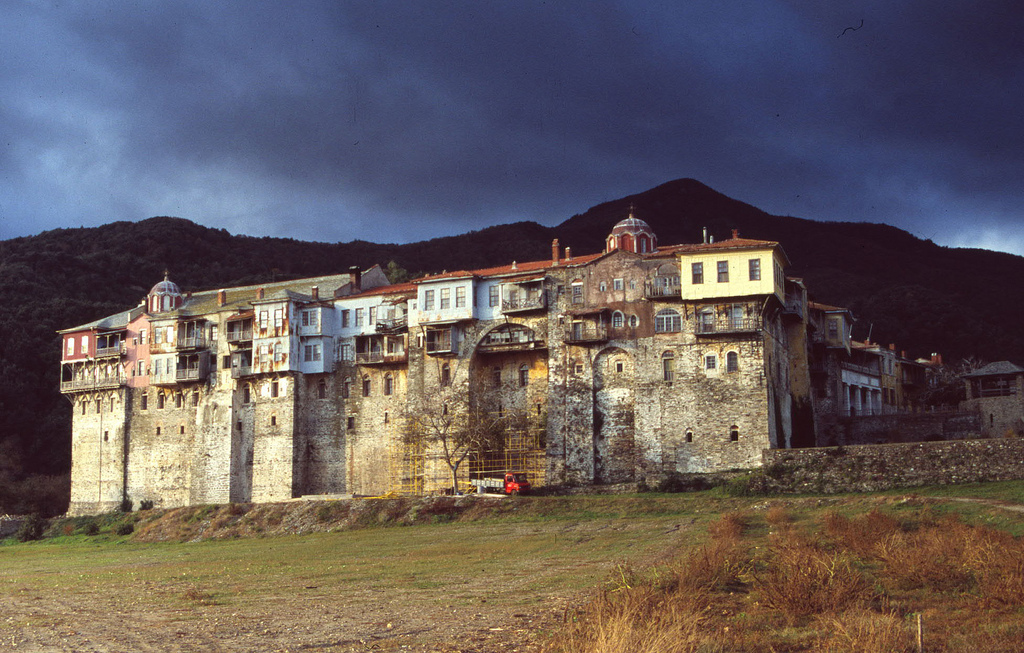
George Zarkadakis visited a monastery on Mount Athos, known as the “Christian Tibet,” to experience hesychasm – the “mental prayer” of Eastern Orthodox tradition:
In the early 14th century, a Greek theologian named Gregory Palamas produced a synthesis of Orthodox philosophy that has defined the theology of the Eastern church ever since. He founded the contemporary tradition of hesychasm, which focuses on achieving experiential knowledge of God. Palamas believed that human beings could never understand the essence of God by employing reason alone. But humans could experience God’s actions (or ‘manifestations’ as he called them), through a retreat into inner prayer. While the Catholic tradition of mental prayer allows the faithful to use icons as aids and regards apparitions as signs from God, Orthodox mental prayer focuses on mental stillness and abstraction, deliberately keeping the mind free of images or thoughts.
Palamas claimed that such prayer gradually builds an increasingly close relationship with God. One of the common themes in late Byzantine iconography is a ladder, representing hesychastic prayer, which connects the earth to the heavens.
Though no longer sharing the “central beliefs” of the faith, Zarkadakis found himself moved to wonder:
I climbed the steps to the highest spot on the wall, and looked out towards the sea. The sky was steadily lightening and a cool breeze carried the rejuvenating scent of salt towards me. Thyme, pine, jasmine and laurel emanated from the monastery’s garden. My face was warmed by the first rays of the sun. I knew that the light that kissed my face came from a star — a great ball of fire fuelled by thermonuclear reactions. That the laurels, the thyme, the bees and the chanting monks were the results of millions of years of biological evolution that had probably begun with a humble bacterium. That I smelled, saw and listened because of electrochemical signals that passed between neurons. That my limbic system was on overdrive.
But despite my knowledge, a sense of mystery remained. Why was the sun so magnificent? Why was the sea so dear? Why did I feel a sense of profound meaning in everything? Perhaps my epiphany owed to nothing more than a second night of sleep deprivation. Nevertheless, I had arrived at a state of mind, possibly not dissimilar to that of the praying monks, where logic failed and gazing at beauty was all that mattered. If that was true then perhaps to know God was simply to look at a rising star, and feel inexplicably moved.
(Photo of the Iviron Monastery, where Zarkadakis stayed, by Leon Hart)
 The Dish