Reviewing Mark David Hall’s recent book Roger Sherman and the Creation of the American Republic, Kevin Gutzman uses the Calvinist Connecticut statesman to scuttle the way we typically understand the Founding:
As Hall puts it, “I am not arguing that Calvinism was the only influence on Sherman and his colleagues, simply that it was a very important influence that needs to be taken more seriously if we are to appreciate the political theory and actions of many of America’s founders.”
… Hall decries the tendency to write as if George Washington, Thomas Jefferson, James Madison, Ben Franklin, Alexander Hamilton, and John Adams (a group disproportionately composed of deists and marginally committed Christians) were the entirety of the Revolutionary generation, and then to deduce the meaning of America’s original commitment to religious freedom from the ideas of those men. One illustration of this tendency is that, by Hall’s calculation, Supreme Court justices writing opinions about the First Amendment’s religion clauses have referred to Thomas Jefferson 112 times and to Sherman only three, even though Sherman helped write the First Amendment and Jefferson was away on diplomatic business in France at the time…
One reason that the more famous Revolutionaries draw so much attention is that, with the exception of George Washington, they were all so eloquent. Sherman was not. Yet his wisdom does occasionally come through. Thus, for example, in one of his newspaper essays advocating ratification of the Constitution, Sherman counseled, “Philosophy may mislead you. Ask experience.” Here one hears echoes of a more famous statement by Patrick Henry, that prominent Virginia Episcopalian orator. As was typical of Americans, Sherman disliked speculation.
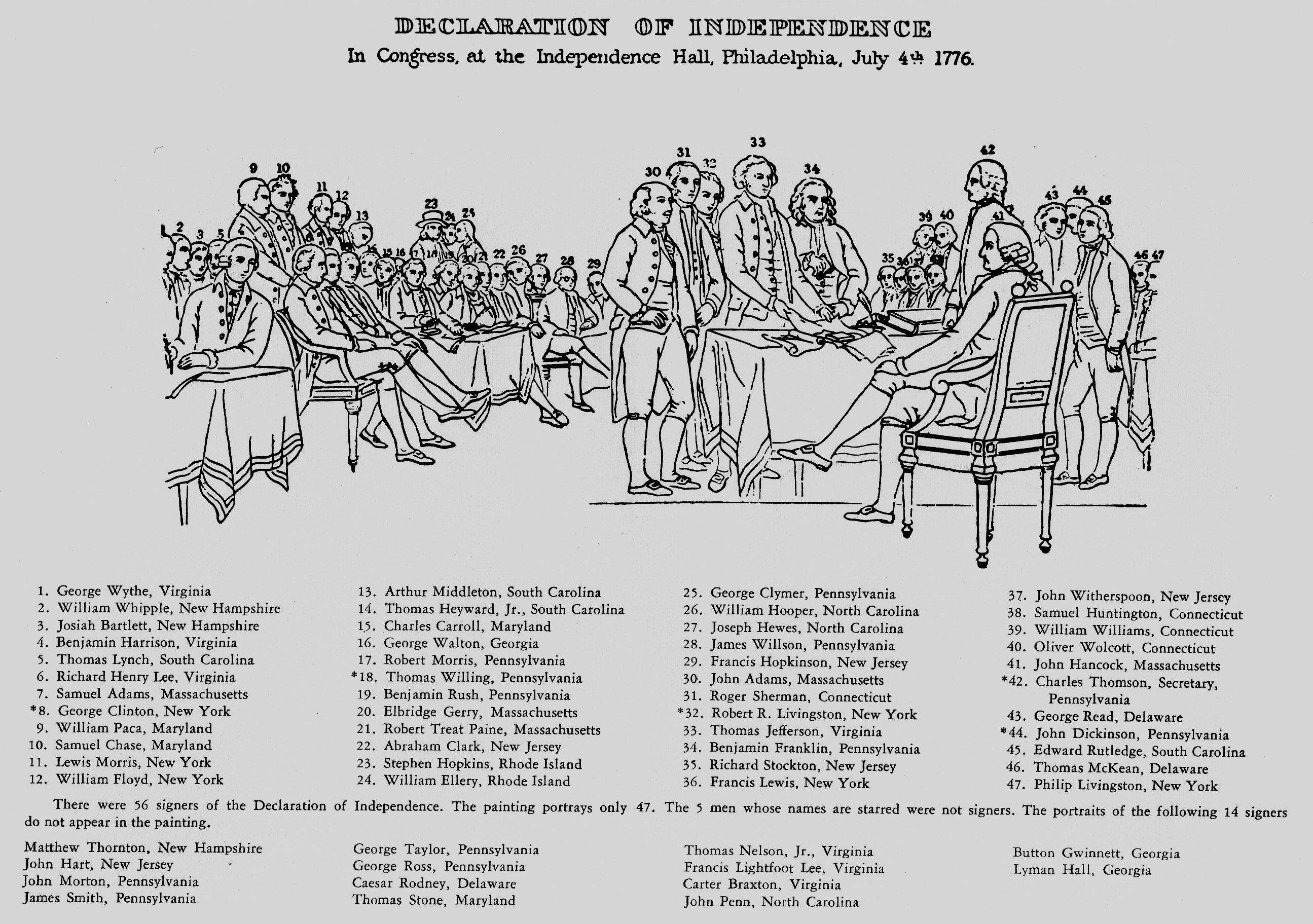
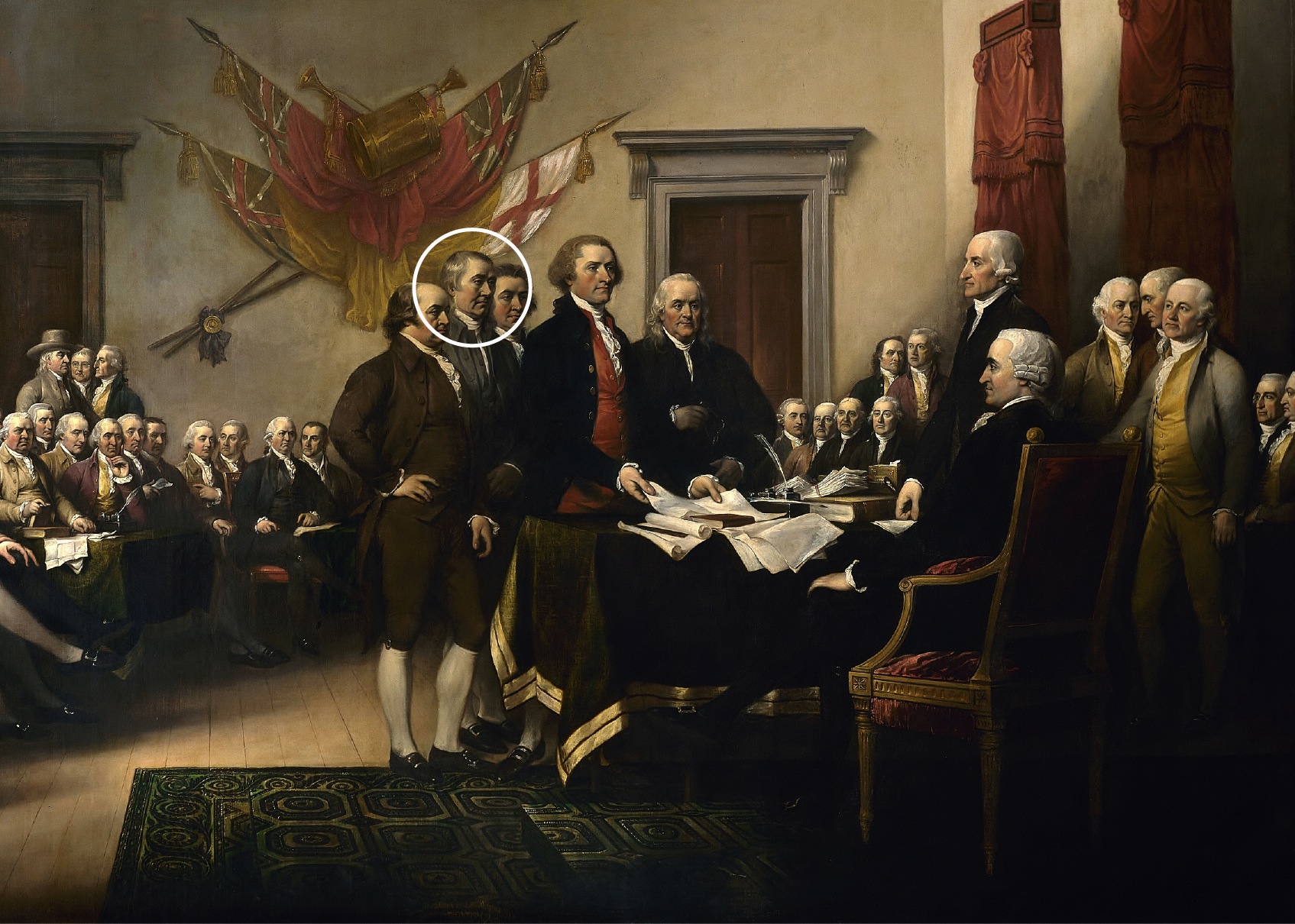
(Above: A Dish-modified illustration identifying Roger Sherman in Declaration Of Independence by John Trumbull, 1819 from Wikimedia Commons. A key for others depicted in the painting here.)
 The Dish