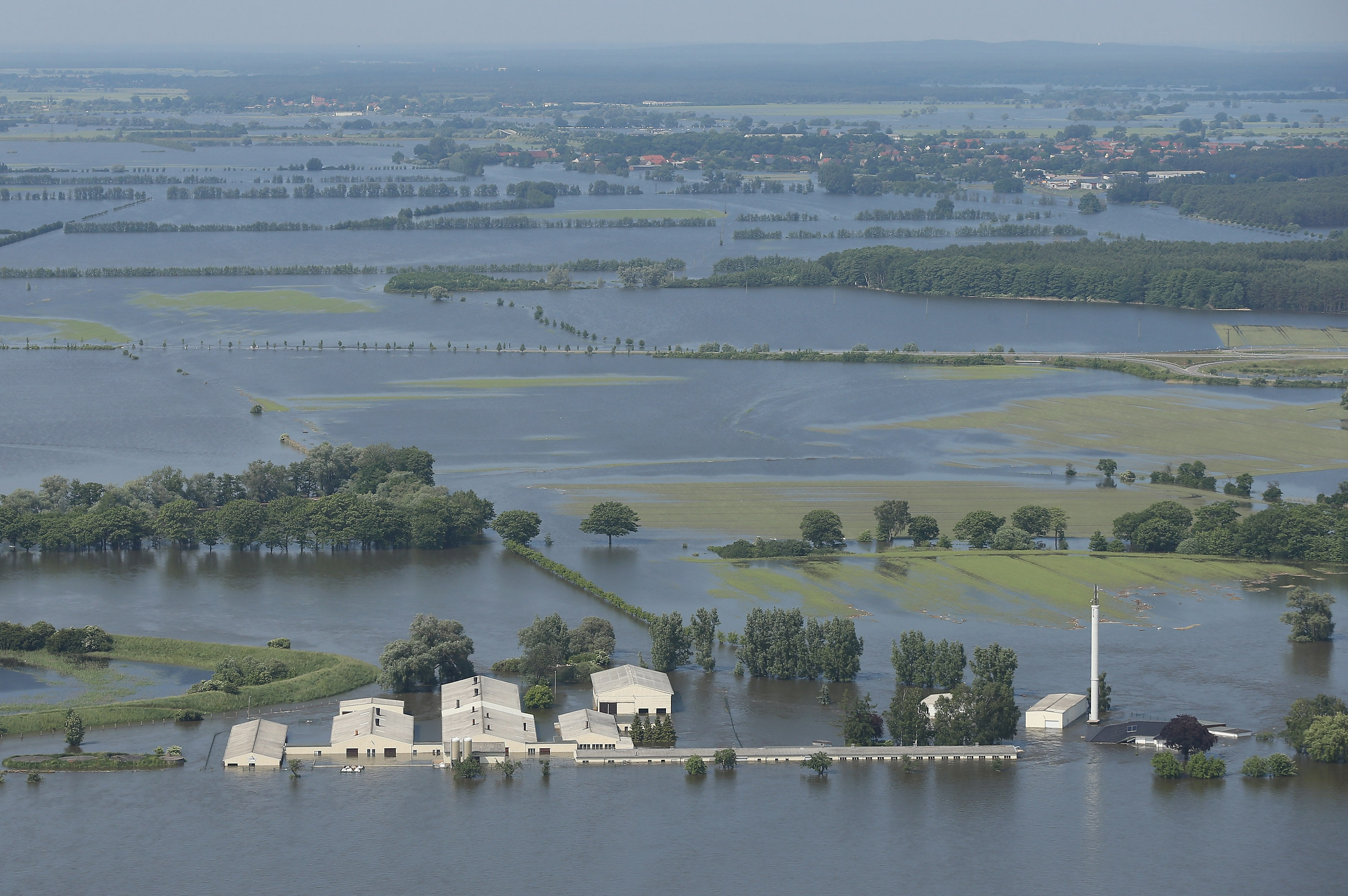
Kate Shepard and James West flag a new FEMA report warning of increased flooding due to climate change, as well as its likely strain on the agency’s budget and individual insurance holders:
Like previous government reports, it anticipates that sea levels will rise an average of four feet by the end of the century. But this is what’s new: The portion of the US at risk for flooding, including coastal regions and areas along rivers, will grow between 40 and 45 percent by the end of the century. That shift will hammer the flood insurance program. Premiums paid into the program totaled $3.2 billion in 2009, but that figure could grow to $5.4 billion by 2040 and up to $11.2 billion by the year 2100, the report found. …
Right now, a number of homeowners who get their flood insurance from the federal government pay subsidized rates. But for the program to stay solvent, the average price of policies would need to increase by as much as 70 percent to offset projected losses, according to the FEMA report. That means individual policyholders who now pay an average rate of $560 per year could have to pay as much as $952 per year by 2100.
Ron Bailey pushes back on the piece:
In its rush to declare a crisis that only benevolent government bureaucrats can solve, [Mother Jones] characteristically overlooks the fact that there should be no National Flood Insurance Program in the first place. If private insurers think it’s too risky for someone to build a house on a plot of land due to the high probability of inundation, then why should taxpayers subsidize their folly? Second, assuming that the U.S. government does not manage to stop modest economic growth for the next 90 years that would mean that today’s per capita GDP of $43,000 growing at 2 percent annually would rise to $255,000 by 2100. It is not unreasonable to think that Americans who would be six times richer in 2100 might be able to afford to pay double for their flood insurance.
Meanwhile, in light of NYC’s recently unveiled $20 billion plan to build flood walls, Dana Milbank thinks Bloomberg is doing a solid job on the climate front:
Obama created an “Interagency Climate Change Adaptation Task Force” in 2009 to examine everything from agriculture to sewer system failures and public-health consequences, but much of the work remains theoretical. Bloomberg’s new plan, with 250 specific recommendations and a hefty price tag, puts climate-change adaptation into a more concrete realm. The businessman-mayor called it “a battle that may well define our future for generations to come” and outlined changes to building standards, telecommunications, transportation and a dozen other areas. … Bloomberg spoke confidently, as if he were a general laying out a military plan. But he was really talking about limiting casualties.
But Marc Tracy encourages the mayor to do much more:
Bloomberg is right about guns and, when he has at other times treated climate change as the political issue it is, he is right about global warming, too. But his emphases are all wrong. While Bloomberg has plenty of actual capital (he is worth some $25 billion and has said he intends to give it all away), he is investing his finite national political capital in a watered-down bill addressing an issue that … is nowhere near as important, by virtually any measure, as climate change is. The scourge of guns, the more than 30,000 American deaths they help cause each year, the gruesome mass shootings they enable: Bloomberg is right to hope they go away. But climate change is an existential threat, to everyone. It is probably not accidental that climate change is the reason Bloomberg gave for endorsing Barack Obama over Mitt Romney.
(Photo: In this aerial view, a farm stands partially submerged in floodwaters from the Elbe river on June 12, 2013 in Fischbeck, Germany. The swollen Elbe is continuing to endanger communities along its northern route in Saxony-Anhalt and Brandenburg states, though the bursting of a dyke near Fischbeck has relieved some pressure from towns farther north. Floods have ravaged portions of southern and eastern Germany in the last week, leaving at least eight people dead and forcing tens of thousands to evacuate their homes. By Sean Gallup/Getty Images)
 The Dish