Fouad Ajami explores how the Muslim Brotherhood “hijacked” the revolution that began with “secular liberals, Christian Copts, young men and those daring women who defied custom and tradition to come out in the public square”:
[T]he Brotherhood had more than eight decades of political experience behind it. The military dictatorship had atomized the feeble liberals, leaving them unprepared for the contest over the new order. Like liberals elsewhere in hard, illiberal places, they were sure they embodied their country’s spirit. They were trounced by the Brotherhood and the hardline Salafis in the first parliamentary elections; the judiciary, a bastion of the old order, stepped in and dissolved the parliament. The democrats didn’t own up to the truth: While Egypt has a sophisticated intellectual elite, a modernist camp, and Europe isn’t too far away, it is a poor country with a high illiteracy rate and a population that the Mubarak dictatorship had been content to leave to darkness and the rule of superstition.
In the best of worlds, the Brotherhood would have been willing to tread carefully and to acknowledge the narrow mandate it had secured with Mursi’s election. But a paranoid movement that ached for power wouldn’t show restraint.
Leslie Chang checks in on the anti-Morsi protest movements:
The biggest challenge to the Egyptian government resides in a sweltering fifth-floor office in a crumbling building in downtown Cairo. It’s paper—millions of pieces of paper, sorted into stacks and piled on chairs and balanced atop cardboard crates. Each is a signed petition calling for the removal of President Mohamed Morsi and new elections, labelling Morsi “a failure in all the meanings of the word … unfit to administer a country the size of Egypt.” The petition charges the country’s leader with betraying the revolution, destroying the economy, and begging for foreign aid to keep the country afloat. Fifteen million Egyptians have signed it, which is two million more than voted Morsi into office a year ago. Many are expected to join mass protests on June 30th. …
After two years of watching politicians on both sides of the fence squabble and prevaricate and fail to improve their lives, Egyptians appear to be rejecting representative democracy, without having had much of a chance to participate in it. In a country with an increasingly repressive regime and no democratic culture to draw on, protest has become an end in itself—more satisfying than the hard work of governance, organizing, and negotiation. This is politics as emotional catharsis, a way to register rage and frustration without getting involved in the system.
Elsewhere, Steve Negus reviews Morsi’s first year in office:
For the winner of the first freely contested presidential election in Egypt’s history, Morsi has reached a point where he is quite vulnerable. When a mass movement says it’s going to try and remove you, and the army and the police signal they’re not going to do much to stop them, it’s sensible to worry — the opposition may swear up and down that they do not want a coup, but it’s pretty easy to imagine a series of events where one ends up happening anyway.
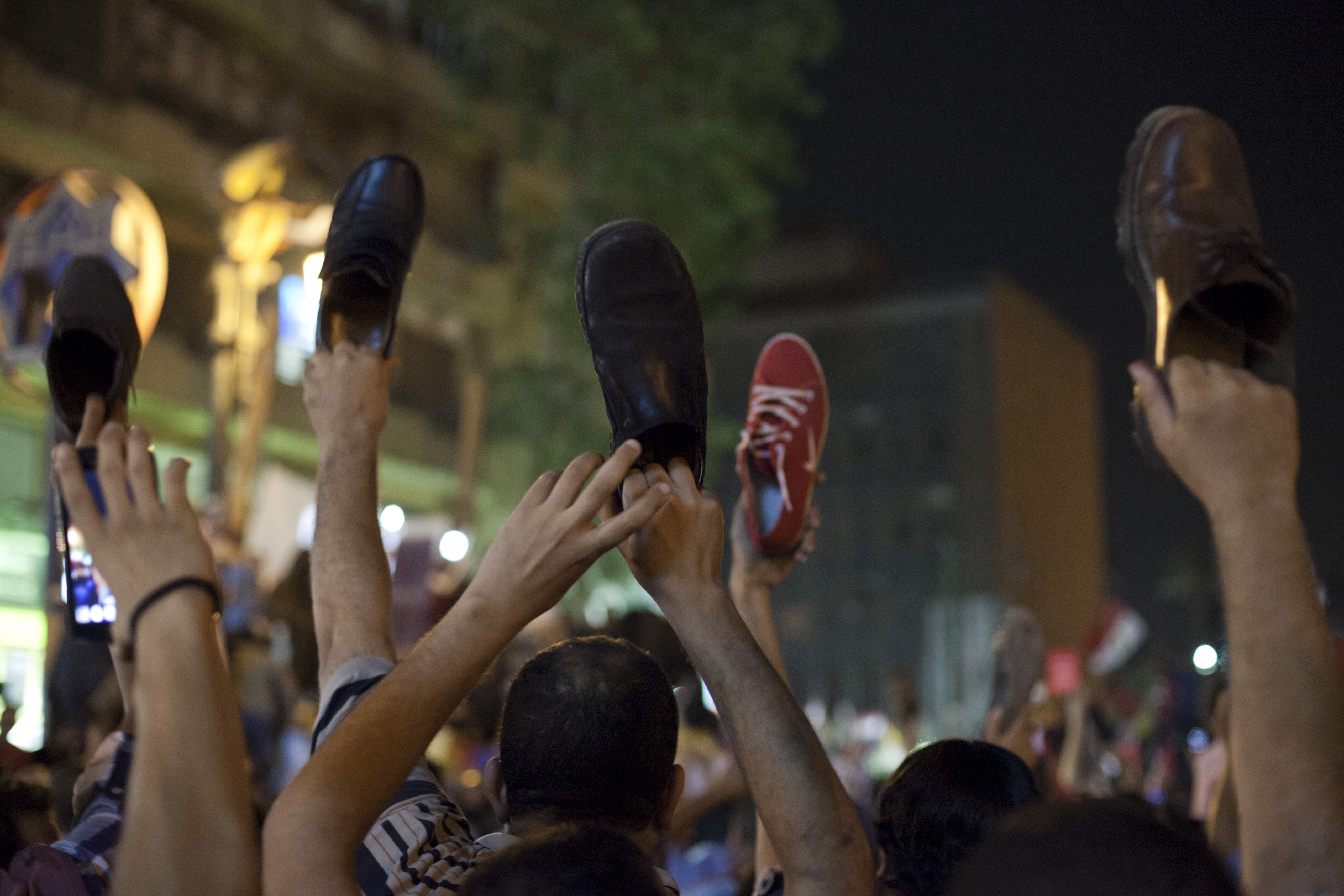
(Photo: Egyptian opposition protesters hold their shoes in the air, an offensive gesture, during a demonstration in Tahrir Square against President Mohammed Morsi, prior to a televised national address by Morsi on June 26, 2013 in Cairo, Egypt. By Ed Giles/Getty Images)
 The Dish