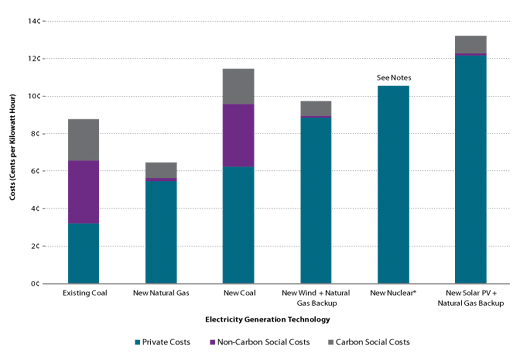
Yglesias sees a “pretty strong” case for the war on coal in the above chart from the Hamilton Project, which shows the total social cost of a kilowatt-hour of energy from a variety of resources:
[T]he only way to consider new coal-fired plants a remotely plausible undertaking is to completely ignore the social costs of burning the coal. By the same token, simply throwing all my garbage into my neighbor’s backyard could look like a cheap and appealing alternative to proper trash disposal if I were allowed to completely ignore the costs to my neighbor.
Existing coal plants are a closer call since the private costs of a plant you’ve already built are naturally quite low. But we can see quite clearly that phasing out existing coal in favor of new natural gas is a clear winner. It’s worth dwelling on that for a moment, since it’s actually quite extraordinary for the cost of a brand-new infrastructure project to be lower than the cost of continuing to run what you’ve already built. The moral of the story here is that if you were able to completely ignore political considerations, the case would be very strong for an aggressive and robust war on coal even if you don’t care a whit about renewable energy.
Meanwhile, David Brodwin tires of climate change’s “environment vs. economy” storyline:
Many politicians and journalists will frame this issue in a misleading way. It will be positioned as a question of “promoting growth and jobs” versus “protecting the environment.” Those who oppose action on climate will ask if we can really “afford” to take action on climate at a time that the economy is still in recovery. This framing is misleading because it implies that taking action to protect the climate will cost more than it saves. Nothing could be more wrong. Stabilizing the climate by reducing carbon emissions saves the economy much more than it costs.
 The Dish