Face Of The Day

9a587502-161e-4193-970b-3a84dc7c5020_NTI_FEMALE_1902_MUGSHOTS_04

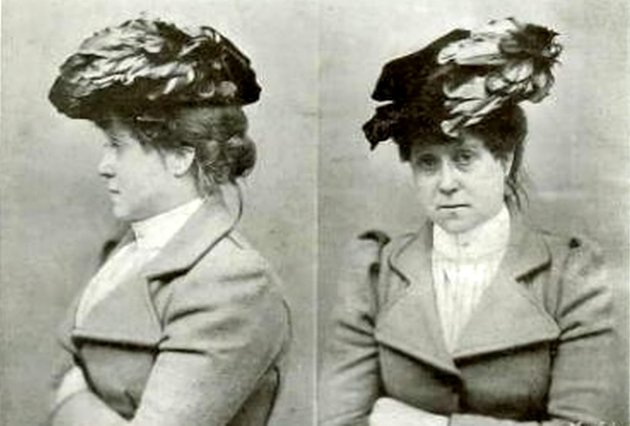
Elizabeth Thompson, after her arrest for being drunk in public – from a cache of mug-shots of habitually drunk female patrons in pubs in Birmingham, England, in the early 1900s. Money quote:

Many of the women on the Black List had scars, missing teeth or other deformities, including Kate Kibble, 50, with her eyepatch and crooked fingers. Surprisingly, most of the women on the list held down jobs, working as charwomen (cleaners), woodchoppers, polishers or grease merchants. One street performer ‘played tin whistle outside licensed premises’, while some also worked as prostitutes to bolster their income.

The eye-patch drinker below the jump:

65c2cc17-216e-4e20-a561-d5b7e97789c8_NTI_FEMALE_1902_MUGSHOTS_01

(Hat tip: Ancestry.co.uk)

Yesterday’s Modern Man

Here’s a charming, unintentionally amusing 1933 essay from Harper’s, “What the Young Man Should Know.” Among the many skills a gentleman should possess? Drinking:

American social habits being what they are, there is one indoor skill which seems to me not only far more important than bridge or dancing, but actually compulsory — drinking. A young man who could convince me that his lips really would never touch liquor might be let off my required course in drinking. But he would be an exceedingly rare bird, and alcohol is so much more evident a liquid in the United States than water that it is probably quite as necessary for a young man to learn how to drink as it is for him to learn how to swim. If the youth of the country had been taught how to drink, just as they were taught not to eat between meals or swallow before they had chewed, we should never have had Prohibition. It is a more difficult art than most, for every man reacts differently, and every man should know, long before the time when (according to our customs) he indulges in his first collegiate binge, whether liquor goes to his head, his legs, or his morals, whether he is the type that sings, fights, weeps, climbs lamp-posts, or pinches the girls. Furthermore, he should learn his capacity and stick within its limits; he should know something about the different kinds of drink, and which drinks produce chaos within him when mixed. By all means let him leave drink alone if he wants to. But since, nine times out of ten, he will drink, let him do so sensibly.

Read the rest for Depression-era thoughts on gambling, swimming, driving, dancing, and more.

Are Energy Drinks That Dangerous? Ctd

According to this NSFW clip of David Cross as Todd Margaret, yep, pretty dangerous:

[youtube http://www.youtube.com/watch?v=kfPReIAKxeQ]

A reader responds to the previous post with his professional opinion:

I have about one referral per year to my cardiology practice where the patient had acute and severe symptoms after consumption of a high-caffeine “energy” drink. I’ve also seen them sitting in my clinic room about to shake themselves silly with tremor and palpitations. These patients have had to be hospitalized for symptoms on at least one occasion, and you might be interested to know that in some of my cases these people work as long-haul truck drivers on the interstate highways. I get that you can ingest a high daily quantity of caffeine by going to Starbucks. Please consider, however, that the people I see are downing their energy drinks after they have already ingested their normal daily quota of coffee or tea – it is not one or the other.

Save The Trees, Save Yourself

Mat McDermott runs down the benefits of urban foliage:

After looking at trees in Atlanta, Baltimore, Boston, Chicago, Los Angeles, Minneapolis, New York City, Philadelphia, San Francisco, and Syracuse, [scientists at the Davey Institute and the U.S. Forest Service] found the annual removal of fine particulate matter varied from 4.7 metric tons in Syracuse to 64.5 metric tons in Atlanta. This correlates to one person’s life per 365,000 people saved each year in Atlanta, to one life saved for every 1.35 million people in San Francisco. Fine particulate air pollution can cause (in addition to premature death): Inflammation of the lungs, accelerate hardening of the arteries, and altered heart function.

Why Should Women Shave? Ctd

A reader writes:

Thank you thank you! I am so glad to have a Dish conversation about us gals having to shave. Well, we don’t have to, but it’s expected. I haven’t shaved in years, not anywhere; but I have a husband who doesn’t mind. I admit to having red-gold hair rather than dark, and I’m not particularly hirsute, so I can appreciate what dark-haired ladies have to deal with. Still, the feeling of two hairy legs rubbing is quite a lovely thing, especially as opposed to the painful stubble of a shaved leg or rash-riddled armpit (to say nothing of the pubic area).

I can remember the fun I had as a bartender, watching guys react to the sight of my hairy legs. It made me laugh, seeing their disgust and hearing them proclaim how their wives would never be allowed to let it grow free.

I look forward to hearing if there’s a sizable reaction to this thread.

Sizable reaction below:

I remember being pulled aside around age 14 by my uncle. The reason why? I was at his house, swimming in the common pool at his townhouse … and I had never shaved. Mind you, my uncle has barely spoken to me over the years, but on this one occasion he saw fit to tell me how unattractive hair on the legs and underarm were and if my mother was too much of an immigrant to realize, here in the US, women shave to be attractive.

I stopped shaving my legs in my 30s after moving to the Bay Area. I stopped shaving my underarms in solidarity with my wife, who during her cancer years was too weak to shave. Since then I’ve noticed a couple of things. 1) Ever notice that both sets of hair are near lymph nodes? 2) Since I stopped shaving my armpits, I haven’t gotten a cold and 3) my dog, a husky, has fur that acts like armor on him. He never gets fleas because they can’t penetrate his undercoat. All this has led me to believe that shaving is pretty much a foolish act. Your hair can act to block things out.

Anyway, in my “pre-lesbian” days, I only dated men with facial hair. There’s something fun about it and if I could, I’d be totally rocking a beard now.

Another reader:

Here is why I started shaving my legs: Girls in my gym class in the 1960s teased me about how hairy my legs were, and my first boyfriend flopped down beside me at the pool after looking me over and declared, “You have more hair on your legs than I do.” I have no desire to ever be 16 again.

Long after I was married and was living in a liberal academic town, I stopped shaving my legs, though I consistently shaved under my arms. I resumed shaving my legs when I moved to a Southern state, where my hairy legs were obvious, in part because they were exposed for many more weeks of the year. When I moved back north, shaving declined in frequency and now is only an occasional event. I cringed self-consciously at one of my husband’s high school reunions when one of his classmates went on and on about how disgusting it was that the women serving at a natural-foods cafe didn’t shave their legs – thus proving, in the friend’s opinion, that their hygiene was seriously deficient. I was glad he wasn’t looking closely at my legs.

Another:

There are maybe five times a year I shave because I want to – first day of the beach, first week of skirt wearing, some date I’m excited about. It can feel festive and fun, like wearing red lipstick. Every other time it’s for men, or square women. It’s unprofessional to have leg hair, so off it goes when the outfit shows it. It’s not like it’s easy, figuring out how to maneuver around your own body with some dumb safety blades. And waxing is so expensive in America! You and your reader are right; it’s oppressive and just more misogynistic bullshit. And you know the shit of it? I would never date a man who demanded I shave, but I don’t think I could physically go on a first date with hairy legs. I’ve internalized the shame about my own body hair to the point that my stubbornness can’t overcome it (which, if you knew me, would be meaningful).

Another:

You referred to shaving as “unnatural servitude” and “a woman’s choice – coerced by men.” While men are a big part of it, the coersion is by our cultural beauty standards enforced by both men and women. The fact is, that whatever choice women make, it is shaped by the cultural definitions of beauty, from thoughtlessly following the standards of beauty magazines to rebelling against them.

I am “lucky” in that my leg hair is naturally blonde and not very noticeable (although more so now than ten years ago), so my decision to never yet shave my legs doesn’t really matter. I still shave my armpits relatively often, especially in the warmer months. And more recently, I’ve payed more attention to whether and how much I should pluck my eyebrows. I’m married, and none of these decisions are going to influence my sex life.

There is a cultural stigma against body hair on women. For most women all these body-hair decisions are quickly noticeable and will be judged by strangers on the street. So if it were just a matter of getting laid, as you say, a higher percentage of women would change their behavior when “off the market.”

Thanks as always for the interesting and wide-ranging reading.
Our Love Of Love Stories

Robert Boswell contemplates the appeal of “how we met” stories:

Why are we drawn to stories about people falling in love? There are likely a host of reasons, but here’s a good one: marriage, when observed from a place of solitude, has the power of dream. Solitary people fall in love with couples, imagining their own lives transformed by such a union. And once the transformation finally happens, people need to talk about it, telling not only their families, friends, and strangers on the bus but also themselves—repeating it to make it real, to investigate the mystery of marital metamorphosis. And they get good at the telling. People who cannot otherwise put together an adequately coherent narrative to get you to the neighborhood grocery will nonetheless have a beautifully shaped tale of how he met she (or he met he, or she met she) and became we.

Such stories often have many literary qualities.

They rely, almost by definition, on the revelation and transformation of character—the same elements that are the backbone of literary stories. The narratives have a mystery at the beginning: how the characters begin loving each other before they understand they’re doing it, the way sleep enters our bodies before we’re actually asleep; and like sleep, we fall into love, and fall deeper as we go. The narratives also have something like a built-in ending. A wedding, after all, is the traditional conclusion for comedies, and it is meant to indicate that the transformation has transpired. Passing through the ritual of the wedding ceremony, the bride and groom are irrevocably changed.

Victim Benching

Middle schooler Amanda Baxter was kicked off of the football team at Strong Mountain Christian Academy because the boys are beginning to “have impure thoughts” about her. Travis Waldron zooms out:

The misguided assumption that the problem is the person who is “different” rather than those who are incapable of accepting and adjusting to the difference has been used to urge gay players to remain in the closet, lest they become a distraction, and to keep female reporters out of male lockerrooms.

There are more than 1,500 girls playing football at American high schools, according to the National Federation of State High School Associations, and that number has increased more than 17 percent in just four years. It’s not just a boys’ sport anymore. And more than that, playing football with a girl could have been a valuable experience for Baxter’s teammates about how to appropriately interact with women and girls, about how a person’s sex doesn’t make her inherently inferior athletically or in any other way, and about how having “impure thoughts” doesn’t mean you have license to act on them. They won’t get that lesson, though, because the adults in charge of Strong Rock Christian Academy’s athletics program apparently have yet to learn it themselves.

Why Immigration Reform Is Struggling

Will Wilkinson explains:

The energetic ideological base of the Republican Party is a nationalist, identity-politics movement for relatively well-to-do older white Americans known as the “tea party”. The tea party is interested in bald eagles, American flags, the founding fathers, Jesus Christ, fighter jets, empty libertarian rhetoric, and other markers of “authentic” American identity and supremacy. That America is “a nation of immigrants” is a stock piece of American identity politics, but the immigrants that made America America were, well, not Mexican, and spoke English, or at least Pennsylvania Dutch. Sorry Mexicans! Even if each element of immigration reform, taken in isolation, is agreed to be a good idea by a solid majority of Republican voters, Republican politicians must nevertheless avoid too-enthusiastically supporting this package of good ideas, lest they fail to project sufficient appreciation for the importance of keeping America American and putting Americans first. To fail to introduce a dead-on-arrival poison-pill amendment that would, say, require all would-be Americans to score over 160 on the LSAT, or to personally assassinate a member of al Qaeda before setting foot on the “path to citizenship” is to invite a primary challenge from a more thoroughly “American” American less cowed by the insidious deracinating forces of multicultural political correctness.

Despite this, he still expects GOP leaders to push something through.