Demystifying The Dolphin

Neuroscientist and dolphin researcher Lori Marino takes on dolphin-assisted therapy (DAT):

DAT typically involves several sessions either swimming or interacting with captive dolphins, often alongside more conventional therapeutic tasks, such as puzzle-solving or motor exercises. The standard price of DAT sessions, whose practitioners are not required by law to receive any special training or certification, is exorbitant, reaching into the thousands of dollars. It has become a highly lucrative international business, with facilities in Mexico, Israel, Russia, Japan, China and the Bahamas, as well as the US. DAT practitioners claim to be particularly successful in treating depression and motor disorders, as well as childhood autism. But DAT is sometimes less scrupulously advertised as being effective with a range of other disorders, from cancer to infections, to developmental delays. …

[T]here is absolutely no evidence for DAT’s therapeutic effectiveness. At best, there might be short-term gains attributable to the feel-good effects of being in a novel environment and the placebo boost of having positive expectations. Nothing more. … DAT clients are often among the most vulnerable members of society, so the industry takes advantage of them. The pseudoscientific patina and untested testimonials serve to reel in desperate parents and people suffering with severe anxiety or depression who will do anything to get some relief. They are persuaded by words such as ‘treatment’ and ‘therapy’ and by the misuse of scientific methods, such as EEG to measure brainwave patterns, which suggest scientific legitimacy.

He also writes that the dolphins are “psychologically and physically traumatised” from captivity. India, which is banning keeping dolphins in captivity because they “should be seen as non-human persons with rights,” seems to agree. Lex Berko prods the US to take a lesson from the section of the Indian constitution that allows issues like this to reach the courts:

[India’s Directive Principles of State Policy] are meant to help guide the courts in making decisions in line with the character of the country. Combined with widening access to courts beginning in the 1980s, they’ve allowed a wide variety of animal protection issues, covering everything from cow slaughter to circus animals to stray dogs, to be heard by the High Courts and the Supreme Court of India. In fact, the courts not only hear the cases, but sometimes go so far as to offer compelling screeds on the validity of animals having rights, something you haven’t heard and probably won’t hear anytime soon from a powerful court in the US. …

By contrast, in the United States the idea of animal rights invokes images of red paint and militant vegans. I could go on for days about why that perception is misinformed, but that’s not the point here. The point is that India has taken steps to better the lives of animals using the law and some very potent language.

Our Dwindling Nest Eggs

Mitchell Tuchman reviews recent projections of retiree financial health from the Social Security Administration:

It is working Americans’ greatest fear: Being dependent on meager Social Security benefits in old age. A surprisingly large number of people will be in that position — a median dependence of 39% in the year 2022 and slightly higher (41%) in 2062, according to a government study. What “dependence” means for the typical household is that 39 cents of each dollar of income they get will come from the government-run retirement plan.

As with all statistics, averages obscure important information. Among the lowest earners, dependence on government income is much higher (52%). Still, even the top fifth of Americans will find that 25% of their income — on average for their group — comes from Social Security.

Nancy Folbre worries that Americans aren’t saving enough for old age:

Persistent unemployment and stagnant wages have left many workers treading water, struggling so hard to stay afloat that they couldn’t open a retirement account even if they wanted to. A new report from the National Institute on Retirement Security, based on analysis of the 2010 Survey of Consumer Finances, shows that about 45 percent of all working-age households don’t hold any retirement account assets, whether in an employer-sponsored 401(k) type plan or an individual retirement account.

Among those 55 to 64 years old, two-thirds of working households with at least one earner have retirement savings less than one year’s income, far below what they will need to maintain their standard of living in retirement. By a variety of measures, most households, even those with defined benefit pensions, are falling far short of the savings they will need.

In Europe, things aren’t much better:

Saving for retirement is “a losing game” for hundreds of millions of European citizens as high charges and taxes destroy the value of pensions, according to the European Federation of Financial Services Users. “If pension savers cannot enjoy [positive] real returns then there is no point in making private provision,” said Guillaume Prache, managing director of EuroFinuse. … Mr Prache said the outlook for pension savings was “grim” as expected returns from bond markets were low or negative and taxes on savings were rising in most European countries, while charges and fees on pension funds showed no signs of falling significantly.

Ask Josh Barro Anything: Spending Smart On Education

In our latest video from Josh, he offers his take on the mixed results of education spending in the US:

Barro is currently the politics editor at Business Insider. He has previously written for Bloomberg View, and before that was a Senior Fellow at the Manhattan Institute. Watch his previous answers here. Our full Ask Anything archive is here.

The Marketing Of Obamacare, Ctd

Sarah Kliff examines the comparisons between the rollout of the “brand new, and relatively unpopular” Medicare Part D program in 2006 and the administration’s rollout of the ACA:

Part D was even less liked [than the ACA in the months prior to launch]: 21 percent of the public had a favorable opinion of the program in April 2005 compared to 35 percent in April 2013 for the Affordable Care Act. Americans felt like they didn’t understand Part D, either. And back in November 2005, nobody had any clue about whether costs would be affordable enough to entice seniors into the new program …

Medicare Part D had a sweeping, year-long campaign that began well in advance of the program’s launch. The Obama administration has decided to focus its efforts differently. It will do most of its outreach push in the late summer and early fall. The White House and its allies worry that if they begin their pitch too soon they’ll be selling a product that is nowhere near landing on the shelves.

To combat the ACA’s low public opinion ratings, HHS is reaching out to NFL and NBA stars to promote enrollment in the exchanges. Travis Waldron explains why the NBA might sign on: 

 The law, judging by conservative response and public polling, remains controversial, and taking a position on the program might risk alienating some NBA fans. But for the same demographic reasons that make the partnership appealing to the White House, it could be appealing to the NBA. Market research shows that blacks, Latinos, young adults, and Americans with low and low-middle incomes make up larger shares of the NBA’s fan base than they do of the general population, and all four of those groups are more likely to view both Obama and his policies more favorably. So while conservatives may be loud in their opposition, it’s hard to believe that their distaste for health care reform would take the form of concerted action like a boycott that would try to hurt the league economically. The NBA has embraced other issues that rankle conservatives, like climate change, environmentalism, and equal rights for LGBT Americans, without backlash.

Meanwhile, Jonathan Bernstein expects confusion over what’s included in the health care reform law to lead to cries of “keep your Obamacare away from my Affordable Care Act”:

[U]nder the hood, there is all sorts of government intervention going on—all sorts of new regulations about what insurance companies can do, how they must spend their money, what products they are allowed to offer through the exchanges. But that’s all going to become invisible to consumers over time. Even things which, for the first group of exchange users, will seem like a big deal. For those currently without the insurance they want because of a pre-existing condition, becoming newly eligible for coverage will be an obvious effect of Obamacare. But for the next generation (and I mean in as short a time as a year), most people will have no idea that they would previously have been bounced—just as almost no one will realize that they would have once been subjected to yearly and lifetime benefits caps, or would previously have been at risk for a rescission if they ever filed a claim.

Wowed By Windmills

American artist Anthony Howe creates wind-driven “kinetic sculptures” out of stainless steel:

The many windmill-like structures respond to their surrounding natural environments by reflecting sunlight and producing motion in response to wind. Using mainly stainless steel and fiberglass, Howe produces all kinds of interesting symmetrically balanced forms and shapes. Standing 17 feet high, the heavy metal glides effortlessly through the air, rotating in organically circular, harmonious movements. The three-dimensional sculptures are intricately balanced to produce mesmerizing patterns that viewers could watch for hours. Howe says he hopes to achieve “pieces [that] assume a spare, linear elegance when conditions are still, mutating to raucous animation when the wind picks up.”

After the jump is another mesmerizing video of a wind-powered sculpture in the shape of a human face:

More of Howe’s work here.

Is Meritocracy Moral?

In a special issue of the Journal of Economic Perspectives, Greg Mankiw makes (pdf) a moral argument against income redistribution. Krugman summarizes:

Mankiw argues that the 1 percent make so much because of their high contribution to output — basically, that they have high marginal productivity. So they earn what they get; and Mankiw further argues that economic opportunity is in fact relatively if not perfectly equal. All’s fair!

Chait calls the article “an embarrassing piece of ignorant tripe”:

Mankiw asserts that his premise, that the rich deserve all they have and are entitled not to pay higher tax rates simply for the social good, “is more consistent with our innate moral intuitions.” If that’s the case, why was Obama so persistent about arguing for higher taxes on the rich, and Mitt Romney — the candidate Mankiw advised — so eager to avoid admitting he wanted lower taxes for the rich? And since Mankiw’s “innate moral intuitions” rest upon a series of shaky factual suppositions, perhaps he should consider the possibility that they are less a rational argument than a rationalization.

I sure can see the innate moral intuition in thinking that a talented person deserves to keep the fruits of her talent, even if it is beyond Chait’s imagination. But what I also see is context, because humans are social animals and all absolute moral claims, for a conservative, need to be adapted or mitigated according to the times and society we actually live in. That’s where I differ from Mankiw. When society is hurtling toward massive and destabilizing inequality which is jeopardizing core trust in the political system, then I think you need to adjust. When globalization and technology are massively enriching a minuscule few, where they once helped far more, it’s time to re-think.

The classic take on this was, of course, Michael Young’s prescient attack on the meritocracy and his fears were subsequently amplified by the brilliant book on the deep sources of our new soaring inequality, The Bell Curve. Young’s core argument:

TheBellCurveAbility of a conventional kind, which used to be distributed between the classes more or less at random, has become much more highly concentrated by the engine of education. A socialrevolution has been accomplished by harnessing schools and universities to the task of sieving people according to education’s narrow band of values.

With an amazing battery of certificates and degrees at its disposal, education has put its seal of approval on a minority, and its seal of disapproval on the many who fail to shine from the time they are relegated to the bottom streams at the age of seven or before. The new class has the means at hand, and largely under its control, by which it reproduces itself.

This is the problem, and it helps you understand that more education (or even higher tax rates) will not necessarily solve the problem of inequality. The causes are deeper and more corrosive – technological, global, and the unintended consequences of meritocratic sorting (which I suspect is also a key force behind cultural polarization from Iran and Turkey to the US. The most brutal take-down of Mankiw, for me, came from the Economist.

Matt Nolan comes to Mankiw’s defense:

All the stuff in this paper should be standard knowledge to virtually anyone who has studied economics – and I don’t mean at a high level.  He is just trying to show the nature of the debate we can have around income inequality for non-economists – and illustrate that there are complicated issues, both in terms of getting the right “measurement” of things, and in terms of our normative assumptions around fairness. …

He is writing to intelligent non-economists about tax and redistributive policy, and illustrating that there are trade-offs, and fundamental normative questions, that have to be faced before we can make a conclusion.  Simply concluding “soak the rich” based on a single graph without context and analysis is moronic.

Chris Dillow maintains that “meritocracy is no evidence whatsoever of the justice of a social system”:

Imagine a Stalinist centrally planned economy. The dictator knows that central planning is a difficult job requiring intelligence, skill and hard work. He therefore ensures a system of rigorous exams and hiring to ensure that the best people occupy key positions. Such a society will be highly meritocratic, in the sense that there’ll be a strong correlation between individuals’ success – their position in the hierarchy – and their “merit”: their IQ, capacity for work or (if you like) the “soft skills” which enable individuals to move up the hierarchy. Indeed, it’s quite likely that this society will be more meritocratic than free market economies, where dumb luck is so important. …

The point here is that you just cannot infer the fairness of an economic system from its degree of meritocracy. An unfair system might be very meritocratic – as in my example of an idealized centrally planned economy. And a fair system might be unmeritocratic …

And Barro thinks Mankiw is “accidentally mak[ing] the case for higher taxes on the rich”:

Normally, economists model labor as something that employees sell to employers. Raise income taxes and you cut the price received by the employee, so he works less. Cut taxes and he works more. A cardiologist might behave exactly like that, doing more procedures if his taxes are cut. But Lady Gaga can’t very easily decide to produce twice as many hit songs. She might only have so many good ideas. And unlike the cardiologist, producers of ideas have had big, positive pre-tax shocks to their income. Being able to sell into a global market and scale up quickly means a great idea is worth a lot more than it used to be. Even if the share of that value that is captured by the idea generator gets cut—whether through a tax increase or a weakening of intellectual property protections—creating great ideas should be more appealing than ever.

Syria, Our New Nineteenth Century Proxy War

The Economist is on board with Syrian intervention, from arms to a no-fly zone, largely because it means curbing the influence of Iran:

The growing risk of a nuclear Iran is one reason why the West should intervene decisively in Syria not just by arming the rebels, but also by establishing a no-fly zone. That would deprive Mr Assad of his most effective weapon—bombs dropped from planes—and allow the rebels to establish military bases inside Syria. This newspaper has argued many times for doing so on humanitarian grounds; but Iran’s growing clout is another reason to intervene, for it is not in the West’s interest that a state that sponsors terrorism and rejects Israel’s right to exist should become the regional hegemon.

The leader fails to persuade me for a few reasons. There is no analysis of the consequences of entering a civil war as decisively as The Economist wants. And there is an assumption, not an argument, that Iran is obviously the biggest threat in the region, and that a nuclear Iran cannot be contained, as every other new nuclear power in history has 853624-gulliver1been. And I suspect crippling a rising Shia power – by brutal sanctions – will not end well for the US and has already failed to achieve its stated goal.

I’m also unsure whether it is better for the US for the Sunni or the Shia factions of Islam to prevail in the growing regional religious war. I’m only sure that we should not care enough to ask the question. These are not our religious wars. We had ours in the 16th and 17th centuries. No one intervened to police ours  – and because of that, we arrived at our own liberal evolution. Non-intervention can be a blessing in resolving core internal conflicts that need to be resolved internally before a new order can arise. That may take decades or centuries. And if we are yanked by every outbreak into intervention, we shall indeed soon be like Gulliver.

One useful way of thinking about this is to ask oneself: what would China do? They’re our main competitor and only likely challenger in global power. And they merrily look the other way, while getting the bulk of the Iraqi oil American soldiers in part died for. Yes, the humanitarian horrors are there. So were they in Iraq, where today, after democratization and an elected government, 24 people were murdered and an insurgent cell making chemical weapons was busted. We were there for a decade and this is what we left behind. How on earth does anyone think we’d do better with a fraction of the resources in Syria?

Larison rolls his eyes at The Economist:

The fact that Iran’s ally in Syria has been fighting off an internal rebellion backed by several other regional governments for the last two years suggests that Iranian power in the region isn’t waxing. It is at best holding steady, and it has clearly declined from where it was a few years ago. Put simply, Iran is in no danger of becoming the region’s hegemon.

Iran and its allies are on the defensive, and even if Assad holds on to power for the next few years Iran and Hizbullah will be preoccupied with propping him up. If an important American client or ally somewhere were wracked by civil war and its government was in danger of being overthrown, no one would be claiming that U.S. regional influence was on the rise. So there’s not much merit to the idea that Iran is gaining in regional influence and strength. On the contrary, it is desperately trying to stave off a serious setback. Even if Iran “wins” in Syria, it won’t be in a better position than it was two years ago. Its regional influence would almost certainly be reduced.

Steve Clemons agrees and wishes the administration would return to the sober calculus preceding the Libyan intervention:

With Syria, Obama is behaving in ways that run counter to the decision criteria he applied in Libya. He is committing intelligence and military resources to a crisis that does not have UN Security Council sanction, and he is not framing his response to the chemical weapons use in terms of either punishing the commanders who authorized their use — or to security those weapons. Instead, Obama is joining the rebel forces and committing to a regime change formula that could potentially falter. And that is before calculating the global strategic costs of getting in a nasty stand-off with Russia whose support is needed on other global challenges.

Larison fires back that “Clemons gives the intervention in Libya more credit for coherence and planning than it deserves”:

[T]he main problem with the analysis here is that it fails to account for how the administration’s muddled Syria policy is in many respects a product of the decision to intervene in Libya. The Libyan war created false hopes of similar action elsewhere, but it also applied a standard for intervention that the conflict in Syria would not be able to meet. Partly to placate critics at home, the administration emphasized the unique, virtually unrepeatable conditions that made direct intervention in Libya feasible.

Recent Dish on Syrian intervention here and here.

SCOTUS Votes Against The Voting Rights Act

White Black Gap

Amy Howe puts today’s SCOTUS decision, which struck down key parts of the Voting Rights Act, “in plain English.”  Dylan Matthews talks to election law expert Rick Pildes, who thinks some reactions to the voting rights law are “hyperbolic”:

After the oral arguments in March, he noted that the home page of the Huffington Post Web site featured the headline “Back to 1964?” Nonsense, he argued. “No one in their right mind can think that there’s a risk that we’re on the verge of going back to the world that existed before 1965.”

So, what is the risk, if there is one? Pildes notes that the Justice Department has come to use section 5 more as a tool to that ensure minority populations are represented in legislative bodies than a way to tackle “ballot box” issues, like voter ID, wait times at the voting booth, and so forth. “For several decades now, it’s been far more significant in terms of redistricting issues than it has in ‘access to the ballotbox’ issues,” he says. “We like to talk about first generation versus second generation claims. First generation claims are about access to the ballot box. Second generation claims are about the representativeness of districts and how they are constructed.”

Drum sighs:

Ten years ago I might have had a smidgen of hope that this would turn out OK. There would be abuses, but maybe not horrible, systematic ones. Today I have little of that hope left. The Republican Party has made it crystal clear that suppressing minority voting is now part of its long-term strategy, and I have little doubt that this will now include hundreds of changes to voting laws around the country that just coincidentally happen to disproportionately benefit whites. There will still be challenges to these laws, but I suspect that the number of cases will be overwhelming and progress will be molasses slow. This ruling is plainly a gift to the GOP for 2014.

John Fund spikes the football, calling it “actually a victory for civil rights”:

[Section 4’s] consideration of state requests for election changes was often arbitrary and partisan, as witnessed by the recent smackdown that the DOJ got from a federal court when it tried to block South Carolina’s voter ID law. The rest of the Voting Rights Act remains in place and will be used to ensure minority voting rights. Congress is free to come up with a different, updated coverage formula for pre-clearance, but given the DOJ’s current stained reputation Congressional action looks unlikely in the near future.

Clint Bolick, director of litigation for the conservative Goldwater Institute in Arizona, says the demise of Section 5 of the Voting Rights Act will also reduce the balkanization of racial gerrymandering that has become so popular lately. “Voting districts drawn on racial or ethnic lines divide Americans,” he says. “This decision helps move us toward the day in which racial gerrymandering becomes a relic of the past.”

Josh Marshall ponders short- and long-term consequences:

I still remain generally hopeful, over the medium term, certainly the long term that the changing nature of the electorate will prove too strong to be bridled by Republican voter suppression efforts which will undoubtedly redouble in response to this wildly activist ruling by the Supreme Court. In the short term, it’s not so clear, though, particularly with regards to 2014. Indeed, the 2012 election and this decision fit together like two pieces of a puzzle.

Republican state governments pushed through numerous laws to thin the electorate and particularly to reduce minority voting. It wasn’t totally successful because of a mix of energized minority voters who turned out in droves in response to these attacks and also because a small band of civil rights and voting rights attorneys who fought the laws across the country, making ample use of the Voting Rights Act.

Josh Green’s perspective:

On its face, this looks like a big victory for Republicans. But is it really? I suspect it will turn out to be a poisoned chalice. Many of the GOP’s current problems stem from the fact that it is overly beholden to its white, Southern base, at a time when the country is rapidly becoming more racially diverse. In order to expand its base of power beyond the House of Representatives, the GOP needs to expand its appeal to minority voters. As the ongoing battle over immigration reform demonstrates, that process is going poorly and looks like it will be very difficult.

Tim Murphy thinks Justice Roberts is relying on bad data:

The basis for Roberts’ argument is that the formula for determining which states, counties, and municipalities warrant special scrutiny under the VRA is outdated. Racism doesn’t exist along a North-South axis as it did in 1965, and Congress is relying on outdated information, Roberts argued. The formula that governs which parts of the country are covered “that Congress reauthorized in 2006 ignores these developments, keeping the focus on decades-old data relevant to decades-old problems, rather than current data reflecting current needs,” Roberts contended. But Roberts, who during oral arguments relied on bungled Census data to assert that Massachusetts has a worse record on voting rights than Mississippi, doesn’t appear to have paid close attention to the data.

In May, political scientists at the University of California-Davis and the University of Connecticut published a study that seemed to anticipate Roberts’ critique, maintaining that “the geography of anti-black prejudice” in the United States closely tracks with the geography of the Voting Rights Act. That is, the states and districts that receive special attention under the VRA because of their histories of discrimination remain the problem areas. (Here’s a handy map from the New York Times that breaks the similarities down.)

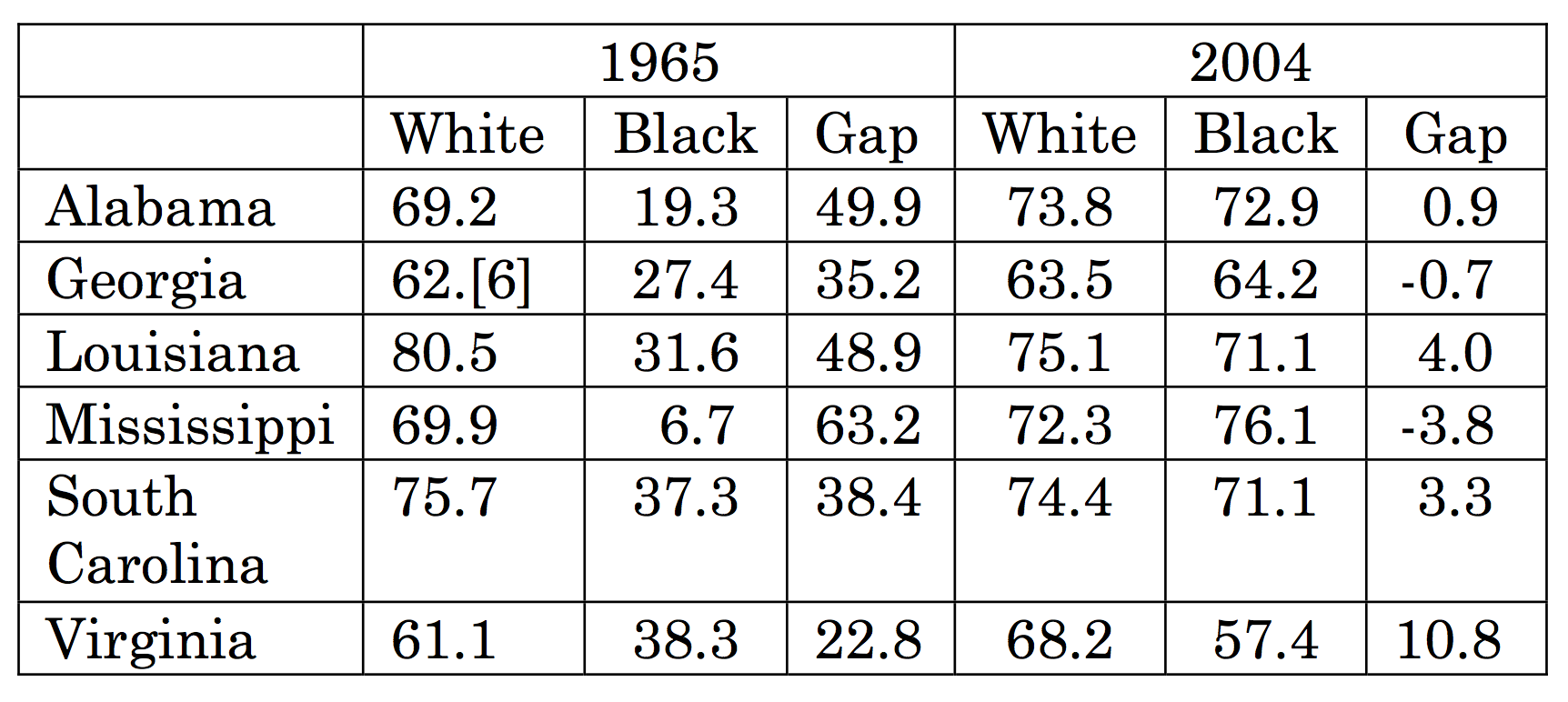
And Derek Thompson flags the above chart, from Roberts’ own opinion, showing the effect of the VRA:

Buried deep in Roberts’ opinion, on page 15, is this remarkable chart comparing voter registration numbers from 1965 to 2004. The influence of the VRA in increasing black registration percentages appears extraordinary and undeniable.