Sinning Against The Earth

In an excerpt from his new book, The Fanaticism of the Apocalypse: Save the Earth, Punish Human Beings, the French philosopher Pascal Bruckner tears into ecological “catastrophism” as pseudo-religious in form and self-hating in content:

Consider the meaning in contemporary jargon of the famous carbon footprint that we all leave behind us. What is it, after all, if not the gaseous equivalent of Original Sin, of the stain that we inflict on our Mother Gaia by the simple fact of being present and breathing? We can all gauge the volume of our emissions, day after day, with the injunction to curtail them, just as children saying their catechisms are supposed to curtail their sins.

Ecologism, the sole truly original force of the past half-century, has challenged the goals of progress and raised the question of its limits. It has awakened our sensitivity to nature, emphasized the effects of climate change, pointed out the exhaustion of fossil fuels. Onto this collective credo has been grafted a whole apocalyptic scenography that has already been tried out with communism, and that borrows from Gnosticism as much as from medieval forms of messianism. Cataclysm is part of the basic tool-kit of Green critical analysis, and prophets of decay and decomposition abound. They beat the drums of panic and call upon us to expiate our sins before it is too late.

In a companion profile, Emily Eakin connects these arguments to Bruckner’s broader intellectual concerns:

He abandoned his faith as a teenager and eventually completed a Ph.D. with Roland Barthes, by which point he’d concluded that Christian concepts of guilt and redemption were inescapable. “Baudelaire said that civilization is the abolition of the original sin,” he told me. “In fact, it’s not true; we haven’t abolished original sin but rather spread it all over.” In Bruckner’s scenario, Marxism transposed the idea of Christ onto the working class; paradise would come after the revolution. Then, with third-worldism, colonized peoples became the embodiment of virtue. Now, he says, it’s Mother Earth: “She is suffering, the metaphor of all victims.”
A Not So Grim Reaper

religiondeath

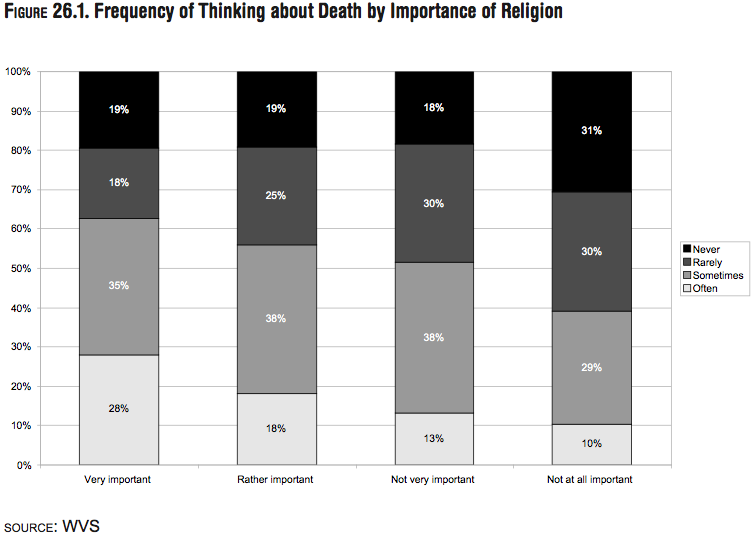
Hemant Mehta, who posts the chart above, turns to an excerpt from sociologist Ryan T. Cragun’s new book, What You Don’t Know about Religion (but Should) to support his case that atheists die “better” than the religious:

A growing body of evidence seems to support the idea that the nonreligious have an easier time coping with death than do the religious, at least with their own mortality. Religious people appear to be more afraid of death than are nonreligious people. Nonreligious people are less likely to use aggressive means to extend their lives and exhibit less anxiety about dying than do religious people. That seems remarkably counterintuitive since the nonreligious are much less likely to believe in an afterlife, which is supposed to help people cope with death. But factor in that religious people are contemplating their eternal fate and it begins to make more sense. Even if they have done everything their religion says they are supposed to do, there is always a bit of uncertainty about where they might end up. As a result, religious people appear to have a greater fear of dying than do nonreligious people.

In a related video post, Mehta answers questions about what atheists believe happens when the fateful day comes:

Related Dish coverage of atheist funerals here.

Fighting Religion With Religion?

Rabbi Jonathan Sacks argues that it will take more than science and atheism to stave off fundamentalism:

In one respect the new atheists are right. The threat to western freedom in the 21st century is not from fascism or communism but from a religious fundamentalism combining hatred of the other, the pursuit of power and contempt for human rights. But the idea that this can be defeated by individualism and relativism is naive almost beyond belief. Humanity has been here before. The precursors of today’s scientific atheists were Epicurus in third-century BCE Greece and Lucretius in first-century Rome. These were two great civilisations on the brink of decline. Having lost their faith, they were no match for what Bertrand Russell calls ‘nations less civilised than themselves but not so destitute of social cohesion’. The barbarians win. They always do.

The new barbarians are the fundamentalists who seek to impose a single truth on a plural world. Though many of them claim to be religious, they are actually devotees of the will to power. Defeating them will take the strongest possible defence of freedom, and strong societies are always moral societies. That does not mean that they need be religious. It is just that, in the words of historian Will Durant, ‘There is no significant example in history, before our time, of a society successfully maintaining moral life without the aid of religion.’

In response, Jerry Coyne calls Sacks an “ignorant fool”:

Here is a partial list of countries that have a very high percentage of nonbelievers. This is all it takes to rebut Sack’s claim that if one loses Judeo-Christian sanctity of life (note that he doesn’t mention Islam) we will descend into evil, barbarism, and perfidy:

  • Sweden
  • Denmark
  • Norway
  • Japan
  • Finland
  • France
  • Germany
  • South Korea

The last time I looked, these countries were remarkably sane, well-behaved, and their inhabitants generally moral.

Looking For Love In All The Right Pages

Sarah Mesle lists what she’s gleaned from her attachment to the Anne of Green Gables novels, including “how to recognize a love story”:

I love a book with a rip-roaring plot but in these, my favorite books, there’s surprisingly little plot. In the beginning of the first volume, an orphan, Anne Shirley, is adopted by a lonely brother and sister, Matthew and Marilla Cuthbert, who live at Green Gables, a small Prince Edward Island farm. In the remaining chapters and volumes, Anne grows up; that’s all. There’s never a Voldemort to battle or a secret garden to find.

Anne’s relationship to her clever hazel-eyed suitor Gilbert Blythe, in its deepening incarnations from rival to school chum to spouse, gives a loose narrative shape to each of the first six volumes. But Montgomery stages the Anne–Gilbert dynamic so that it is both deeply stirring and completely secondary. The central pleasure of the novels come from Anne’s picaresque adventures as she meets people — sometimes kind people (Matthew Cuthbert), quite often curmudgeonly antisocial people (Old Mrs. Barry), almost always Canadian people, regularly sad and damaged people (Marilla Cuthbert) — and teaches them to see the world differently. All of these characters, in their ways, fall in love with Anne. She helps them discover that they are not bereft of hope or humor but rather are, in Anne’s iconic phrase, “kindred spirits.”

So rather than a single dramatic or romantic plotline, the novels’ many episodes work to reinforce, over and over again, the central lesson that healing human connection — which is to say, love — in many forms, is possible.

Ask Dan Savage Anything: Gay Advice For Straight Couples

Dan suggests a four-word question that every straight couple should consider adopting into their sex life:

Dan’s new book, American Savage: Insights, Slights, and Fights on Faith, Sex, Love, and Politicsis in bookstores now. My recent conversation with him at the New York Public Library is here. Dan’s previous answers are here. Our full Ask Anything archive is here.

What Do Women Want To See?

In an interview with Tracy Clark-Flory, former Playgirl editor Jessanne Collins describes where the magazine fell short:

Did you ever witness a Playgirl shoot that you found legitimately sexy?

Honestly, no. I mean, maybe this is another sign that I was very much a fish out of water, but I just did not at all get the aesthetic. I don’t buy the myth that women are “not visual” people whatsoever. I check out dudes. I know we all have specific aesthetic triggers. And yet in all those pages upon pages of photos — none of them did it for me. There was an almost clinical approach to photography — almost as if these bodies were specimens under a microscope, every muscle all waxed and on display — and I think that’s the major thing. It’s this certain type of porn trope that doesn’t translate well for a real female audience.

Which is why the majority of its readership was male, of course:

One can’t help but wonder why it took Playgirl so long to embrace their male demographic, which accounts for 60% of the title’s readership and 65% of online subscribers [in early 2008, shortly before the print magazine’s collapse].

Clark-Flory also asked Collins, “What would it take to publish a successful porn magazine for women?”:

Again, I think it’s very much a myth that women don’t like to look at hot visual content. I think the hard part is that there’s literally no formula for what that is. There’s something about expectedness, in fact, that just kills intrigue immediately. And this is a challenge because porn’s a pretty formulaic thing, most of it, especially what’s produced in a corporate capacity. So a porn magazine for women would have to be out of bounds — it would take a real eye for the particular chemistry that goes into making content that is suggestive and explicit, even, without being cheesy — it takes nuance, subtlety, a kind of storytelling. I think women are visual, but I also think perhaps they’re a different kind of visual than men are, maybe, in that a little can go a long way — there’s something hotter in an insinuation, a possibility, a tease than there is about a straightforward close-up of a giant penis. For many women, anyway. This is why the romance genre is so wildly successful where porn for women, in today’s porn terms, can be a hard sell. Also, smart words! Language can do a lot to turn women on, but it has to be the right language.

High Culture

Reviewing Tao Lin’s new novel Taipei, Audrea Lim surveys a history of drug use in literature:

The scholar Marcus Boon’s The Road to Excess: A History of Writers on Drugs (2002) usefully taxonomizes the different literary and philosophical tendencies associated with different classes of drugs. Narcotics are a transcendental experience, providing access to the sublime. (Antonin Artaud compared them to literature and theater). Amphetamines transform authors into tireless writing machines. (Kerouac cranked out On The Road in two or three weeks on Benzedrine). Cannabis causes the mind to meander, highlighting unnoticed details and revealing connections between seemingly unrelated things, a state that has obvious affinities with the mindset of the flâneur who wanders aimlessly through Paris’ Arcades. (It is telling that the list of books Walter Benjamin regretted never writing included one on hashish.) … Drugs can help us to adapt, to be more productive, and even to excel within our circumstances, to make our lives more bearable, and in some cases, to radically reconfigure our subjectivity, if not the world.

In Taipei, drug use is less about changing the world than it is about adjusting to it.

[The protagonist] Paul, nervous and shy by nature, tries various combinations of drugs to help him cope with ordinary life, but they don’t actually make him any more comfortable. He swallows potent chemical cocktails at parties, but they seem to produce the opposite of the intended effect: “after four more parties, two of which he similarly slept on sofas after walking mutely through rooms without looking at anyone, Paul began attending less social gatherings and ingesting more drugs.” The scene he is part of (twentysomething middle-class white kids who make mostly meaningless art) is hedonistic, yet while he participates, he seems not to derive any pleasure from it. If altered states were once, as the old Aldous Huxley chestnut has it, “doors of perception,” then sometime between Huxley’s era and the one depicted in Taipei, those doors seem to have closed.

(Video: William S. Burroughs talking about his addiction to heroin in 1977)

The May-December Debate

Recently, Hugo Schwyzer invoked Johnny Depp’s new girlfriend – 23 years his junior – to criticize men who date younger women:

It’s hard not to conclude that much of the appeal is about the hope of finding someone less demanding. A man in his 40s who wants to date women in their 20s is making the same calculation as the man who pursues a “mail-order bride” from a country with less egalitarian values. It’s about the mistaken assumption that younger women will be more malleable. Men who chase younger women aren’t eroticizing firmer flesh as much as they are a pre-feminist fantasy of a partner who is endlessly starry-eyed and appreciative. …  One of the basic rules of tennis applies here: If you want to improve your skills, you need to play someone who is (at a minimum) at your own level.

Christopher Ryan doesn’t buy it:

So here’s the moral of the story: Old losers like Johnny Depp are too weak-willed to pick on someone their own age, so they chase younger women who will put up with their bullsh*t because the poor young things don’t know any better and couldn’t do anything about if they did. Ha! A quick perusal of Amber Heard’s Wikipedia page suggests that if old Johnny’s expecting malleable, starry-eyed, and appreciative, he’s got another thing coming. Turns out, Miss Heard is a big fan of Ayn Rand, guns, and [dating female photographer Tasya van Ree for four years]. Schwyzer’s attempt to shame consenting adults out of what he considers to be inappropriate relationships strikes me as quite the opposite of an informed feminist perspective. If anyone’s suffering from a “pre-feminist fantasy” in this situation, it would appear to be Mr. Schwyzer, who thinks a smart, successful 27 year-old woman is necessarily disempowered by her youth and beauty.

Face Of The Day

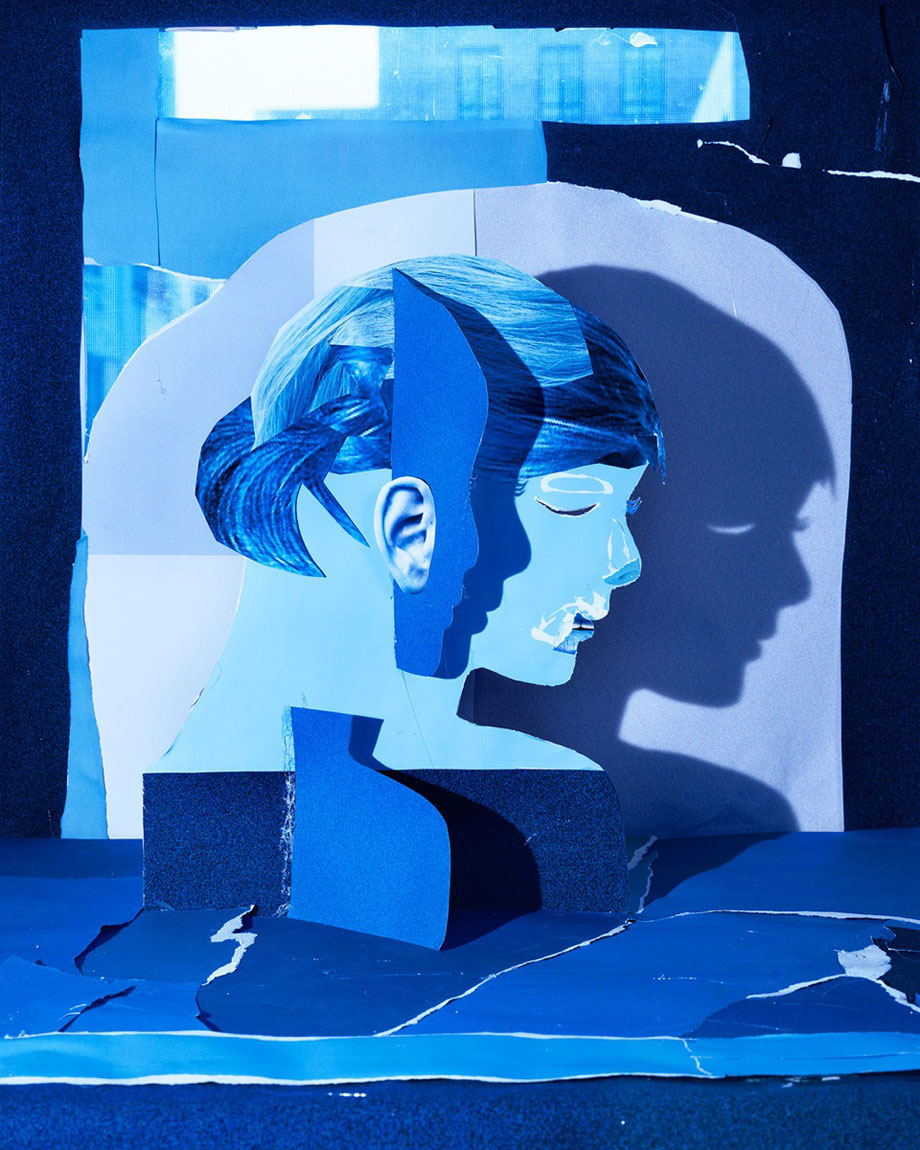
Crescent Eyed Portrait (in Blue), 2013

Daniel Gordon pays tribute to Matisse with a modern-day approach to portraiture:

To create each piece, Gordon sorts through photographic images found on the Internet, prints them, and builds 3-D tableaux he then shoots with an 8×10 view camera. He said he is inspired by not only Matisse’s art but also his philosophies. “I’m interested in taking ideas that were radical in Matisse’s day (collapsing space through the blending of foreground and background, multiple angles viewed at the same time, and Fauvist color and expression, among others) and moving them into a contemporary photographic space,” Gordon wrote via email. “I suppose it’s a kind of physical version of Photoshop that’s playing with a big history and multiple mediums.”

(Image: Crescent Eyed Portrait (in Blue), 2013, Daniel Gordon. From Still Lifes, Portraits & Parts by Daniel Gordon, Mörel Books, 2013. Courtesy of the artist. Gordon’s show at M+B runs through June 29.)