Perfecting Your Poison

Ezra Glinter reckons that we have entered a “golden age” of cocktails not seen since the late 19th century:

As [Esquire drinking correspondent David] Wondrich argued to me, bars now have to stay ahead of their customers, as well as their competition. Basic cocktails aren’t more difficult to make than a good tuna fish sandwich, and obscure ingredients are no longer difficult to obtain. The last time I was at my favorite liquor store it had some sixty different types of gin, twenty-five of rye, and twenty-one of vermouth, not to mention all the vodka and bourbon and rum. … With a modest outlay you can create a cocktail den right in your own living room.

For me, that’s the best part of this great liquor renaissance. Events like [women’s bartending competition] Speed Rack are exciting, and getting a complicated drink at a fancy bar is a nice luxury, if you don’t mind shelling out the price of [a] meal for it. But figuring out the best proportions of vermouth-to-rye in a Manhattan, or a new secret ingredient for a Bloody Mary, or what sort of drinks you might make with a bottle of ginger liqueur—that’s the real fun. There isn’t a lot of social value involved (though plenty of cocktail enthusiasts claim otherwise) and the whole thing might be, as Samuel Johnson wrote of whiskey, just “the art of making poison pleasant.” But mixing drinks provides something other forms of liquor connoisseurship don’t—the opportunity to turn a drink into a creative act. In a golden age of liquor, why drink something boring?

Recent Dish on a new documentary, Hey Bartender, here.
Links Through Their Lives, Ctd

Tom Shone expands on his glowing praise for Richard Linklater’s trilogy – Before Sunrise, Before Sunset, and the recently-released Before Midnight:

If asked to provide a list of great American achievements over the past 20 years, I would say the election of Barack Obama in 2008, the iPhone and the speech with which Jesse [Ethan Hawke] first talks Céline [Julie Delpy] off the train in “Before Sunrise“. It had to do with time travellers, as I recall, but it was the tone that did it—a small miracle of foxy charm and open-hearted entreaty, whisked along by a Huck Finn boulevardier spirit. It turned out to be enough to power an entire movie.  Make that three.

Shone speaks of a “third character” in the films – Time:

It has long been an obsession of Linklater’s, going back to his first film, “Slacker” (1991), and one he shares with his fellow indie alumnus Tarantino. It makes you wonder what they were putting in the coffee at Sundance in 1994 that caused all the film-makers of their generation to launch far-reaching investigations into the nature of time and narrative. Where Tarantino in “Pulp Fiction” bent chronology to his own ends like a magician constructing an animal with balloons, Linklater, by both temperament and theme, went with the flow, setting in motion a series that would turn out to record nothing less than the wear and tear of time on love’s young dream. … [T]he Céline and Jesse films will be held up as classics of the heartfelt sequel form, up there with Truffaut’s Antoine Doinel films, Satyajit Ray’s Apu films and the “Toy Story” trilogy.

Previous Dish on Before Midnight here.

The Literary Tourist

Laura C. Mallonee visited the former New York homes of poet Elizabeth Bishop:

So this is what it’s like to see the world through Elizabeth’s eyes, I think. In her poem “Varick Street,” she describes “wretched uneasy buildings,” “pale dirty light,” “soot and hapless odors,” but today the neighborhood is charming, almost idyllic: an enclave of expensive Georgian architecture and blooming flowers. The sun is out today after a long winter; birds sing almost too sweetly. I think how much I love New York.

But Bishop was never happy here; she wrote to her psychologist in 1948 that she disliked the city. The same year, she half-jokingly told Robert Lowell, “When you write my epitaph, you must say I was the loneliest person who ever lived.” After [her building] was bulldozed in the summer of 1949, the poet checked herself into Blythewood, a mental institution. And yet she had just published, in 1946, her first volume of poetry, North & South, which was deluged with critical praise and later won her the Pulitzer. Wasn’t she an established writer, friends with Moore and Lowell? From the perspective of a lowly graduate student, I envy her vantage point: no longer striving to prove herself capable; a seat at the literary round table; a contributor to the cultural dialogue.

I stroll along snapping photos with my camera phone, and a breeze rushes down the sidewalk, carrying with it a dense whiff of urine. I fondly recall the “elongated nostrils/haired with spikes” in “Varick Street” that “give off such stenches.” Before I know it, a dark figure is lunging toward me and I cry out, slumping awkwardly against a gate. When I look up, the thief has bolted with my iPhone. No one is around to see me break into an irrational mixture of tears and hyperventilation. “What do we long for when we see beauty?” Nietzche once asked. “We think much happiness must be connected with it. But that is an error.” Perhaps this is true of success, as well.

Recent Dish on the relationship between Bishop and Robert Lowell here.

Speak The Speech

Sam Leith considers the components of a good speech:

It must be forceful in argument, memorable in style, resonant in its references. It must also, before anything else, connect its speaker to its audience. This is what Aristotle, the first Western authority on rhetoric, called ethos—the basic movement in any effective speech that transforms the “me” of the speaker and the “you” of the audience into “we”: “Friends, Romans, countrymen…”

Ethos is established by, quite literally, speaking the audience’s language: shared jokes, common reference points, recognisable situations. As the rhetorical theorist Kenneth Burke has said: “You persuade a man only in so far as you can talk his language by speech, gesture, tonality, order, image, attitude, idea, identifying your ways with his.” You can then take the shared language—and with it your audience—wherever you want it to go.

On Anger In Writing

In an interview, Jamaica Kincaid addresses being labeled an “angry” writer:

It’s an interesting thing, the angry thing. And I wouldn’t mind being labeled as “angry,” if it wasn’t used once again to denigrate and belittle. First of all, I don’t feel I’m angry. I feel as though I’m describing something true. If I had stabbed my husband, I could understand being called “angry.” If I had an affair with my husband’s best friend (an imagined husband, mind you; I now have to be careful about these things!) and written about that experience, I could see the anger. But I’m not doing that. When I wrote A Small Place, the New York Times reviewed it in “Briefly Noted” and the thing the reviewer said, for the most part, was “Oh, it’s so angry.” I think that’s where the angry started, with A Small Place.

I’ve come to see that I’m saying something that people generally do not want to hear. In my writing, I’m often describing a universal situation. A situation in which human beings often choose to violate each other. Sometimes I happen to explore that in terms of the black/white dynamic. Generally, a white person does not like me to say, or does not like to be told, “You know, what you did was incredibly wrong.” …

In my writing I’m trying to explore the violations people commit upon each other. And the important thing isn’t whether I’m angry. The more important thing is, is it true?

(Hat tip: The Hairpin)

The Last, Last Page

After winning the Trillium Book Award for her short story collection, Dear Life, Alice Munro told an interviewer “it’s nice to go out with a bang,” which seems to indicate she’s retiring from writing. In response, Laura Bennett reflects on our fascination with literary retirements:

There are plenty of novelists whose withdrawals from writing became the stuff of legend. Rimbaud flamed out before his 21st birthday and spent the rest of his life working as a soldier, in a stone quarry, as a salesman of coffee and guns. Salinger’s reclusive retirement fueled the mysterious lightning bolt quality of his legacy: one landmark novel, countless unpublished works. But today, in a culture obsessed with the minute chronicling of celebrity doings, our parsing of writers’ retirements has become preemptive, a kind of artistic augury.

Of course, one needn’t retire from writing as if it were the same as quitting a law firm or terminating an athletic career. It’s nice to hold onto the myth that writers write because some inner urge compels them, rather than publishers or deadlines or financial pressures. And when a writer fails to retire, it is equally a media marvel. Whenever someone over eighty publishes anything, half the book review often reads like a referendum on their age. Cynthia Ozick toldThe New York Times Book Review in March that she was tired of seeing reviews written as a measure of a writer’s mortality. “Middle C [by William Gass] is nearly everywhere accompanied by the numeral 88, as if Gass were a set of piano keys. Even his publisher sees fit to identify him by his years: a masterpiece by an 88 year-old master.”

Recent Dish on Munro’s work here.

A Poem For Saturday

Muriel Rukeyser was born on December 15, 1913, so this year marks her centennial. While at Vassar College she founded – along with Elizabeth Bishop, Mary McCarthy, and Eleanor Clark – an undergraduate literary magazine called Con Spirito. Rukeyser was in Spain as its civil war erupted, reported on its tumultuous first days, and remained politically committed all of her life, becoming president of the American Center of PEN from 1975-76. Her debut collection Theory of Flight won the Yale Younger Poets Prize in 1935, and subsequent works included her Collected Poems and A Muriel Rukeyser Reader. In an introduction to Selected Poems of Muriel Rukeyser, published in 2004, Adrienne Rich wrote:

Reading Muriel Rukeyser, writing about her as I have from time to time, I have come to feel more and more the power of her work and presence in American literature—the many kinds of lives and issues she touched, the silences she broke, the voices she made audible, the landscapes she covered. In our own time of crisis, when the idea of perpetual war has dropped whatever masks it ever wore, when poetry is still feared yet no longer so marginalized, when a late-1920s schoolgirl’s perception of the ‘grim towers of empire’ and ‘the terrible, murderous differences in the way people lived’ accord with what more and more people around the world are experiencing and naming, this poet has readers waiting for her….

We’re featuring Rukeyser’s poetry all weekend, beginning with “Gift”:

the child, the poems, the child, the poems, the journeys
back and forth across our long country
of opposites,
and through myself, through you, away from you, toward
you, the dreams of madness and of an
impossible complete time—
gift be forgiven.

(From Selected Poems, Library of America © 1978 by Muriel Rukeyser. Reprinted by permission of ICM Partners)

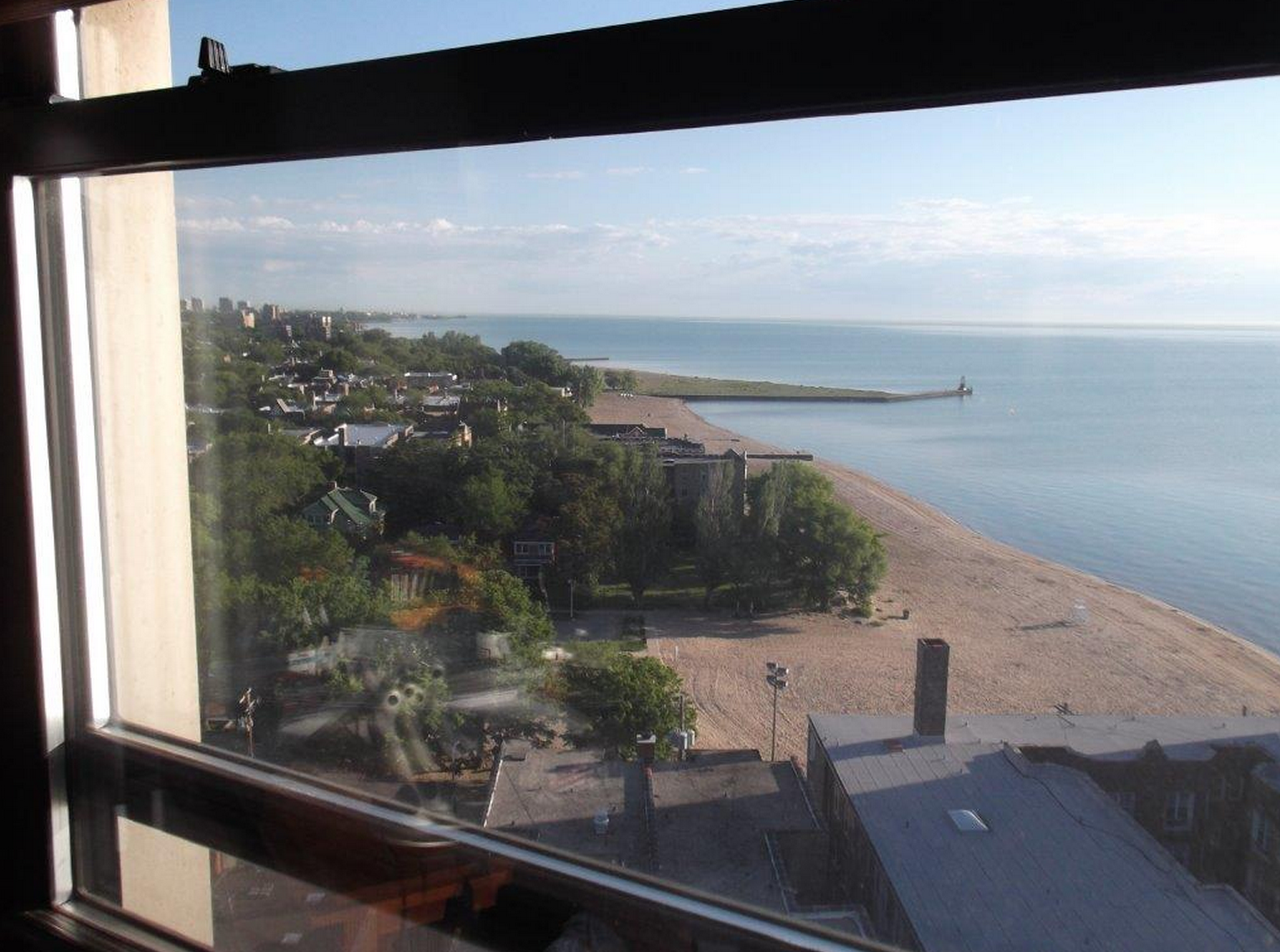
The View From Your Window Contest

Screen Shot 2013-06-22 at 9.39.07 AM

You have until noon on Tuesday to guess it. City and/or state first, then country. Please put the location in the subject heading, along with any description within the email. If no one guesses the exact location, proximity counts.  Be sure to email entries to contest@andrewsullivan.com. Winner gets a free The View From Your Window book. Have at it.

Datamining The Classics

“Today’s student of literature must be adept at gathering evidence from individual texts and equally adept at mining digital text repositories,” according to English professor Matthew Jockers. John Sunyer reports on Jockers’s controversial “big data” approach to literature:

[Jockers] holds the distinction of being the first English professor to assign more than 1,200 novels in one class. “Luckily for the students, they didn’t have to read them,” he says.

In his recent book Macroanalysis: Digital Methods & Literary History (2013), Jockers publishes a list of the most influential writers of the 19th century. The study is based on an analysis of 3,592 works published from 1780 to 1900, he explains. It took a lot of digging, and a computer did it by cross-checking about 700 variables across the sample, including, for example, word frequencies and the absence or presence of themes such as death.

“Literary history would tell you to expect Charles Dickens, Thomas Hardy and Mark Twain to be at the top of the list,” says Jockers. But the data revealed that Sir Walter Scott and Jane Austen had the greatest effect on other authors, in terms of writing style and themes.