The Purging Of Syria’s Moderate Rebels

Reuters reports that Jihadist rebels are sidelining and even disarming more moderate rebels within Syria. Allahpundit asks how the US plans to address this issue:

If the jihadis are intent on isolating and purging the moderates, what exactly is the strategy for getting them to fight in concert against Assad? The assumption thus far has been, I guess, that once U.S.-armed units start to put a hurt on the regime, the jihadis will leave them alone and will try to multiply the effect by focusing on the regime themselves. But in light of this story, maybe that’s naive. Maybe the jihadis will launch a two-front war, one against Assad and one against the proxy army of their western archenemy, which in turn will make things easier for Assad’s forces by letting them fight a divided enemy. That would be the exact opposite of what the U.S. is out to do here, i.e. help the rebels beat up on the regime and drag out the war until Assad sues for peace.

The British public, by the way, is overwhelmingly against their leaders’ current posture. Only 24 percent back Cameron’s loony idea. My impression among friends in London is that they are terrified that this could lead not just to a regional but global war, if Russia, Britain, France and the US go to war old-school by elbowing their way into Syria’s civil war. Allahpundit continues:

Even in a best-case scenario, in which the CIA somehow builds a small moderate force and turns it into an effective army, what’s the plan for the obviously inevitable civil war after the Assad falls between the U.S.-backed Sunni moderates and the Sunni jihadis? You’re going to have to fight and kill them too, apparently, or else they’ll fight and kill you. That means committing to years of supplying one side here, and maybe doing more than that if/when things don’t go their way. How long, roughly, is all of this going to take?

Nicholas Thompson wishes the US had stayed out of the war altogether:

There were other options. Obama could have continued imposing sanctions and sending non-lethal aid to rebel groups. If the goal is to save lives and give comfort to the victims, we should give further support to the refugee camps. Joining the battle, though, transforms it. Now our weapons will be killing people. We will be tied by blood to one side in a sectarian civil war that seems likely to spread in an unpredictable fashion. We are now part owners of the pain it will cause—in Syria, Lebanon, and elsewhere.

James Gandolfini, RIP

Last night, Gandolfini, the terrifying yet relatable Tony Soprano, passed away. Alyssa eulogizes:

If you write about television, as I do, or watch it frequently, Gandolfini’s performance as Tony Soprano on the titular show that helped remake HBO and prestige television along with it was a major contribution to the world we inhabit together. … [M]ore than anything else, it was Gandolfini, who gave us a man who fascinated us and commanded our sympathy despite the enormity of his crimes, reminding us that people whose only sins are against each other’s hearts deserve our attention, too.

James Poniewozik reflects on how he changed television drama:

James Gandolfini was our usher into that new TV era, by taking a performance that could have been cartoonish (remember Analyze This?) and making it psychologically layered and unshakeable. This was a man who could show us a brute throttling a Mafia turncoat while looking at colleges with his daughter and make us think: I want to know this guy better. He could lead us, mildly contemplating an onion ring, to the finale’s famous cut-to-black, to the tune of “Don’t Stop Believin’,” and leave us wondering whether he lived or died, and what he deserved, and what it all meant. We can only wonder what more Gandolfini would have done with a more fair measure of years.

Suderman nods:

Certainly [the show] was among the most influentual, with its creators and core ideas still reverberating through the so many of the high-quality dramas produced today.

And that influence, and it staying power, has a lot to do with the way Gandolfini payed Tony: powerful but conflcted, angry and often menacingly violent but not wholly heartless, driven and determined yet fundamentally confused about what he wanted out of life. Was he a monster? Or just the man next door? Gandolfini’s performance helped provide the only possible answer to that pair of questions: Yes. It was the perfect role, and he was the perfect actor for it. It’s impossible to imagine The Sopranos without Gandolfini, and nearly as difficult to imagine the modern TV drama landscape — with its emphasis on brooding serials led by aging male antiheroes — without his work on the show.

Marc Tracy wants critics to remember that Gandolfini wasn’t Tony:

I can hear the laptops clacking: obituarists are saying that the [Sopranos]’s obsession with death (“In the midst of death, we are in life. Or is it the other way around?”) has prepared us for Gandolfini’s death as we are prepared for nobody else’s death; that the final scene blah blah blah; that, indeed, “Whaddya gonna do?” No. At least when we ascribe attributes of a fictional character to her author, it is not always a fallacy—the author has created the character, and so it is fair to ask what he has invested her with. Gandolfini’s achievement was different: while Tony may share things with Gandolfini, ultimately what Gandolfini does is completely efface himself, disappearing into the role completely in order to make the entire thing work.

“The Sopranos” likely would have been a pretty good show no matter who was playing Tony (unless it was Steve Van Zandt, who played Silvio and reportedly auditioned for the part). Would it have been the American masterpiece it was with anyone other than Gandolfini? To ask the question, as Christopher Hitchens used to write, is to answer it.

Stop The Force-Feeding At GTMO

DiFi stands up against the Obama administration and in defense of core American values:

Dear Secretary Hagel:

I have given a great deal of thought since visiting the detention facility at Guantanamo Bay on June 7, 2013, about the continued hunger strikes and force-feeding occurring there. I write to express to you my concerns and opposition to the force- feeding of detainees, not for reasons of medical necessity but as a matter of policy that stands in conflict with international norms …

During our visit, more than 60 percent of the 166 detainees held at Guantanamo Bay were categorized by the Department of Defense as “hunger strikers,” with more than 40 of them being force-fed. Four detainees were in the facility’s hospital for problems related to their feeding or hunger strike. During our visit to the prison, we were briefed on the Department of Defense policies regarding force-feedings and I remain concerned that these policies are out of step with international norms, medical ethics and practices of the U.S. Bureau of Prisons.

The International Committee of the Red Cross (ICRC) and the World Medical Association (WMA), as well as numerous international organizations (including the Office of the UN High Commissioner for Human Rights, the Inter-American Commission on Human Rights, the United Nations Working Group on Arbitrary Detention, and three UN Special Rapporteurs) have all criticized or opposed the force- feedings of detainees.

The WMA recently stated that “[f]orcible feeding is never ethically acceptable,” and “that physicians should never be used to break hunger strikes through acts such as force-feeding.” The American Medical Association has supported the WMA’s position on this matter. On May 13, 2013, several human rights and anti-torture organizations—citing the positions of the ICRC and WMA—wrote that the force-feeding of detainees at the Guantanamo Bay facility violates Common Article 3 of the Geneva Conventions prohibiting cruel, humiliating and degrading treatment. Moreover, a recently published bipartisan Task Force on Detainee Treatment—led by former Congressman Asa Hutchinson and former Ambassador Jim Jones—found that the Department of Defense’s force-feeding practices were “contrary to established medical and professional ethical standards” and called on the United States to adopt standards of care, policies, and procedures in keeping with the guidelines developed by the WMA, “including affirmation that force-feeding is prohibited.”

In addition to the allegation that the Department of Defense’s force-feeding practices are out of sync with international norms, they also appear to deviate significantly from U.S. Bureau of Prison practices. Based on a review by Intelligence Committee staff, the significant differences between force-feedings at Guantanamo Bay and within the U.S. Bureau of Prisons relate to the manner in which detainees are force-fed, how often detainees are force-fed, and the safeguards and oversight in place during force-feedings.

Within the Bureau of Prisons, force-feeding is exceedingly rare. The Intelligence Committee staff has been told that no inmate within the Bureau of Prisons has been force-fed in more than six months. When force-feedings do occur within the Bureau of Prisons, we have been told that nearly 95% of the time they are conducted with a fully compliant inmate requiring no restraints. At Guantanamo Bay, on the other hand, all detainees being force-fed—regardless of their level of cooperation—are placed in chairs where they are forcibly restrained. The visual impression is one of restraint: of arms, legs, and body. Further, at Guantanamo Bay, detainees are fed twice a day in this manner, potentially over a substantial period of time. This also is inconsistent with the practice of the U.S. Bureau of Prisons.

Additionally, the U.S. federal prison guidelines for force-feedings include several safeguards and oversight mechanisms that are not in place at Guantanamo Bay. These guidelines require the warden to notify a sentencing judge of the involuntary feeding, with background and an explanation of the reasons for involuntary feeding. Further, the Bureau of Prisons requires an individualized assessment of an inmate’s situation to guide how force-feedings are administered, a practice that I found largely absent at Guantanamo Bay. Finally, all force-feedings must be videotaped within the Bureau of Prisons.

Hunger strikes are a long known form of non-violent protest aimed at bringing attention to a cause, rather than an attempt of suicide. I believe that the current approach raises very important ethical questions and complicates the difficult situation regarding the continued indefinite detention at Guantanamo. I urge you to reevaluate the force-feeding policies at Guantanamo Bay and to put in place the most humane policies possible.

Ask Fareed Zakaria Anything: Misjudging Iraq

In today’s video from Fareed, he reviews how wrong he was about the Iraq War:

In an op-ed yesterday, Fareed restated his opposition to our intervention in Syria, highlighting the United States’ historical tendency to screw up such affairs:

In the mid-1980s, the scholar Samuel Huntington pondered why the United States, the world’s dominant power — which had won two world wars, deterred the Soviet Union and maintained global peace — was so bad at smaller military intervention.

Since World War II, he noted, the United States had engaged militarily in a series of conflicts around the world, and in almost every case the outcome had been inconclusive, muddled or worse. Huntington concluded that we rarely entered conflicts actually trying to win. Instead, he reasoned, U.S. military intervention has usually been sparked by a crisis, which put pressure on Washington to do something. But Americans rarely saw the problem as one that justified getting fully committed. So, we would join the fight in incremental ways and hope that this would change the outcome. It rarely does. (More recent conflicts where we have succeeded — the 1990 Persian Gulf War, Grenada and Panama — were all ones where we did fight to win, used massive force and achieved a quick, early knockout.)

In Syria, we have lofty ends but no one wants to use the means necessary to achieve them. So we are now giving arms to the opposition and hoping this will bring the regime to the negotiating table or force it to strike a deal. But, as Huntington observed, “military forces are not primarily instruments of communication to convey signals to an enemy; they are instead instruments of coercion to compel him to alter his behavior.”

He adds that if Obama is indeed engaging in some kind of clever realpolitik, it is with “Machiavellian rather than humanitarian” intent. Fareed also made an argument against intervening in Syria in a previous AA answer.

If you want to keep track of his other work, Fareed Zakaria GPS airs Sundays on CNN, as well as via podcast, and he is also an Editor-at-Large of TIME Magazine, a Washington Post columnist, and the author of The Post-American WorldThe Future of Freedom, and From Wealth to Power: The Unusual Origins of America’s World Role. Fareed’s previous AA videos are here. Our full AA archive is here.

A Life In Beards

The poet Donald Hall views his life through the prism of beards he has grown. His essay concludes:

When I turned eighty and rubbed testosterone onto my chest, my beard roared like a lion and lengthened four inches. The hair on my head grew longer and more jumbled, and with Linda’s encouragement I never restrained its fury. Linda wheelchaired me through airports as my eighties prolonged, and more than ever I enjoyed being grubby and noticeable. As I decline more swiftly toward the grave I have made certain that everyone knows—my children know, Linda knows, my undertaker knows—that no posthumous razor may scrape my blue face.

I know I’m a little obsessed here – but what’s a blog for? A simpler argument, it seems to me, is to defer to the default. Men – by virtue of having way more testosterone than women will grow beards if they do nothing. The case, it seems to me, has to be made by those who want them to scrape the constantly growing hair off their face every day with a metal edge. And beards do change over time. I grew one in my twenties which was far less dense than mine is now. And, of course, I’m whitening fast (graying is a misnomer). There is a beard for every season – and as long as it takes less time to maintain than the daily shave, I can see why the next generation has become so comfortable with it. It’s saner than clean-shaven as a practical element in life.

Moderates In Islamist Clothing?

SYRIA-CONFLICT

Goldberg runs through the reasons hawks in the State Department want to bomb Syria. Among them:

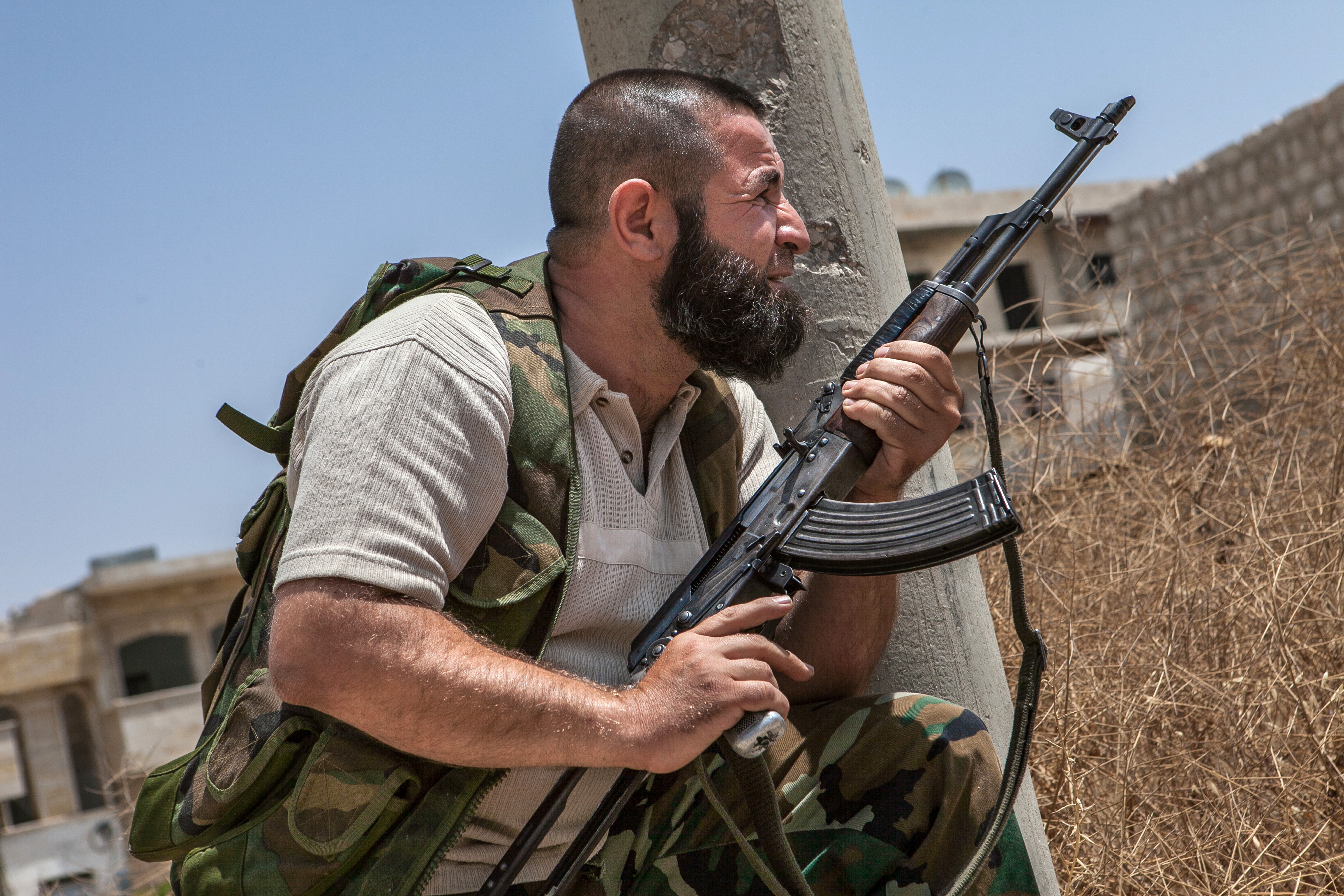
The State Department has been working for some time with the more moderate leaders among the fractured and disputatious rebel alliance. It believes not only that it can do business with many of these leaders, but also that by doing business with them it will strengthen them. Several months ago, when I ducked across the Jordan-Syria border and met with some of the rebels, I took note of their long beards, a sign of religious intensity. The rebels were quick to tell me that they only grew beards because the more radical Islamists among them had the best weapons, and would only supply these weapons to like-minded rebels. In other words, the beards were simply a marketing tool, not an expression of sincere radicalism. If the more moderate among the rebels suddenly began receiving heavier weapons from the Americans, they would be empowered, and the Islamists marginalized.

You need some pretty sharp beard antennae for that (check out the Sunni musclebear above. You think the State Department knows what’s in his head?). And if they were extremists, why would they tell an American that? Either they are extremists or they function at the mercy of extremists. I’d steer clear. Then there’s the argument that inaction will somehow hurt our interests more. That, apparently, is what Kerry believes. Here’s Goldberg’s version of that argument:

The U.S. must play a leadership role in the Mideast or the vacuum left by its departure will be filled by radicals, of both the Shiite and Sunni varieties.

To which I would counter: isn’t that going to happen whatever we do? And how do we intend to prevent that? I think democracy in that region will empower the extremists for a while until the logic of their backwardness compels an adjustment. This will take time. I think our interests are far better served by not trying to mold things we cannot understand and cannot control. Again: you’d think that Goldberg had never heard of the Iraq war reading his column. It goes un mentioned, even as he makes very similar arguments to those he made then. It’s Etch-A-Sketch. Larison counters forcefully as well:

Considering how eager many American politicians are to believe in the “rehabilitation” of groups as fanatical as the MEK simply because they have the “right” enemy, we should consider the possibility that the U.S. could just as easily be duped into arming groups that conveniently say all the right things.

But then you see Jeffrey’s real objective, stated up-front:

Whether we like it or not, we are in a conflict with Iran, and our credibility is on the line.

Just as it was to prove Saddam’s WMDs. And if we do not like the conflict, we shouldn’t simply acquiesce. We should challenge it – because containment is a real option, and war would be a body-blow to the Iranian people. Israel has shown it can take care of itself in this sectarian clusterfuck. We should take care of ourselves too – by not taking the Jihadist bait.

(Photo: A Syrian rebel fighter belonging to the ‘Martyrs of Maaret al-Numan’ battalion holds a position on June 13, 2013 in the northwestern town of Maaret al-Numan in front of the army base of Wadi Deif, down in the valley. By Daniel Leal-Olivas/AFP/Getty Images.)

Twittiquette

Betsy Morais reviews Daniel Post Senning’s Emily Post’s Manners in a Digital World: Living Well Online:

Many have handed down commandments on the rules of Web manners. Etiquette is a public performance, just as it was a century ago—but now “public” has become synonymous with “on the Internet.” Underlying all the prescriptions is the vanishing line between the manners of the analog universe and those of its virtual counterpart, since we move so seamlessly from one to the other.

Senning writes, “In an increasingly connected world, it is up to each individual to set boundaries.” We will be judged, then, by the standard of presence—the courtesy of acknowledging our surroundings. …

What we really need is a guide for those already immersed in the Internet; there is the alphabet, and then there is fluency. A Twitter user may be familiar with the “@” symbol, but it carries its own detailed rules. For instance, “.@” has different implications than “@” on its own. Depending on context, placing the period before the symbol can either be generous—“.@strugglingmusician has a terrific new video on YouTube”—or self-serving. (“.@minorcelebrity thanks for the compliment!”) As in “real life,” these kinds of signals are used as self-conscious indications of relative status.

The Slow Death Of The Small Farm

4739658071_b64ee458e8_z

Looking over the latest USDA report, Ryan O’Hanlon learns that most small farmers lose money and are forced to hustle on the side:

The more-interesting part of this and what appears to be a big part of the side hustle for many farms is “agrotourism” and things like “on-farm cafes, restaurants, and dining rooms for special farm dinners … classes, tours, U-picks, and venues for weddings and family reunions.” As in: farmers are making money by having people watch them do the thing that no longer makes them any money. People want to see farmers farm or they want to get married on a farm or they want to drink freshly-squeezed (?) milk, so they go to a farm and pay for those things. But they only come because of some attraction to “the idea of the farm,” which, itself, is a dying thing—except, the people also wouldn’t come if it wasn’t a dying/outdated/different concept because society would be radically different if the small farm was a booming business and then the nostalgia-tourism aspect wouldn’t even exist. It’s a weird loop, and one that probably can’t last forever.

Which means it won’t. Which means more potential horrors like these.

(Photo from a Brunty Farms tour by Edsel Little)